Revision Library
Choose a subject
Menu
Science
Need a new topic?
Missing a topic, found a bug, or want something added?

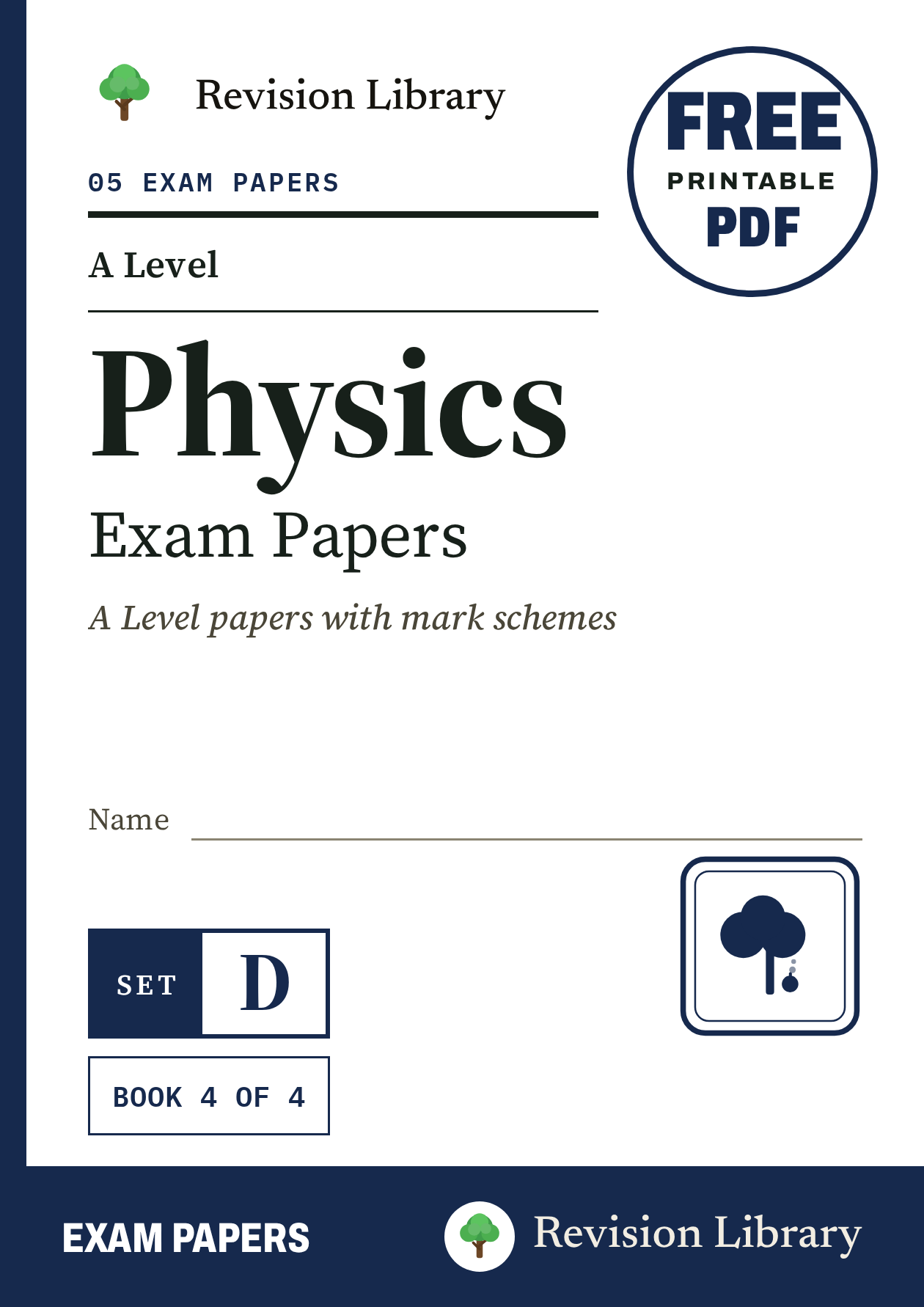
Book 4 of 4

A Level Physics Exam Papers Set D

A Level Paper 4: Waves and Circular Motion, A Level Paper 5: Extended Practice and A Level Paper 6: Full Course Review

Level
A Level · Edexcel 9PH0 · AQA 7408 · OCR H556
Series
A Level Physics Exam Papers, book 4 of 4
Suitable for
Years 12-13, AQA / Edexcel / OCR
FreePDF download · 2027 edition · 67 A4 pages
  • One file, prints straight to A4
  • No account, no password

3 papers, mark schemes at the back. This set is one of 558 free PDFs on the shelf.

Pages
67 A4 pages
Papers
3 papers
Questions
70 · 260 marks
Answers
From page 52

What is inside

3 papers · answers from p52

Each paper starts with a page showing its marks and a suggested time, followed by the questions. The mark schemes for all 3 papers are at the back, so you can sit each paper as a mock and mark it afterwards.

  1. 01A Level Paper 4: Waves and Circular Motion22 questions · 80 marksp3
  2. 02A Level Paper 5: Extended Practice22 questions · 80 marksp19
  3. 03A Level Paper 6: Full Course Review26 questions · 100 marksp33
  4. AnswersMark schemes for every paperp52

Each paper is drawn from one of our worksheet packs. Follow a paper title for the full pack on its own page, or browse every A Level Sciences pack. Every book on the shelf is a complete printable workbook of up to 120 A4 pages.

Explore this volume

A Level Physics Exam Papers Set D includes A Level Paper 4: Waves and Circular Motion (from page 3); A Level Paper 5: Extended Practice (from page 19); A Level Paper 6: Full Course Review (from page 33).

Worked question 21 - A Level Paper 4: Waves and Circular Motion

Two tuning forks, A and B, are sounded together and 8 beats are heard in 4.0 s. Fork A vibrates at exactly 256 Hz.

Fork B is then loaded with a small piece of wax, which lowers its frequency, and the beat frequency is observed to decrease. Determine the two frequencies that fork B could originally have had, and state which of these must be the correct original frequency of B.

Answer

Fork B could originally have been 258 Hz or 254 Hz; the original frequency must have been 258 Hz

Mark scheme

M1for using beat frequency = number of beats/time
A1for beat frequency = 8/4.0 = 2.0 Hz
M1for the two possible frequencies of B = 256 +/- 2.0
A1for possible frequencies = 258 Hz or 254 Hz
B1for selecting 258 Hz because lowering it moves it towards 256 Hz and decreases the beat frequency; lowering 254 Hz would increase the frequency difference

Question 8 - A Level Paper 4: Waves and Circular Motion

2 marks

A string fixed at both ends has a fundamental (first harmonic) frequency of 220 Hz.

State the frequency of (a) the second harmonic, and (b) the fourth harmonic, of this string.

Answer

second harmonic = 440 Hz, fourth harmonic = 880 Hz

Mark scheme

B1for second-harmonic frequency = 440 Hz
B1for fourth-harmonic frequency = 880 Hz

Question 18 - A Level Paper 4: Waves and Circular Motion

4 marks

A string of length 0.75 m and mass per unit length 5.0x10^-4 kg/m is to be tuned so that its second harmonic has a frequency of 300 Hz.

Calculate (a) the required wave speed on the string, using f = n v/(2L) for the nth harmonic, and (b) the tension needed in the string, using v = sqrt(T/mu).

Answer

required wave speed = 225 m/s, tension needed = 25.3 N

Mark scheme

M1for rearranging f = 2v/(2L) to v = fL and substituting 300 x 0.75
A1for v = 225 m s^-1; accept 230 m s^-1 to 2 significant figures
M1for T = mu v^2 = (5.0x10^-4) x 225^2, using unrounded v
A1for T = 25.3 N; accept 25 N to 2 significant figures

Question 14 - A Level Paper 4: Waves and Circular Motion

5 marks

A mass of 0.40 kg is attached to a spring of spring constant 64 N/m and set into simple harmonic motion by a small vertical displacement.

Calculate (a) the period of oscillation, using T = 2 pi sqrt(m/k), and (b) the frequency of oscillation.

Answer

T = 0.497 s, f = 2.01 Hz

Mark scheme

M1for using T = 2 pi sqrt(m/k)
M1for sqrt(0.40/64) = 0.0791
A1for T = 2 pi x 0.0791 = 0.497 s
M1for using f = 1/T
A1for f = 2.01 Hz

Question 16 - A Level Paper 5: Extended Practice

5 marks

A copper wire has a Young modulus of 1.1x10^11 Pa, a cross-sectional area of 3.0x10^-7 m^2 and a natural length of 2.5 m. Assume the wire or wires remain in their linear elastic regions.

Calculate the extension of the wire when a tensile force of 25 N is applied.

Answer

1.89 x 10^-3 m

Mark scheme

M1for using stress = force/area
A1for stress = 25/3.0x10^-7 = 8.33x10^7 Pa
M1for using strain = stress/Young modulus
M1for strain = 8.33x10^7/1.1x10^11
A1for extension = strain x length = 1.89x10^-3 m

Question 9 - A Level Paper 5: Extended Practice

2 marks

Unpolarised light of intensity I0 passes through a polarising filter, which transmits half of the incident intensity, and then through a second polarising filter whose transmission axis is at 60 degrees to that of the first.

Using Malus's law, I = I1 cos^2(theta), calculate the intensity transmitted through the second filter as a fraction of I0.

Answer

Transmitted intensity = 0.125 I0 (one eighth of the original intensity)

Mark scheme

M1for evaluating cos^2(60 degrees) = 0.25
A1for transmitted fraction = (1/2) x 0.25 = 0.125 = 1/8 of I0; credit the fraction once

Question 12 - A Level Paper 5: Extended Practice

4 marks

A mass on a spring oscillates with simple harmonic motion of amplitude 0.060 m and period 0.80 s.

Calculate the maximum speed and the maximum acceleration of the mass.

Answer

maximum speed = 0.471 m/s, maximum acceleration = 3.70 m/s^2

Mark scheme

M1for angular frequency = 2 pi/T = 2 pi/0.80 = 7.85 rad/s
M1for using maximum speed = angular frequency x amplitude
A1for maximum speed = 7.85 x 0.060 = 0.471 m/s
A1for maximum acceleration = angular frequency^2 x amplitude = 7.85^2 x 0.060 = 3.70 m/s^2

Question 17 - A Level Paper 6: Full Course Review

4 marks

Two springs, each of spring constant 50 N/m, are connected in series.

Calculate the combined (effective) spring constant of the series combination, using 1/k(total) = 1/k1 + 1/k2, and state how this compares with the spring constant of a single spring.

Answer

k(total) = 25 N/m; the series combination is less stiff than a single spring

Mark scheme

M1for using 1/k(total) = 1/k1 + 1/k2
M1for 1/k(total) = 1/50 + 1/50 = 2/50
A1for k(total) = 25 N/m
B1for the series combination is less stiff (has a smaller spring constant) than a single spring, since each spring stretches under the same force, giving twice the total extension

Question 9 - A Level Paper 6: Full Course Review

2 marks

Two identical springs, each of spring constant 80 N/m, support a mass side by side, in parallel, sharing the load equally.

Calculate the combined (effective) spring constant of the parallel combination, using k(total) = k1 + k2, and state how this compares with the spring constant of a single spring.

Answer

k(total) = 160 N/m; the parallel combination is stiffer than a single spring

Mark scheme

A1for k(total) = 80 + 80 = 160 N/m
B1for the parallel combination is stiffer (has a greater spring constant) than a single spring

A Level Physics Exam Papers runs to 4 volumes

Book 4 of 4 · 244 pages in the set

Each set is a separate free PDF with its own mark schemes at the back.

Volume 1

54 pp · 57 Qs

AS Paper 1: Core Skills, AS Paper 2: Particles and Waves and AS Paper 3: Waves and Mechanics

Volume 2

67 pp · 68 Qs

AS Paper 4: Mechanics and Materials, AS Paper 5: Extended Practice and AS Paper 6: Full Course Review

Volume 3

56 pp · 52 Qs

A Level Paper 1: Mechanics and Electricity, A Level Paper 2: Nuclear Physics and Waves and A Level Paper 3: Thermal Physics and Mechanics

Volume 4 · this book

67 pp · 70 Qs

A Level Paper 4: Waves and Circular Motion, A Level Paper 5: Extended Practice and A Level Paper 6: Full Course Review

More A Level books

A Level Biology Exam Papers Set A

64 pp · 49 Qs

AS Paper 1: Molecules, Cells and Exchange, AS Paper 2: Transport and Genetics, AS Paper 3: Molecules and Genetics and Plant Transport

Want a different mix of topics?