Revision Library
Choose a subject
Menu
Psychology
Need a new topic?
Missing a topic, found a bug, or want something added?

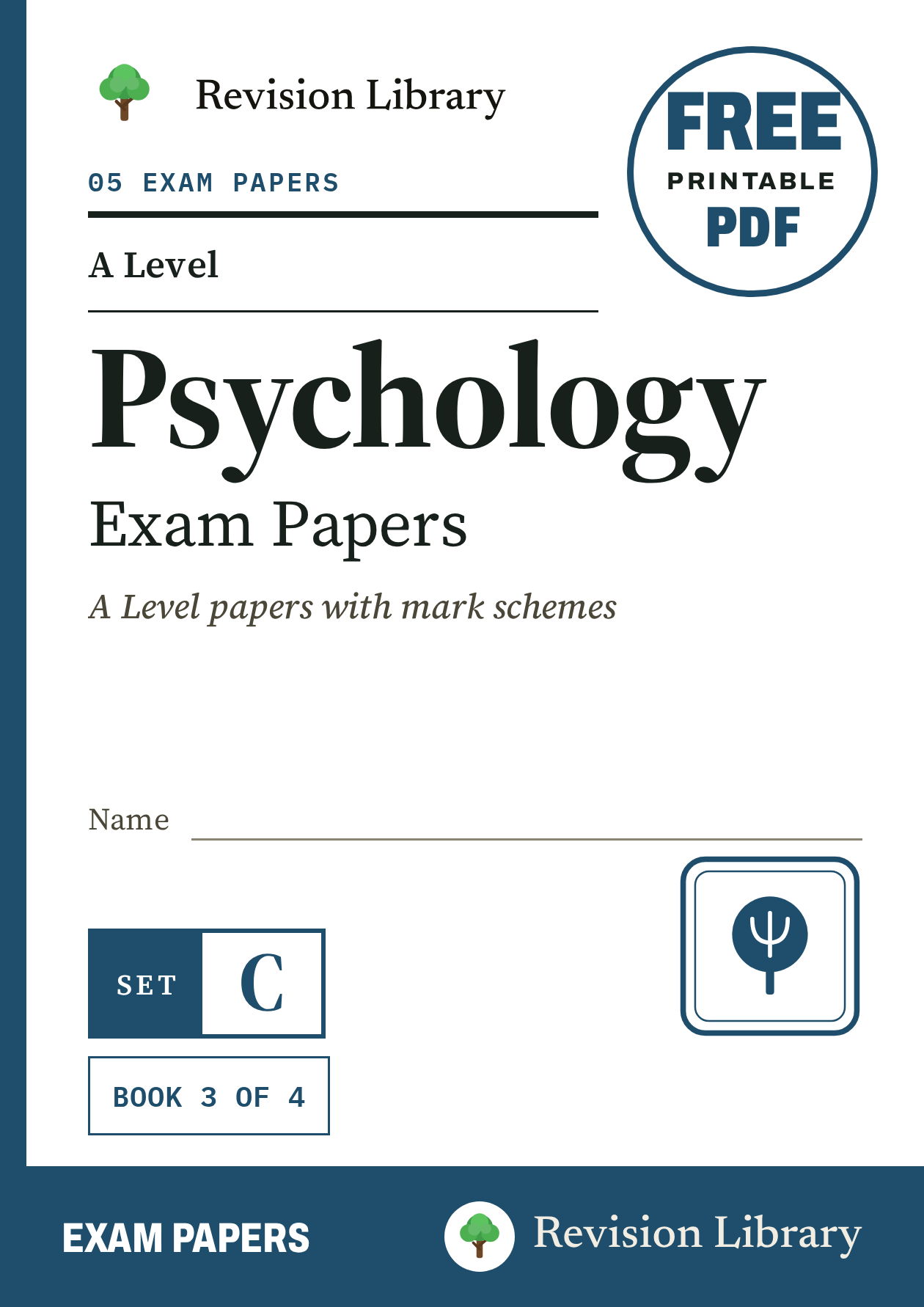
Book 3 of 4

A Level Psychology Exam Papers Set C

A Level Paper 1: Psychopathology and Social Influence, A Level Paper 2: Memory and Psychopathology, A Level Paper 3: Issues and Debates and Approaches

Level
A Level · AQA 7182
Series
A Level Psychology Exam Papers, book 3 of 4
Suitable for
Years 12-13, AQA

At A Level the marks sit in evaluation rather than description, and that is the half students most often run out of time to practise. Each volume takes a group of topics and keeps the full mark scheme, so the evaluative points can be checked against what the examiner credits.

FreePDF download · 2027 edition · 60 A4 pages
  • One file, prints straight to A4
  • No account, no password

3 papers in the AQA format, mark schemes at the back. This set is one of 558 free PDFs on the shelf.

Pages
60 A4 pages
Papers
3 papers
Questions
45 · 200 marks
Answers
From page 42

What is inside

3 papers · answers from p42

Each paper starts with a page showing its marks and a suggested time, followed by the questions. The mark schemes for all 3 papers are at the back, so you can sit each paper as a mock and mark it afterwards.

  1. 01A Level Paper 1: Psychopathology and Social Influence14 questions · 60 marksp3
  2. 02A Level Paper 2: Memory and Psychopathology14 questions · 60 marksp14
  3. 03A Level Paper 3: Issues, Debates and Approaches17 questions · 80 marksp25
  4. AnswersMark schemes for every paperp42

Each paper is drawn from one of our worksheet packs. Follow a paper title for the full pack on its own page, or browse every A Level Psychology pack. Every book on the shelf is a complete printable workbook of up to 120 A4 pages.

Explore this volume

A Level Psychology Exam Papers Set C includes A Level Paper 1: Psychopathology and Social Influence (from page 3); A Level Paper 2: Memory and Psychopathology (from page 14); A Level Paper 3: Issues, Debates and Approaches (from page 25).

Worked question 8 - A Level Paper 2: Memory and Psychopathology

Two independent groups complete a memory test. Group A (with distraction) scores 12, 14, 10, 16, 13. Group B (without distraction) scores 18, 20, 17, 19, 21.

Calculate the mean for each group and the difference between the means.

Answer

Group A mean = 13, Group B mean = 19, difference between the means = 6.

Mark scheme

M1for summing Group A's scores, 12 + 14 + 10 + 16 + 13 = 65
A1for a Group A mean of 13 (65 / 5)
M1for summing Group B's scores, 18 + 20 + 17 + 19 + 21 = 95
A1for a Group B mean of 19 (95 / 5)
A1for a difference between the means of 6 (19 - 13)

Question 6 - A Level Paper 2: Memory and Psychopathology

5 marks

A psychologist gives the same memory test to eight participants before and after a training programme.

Scores before: 14, 16, 12, 18, 15, 17, 13, 19. Scores after: 18, 19, 15, 20, 17, 20, 16, 21.

Calculate the mean score before training, the mean score after training, and the improvement in the mean score.

Answer

Mean before = 15.5, mean after = 18.25, improvement = 2.75.

Mark scheme

M1for summing the eight 'before' scores, 14 + 16 + 12 + 18 + 15 + 17 + 13 + 19 = 124
A1for a 'before' mean of 15.5 (124 / 8)
M1for summing the eight 'after' scores, 18 + 19 + 15 + 20 + 17 + 20 + 16 + 21 = 146
A1for an 'after' mean of 18.25 (146 / 8)
A1for an improvement of 2.75 (18.25 - 15.5)

Question 9 - A Level Paper 2: Memory and Psychopathology

4 marks

Explain two further techniques used in the cognitive interview, besides 'report everything'.

Answer

Any two of: 'change order' (recalling events in a different sequence, e.g. from the end backwards, to prevent recall being distorted by expectations of what should happen); 'change perspective' (recalling from another person's viewpoint, for the same reason, disrupting schema-driven recall); 'mental reinstatement of context' (mentally recreating the scene and one's feelings, giving context cues that aid retrieval).

Mark scheme

1 mark for identifying one technique other than 'report everything': 'change order' (recalling events in a different order, e.g. from the end), 'change perspective' (recalling from another person's point of view) or 'mental reinstatement of context' (mentally recreating the scene and how it felt)
1 mark for explaining its aim: change order and change perspective aim to stop recall relying on expectations of what should have happened (schema); mental reinstatement of context provides context cues that aid retrieval
1 mark for identifying a second, different technique from the same list
1 mark for explaining the aim of the second technique (as above)

Question 4 - A Level Paper 2: Memory and Psychopathology

4 marks

Outline the difference between episodic memory and semantic memory as two types of long-term memory, giving an example of each.

Answer

Episodic memory is memory for personal, timestamped experiences (e.g. your first day at secondary school); semantic memory is memory for general facts and knowledge (e.g. knowing Paris is the capital of France).

Mark scheme

1 mark for identifying episodic memory as memory for personal events/experiences, timestamped with when and where they happened
1 mark for a suitable example of episodic memory, e.g. remembering your first day at secondary school
1 mark for identifying semantic memory as memory for facts and general knowledge about the world
1 mark for a suitable example of semantic memory, e.g. knowing that Paris is the capital of France

Question 9 - A Level Paper 3: Issues, Debates and Approaches

5 marks

Researchers studied a group of London taxi drivers who had each spent several years learning and using complex mental maps of the city's streets as part of their job, comparing brain scans with a group of non-taxi drivers. The taxi drivers showed a larger volume in the rear part of the hippocampus than the comparison group, and this was more pronounced in drivers who had done the job for longer.

Use your knowledge of plasticity to explain these findings.

Answer

This reflects brain plasticity: extensive spatial navigation experience appears to have caused structural growth in the hippocampus, with a stronger effect for longer-serving drivers, supporting continued plasticity in the adult brain.

Mark scheme

1 mark for identifying this as an example of brain plasticity, the brain changing its structure in response to experience
1 mark for identifying the hippocampus as a brain area associated with spatial memory and navigation
1 mark for explaining that the extensive navigation experience required for the job appears to have caused structural growth in this area
1 mark for noting the finding that the effect was more pronounced with more time in the job supports a causal role for the experience itself, rather than a pre-existing difference
1 mark for noting this supports the idea that plasticity can continue in the adult brain, not only during childhood development

Question 4 - A Level Paper 3: Issues, Debates and Approaches

4 marks

Outline one strength and one limitation of using observations in psychological research.

Answer

Strength: naturalistic observation can have high ecological validity, especially when covert and participants behave naturally. Limitation: cause and effect cannot be established because variables are not controlled, and observer bias can affect recording.

Mark scheme

1 mark for a suitable strength, e.g. naturalistic observations can have high ecological validity since behaviour is observed in its natural setting
1 mark for elaborating the strength, e.g. participants behave more naturally when unaware of being observed, as in a covert observation
1 mark for a suitable limitation, e.g. observations do not allow cause and effect to be established, since variables are not controlled/manipulated
1 mark for elaborating the limitation, e.g. observer bias may also affect what behaviour is recorded/interpreted as occurring

Question 6 - A Level Paper 3: Issues, Debates and Approaches

5 marks

A psychologist publishes research suggesting a genetic basis for criminal behaviour, based on a study of a small number of families with a history of offending.

Use your knowledge of socially sensitive research to evaluate the potential ethical implications of publishing this research.

Answer

This is socially sensitive research: it risks stigmatising affected families and could be misused to justify discriminatory judgements or policy, especially given the small sample means the finding may be over-generalised; researchers must weigh such wider impact, not only scientific validity.

Mark scheme

1 mark for identifying this as an example of socially sensitive research, since the findings could have consequences beyond the study itself
1 mark for identifying a potential implication, e.g. individuals in these families could be stigmatised or unfairly judged as likely offenders
1 mark for identifying a further implication, e.g. the findings could be misused to justify discriminatory policy towards particular families or groups
1 mark for noting the small sample size means the findings may be over-generalised beyond what the evidence supports
1 mark for a balancing point, e.g. researchers have a responsibility to consider the wider impact of publishing findings, not only their scientific validity

Question 8 - A Level Paper 1: Psychopathology and Social Influence

4 marks

At an unfamiliar restaurant overseas, Sam cannot read the menu and orders exactly the same dish as the rest of his group, assuming they must know which dishes are good.

Use your knowledge of informational social influence to explain Sam's behaviour.

Answer

Sam's behaviour reflects informational social influence: the unfamiliar, ambiguous menu increases his uncertainty, so he uses the group as a source of information, assuming they know better, and may genuinely come to believe (internalise) that the chosen dish is a good one.

Mark scheme

1 mark for identifying Sam's behaviour as an example of informational social influence
1 mark for explaining that the unfamiliar, ambiguous situation increases his uncertainty about the right choice
1 mark for explaining that Sam looks to the group as a source of information, assuming they know more than he does
1 mark for noting Sam's agreement is likely to involve internalisation, since he may now genuinely believe the dish is a good choice, not just publicly go along with it

Question 12 - A Level Paper 1: Psychopathology and Social Influence

6 marks

Discuss one limitation of research into conformity, using an example from a named study to support your answer.

Answer

Asch's conformity research may lack temporal validity (conducted in the 1950s, with later studies finding lower conformity) and population validity (an all-male American sample), though the core phenomenon has since been replicated more widely.

Mark scheme

1 mark for identifying a limitation, e.g. Asch's research lacks temporal validity, since it was conducted in the 1950s
1 mark for explaining why this matters, e.g. conformity may be lower today, since individualism has increased in Western societies since the 1950s
1 mark for reference to supporting evidence, e.g. later replications finding lower conformity rates than Asch's original study
1 mark for identifying a further limitation, e.g. Asch's sample consisted only of American men, limiting generalisability
1 mark for explaining the implication, e.g. findings may not apply equally to women or to more collectivist cultures, where conformity could differ
1 mark for a balancing point, e.g. despite these limitations the basic phenomenon of conforming to a unanimous majority has since been replicated more widely

A Level Psychology Exam Papers runs to 4 volumes

Book 3 of 4 · 247 pages in the set

Each set is a separate free PDF with its own mark schemes at the back.

Volume 1

52 pp · 41 Qs

AS Paper 1: Social Influence and Memory, AS Paper 2: Attachment and Approaches and AS Paper 3: Biopsychology and Social Influence

Volume 2

61 pp · 53 Qs

AS Paper 4: Extended Topics Review, AS Paper 5: Memory and Attachment and AS Paper 6: Full Course Practice

Volume 3 · this book

60 pp · 45 Qs

A Level Paper 1: Psychopathology and Social Influence, A Level Paper 2: Memory and Psychopathology, A Level Paper 3: Issues and Debates and Approaches

Volume 4

74 pp · 65 Qs

A Level Paper 4: Attachment and Mental Health, A Level Paper 5: Whole-Course Review and A Level Paper 6: Full Topics Review

More A Level books

A Level Psychology Topic Workbook 1

114 pp · 138 Qs

Conformity: types, explanations, Asch's research and Zimbardo's Stanford Prison Experiment, Milgram's Baseline Study Into Obedience: Procedure and Findings, Explanations for Obedience: Agentic State and Legitimacy of Authority and 12 more

Want a different mix of topics?

Sitting an exam soon? Build a A Level Psychology mock paper or print a ready-made one.