Revision Library
Choose a subject
Menu

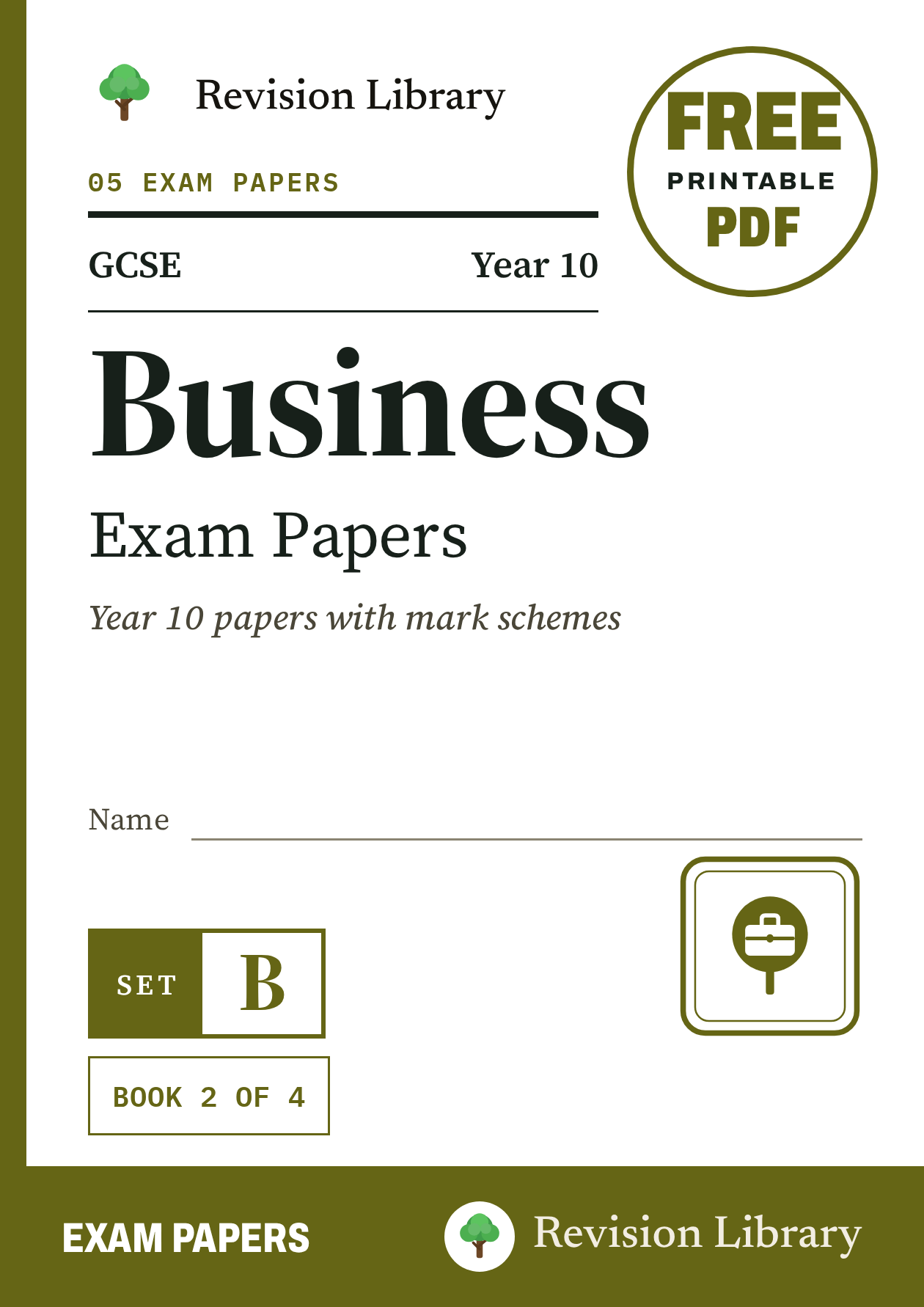
Book 2 of 4

GCSE Business Exam Papers Set B

Year 10 Paper 4: Ideas and Markets, Year 10 Paper 5: Enterprise and Finance and Year 10 Paper 6: Mixed Practice

Level
GCSE · AQA 8132
Series
GCSE Business Exam Papers, book 2 of 4
Suitable for
Years 10-11, AQA
FreePDF download · 2027 edition · 68 A4 pages
  • One file, prints straight to A4
  • No account, no password

3 papers in the AQA format, mark schemes at the back. This set is one of 558 free PDFs on the shelf.

Pages
68 A4 pages
Papers
3 papers
Questions
56 · 240 marks
Answers
From page 48

What is inside

3 papers · answers from p48

Each paper starts with a page showing its marks and a suggested time, followed by the questions. The mark schemes for all 3 papers are at the back, so you can sit each paper as a mock and mark it afterwards.

  1. 01Year 10 Paper 4: Ideas and Markets19 questions · 80 marksp3
  2. 02Year 10 Paper 5: Enterprise and Finance14 questions · 60 marksp17
  3. 03Year 10 Paper 6: Mixed Practice23 questions · 100 marksp29
  4. AnswersMark schemes for every paperp48

Each paper is drawn from one of our worksheet packs. Follow a paper title for the full pack on its own page, or browse every GCSE Business pack. Every book on the shelf is a complete printable workbook of up to 120 A4 pages.

Explore this volume

GCSE Business Exam Papers Set B includes Year 10 Paper 4: Ideas and Markets (from page 3); Year 10 Paper 5: Enterprise and Finance (from page 17); Year 10 Paper 6: Mixed Practice (from page 29).

Worked question 7 - Year 10 Paper 4: Ideas and Markets

A furniture company sells only through its own website, with no physical shops.

Explain two advantages to the company of using online distribution rather than selling through shops.

Answer

Two developed advantages, such as lower costs than running shops, and access to a wider customer base not limited by location

Mark scheme

B1for identifying an advantage, such as lower costs from not paying shop rent, rates or shop staff
B1for developing it, such as being able to offer lower prices or keep more profit per sale
B1for identifying a second advantage, such as reaching a wider, potentially national or international, customer base
B1for developing it, such as customers not being limited to those who can visit a physical location, increasing potential sales

Question 13 - Year 10 Paper 4: Ideas and Markets

4 marks

An online craft seller has monthly sales revenue of 3000 pounds selling through her own website, keeping all of it.

A marketplace platform offers to list her products, taking 10 percent commission on each sale, but she expects sales would rise to 4200 pounds a month because of the platform's existing customer traffic.

Calculate the money she would keep from selling through the marketplace after commission, and state whether switching would be worthwhile in terms of money kept.

Answer

Money kept via the marketplace = 3780 pounds, compared with 3000 pounds kept via her own website; switching is worthwhile since she keeps more overall

Mark scheme

M1for money kept via the marketplace = 4200 times 0.90
A1for 3780 pounds
B1for comparing this with the 3000 pounds she currently keeps in full via her own website
B1for a justified conclusion that switching is worthwhile, since she would keep more money overall despite the 10 percent commission

Question 1 - Year 10 Paper 4: Ideas and Markets

2 marks

State two examples of primary market research a new sandwich shop could use to find out what customers want.

Answer

Any two distinct primary research methods, such as a questionnaire survey, an interview, a focus group, direct customer observation or a tasting trial collecting feedback. Questionnaire and survey describe the same method here; sampling alone does not identify a research method.

Mark scheme

B1for one primary research method, such as a questionnaire survey, interviews, a focus group, direct observation or a tasting trial collecting feedback
B1for a second distinct primary method; do not count questionnaire and survey twice, and do not credit sampling alone without a data-collection method

Question 19 - Year 10 Paper 4: Ideas and Markets

6 marks

A new entrepreneur is deciding how to source ingredients for a small chocolate business. Fair trade ingredients cost more but guarantee a fair price to overseas farmers; the cheaper alternative does not.

Evaluate whether the entrepreneur should choose the more expensive fair trade ingredients.

Answer

Fair trade guarantees farmers a fair price, matching ethical objectives and possibly attracting customers willing to pay more. Higher ingredient costs reduce margins unless prices or sales compensate. Choose fair trade where customers value it enough or the owner's ethical objective justifies the cost; otherwise affordability may constrain adoption.

Mark scheme

B1for a benefit of fair trade, such as ethical sourcing or appeal to customers who value fair farmer payments
B1for developing how this could strengthen reputation, loyalty or willingness to pay
B1for identifying that higher ingredient costs can reduce margin at unchanged prices
B1for developing the trade-off, such as a price increase deterring price-sensitive customers
B1for a distinct relevant factor, such as owner values or evidence of customers' willingness to pay a premium
B1for a justified conclusion balancing ethical or marketing benefits against extra cost; accept either supported decision

Question 9 - Year 10 Paper 5: Enterprise and Finance

5 marks

In a small town, three plumbing firms share a market worth 500000 pounds a year.

Firm A has annual revenue of 175000 pounds and Firm B has annual revenue of 235000 pounds.

Calculate Firm A's market share and Firm B's market share as percentages, and state which firm has the larger share.

Answer

Firm A's market share = 35 percent; Firm B's market share = 47 percent; Firm B has the larger share

Mark scheme

M1for Firm A's share = 175000 divided by 500000, multiplied by 100
A1for 35 percent
M1for Firm B's share = 235000 divided by 500000, multiplied by 100
A1for 47 percent
B1for correctly concluding that Firm B has the larger market share

Question 2 - Year 10 Paper 5: Enterprise and Finance

3 marks

A qualified electrician earns 32000 pounds a year working for a large firm and is considering leaving to set up his own electrical contracting business.

Explain one opportunity cost the electrician gives up by leaving his job to start the business.

Answer

The next best alternative forgone is the 32000 pounds annual salary. Leaving employment sacrifices predictable income and may make personal bills harder to cover before contracting becomes established.

Mark scheme

B1for identifying the 32000 pounds annual salary or another valid employment benefit forgone
B1for explaining this is the next best alternative sacrificed by choosing self-employment
B1for developing the consequence, such as losing predictable income while new contracting revenue is uncertain; do not require the new business to exceed the former salary

Question 7 - Year 10 Paper 5: Enterprise and Finance

4 marks

In a local area, four coffee shops share a total market worth 800000 pounds a year in sales.

Bean and Co has annual sales of 184000 pounds in that market.

Calculate Bean and Co's market share as a percentage, and state whether this gives Bean and Co the largest share, given that the other three shops hold 26 percent, 22 percent and 29 percent.

Answer

23 percent; no, the shop with a 29 percent share has the largest share

Mark scheme

M1for dividing 184000 by 800000
M1for multiplying the result by 100
A1for 23 percent
B1for stating that 23 percent is not the largest share, supported by comparison with 29 percent or 26 percent; award this comparison once

Question 7 - Year 10 Paper 6: Mixed Practice

3 marks

Explain one reason why branding, such as a distinctive logo and name, is an important part of a business's product.

Answer

A distinctive logo and name help customers recognise and find the product again, encouraging repeat sales. This is a complete developed reason: a premium price is not required. Accept other valid developed branding reasons, including differentiation or a possible price premium.

Mark scheme

B1for identifying a valid role of branding, such as helping customers recognise the product through its distinctive logo and name
B1for developing that role, such as explaining that recognition helps customers find the product again among competing products
B1for a linked business benefit, such as encouraging repeat sales; a premium price is not required. Accept other valid developed branding reasons, including differentiation or a possible price premium

Question 8 - Year 10 Paper 6: Mixed Practice

4 marks

A mobile pizza van owner is turning away customers at busy times and is deciding whether to use her savings to buy a second, larger van.

Explain two risks to the owner of using her savings to buy the second van.

Answer

Savings tied up in the second van leave less emergency cash if repairs or bills arise. Busy-time demand may not persist or cover extra running costs, so the investment could reduce profit or lose money.

Mark scheme

B1for identifying that savings used for the second van are no longer readily available as an emergency cash buffer
B1for developing how this could make unexpected bills or a downturn harder to manage; do not assume all savings are spent
B1for a second risk, such as extra operating costs or insufficient sustained demand for the second van
B1for developing how extra van costs could exceed its additional contribution and reduce profit; accept other distinct developed risks

GCSE Business Exam Papers runs to 4 volumes

Book 2 of 4 · 256 pages in the set

Each set is a separate free PDF with its own mark schemes at the back.

Volume 1

61 pp · 47 Qs

Year 10 Paper 1: Core Skills, Year 10 Paper 2: Planning and Marketing and Year 10 Paper 3: Running the Business

Volume 2 · this book

68 pp · 56 Qs

Year 10 Paper 4: Ideas and Markets, Year 10 Paper 5: Enterprise and Finance and Year 10 Paper 6: Mixed Practice

Volume 3

58 pp · 46 Qs

Year 11 Paper 1: Small Business Foundations, Year 11 Paper 2: Growing the Business and Year 11 Paper 3: Marketing and Operations

Volume 4

69 pp · 56 Qs

Year 11 Paper 4: Finance and Growth, Year 11 Paper 5: People and Quality and Year 11 Paper 6: Full Course Mixed Practice

More GCSE books

GCSE Business Topic Workbook 1

107 pp · 206 Qs

The purpose of business and enterprise, Business ownership structures, Business aims and objectives and 11 more

Want a different mix of topics?

Sitting an exam soon? Build a GCSE Business mock paper or print a ready-made one.