Revision Library
Choose a subject
Menu

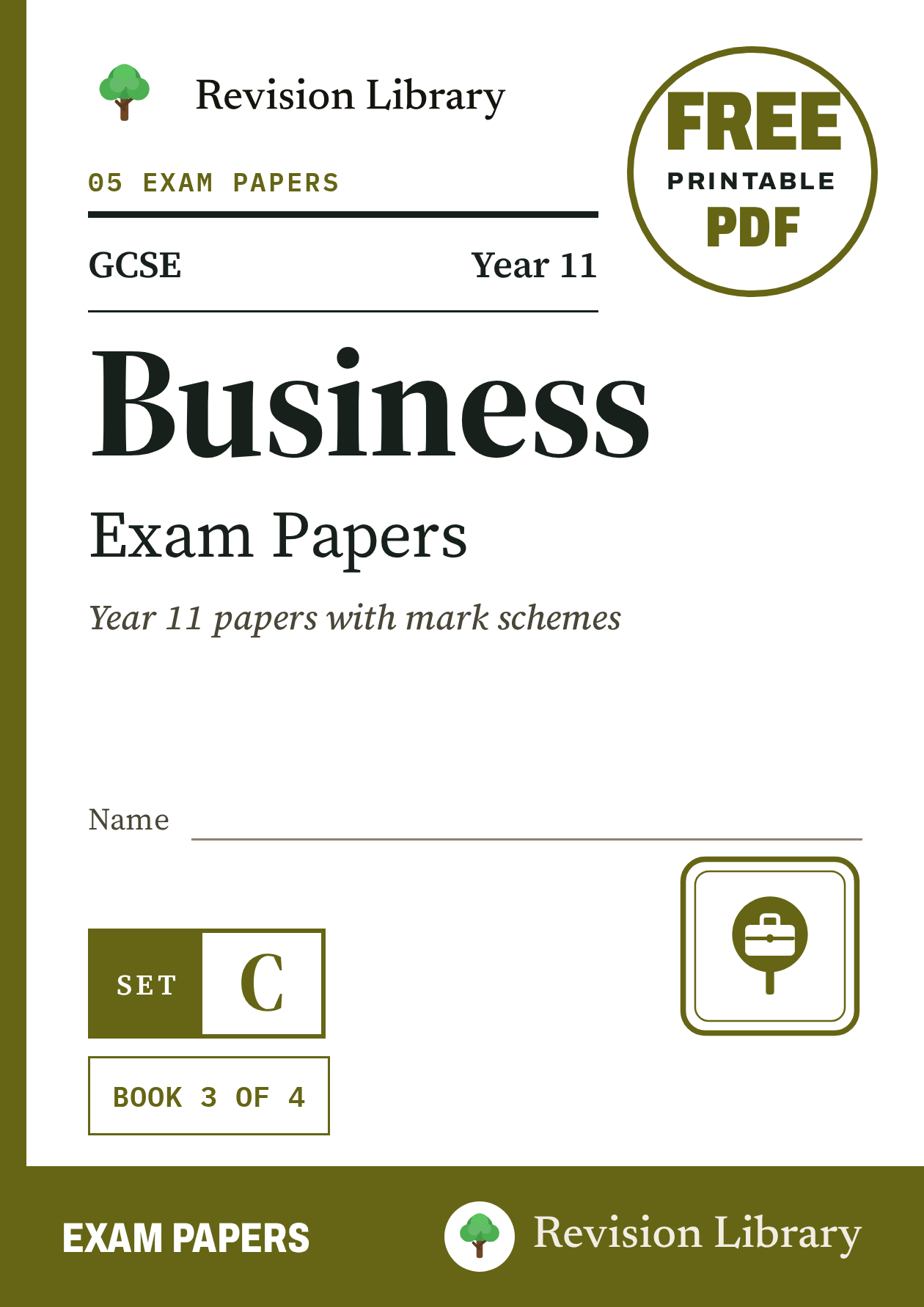
Book 3 of 4

GCSE Business Exam Papers Set C

Year 11 Paper 1: Small Business Foundations, Year 11 Paper 2: Growing the Business and Year 11 Paper 3: Marketing and Operations

Level
GCSE · AQA 8132
Series
GCSE Business Exam Papers, book 3 of 4
Suitable for
Years 10-11, AQA
FreePDF download · 2027 edition · 58 A4 pages
  • One file, prints straight to A4
  • No account, no password

3 papers in the AQA format, mark schemes at the back. This set is one of 558 free PDFs on the shelf.

Pages
58 A4 pages
Papers
3 papers
Questions
46 · 200 marks
Answers
From page 42

What is inside

3 papers · answers from p42

Each paper starts with a page showing its marks and a suggested time, followed by the questions. The mark schemes for all 3 papers are at the back, so you can sit each paper as a mock and mark it afterwards.

  1. 01Year 11 Paper 1: Small Business Foundations14 questions · 60 marksp3
  2. 02Year 11 Paper 2: Growing the Business14 questions · 60 marksp15
  3. 03Year 11 Paper 3: Marketing and Operations18 questions · 80 marksp26
  4. AnswersMark schemes for every paperp42

Each paper is drawn from one of our worksheet packs. Follow a paper title for the full pack on its own page, or browse every GCSE Business pack. Every book on the shelf is a complete printable workbook of up to 120 A4 pages.

Explore this volume

GCSE Business Exam Papers Set C includes Year 11 Paper 1: Small Business Foundations (from page 3); Year 11 Paper 2: Growing the Business (from page 15); Year 11 Paper 3: Marketing and Operations (from page 26).

Worked question 3 - Year 11 Paper 1: Small Business Foundations

A market stall sells scented candles for 9 pounds each. Each candle costs 3 pounds to make.

The stall's fixed costs are 180 pounds per week. Calculate the contribution per candle, and the number of candles the stall must sell each week to break even.

Answer

Contribution = 6 pounds per candle; break-even output = 30 candles per week

Mark scheme

M1for contribution per candle = 9 minus 3
M1for dividing the fixed costs of 180 by the contribution per candle
A1for 30 candles per week

Question 1 - Year 11 Paper 1: Small Business Foundations

2 marks

State two personal qualities that help an entrepreneur to succeed when starting a new business.

Answer

Any two of: determination, risk-taking, self-motivation, creativity, resilience

Mark scheme

B1for one valid quality, such as determination or risk-taking
B1for a second valid quality, such as self-motivation or creativity

Question 4 - Year 11 Paper 1: Small Business Foundations

3 marks

A well-established chain of five supermarkets has traded successfully and profitably for over twenty years.

Explain one reason why profit maximisation, rather than survival, is likely to be this business's main objective.

Answer

Twenty years of profitable trading and five supermarkets suggest an established customer base. Immediate survival may therefore be less pressing, allowing the owners to focus on increasing the return from operations through profit maximisation; continued survival is not guaranteed.

Mark scheme

B1for identifying the established trading record or customer base indicated by twenty profitable years and five supermarkets
B1for developing why this may make immediate survival less pressing than for a new firm
B1for linking profit maximisation to greater returns for owners; accept another coherent explanation and do not require a claim that survival is guaranteed

Question 10 - Year 11 Paper 1: Small Business Foundations

5 marks

A tutoring business has fixed costs of 900 pounds a month. It charges 30 pounds per hour of tutoring, and the variable cost per hour, for materials, is 5 pounds.

Calculate the number of hours needed each month to break even, and the number of hours needed to make a target profit of 750 pounds.

Answer

Break-even = 36 hours per month; hours needed for a 750-pound target profit = 66 hours per month

Mark scheme

M1for contribution per hour = 30 minus 5
M1for dividing 900 by the 25-pound contribution
A1for a break-even output of 36 hours
M1for dividing the fixed costs plus the 750-pound target profit, 1650, by the 25-pound contribution
A1for 66 hours needed to reach the target profit

Question 6 - Year 11 Paper 2: Growing the Business

5 marks

A factory produces 8000 units a month with total costs of 64000 pounds.

After a further expansion, it produces 15000 units a month, but total costs rise to 135000 pounds because of the extra management and coordination the larger factory now needs.

Calculate the average cost per unit before and after this expansion, and state whether the business has experienced diseconomies of scale.

Answer

Average cost before = 8 pounds per unit; average cost after = 9 pounds per unit; yes, this shows diseconomies of scale, as average cost has risen despite higher output

Mark scheme

M1for average cost before = 64000 divided by 8000
A1for an average cost before of 8 pounds per unit
M1for average cost after = 135000 divided by 15000
A1for an average cost after of 9 pounds per unit
B1for concluding that this shows diseconomies of scale, since average cost per unit has risen despite higher output

Question 11 - Year 11 Paper 2: Growing the Business

5 marks

A prospective franchisee is comparing opening an independent cafe, costing 40000 pounds to set up with no ongoing brand fees, against buying a cafe franchise.

The franchise costs a 15000-pound joining fee plus an ongoing 8 percent royalty on the franchise's forecast annual revenue of 150000 pounds.

For this comparison, assume these are the only differing first-year costs: all other setup and operating costs are equal for the two options.

Calculate the total first-year cost of the franchise option, fee plus the first year's royalty, and state which option has the lower first-year cost.

Answer

Royalty = 12000 pounds; fee plus first-year royalty = 27000 pounds. Under the stated equal-other-costs assumption, the franchise costs 13000 pounds less in the first year than the independent option.

Mark scheme

M1for the royalty = 8 percent of 150000
A1for 12000 pounds
M1for total first-year franchise cost = 15000 plus 12000
A1for 27000 pounds
B1for comparing 27000 pounds with 40000 pounds and identifying the franchise as cheaper under the explicit equal-other-costs assumption

Question 12 - Year 11 Paper 2: Growing the Business

6 marks

In this hypothetical business scenario, a care home employs 46 care assistants, each currently paid 20000 pounds a year. A rise in the minimum wage will increase this to 23000 pounds a year for every assistant.

To keep its total wage bill unchanged, management is considering reducing the number of care assistants instead of finding the extra money.

Calculate the current total wage bill, and the maximum number of care assistants the home could employ at the new pay rate without increasing this total wage bill, then evaluate whether cutting staff numbers this way is a good response to the wage rise.

Answer

Current wage bill is 920000 pounds; the new rate funds at most 40 assistants, six fewer. Cutting to 40 is sensible only if safe care and service can still be delivered; no safe staffing threshold is given.

Mark scheme

M1for current wage bill = 46 times 20000
A1for 920000 pounds per year
M1for maximum headcount = (46 times 20000) divided by 23000
A1for 40 care assistants, the maximum whole number within the wage budget
B1for explaining a consequence of six fewer assistants, such as greater workload or care risk, or a supported efficiency mitigation
B1for a reasoned judgement either way that weighs the wage constraint against care provision; no safe staffing threshold is supplied

Question 5 - Year 11 Paper 3: Marketing and Operations

3 marks

Explain one reason why comparing a business's own quality standards against a leading competitor, known as benchmarking, can help improve quality.

Answer

Comparing measured quality with a leading competitor can reveal a gap, helping the business set a specific target and improve a relevant process to reduce defects. Accept other valid developed benchmarking reasons. The comparison does not establish every weakness, prove the competitor is best in every respect or guarantee improvement.

Mark scheme

B1for a valid reason benchmarking can help, such as revealing a measured gap in quality or a relevant process difference
B1for explaining how that comparison guides a specific target, investigation or process change
B1for a linked improvement consequence, such as better allocation of resources or fewer defects; do not assume the comparator is best in every respect or that comparison alone guarantees improvement

Question 9 - Year 11 Paper 3: Marketing and Operations

5 marks

A local bakery is choosing between two advertising options for a 240-pound budget: a local newspaper advert reaching an estimated 8000 people, or a social media advert reaching an estimated 20000 people for the same cost.

Calculate the cost per person reached for each option, and state which option is more cost-effective in reaching people.

Answer

Newspaper cost per person reached = 0.03 pounds; social media cost per person reached = 0.012 pounds; social media is more cost-effective

Mark scheme

M1for newspaper cost per person = 240 divided by 8000
A1for 0.03 pounds per person
M1for social media cost per person = 240 divided by 20000
A1for 0.012 pounds per person
B1for correctly concluding that the social media advert is more cost-effective, reaching people at a lower cost each

GCSE Business Exam Papers runs to 4 volumes

Book 3 of 4 · 256 pages in the set

Each set is a separate free PDF with its own mark schemes at the back.

Volume 1

61 pp · 47 Qs

Year 10 Paper 1: Core Skills, Year 10 Paper 2: Planning and Marketing and Year 10 Paper 3: Running the Business

Volume 2

68 pp · 56 Qs

Year 10 Paper 4: Ideas and Markets, Year 10 Paper 5: Enterprise and Finance and Year 10 Paper 6: Mixed Practice

Volume 3 · this book

58 pp · 46 Qs

Year 11 Paper 1: Small Business Foundations, Year 11 Paper 2: Growing the Business and Year 11 Paper 3: Marketing and Operations

Volume 4

69 pp · 56 Qs

Year 11 Paper 4: Finance and Growth, Year 11 Paper 5: People and Quality and Year 11 Paper 6: Full Course Mixed Practice

More GCSE books

GCSE Business Topic Workbook 1

107 pp · 206 Qs

The purpose of business and enterprise, Business ownership structures, Business aims and objectives and 11 more

Want a different mix of topics?

Sitting an exam soon? Build a GCSE Business mock paper or print a ready-made one.