Revision Library
Choose a subject
Menu

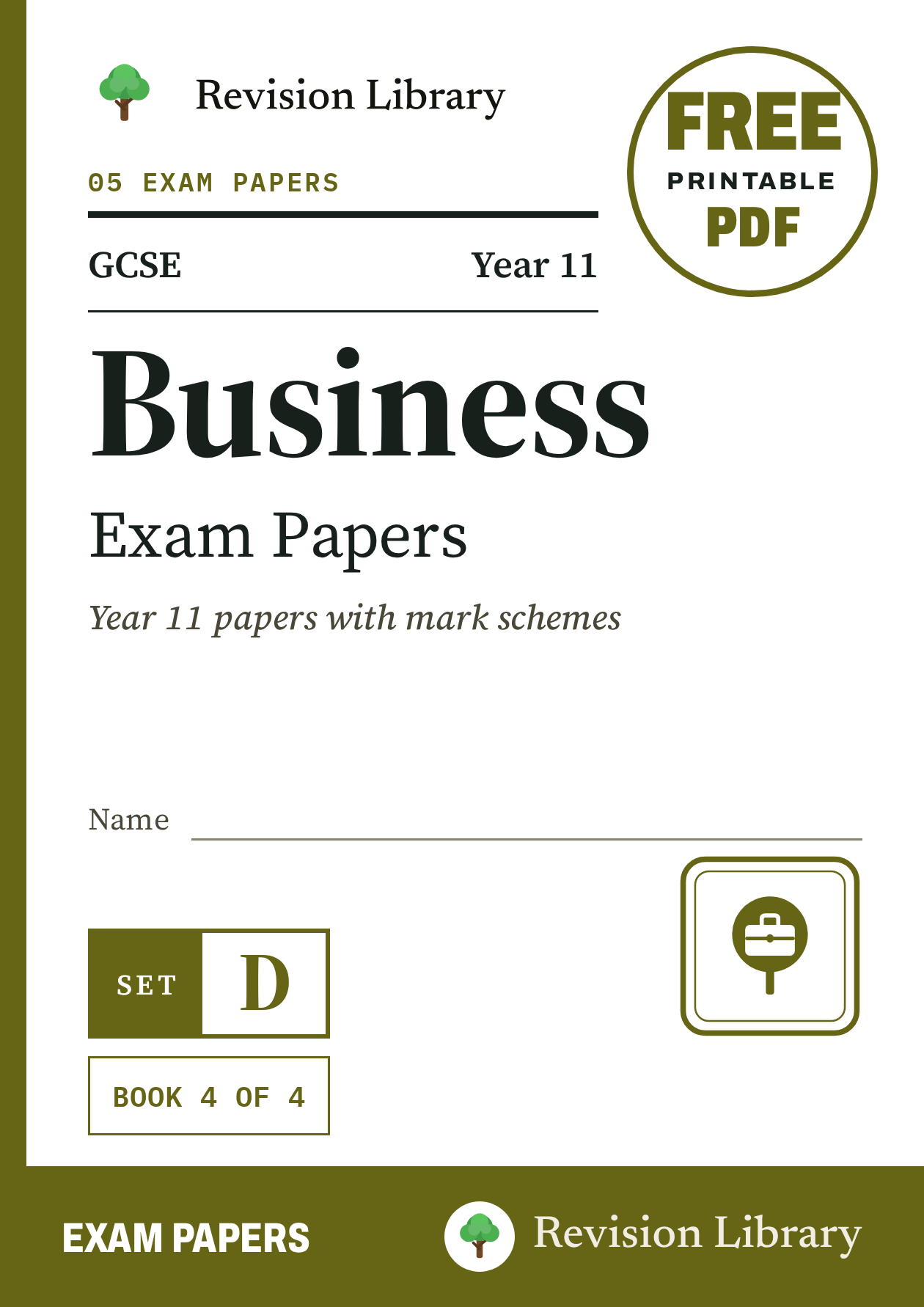
Book 4 of 4

GCSE Business Exam Papers Set D

Year 11 Paper 4: Finance and Growth, Year 11 Paper 5: People and Quality and Year 11 Paper 6: Full Course Mixed Practice

Level
GCSE · AQA 8132
Series
GCSE Business Exam Papers, book 4 of 4
Suitable for
Years 10-11, AQA
FreePDF download · 2027 edition · 69 A4 pages
  • One file, prints straight to A4
  • No account, no password

3 papers in the AQA format, mark schemes at the back. This set is one of 558 free PDFs on the shelf.

Pages
69 A4 pages
Papers
3 papers
Questions
56 · 240 marks
Answers
From page 50

What is inside

3 papers · answers from p50

Each paper starts with a page showing its marks and a suggested time, followed by the questions. The mark schemes for all 3 papers are at the back, so you can sit each paper as a mock and mark it afterwards.

  1. 01Year 11 Paper 4: Finance and Growth19 questions · 80 marksp3
  2. 02Year 11 Paper 5: People and Quality14 questions · 60 marksp18
  3. 03Year 11 Paper 6: Full Course Mixed Practice23 questions · 100 marksp30
  4. AnswersMark schemes for every paperp50

Each paper is drawn from one of our worksheet packs. Follow a paper title for the full pack on its own page, or browse every GCSE Business pack. Every book on the shelf is a complete printable workbook of up to 120 A4 pages.

Explore this volume

GCSE Business Exam Papers Set D includes Year 11 Paper 4: Finance and Growth (from page 3); Year 11 Paper 5: People and Quality (from page 18); Year 11 Paper 6: Full Course Mixed Practice (from page 30).

Worked question 1 - Year 11 Paper 4: Finance and Growth

State two examples of government legislation that could affect how a business operates.

Answer

Any two of: minimum wage law, health and safety law, consumer protection law, environmental regulations, employment rights law

Mark scheme

B1for a valid example, such as minimum wage law or health and safety law
B1for a second valid example, such as consumer protection law, environmental regulations, or employment rights law

Question 4 - Year 11 Paper 4: Finance and Growth

3 marks

Explain one effect an economic boom, when the economy is growing strongly and consumer confidence is high, is likely to have on a business selling non-essential luxury goods.

Answer

Luxury demand may rise because confident households are more willing to buy discretionary items, increasing sales revenue.

Mark scheme

B1for identifying a possible increase in luxury demand during a boom
B1for explaining why confident customers may spend more on discretionary goods
B1for linking higher sales to higher revenue, or to higher profit conditional on costs

Question 11 - Year 11 Paper 4: Finance and Growth

5 marks

A market stall's cash flow forecast is shown below.

July: inflows of 5200 pounds, outflows of 4700 pounds, opening balance of 300 pounds. August: inflows of 4100 pounds, outflows of 5900 pounds, with an opening balance equal to July's closing balance.

Calculate the closing balance for July, and the closing balance for August, and state one action the stallholder could take in July to prepare for the August shortfall.

Answer

July closing balance = 300 + 5200 - 4700 = 800 pounds. August closing balance = 800 + 4100 - 5900 = negative 1000 pounds. In July, arrange an agreed overdraft or loan of at least 1000 pounds, or negotiate to postpone sufficient August outflows beyond August.

Mark scheme

M1for July's net cash flow = 5200 minus 4700
A1for a July closing balance of 800 pounds
M1for August's net cash flow = 4100 minus 5900
A1for an August closing balance of negative 1000 pounds
B1for a valid preparatory action, such as arranging an overdraft or short-term loan in July before the shortfall occurs, or delaying a non-essential August outflow

Question 10 - Year 11 Paper 4: Finance and Growth

4 marks

A restaurant has sales revenue of 210000 pounds, total costs of 178500 pounds, and net profit of 31500 pounds for the year. The owner's target is a net profit margin of at least 20 percent.

Calculate the restaurant's net profit margin, to one decimal place, and state whether it has met the owner's target.

Answer

Net profit margin = 15.0 percent; no, this has not met the owner's 20 percent target

Mark scheme

M1for dividing net profit of 31500 by sales revenue of 210000
M1for multiplying the result by 100
A1for a net profit margin of 15.0 percent
B1for concluding that 15.0 percent does not meet the 20 percent target, a shortfall of 5 percentage points; credit the comparison once

Question 8 - Year 11 Paper 5: People and Quality

4 marks

A retailer is deciding whether to train its new sales staff before they start serving customers.

Explain two benefits to the retailer of providing training for new staff.

Answer

Product training helps sales staff recommend suitable products, improving customer satisfaction and repeat sales. Till training reduces transaction errors, cutting refunds and wasted staff time.

Mark scheme

B1for a valid training benefit for this retailer, such as product knowledge improving advice
B1for developing the first benefit into a customer service, sales, cost or retention consequence
B1for a second distinct benefit, such as fewer till errors, faster service or improved motivation
B1for developing the second benefit into a retailer outcome; accept any two valid developed benefits

Question 5 - Year 11 Paper 5: People and Quality

3 marks

A warehouse manager wants to motivate staff without increasing the wage budget.

Explain one non-financial method the manager could use to motivate staff.

Answer

Give warehouse staff responsibility for organising their picking area, increasing ownership of work and encouraging care and effort.

Mark scheme

B1for a valid non-financial method, such as empowerment, recognition, enrichment or job rotation
B1for explaining how this method can make warehouse staff feel trusted, valued or more interested
B1for linking the method to motivation or effort without using increased pay as the incentive

Question 2 - Year 11 Paper 5: People and Quality

3 marks

Explain one benefit to a business of employing part-time staff rather than only full-time staff.

Answer

Part-time staff can cover busy periods without paying for full-time hours in quiet periods, reducing avoidable wage cost.

Mark scheme

B1for a valid business benefit of part-time staff, such as matching hours to busy periods or attracting suitable applicants
B1for explaining how part-time hours produce the chosen benefit
B1for developing this into lower avoidable cost, better staffing, retention or service; no requirement to use wage savings

Question 16 - Year 11 Paper 6: Full Course Mixed Practice

5 marks

A workshop has fixed costs of 6000 pounds a month and a maximum capacity of 1000 units a month.

Calculate the fixed cost per unit if it operates at 40 percent capacity utilisation, and the fixed cost per unit if it operates at 80 percent capacity utilisation. Explain why the fixed cost per unit changes.

Answer

At 40 percent capacity, output is 400 units and fixed cost per unit is 15 pounds. At 80 percent, output is 800 units and fixed cost per unit is 7.50 pounds. The same 6000-pound monthly fixed cost is spread over twice as many units, so the fixed cost per unit halves.

Mark scheme

M1for output at 40 percent capacity = 1000 times 0.40 = 400 units
A1for fixed cost per unit = 6000 divided by 400 = 15 pounds
M1for output at 80 percent capacity = 1000 times 0.80 = 800 units
A1for fixed cost per unit = 6000 divided by 800 = 7.50 pounds
B1for explaining that the same total fixed cost is spread over more units, so fixed cost per unit falls

Question 1 - Year 11 Paper 6: Full Course Mixed Practice

2 marks

State two elements of the marketing mix, other than price.

Answer

Any two of: product, promotion, place

Mark scheme

B1for a valid element, such as product
B1for a second valid element, such as promotion or place

GCSE Business Exam Papers runs to 4 volumes

Book 4 of 4 · 256 pages in the set

Each set is a separate free PDF with its own mark schemes at the back.

Volume 1

61 pp · 47 Qs

Year 10 Paper 1: Core Skills, Year 10 Paper 2: Planning and Marketing and Year 10 Paper 3: Running the Business

Volume 2

68 pp · 56 Qs

Year 10 Paper 4: Ideas and Markets, Year 10 Paper 5: Enterprise and Finance and Year 10 Paper 6: Mixed Practice

Volume 3

58 pp · 46 Qs

Year 11 Paper 1: Small Business Foundations, Year 11 Paper 2: Growing the Business and Year 11 Paper 3: Marketing and Operations

Volume 4 · this book

69 pp · 56 Qs

Year 11 Paper 4: Finance and Growth, Year 11 Paper 5: People and Quality and Year 11 Paper 6: Full Course Mixed Practice

More GCSE books

GCSE Business Topic Workbook 1

107 pp · 206 Qs

The purpose of business and enterprise, Business ownership structures, Business aims and objectives and 11 more

Want a different mix of topics?

Sitting an exam soon? Build a GCSE Business mock paper or print a ready-made one.