Revision Library
Choose a subject
Menu
Computer Science
Need a new topic?
Missing a topic, found a bug, or want something added?

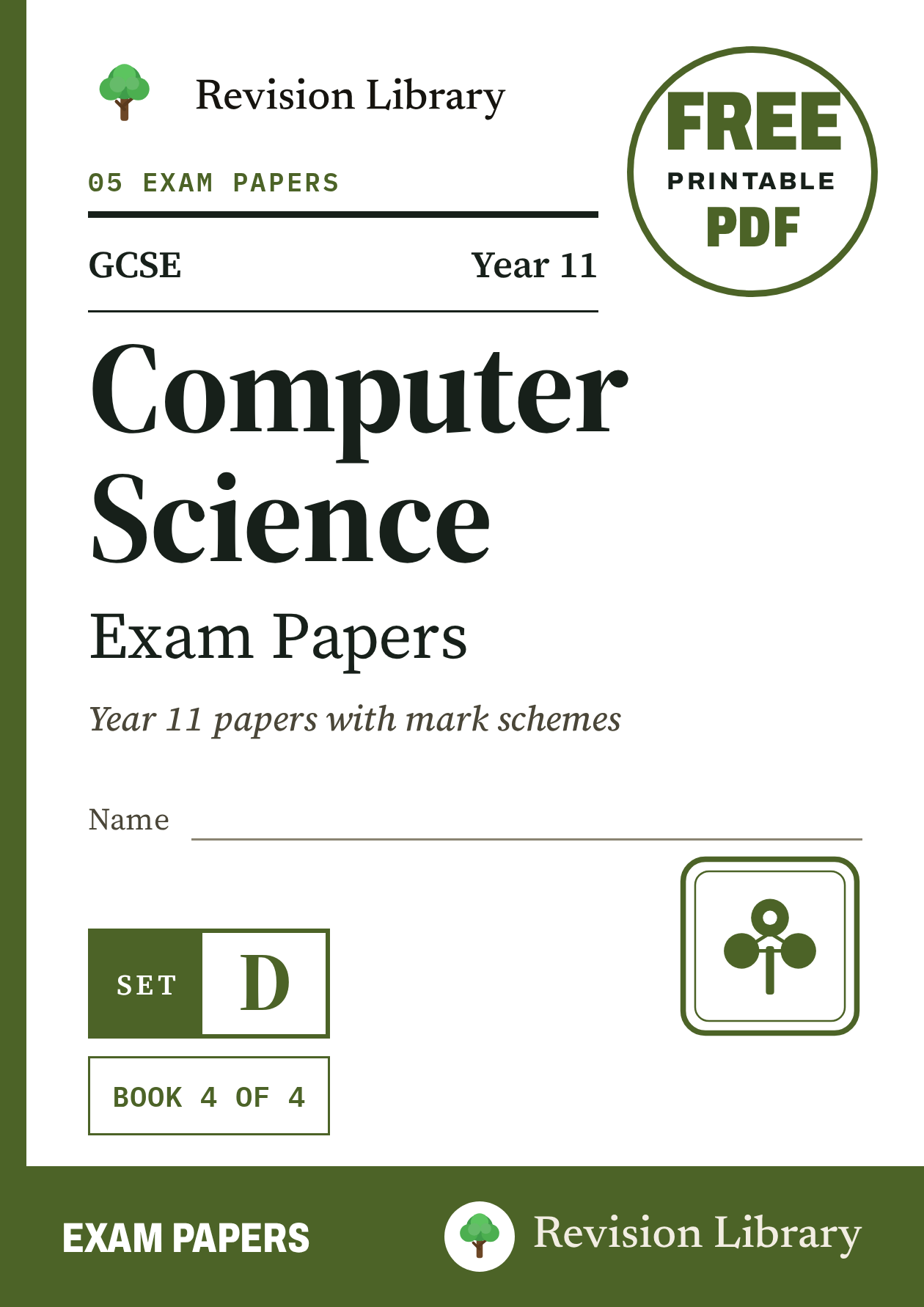
Book 4 of 4

GCSE Computer Science Exam Papers Set D

Year 11 Paper 4: Algorithms and Ethics, Year 11 Paper 5: Systems and Data and Year 11 Paper 6: Revision Mix

Level
GCSE · AQA 8525 · OCR J277
Series
GCSE Computer Science Exam Papers, book 4 of 4
Suitable for
Years 10-11, AQA / OCR
FreePDF download · 2027 edition · 70 A4 pages
  • One file, prints straight to A4
  • No account, no password

3 papers, mark schemes at the back. This set is one of 558 free PDFs on the shelf.

Pages
70 A4 pages
Papers
3 papers
Questions
68 · 260 marks
Answers
From page 52

What is inside

3 papers · answers from p52

Each paper starts with a page showing its marks and a suggested time, followed by the questions. The mark schemes for all 3 papers are at the back, so you can sit each paper as a mock and mark it afterwards.

  1. 01Year 11 Paper 4: Algorithms and Ethics21 questions · 80 marksp3
  2. 02Year 11 Paper 5: Systems and Data21 questions · 80 marksp18
  3. 03Year 11 Paper 6: Revision Mix26 questions · 100 marksp33
  4. AnswersMark schemes for every paperp52

Each paper is drawn from one of our worksheet packs. Follow a paper title for the full pack on its own page, or browse every GCSE Computer Science pack. Every book on the shelf is a complete printable workbook of up to 120 A4 pages.

Explore this volume

GCSE Computer Science Exam Papers Set D includes Year 11 Paper 4: Algorithms and Ethics (from page 3); Year 11 Paper 5: Systems and Data (from page 18); Year 11 Paper 6: Revision Mix (from page 33).

Worked question 3 - Year 11 Paper 4: Algorithms and Ethics

A program stores a person's height in metres as a decimal value, for example 1.75.

State the most appropriate data type for this variable, and state one other example of data that would use this data type.

Answer

Real/float; another example could be a temperature or an average, which also need decimal places

Mark scheme

B1real (float) is the most appropriate data type, since the value needs decimal places
B1valid other example, for example a temperature reading, an average, or a price with pence

Question 13 - Year 11 Paper 4: Algorithms and Ethics

4 marks

A subroutine called addTax is written to take a price as a parameter and return the price with 20% tax added.

Explain what a parameter is using addTax(price), distinguish the formal parameter from a supplied argument, and give a call with its returned value. Assume real arithmetic and 20% tax.

Use the example call addTax(100) in your explanation.

Answer

A parameter is a named input in a subroutine definition. In addTax(price), price is the formal parameter; calling addTax(100) supplies the argument 100 to it. The body uses that value to return price * 1.2, giving 120 for this call.

Mark scheme

B1Parameter is a named input in the subroutine definition
B1price receives the supplied value for each addTax call
B1Body uses price to calculate price * 1.2
B1Example addTax(100) supplies 100 and returns 120

Question 15 - Year 11 Paper 4: Algorithms and Ethics

5 marks

A programmer's code reads a number from the user as a string, and needs to convert it into an integer before doing a calculation. Later, the program needs to convert a calculated integer total back into a string so it can be joined with other text and displayed.

Explain why both of these conversions (casting) are needed, referring to what would go wrong without each one.

Answer

Cast numeric input text to an integer so arithmetic uses its numerical value: int("12") + 3 is 15. Without conversion a language may concatenate to form "123" or raise a type error. Cast a calculated total back with str(total) when joining it to text, for example "Total: " + str(15) gives "Total: 15"; a language without implicit conversion may otherwise reject the mixed types. Exact behaviour depends on the language.

Mark scheme

B1Numeric input initially has string type
B1Casting to integer enables numeric arithmetic
B1Without casting addition may concatenate or raise a type error
B1Cast integer total to string for text concatenation
B1Without a supported implicit conversion mixed-type concatenation may fail

Question 10 - Year 11 Paper 4: Algorithms and Ethics

3 marks

A logical shift right by 3 places is applied to the 8-bit binary number 01101000, with zeros filling the empty places on the left.

State the resulting 8-bit binary number, and state the denary value of the number both before and after the shift.

Answer

00001101; denary value before: 104, after: 13 (divided by 8)

Mark scheme

B1Resulting binary number 00001101.
B1Denary value before: 104.
B1Denary value after: 13.

Question 4 - Year 11 Paper 5: Systems and Data

3 marks

The fetch-execute cycle describes how a CPU processes a single instruction.

State the three steps of the fetch-execute cycle, in order.

Answer

Fetch the next instruction from memory, decode its meaning, then execute it, in that order.

Mark scheme

B1fetch, first
B1decode, second
B1execute, third

Question 10 - Year 11 Paper 5: Systems and Data

4 marks

A student claims: 'A CPU with a very large cache will always outperform a CPU with a small cache, whatever else differs between them.'

Discuss whether this claim is accurate, referring to clock speed and number of cores as well as cache size.

Answer

False: larger cache helps by reducing memory misses when reused data fits, but lower frequency can reduce computation throughput and fewer cores can reduce parallel throughput. Cache benefit depends on workload and diminishing returns; compare all factors rather than cache alone.

Mark scheme

B1a larger cache can reduce slower RAM accesses where data is reused
B1clock speed affects the number of cycles available per second
B1core count affects throughput for parallel software
B1a lower clock speed or fewer useful cores can outweigh a cache advantage, so a larger-cache CPU can be slower

Question 9 - Year 11 Paper 5: Systems and Data

4 marks

A bitmap image is 200 pixels wide and 150 pixels high, and uses a colour depth of 8 bits per pixel.

Calculate the uncompressed image-data size in bytes. Ignore headers, metadata and any other storage overhead.

Answer

30000 bytes of uncompressed pixel data.

Mark scheme

M1for calculating the total number of pixels, 200 x 150 = 30000
M1for multiplying by the colour depth, 30000 x 8 = 240000 (bits)
M1for dividing by 8 to convert bits into bytes
A1for 30000 bytes

Question 19 - Year 11 Paper 6: Revision Mix

4 marks

A single parity bit is added to each 7-bit binary code sent between two computers, set so that the total number of 1 bits, including the parity bit, is always even.

The 7-bit code 1011001 is sent. State the value the parity bit should be set to, and explain how the receiving computer could use the parity bit to detect a single-bit transmission error.

Answer

Parity bit = 0 (the code already has four 1 bits, an even number); the receiver recounts the 1 bits including the parity bit, and an odd total reveals a single-bit error

Mark scheme

M1Counts four 1 bits in 1011001.
A1Parity bit 0; the correct parity answer earns the counting mark.
B1Receiver counts the 1 bits in the whole received code including the parity bit.
B1A single flipped bit changes even parity to odd, so an odd total signals an error; does not locate or correct it.

Question 11 - Year 11 Paper 6: Revision Mix

3 marks

A student named Aisha copies several images from a website and uses them in a school project without permission or acknowledgement.

Identify which piece of legislation this relates to, and explain the ethical issue involved.

Answer

This relates to the Copyright, Designs and Patents Act 1988. Uncredited copying can be unfair to creators or misrepresent authorship. Whether it infringes copyright depends on rights, licence and any applicable exception; school use is not automatically unlawful.

Mark scheme

B1identify Copyright, Designs and Patents Act 1988
B1creators/rightsholders control copying/reuse subject to licences and exceptions
B1uncredited copying can deny recognition or misrepresent authorship, raising fairness/honesty concerns

GCSE Computer Science Exam Papers runs to 4 volumes

Book 4 of 4 · 261 pages in the set

Each set is a separate free PDF with its own mark schemes at the back.

Volume 1

59 pp · 58 Qs

Year 10 Paper 1: Core Skills, Year 10 Paper 2: Software and Networks and Year 10 Paper 3: Systems and Algorithms

Volume 2

69 pp · 65 Qs

Year 10 Paper 4: Data and Algorithms, Year 10 Paper 5: Mixed Topics and Year 10 Paper 6: Full Course Review

Volume 3

63 pp · 57 Qs

Year 11 Paper 1: Systems and Security, Year 11 Paper 2: Programming and Data and Year 11 Paper 3: Systems and Programming

Volume 4 · this book

70 pp · 68 Qs

Year 11 Paper 4: Algorithms and Ethics, Year 11 Paper 5: Systems and Data and Year 11 Paper 6: Revision Mix

More GCSE books

Want a different mix of topics?

Sitting an exam soon? Build a GCSE Computer Science mock paper or print a ready-made one.