Revision Library
Choose a subject
Menu
Computer Science
Need a new topic?
Missing a topic, found a bug, or want something added?

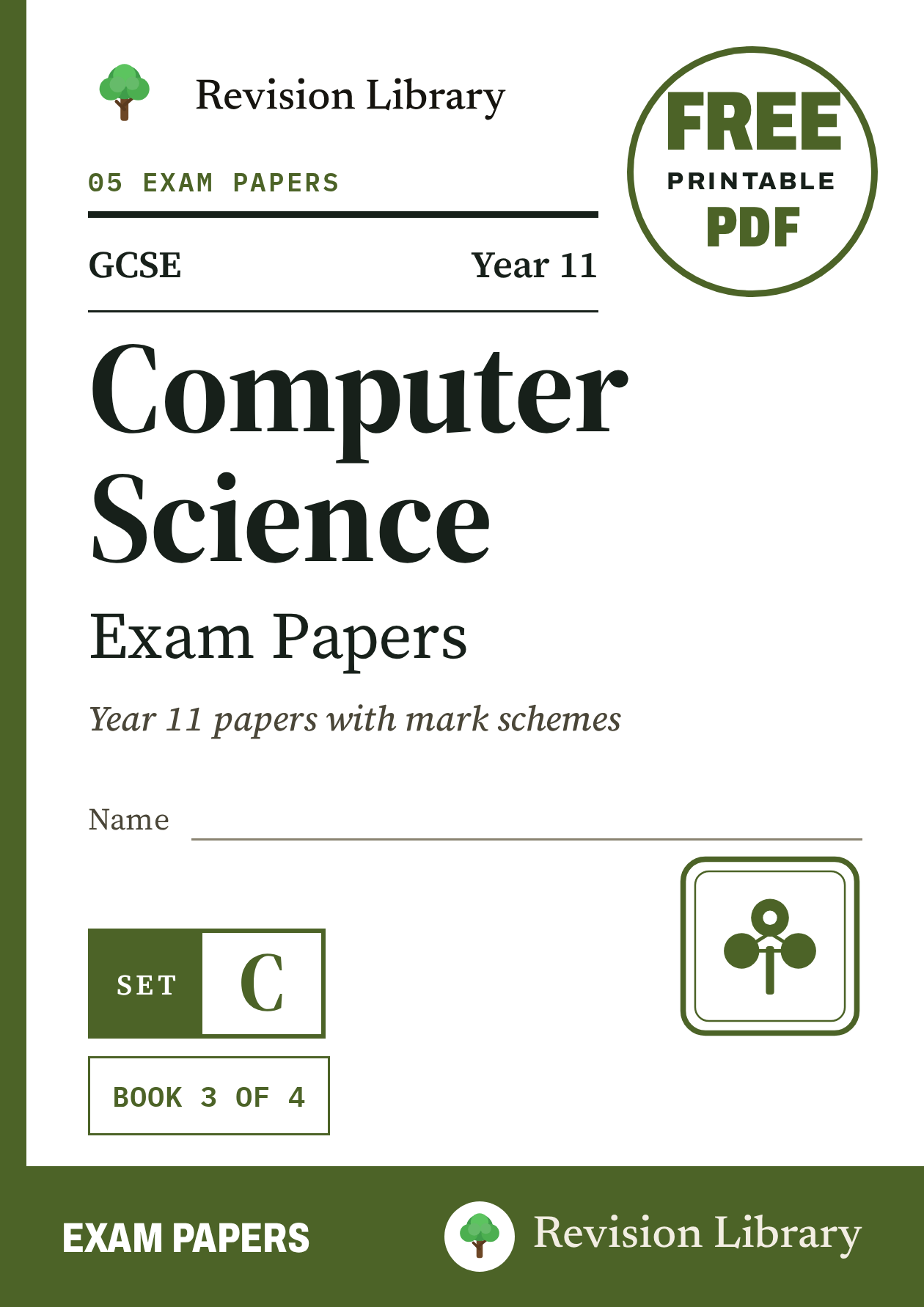
Book 3 of 4

GCSE Computer Science Exam Papers Set C

Year 11 Paper 1: Systems and Security, Year 11 Paper 2: Programming and Data and Year 11 Paper 3: Systems and Programming

Level
GCSE · AQA 8525 · OCR J277
Series
GCSE Computer Science Exam Papers, book 3 of 4
Suitable for
Years 10-11, AQA / OCR
FreePDF download · 2027 edition · 63 A4 pages
  • One file, prints straight to A4
  • No account, no password

3 papers, mark schemes at the back. This set is one of 558 free PDFs on the shelf.

Pages
63 A4 pages
Papers
3 papers
Questions
57 · 200 marks
Answers
From page 46

What is inside

3 papers · answers from p46

Each paper starts with a page showing its marks and a suggested time, followed by the questions. The mark schemes for all 3 papers are at the back, so you can sit each paper as a mock and mark it afterwards.

  1. 01Year 11 Paper 1: Systems and Security20 questions · 60 marksp3
  2. 02Year 11 Paper 2: Programming and Data14 questions · 60 marksp15
  3. 03Year 11 Paper 3: Systems and Programming23 questions · 80 marksp27
  4. AnswersMark schemes for every paperp46

Each paper is drawn from one of our worksheet packs. Follow a paper title for the full pack on its own page, or browse every GCSE Computer Science pack. Every book on the shelf is a complete printable workbook of up to 120 A4 pages.

Explore this volume

GCSE Computer Science Exam Papers Set C includes Year 11 Paper 1: Systems and Security (from page 3); Year 11 Paper 2: Programming and Data (from page 15); Year 11 Paper 3: Systems and Programming (from page 27).

Worked question 8 - Year 11 Paper 1: Systems and Security

A washing machine contains a small chip that stores its built-in wash programs.

Explain why ROM, rather than RAM, is used to store these wash programs.

Answer

ROM retains the wash programs after power is removed. These fixed programs must be available at startup and should resist accidental modification; RAM is volatile and would lose them when switched off.

Mark scheme

B1ROM retains wash programs without power, whereas RAM would lose them
B1fixed wash-control programs do not normally change, so persistent read-only firmware is suitable

Question 13 - Year 11 Paper 1: Systems and Security

4 marks

A company's file server automatically moves files that have not been opened in over a year from its SSD to a much larger, cheaper HDD, keeping only recently used files on the SSD.

Explain the advantage of this approach compared with storing all files on the SSD alone.

Answer

Keep frequently used files on fast SSD for responsiveness and inactive files on cheaper-per-GB high-capacity HDD. This frees expensive SSD capacity and lowers total storage cost for a large archive; reopening moved files is slower, a trade-off acceptable for rare use.

Mark scheme

B1SSD capacity costs more per GB but provides faster access than HDD capacity
B1infrequently accessed files can tolerate slower HDD access
B1moving those files frees expensive SSD capacity and can reduce how much SSD storage must be purchased
B1keeping active files on SSD preserves fast routine access

Question 15 - Year 11 Paper 1: Systems and Security

3 marks

A CPU has a small amount of very fast cache memory built into the chip, in addition to its main RAM.

Explain how cache improves CPU performance, referring to how frequently data is used.

Answer

Cache holds copies of frequently/recently used instructions/data close to the CPU. Its low access latency compared with RAM means a cache hit avoids a slower memory access; reuse gives more hits, less CPU waiting and faster execution. Misses still require RAM.

Mark scheme

B1cache stores copies of frequently or recently used data/instructions likely to be reused
B1cache access is faster than RAM access
B1cache hits avoid RAM transfers, reducing CPU waiting and improving execution speed

Question 12 - Year 11 Paper 1: Systems and Security

3 marks

A laptop CPU can briefly boost above its base clock speed. Under sustained heavy load, its cooling system and power supply cannot support that boost speed continuously.

Explain why this CPU reduces its clock speed after a period of boosting.

Answer

On this cooling- and power-limited laptop, boost increases power use and heat. The CPU reduces frequency when it reaches its thermal or power limit; with sufficient headroom other systems can sustain boost.

Mark scheme

B1a higher clock rate typically increases power consumption
B1higher power consumption produces more heat
B1the given cooling/power limits prevent sustained boost: frequency must fall to remain within safe operating limits

Question 11 - Year 11 Paper 2: Programming and Data

6 marks

A supermarket needs to search its list of 50000 product barcodes to find a product's price at the checkout. The list of barcodes is kept sorted, and a new search happens every time an item is scanned, hundreds of times a minute across many tills.

Discuss why binary search is well suited to these frequent lookups, comparing its worst-case checked-item comparisons with linear search. Explain the effect of losing sorted order, and name one other data structure that could support efficient exact barcode lookup.

Answer

Binary search is well suited to frequent lookups on the sorted barcodes: every unsuccessful comparison halves the interval, with at most 16 checks for 50000 items. Linear search may need 50000 checks, so repeated checkout lookups favour binary search. Correct comparisons require sorted order; an unsorted list can cause it to discard the interval containing the barcode and falsely report absence. Keep order on updates or sort first; linear search works without order but is slower for this workload. Binary search is not uniquely essential: a suitable hash index can also support quick exact lookups.

Mark scheme

B1Frequent barcode lookups need efficient repeated searches
B1Halving the interval yields at most 16 checked items
B1Linear search can require 50000 checks
B1Sorted order makes elimination correct
B1Unsorted data can cause false not-found results and needs sorting or a different search
B1Other indices such as hash tables can also provide efficient exact lookups

Question 6 - Year 11 Paper 2: Programming and Data

4 marks

A programmer wants to validate that a user enters a number from 1 to 10 inclusive, re-asking until a valid number is entered. Their pseudocode is:

input number

while number < 1 or number > 10

print "Invalid, try again"

input number

endwhile

print "Valid number entered"

For the printed inputs, state why each is rejected or accepted, and list all messages printed in order.

Answer

Input 15 is rejected because it exceeds 10: print Invalid, try again. Input 0 is rejected because it is below 1: print Invalid, try again again. Input 7 is accepted because both out-of-range comparisons are false, so the loop exits and prints Valid number entered.

Mark scheme

B115 exceeds 10 and triggers the loop
B10 is below 1 and triggers the loop
B17 is within range and exits the loop
B1Two invalid messages then one valid message are printed

Question 10 - Year 11 Paper 2: Programming and Data

5 marks

The following pseudocode is intended to swap the values stored in two variables, a and b, but contains a logic error.

a = b

b = a

Identify the error, explain why it does not correctly swap the values, and state a correction using a third variable.

Example initial values: a = 2 and b = 9.

Answer

The first assignment overwrites the old a before it is saved. Then b = a copies the old b back, leaving both equal to the old b. Correct pseudocode: temp = a a = b b = temp For a=2,b=9, the corrected final values are a=9,b=2. For the printed a=2,b=9 test, the faulty code ends with a=9,b=9.

Mark scheme

B1First assignment loses the original a
B1Original code leaves both variables equal to original b
B1Save original a with temp = a
B1Assign original b to a using a = b
B1Assign saved original a to b using b = temp

Question 20 - Year 11 Paper 3: Systems and Programming

5 marks

A photography studio in Leeds needs to back up 500 GB of client photographs every week. The backups must be kept off-site for two years and need to survive being transported by hand.

Evaluate whether the studio should use solid-state storage or optical storage for these backups, referring to capacity, durability and cost in your answer.

Answer

An SSD can hold a weekly backup in one shock-resistant device; optical media need multiple protected discs. Compare total retained-media and equipment costs over two years. Either recommendation is acceptable if capacity, handling risks and cost are weighed.

Mark scheme

B1an appropriately sized SSD can hold a 500 GB backup on one device
B1optical media need multiple discs per weekly backup, increasing handling and retention-management effort
B1SSDs tolerate transport shocks without moving heads, whereas optical discs need protection from scratches/cracks; either can fail
B1compare total cost for the two-year retained set, including drives/readers/media, rather than assuming a universal price-per-GB ordering
B1justified recommendation weighs transport durability and practical weekly capacity against the available budget; accept either technology with a defensible comparison

Question 17 - Year 11 Paper 3: Systems and Programming

5 marks

A school laptop has 8 GB of RAM. Three applications use 1536 MB, 512 MB and 4096 MB. Use 1 GB = 1024 MB. For this calculation, ignore RAM used by the operating system and all other processes.

Calculate how much RAM remains free in MB, and state whether a fourth application needing 2048 MB could fit without virtual memory.

Answer

2048 MB remains; the fourth application fits exactly under the stated no-other-RAM-use assumption.

Mark scheme

M1convert 8 GB to 8192 MB
M1total the three applications: 1536 + 512 + 4096 = 6144 MB
M1subtract 6144 from 8192
A12048 MB remains
B1yes, the fourth application fits exactly under the stated assumption that there are no other RAM consumers

GCSE Computer Science Exam Papers runs to 4 volumes

Book 3 of 4 · 261 pages in the set

Each set is a separate free PDF with its own mark schemes at the back.

Volume 1

59 pp · 58 Qs

Year 10 Paper 1: Core Skills, Year 10 Paper 2: Software and Networks and Year 10 Paper 3: Systems and Algorithms

Volume 2

69 pp · 65 Qs

Year 10 Paper 4: Data and Algorithms, Year 10 Paper 5: Mixed Topics and Year 10 Paper 6: Full Course Review

Volume 3 · this book

63 pp · 57 Qs

Year 11 Paper 1: Systems and Security, Year 11 Paper 2: Programming and Data and Year 11 Paper 3: Systems and Programming

Volume 4

70 pp · 68 Qs

Year 11 Paper 4: Algorithms and Ethics, Year 11 Paper 5: Systems and Data and Year 11 Paper 6: Revision Mix

More GCSE books

Want a different mix of topics?

Sitting an exam soon? Build a GCSE Computer Science mock paper or print a ready-made one.