Revision Library
Choose a subject
Menu
Geography

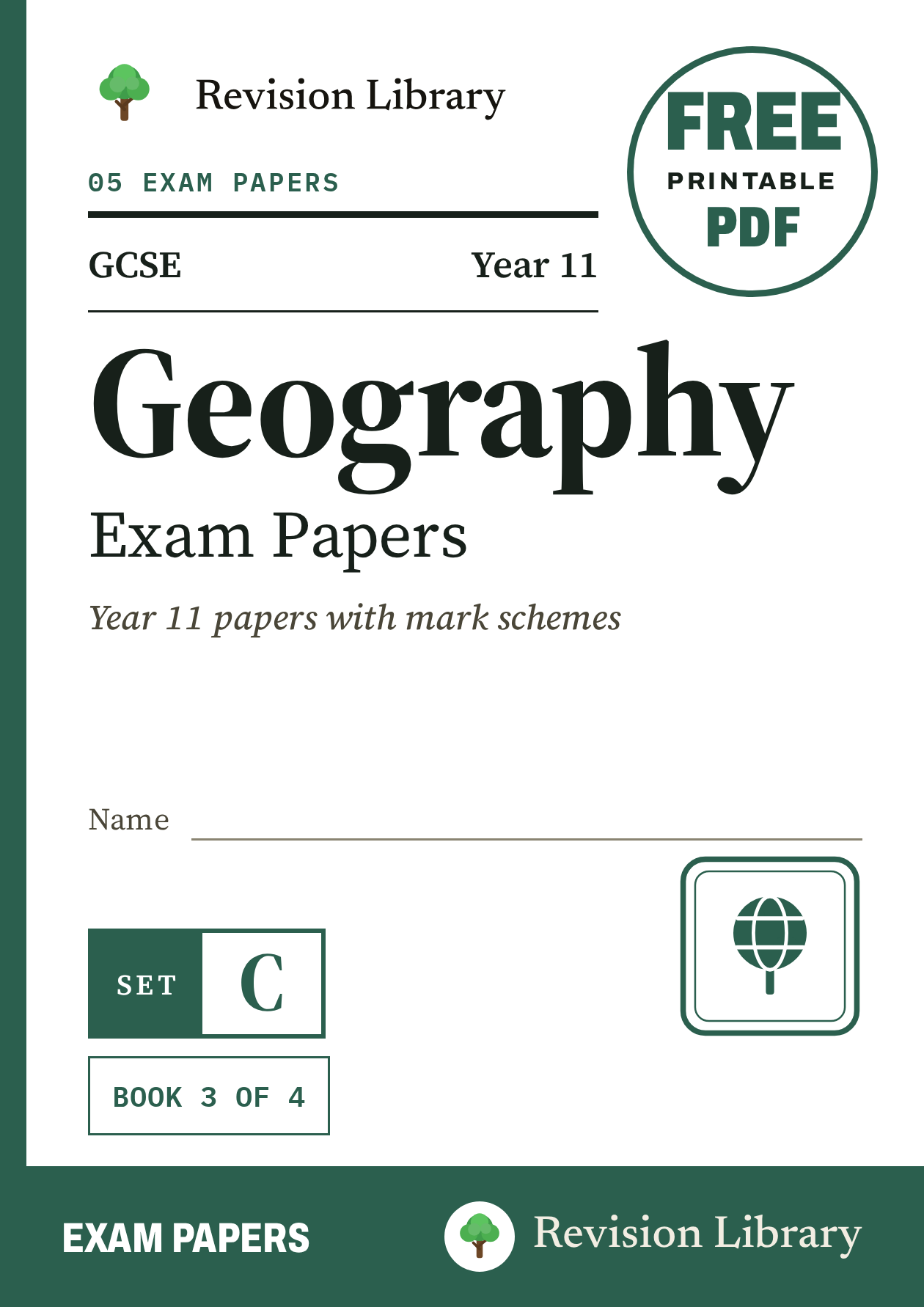
Book 3 of 4

GCSE Geography Exam Papers Set C

Year 11 Paper 1: UK Landscapes and Human Geography, Year 11 Paper 2: Natural Hazards and Human Geography and Year 11 Paper 3: Ecosystems and Human Geography

Level
GCSE · AQA 8035
Series
GCSE Geography Exam Papers, book 3 of 4
Suitable for
Years 10-11, AQA
FreePDF download · 2027 edition · 62 A4 pages
  • One file, prints straight to A4
  • No account, no password

3 papers in the AQA format, mark schemes at the back. This set is one of 558 free PDFs on the shelf.

Pages
62 A4 pages
Papers
3 papers
Questions
59 · 220 marks
Answers
From page 46

What is inside

3 papers · answers from p46

Each paper starts with a page showing its marks and a suggested time, followed by the questions. The mark schemes for all 3 papers are at the back, so you can sit each paper as a mock and mark it afterwards.

  1. 01Year 11 Paper 1: UK Landscapes and Human Geography22 questions · 80 marksp3
  2. 02Year 11 Paper 2: Natural Hazards and Human Geography21 questions · 80 marksp19
  3. 03Year 11 Paper 3: Ecosystems and Human Geography16 questions · 60 marksp34
  4. AnswersMark schemes for every paperp46

Each paper is drawn from one of our worksheet packs. Follow a paper title for the full pack on its own page, or browse every GCSE Geography pack. Every book on the shelf is a complete printable workbook of up to 120 A4 pages.

Explore this volume

GCSE Geography Exam Papers Set C includes Year 11 Paper 1: UK Landscapes and Human Geography (from page 3); Year 11 Paper 2: Natural Hazards and Human Geography (from page 19); Year 11 Paper 3: Ecosystems and Human Geography (from page 34).

Worked question 8 - Year 11 Paper 1: UK Landscapes and Human Geography

State three limitations of using Gross National Income (GNI) per head alone to measure development.

Answer

It hides income inequality, excludes direct measures of health and education, and does not account for differences in purchasing power unless adjusted.

Mark scheme

B1Hides income distribution.
B1Omits direct health and education measures.
B1Unadjusted values ignore differences in price levels.

Question 21 - Year 11 Paper 1: UK Landscapes and Human Geography

6 marks

For a major infrastructure project you have studied in a newly emerging economy (NEE), assess its impact on the country's economic development.

Answer

The Lesotho Highlands Water Project transfers water to Gauteng in South Africa. More reliable supply can support industry and mining and reduce disruption to production. However, water has a financial cost, and dam building brings displacement and environmental loss in the donor area. Overall it can enable development in the receiving economy, but economic gains must be weighed against costs borne elsewhere; local material gives no quantified net growth effect.

Mark scheme

B1Identify Lesotho Highlands Water Project and Gauteng in South Africa.
B1Water security supports industry and mining.
B1Explain reduced production disruption.
B1Water payments are an economic cost.
B1Displacement or habitat loss in donor area.
B1Qualified judgement linking benefits to costs without invented growth figures.

Question 12 - Year 11 Paper 1: UK Landscapes and Human Geography

5 marks

Explain two reasons why bottom-up (small-scale, community based) aid projects can be more effective than top-down (large-scale, national) aid projects at helping the poorest people in a country.

Answer

Local consultation can identify the poorest households actual needs, directing spending towards useful services. Simple locally maintainable technology can lower repair costs and dependence on outside experts, keeping services running. Effectiveness still depends on capacity and funding.

Mark scheme

B1Local consultation identifies needs.
B1Better targeting benefits poorest households.
B1Appropriate simple technology.
B1Local maintenance supports continuity.
B1Explain a further link such as affordable repairs or community ownership.

Question 1 - Year 11 Paper 1: UK Landscapes and Human Geography

1 marks

Name the erosional process in which air trapped in cracks in a cliff face is compressed by waves, weakening the rock.

Answer

Hydraulic action: waves compress air trapped in cliff cracks, exerting pressure on the rock.

Mark scheme

B1for hydraulic action

Question 3 - Year 11 Paper 2: Natural Hazards and Human Geography

1 marks

Name the economic sector that includes jobs directly extracting raw materials, such as farming, fishing or mining.

Answer

The primary sector.

Mark scheme

B1Primary sector.

Question 2 - Year 11 Paper 2: Natural Hazards and Human Geography

1 marks

Name one piece of evidence scientists use to study the Earth's climate from thousands of years before instrumental records began.

Answer

Any valid source, e.g. ice cores, tree rings, or pollen analysis

Mark scheme

B1for a valid source of evidence, e.g. ice cores (or tree rings/pollen analysis)

Question 16 - Year 11 Paper 2: Natural Hazards and Human Geography

5 marks

Explain two reasons why drip irrigation is often considered a more sustainable method of irrigating crops than spraying water over a field from above.

Answer

Drip irrigation delivers small amounts near plant roots, so less water is lost by evaporation from exposed sprays. Targeted delivery also reduces water reaching bare ground and running off, lowering abstraction for the same useful supply. Savings depend on maintenance and avoiding expansion of total water use.

Mark scheme

B1Delivery close to roots.
B1Reduced evaporation relative to overhead spray.
B1Less watering of bare ground.
B1Reduced runoff and unnecessary abstraction.
B1Link to conserving scarce water for continuing crop production.

Question 4 - Year 11 Paper 3: Ecosystems and Human Geography

3 marks

State three pieces of equipment a student might use during river fieldwork to measure velocity, width and depth.

Answer

A flow meter for velocity, a tape measure for width and a metre rule for depth. A float with timing equipment is an alternative velocity method, but a stopwatch alone does not measure velocity.

Mark scheme

B1Flow meter for velocity.
B1Tape measure for width.
B1Metre rule for depth.

Question 16 - Year 11 Paper 3: Ecosystems and Human Geography

6 marks

Assess the causes of desertification and evaluate strategies that can be used to reduce its rate.

Answer

A balanced answer citing climatic and human causes and evaluating strategies such as shelterbelts and drip irrigation

Mark scheme

B1for identifies a climatic cause, e.g. periods of low, unreliable rainfall
B1for identifies a human cause, e.g. overgrazing by livestock removes vegetation that protects the soil
B1for identifies a second human cause, e.g. overcultivation of land or removal of trees for fuelwood
B1for describes a management strategy, e.g. planting a tree shelterbelt to reduce wind erosion
B1for describes a second strategy and evaluates a relevant limitation of either strategy, such as water supply, cost or maintenance
B1for reaches a supported judgement on how effective these strategies are at reducing desertification

GCSE Geography Exam Papers runs to 4 volumes

Book 3 of 4 · 255 pages in the set

Each set is a separate free PDF with its own mark schemes at the back.

Volume 1

59 pp · 48 Qs

Year 10 Paper 1: Hazards and Landscapes, Year 10 Paper 2: Hazards and the Living World and Year 10 Paper 3: Ecosystems and UK Landscapes

Volume 2

68 pp · 64 Qs

Year 10 Paper 4: Physical Geography Topics, Year 10 Paper 5: Weather, Ecosystems and Landscapes and Year 10 Paper 6: Whole Year Review

Volume 3 · this book

62 pp · 59 Qs

Year 11 Paper 1: UK Landscapes and Human Geography, Year 11 Paper 2: Natural Hazards and Human Geography and Year 11 Paper 3: Ecosystems and Human Geography

Volume 4

66 pp · 63 Qs

Year 11 Paper 4: Physical Geography Topics, Year 11 Paper 5: Weather, Ecosystems and UK Landscapes and Year 11 Paper 6: Mixed Topics

More GCSE books

GCSE Geography Essentials 1

33 topics · 268 Qs

The challenge of natural hazards, The living world, Physical landscapes in the UK, Urban issues and challenges, The changing economic world, The challenge of resource management

Want a different mix of topics?

Sitting an exam soon? Build a GCSE Geography mock paper or print a ready-made one.