Revision Library
Choose a subject
Menu
Physical Education
Need a new topic?
Missing a topic, found a bug, or want something added?

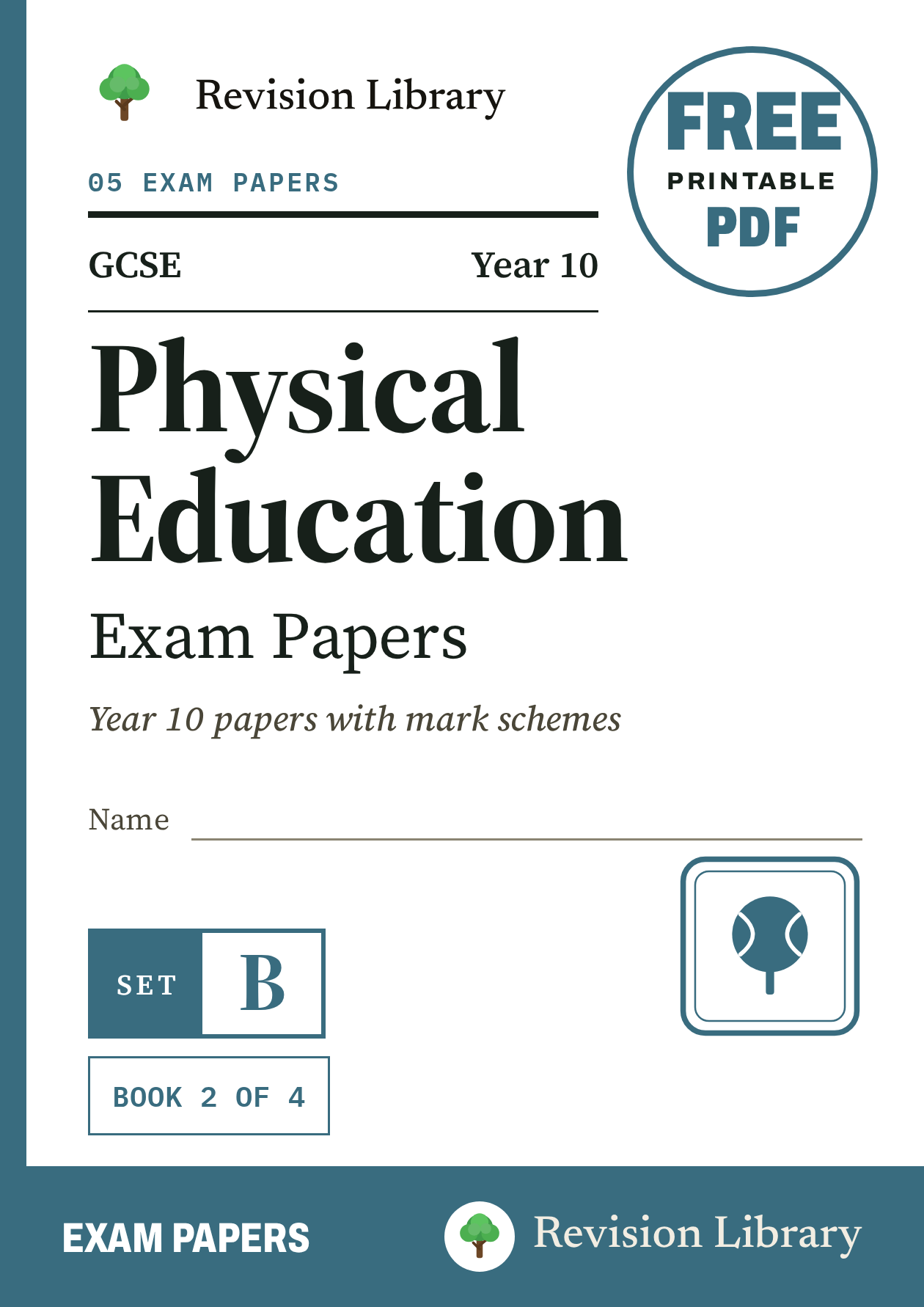
Book 2 of 4

GCSE Physical Education Exam Papers Set B

Year 10 Paper 4: Skeleton, Muscles and Fitness Testing, Year 10 Paper 5: Physical Training Focus and Year 10 Paper 6: Full Year 10 Review

Level
GCSE · AQA 8582
Series
GCSE Physical Education Exam Papers, book 2 of 4
Suitable for
Years 10-11, AQA (theory)
FreePDF download · 2027 edition · 64 A4 pages
  • One file, prints straight to A4
  • No account, no password

3 papers in the AQA format, mark schemes at the back. This set is one of 558 free PDFs on the shelf.

Pages
64 A4 pages
Papers
3 papers
Questions
56 · 240 marks
Answers
From page 48

What is inside

3 papers · answers from p48

Each paper starts with a page showing its marks and a suggested time, followed by the questions. The mark schemes for all 3 papers are at the back, so you can sit each paper as a mock and mark it afterwards.

  1. 01Year 10 Paper 4: Skeleton, Muscles and Fitness Testing18 questions · 80 marksp3
  2. 02Year 10 Paper 5: Physical Training Focus14 questions · 60 marksp18
  3. 03Year 10 Paper 6: Full Year 10 Review24 questions · 100 marksp29
  4. AnswersMark schemes for every paperp48

Each paper is drawn from one of our worksheet packs. Follow a paper title for the full pack on its own page, or browse every GCSE Physical Education pack. Every book on the shelf is a complete printable workbook of up to 120 A4 pages.

Explore this volume

GCSE Physical Education Exam Papers Set B includes Year 10 Paper 4: Skeleton, Muscles and Fitness Testing (from page 3); Year 10 Paper 5: Physical Training Focus (from page 18); Year 10 Paper 6: Full Year 10 Review (from page 29).

Worked question 14 - Year 10 Paper 4: Skeleton, Muscles and Fitness Testing

A hockey goalkeeper must dive to save a shot, then get back to her feet quickly to make a second save, and repeat this many times throughout a match.

Explain which components of fitness this goalkeeper relies on most, and how each one contributes to her performance.

Answer

For example, reaction time starts the response promptly, power drives the dive and return to feet, and muscular endurance supports repeated saves. Any three distinct relevant components with explanations can earn full credit.

Mark scheme

B1for one relevant component, such as reaction time, power, agility, muscular endurance or balance
B1for a correct save/recovery/repetition explanation of that component
B1for a second distinct relevant component
B1for its distinct contextual explanation
B1for a third distinct relevant component
B1for its distinct contextual explanation; accept other valid components and do not require every model example

Question 9 - Year 10 Paper 4: Skeleton, Muscles and Fitness Testing

4 marks

A weightlifter can lift a very heavy barbell slowly in a deadlift, while lifting a lighter bar explosively above her head in a clean and jerk places more emphasis on rapid force production.

Identify the components of fitness shown by these two lifts, and explain the difference between them.

Answer

Strength is maximal force, emphasised by the heavy slow deadlift. Power is force produced at speed, emphasised by the explosive overhead lift; strength contributes to power.

Mark scheme

B1for strength identified for the deadlift
B1for power identified for the clean and jerk
B1for a correct definition of strength, e.g. the maximum force a muscle can exert in one effort, regardless of speed
B1for a correct definition/distinction for power, e.g. power combines strength and speed, so it is the ability to exert force quickly

Question 11 - Year 10 Paper 4: Skeleton, Muscles and Fitness Testing

5 marks

In a 100 m race, sprinters must respond to the starting gun as quickly as possible before then running at their maximum pace to the finish line.

Identify the two components of fitness required at the start and during the race, define each one, and explain the difference between them.

Answer

Reaction time (responding to the gun) and speed (covering the distance); reaction time is about starting to move quickly, speed is about how fast the body then travels

Mark scheme

B1for reaction time identified for the start
B1for speed identified for the race itself
B1for a correct definition of reaction time, e.g. the time taken to respond to a stimulus
B1for a correct definition of speed, e.g. the maximum rate at which a person is able to move over a set distance
B1for a correct explanation of the difference, e.g. reaction time is about how quickly the body begins to move, while speed is about how quickly it then covers the ground

Question 12 - Year 10 Paper 4: Skeleton, Muscles and Fitness Testing

5 marks

A trampolinist performs a skill combining a forward somersault with a half twist of her body, all within one movement.

Identify the plane and axis for the somersault and for the twist. Explain how this skill illustrates movement about more than one axis.

Answer

Somersault: sagittal plane, transverse axis. Twist: transverse plane, longitudinal axis. One skill combines rotations about different body axes.

Mark scheme

B1for sagittal plane for the somersault
B1for transverse axis for the somersault
B1for transverse plane for the twist
B1for longitudinal axis for the twist
B1for explaining that the skill combines rotations about different body axes within one movement

Question 12 - Year 10 Paper 5: Physical Training Focus

6 marks

A judoka must generate explosive power to execute a throw, but also needs good balance and coordination to control her opponent's fall and her own body position throughout.

Explain which components of fitness this judoka relies on most during the throw, and how each one contributes to a successful, controlled technique.

Answer

Power supplies rapid throwing force; balance controls the judoka's own position; coordination combines the pull, turn and leg action at the right time. Each needs its own explanation.

Mark scheme

B1for power
B1for explaining rapid force production to unbalance or throw the opponent
B1for balance
B1for explaining control of the judoka's own body during the throw
B1for coordination
B1for explaining correctly timed combination of pulling, turning or leg actions; equivalent controlled-throw explanations are valid

Question 1 - Year 10 Paper 5: Physical Training Focus

2 marks

A powerlifter attempts to lift the heaviest possible barbell for a single deadlift repetition.

Name the component of fitness most needed for this lift, and give its definition.

Answer

Strength - the maximum force a muscle group can exert in one maximal effort

Mark scheme

B1for strength (accept maximal strength)
B1for a correct definition, e.g. the maximum force a muscle or muscle group can exert in a single effort

Question 11 - Year 10 Paper 5: Physical Training Focus

5 marks

A trampolinist performs a skill combining a forward somersault with a half twist of her body, all within one movement.

Identify the plane and axis for the somersault and for the twist. Explain how this skill illustrates movement about more than one axis.

Answer

Somersault: sagittal plane, transverse axis. Twist: transverse plane, longitudinal axis. One skill combines rotations about different body axes.

Mark scheme

B1for sagittal plane for the somersault
B1for transverse axis for the somersault
B1for transverse plane for the twist
B1for longitudinal axis for the twist
B1for explaining that the skill combines rotations about different body axes within one movement

Question 21 - Year 10 Paper 6: Full Year 10 Review

6 marks

A triathlete must swim, then cycle, then run one after another in a single race, each discipline placing slightly different physical demands on her.

Explain how the importance of cardiovascular endurance and other components of fitness changes across the three disciplines of a triathlon.

Answer

Cardiovascular endurance supplies oxygen throughout. Swimming uses repeated shoulder actions, cycling repeated pedalling and bicycle control, and running repeated leg contractions and coordination. Other components vary with these tasks; no fixed global ranking is required.

Mark scheme

B1for cardiovascular endurance supporting sustained work throughout the triathlon
B1for a justified swimming-specific demand, such as shoulder endurance or flexibility
B1for a justified cycling-specific demand, such as leg endurance or balance
B1for a justified running-specific demand, such as leg endurance or coordination
B1for explaining sustained oxygen delivery to working muscles across the disciplines, distinct from merely saying it matters throughout
B1for explaining how different movement patterns change the emphasis on other components; no absolute ranking between disciplines is required

Question 4 - Year 10 Paper 6: Full Year 10 Review

2 marks

A diver performs a forward somersault, rotating head over heels.

Name the plane and the axis of rotation used during this somersault.

Answer

Sagittal plane, transverse axis

Mark scheme

B1for the sagittal plane
B1for the transverse axis

GCSE Physical Education Exam Papers runs to 4 volumes

Book 2 of 4 · 248 pages in the set

Each set is a separate free PDF with its own mark schemes at the back.

Volume 1

59 pp · 48 Qs

Year 10 Paper 1: Body Systems and Training Basics, Year 10 Paper 2: Muscles, Movement and Training Principles, Year 10 Paper 3: Skeleton and Circulation and Training Methods

Volume 2 · this book

64 pp · 56 Qs

Year 10 Paper 4: Skeleton, Muscles and Fitness Testing, Year 10 Paper 5: Physical Training Focus and Year 10 Paper 6: Full Year 10 Review

Volume 3

58 pp · 48 Qs

Year 11 Paper 1: Psychology, Health and Society, Year 11 Paper 2: Body Systems, Fitness Testing and Society, Year 11 Paper 3: Training and Health and the Mind

Volume 4

67 pp · 58 Qs

Year 11 Paper 4: Movement, Skill and Wellbeing, Year 11 Paper 5: Fitness, Diet and Mental Preparation and Year 11 Paper 6: Full Course Review

More GCSE books

GCSE Physical Education Topic Workbook 1

101 pp · 188 Qs

Musculoskeletal System: Bones, Joints and Muscles, Synovial Joints: Ligaments, Tendons and Cartilage, Cardiovascular System: The Heart and Blood Vessels and 7 more