Revision Library
Choose a subject
Menu
Physical Education
Need a new topic?
Missing a topic, found a bug, or want something added?

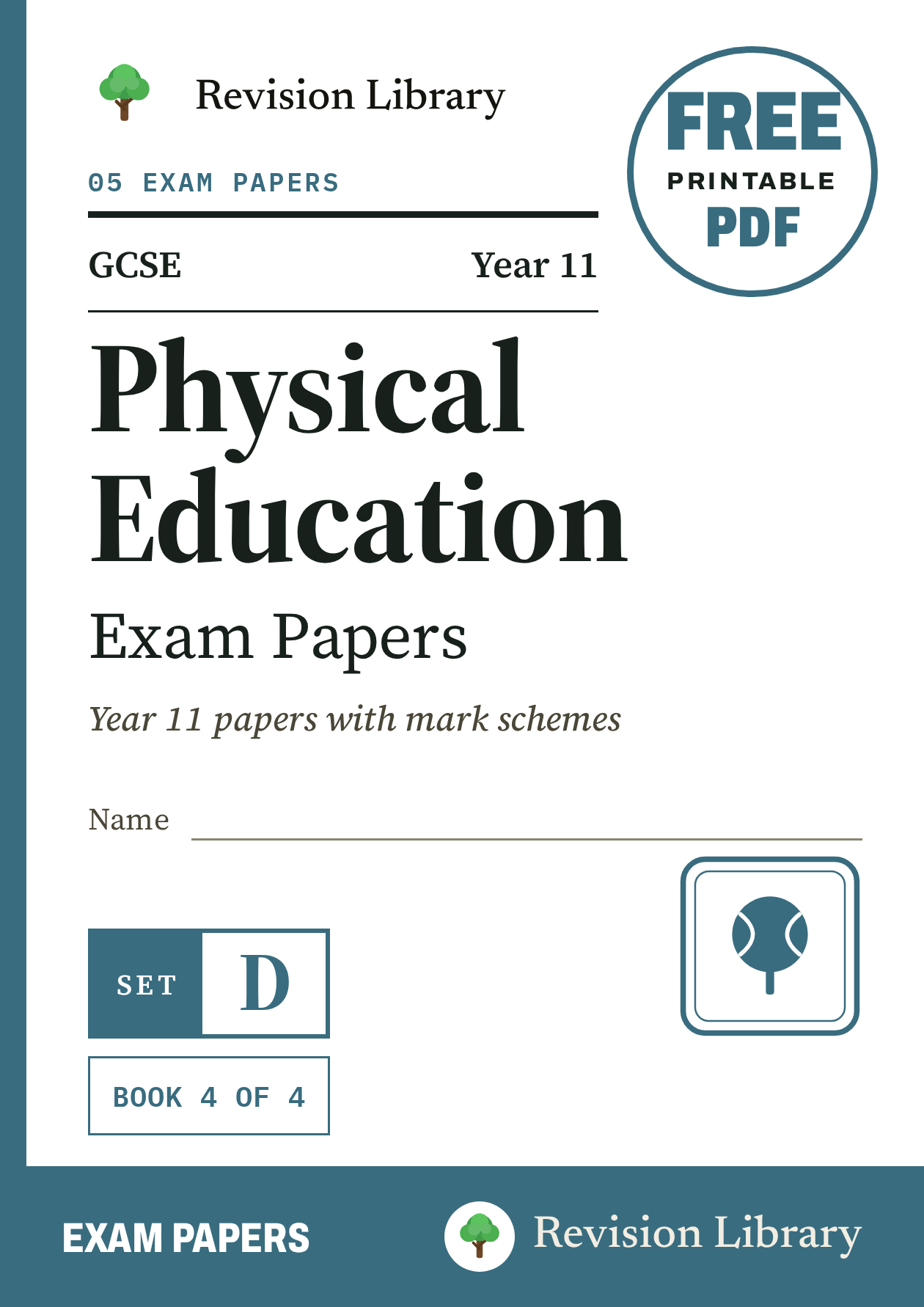
Book 4 of 4

GCSE Physical Education Exam Papers Set D

Year 11 Paper 4: Movement, Skill and Wellbeing, Year 11 Paper 5: Fitness, Diet and Mental Preparation and Year 11 Paper 6: Full Course Review

Level
GCSE · AQA 8582
Series
GCSE Physical Education Exam Papers, book 4 of 4
Suitable for
Years 10-11, AQA (theory)
FreePDF download · 2027 edition · 67 A4 pages
  • One file, prints straight to A4
  • No account, no password

3 papers in the AQA format, mark schemes at the back. This set is one of 558 free PDFs on the shelf.

Pages
67 A4 pages
Papers
3 papers
Questions
58 · 240 marks
Answers
From page 48

What is inside

3 papers · answers from p48

Each paper starts with a page showing its marks and a suggested time, followed by the questions. The mark schemes for all 3 papers are at the back, so you can sit each paper as a mock and mark it afterwards.

  1. 01Year 11 Paper 4: Movement, Skill and Wellbeing19 questions · 80 marksp3
  2. 02Year 11 Paper 5: Fitness, Diet and Mental Preparation15 questions · 60 marksp17
  3. 03Year 11 Paper 6: Full Course Review24 questions · 100 marksp29
  4. AnswersMark schemes for every paperp48

Each paper is drawn from one of our worksheet packs. Follow a paper title for the full pack on its own page, or browse every GCSE Physical Education pack. Every book on the shelf is a complete printable workbook of up to 120 A4 pages.

Explore this volume

GCSE Physical Education Exam Papers Set D includes Year 11 Paper 4: Movement, Skill and Wellbeing (from page 3); Year 11 Paper 5: Fitness, Diet and Mental Preparation (from page 17); Year 11 Paper 6: Full Course Review (from page 29).

Worked question 17 - Year 11 Paper 4: Movement, Skill and Wellbeing

A weightlifter performs a bicep curl, lifting a dumbbell by bending his elbow.

Explain, using the terms fulcrum, effort and load, how a third class lever system operates at the elbow during this movement, and state one advantage this type of lever gives the weightlifter.

Answer

The elbow is the fulcrum, biceps insertion supplies effort between the joint and dumbbell load. This third-class arrangement gives greater hand travel and speed for a small movement at the insertion.

Mark scheme

B1for the elbow joint as the fulcrum
B1for biceps effort applied through its insertion on the forearm
B1for the dumbbell as the load; accept inclusion of forearm and hand weight
B1for effort lying between fulcrum and load, making third class
B1for identifying speed or range of movement as an advantage
B1for explaining that the longer load arm moves the hand further or faster for a small movement at the effort point

Question 3 - Year 11 Paper 4: Movement, Skill and Wellbeing

3 marks

A PE student performs a star jump, moving her arms and legs out to the sides and then back in again.

Name the plane and axis this movement takes place in, and name the joint action occurring at the hip and shoulder as the limbs move outward.

Answer

Frontal plane, sagittal axis; abduction at the hip and shoulder

Mark scheme

B1for the frontal plane
B1for the sagittal axis
B1for abduction, occurring at both the hip and shoulder as the limbs move outward

Question 5 - Year 11 Paper 4: Movement, Skill and Wellbeing

3 marks

During the upward phase of a press-up, an athlete straightens her elbows.

Explain the roles of the agonist and antagonist at the elbow, using the triceps and biceps.

Answer

The triceps (agonist) contracts while the biceps (antagonist) relaxes, working as an antagonistic pair

Mark scheme

B1for the agonist (triceps) contracting to produce the movement, straightening the elbow
B1for the antagonist (biceps) relaxing (lengthening) to allow the movement to happen
B1for correct use of the term antagonistic pair to describe how the two muscles work together

Question 1 - Year 11 Paper 4: Movement, Skill and Wellbeing

2 marks

A gymnast performs a handstand, supporting her whole body weight through her wrists and shoulders.

Name the bone found in the upper arm and the bone found in the forearm on the thumb side.

Answer

Humerus (upper arm) and radius (forearm, thumb side)

Mark scheme

B1for humerus (upper arm)
B1for radius (forearm, thumb side)

Question 5 - Year 11 Paper 5: Fitness, Diet and Mental Preparation

3 marks

A tennis player is reminded to drink water regularly throughout a long match played in warm conditions.

State two functions of water and explain how one of them supports exercise in these warm conditions.

Answer

Water supports temperature regulation and transport of nutrients and oxygen in blood. Sweat evaporation helps remove heat during warm-weather exercise. Accept any two distinct valid functions, including joint lubrication, with one relevant exercise link.

Mark scheme

B1for State one valid water function, such as temperature regulation.
B1for State a second distinct function, such as transport or joint lubrication.
B1for Explain one link to exercise, such as sweat evaporation helping heat loss in warm conditions.

Question 8 - Year 11 Paper 5: Fitness, Diet and Mental Preparation

4 marks

A gymnast trains indoors with limited sunlight exposure. For this task, sunlight can support vitamin D production; vitamin D helps calcium absorption and calcium supports bone mineralisation.

Explain how these factors could affect bone health under repeated gymnastics loading, without assuming that limited sunlight alone proves deficiency or predicts a fracture.

Answer

Vitamin D helps the body absorb calcium, supporting bone mineralisation. Limited sunlight may reduce vitamin D production, which could compromise bone health if overall provision is inadequate. Repeated gymnastics loading on weakened bone could increase fracture risk; limited sunlight alone does not establish deficiency or predict a fracture.

Mark scheme

B1for Use the supplied information: vitamin D helps calcium absorption.
B1for Explain calcium supports strong mineralised bones.
B1for Use the supplied information: limited sunlight may reduce vitamin D production.
B1for Explain a conditional link to bone weakness and fracture risk under repeated loading, without diagnosing deficiency.

Question 13 - Year 11 Paper 5: Fitness, Diet and Mental Preparation

6 marks

A local authority is deciding whether to fund a new sports facility in a low income area with historically low participation rates, or to spend the same budget on a marketing campaign promoting existing facilities across the whole town.

Discuss the advantages and disadvantages of each option, and recommend which is likely to have the greater impact on participation in the low income area specifically.

Answer

A nearby facility can reduce travel and provide suitable opportunities, but building and running costs are high and fees may remain a barrier. Marketing can reach people cheaply and explain existing opportunities, but cannot fix inaccessible or unaffordable provision. Prefer the facility if local access is the main unmet need and affordable sessions are funded; prefer targeted marketing if suitable affordable facilities already exist but awareness is low.

Mark scheme

B1for Explain an advantage of local facility provision.
B1for Explain a disadvantage, such as building costs, delivery time or continuing fees.
B1for Explain an advantage of promoting existing opportunities.
B1for Explain a disadvantage, such as failing to fix missing or unaffordable provision.
B1for Recommend either option clearly.
B1for Justify that choice using stated assumptions about the local barrier; do not infer missing facilities from low income alone.

Question 20 - Year 11 Paper 6: Full Course Review

6 marks

For this curriculum task, use these possible effects: smoking can impair breathing and oxygen delivery and increase respiratory and cardiovascular health risks; insufficient sleep can impair recovery, concentration and wellbeing. A footballer smokes and regularly stays up late before matches.

Explain how each habit could affect his performance and long term wellbeing, using conditional language.

Answer

Smoking can impair oxygen delivery and breathing, making sustained football effort harder; it also increases long term cardiovascular and respiratory health risks. Too little sleep can impair concentration and recovery, worsening decisions or training readiness; persistent insufficient sleep can undermine mental and physical wellbeing. Neither consequence is certain for every person.

Mark scheme

B1for using the supplied possible smoking effect on breathing or oxygen delivery.
B1for explaining how this could reduce sustained football effort.
B1for linking smoking to the supplied possible respiratory or cardiovascular health risks, without certainty.
B1for using the supplied sleep and recovery link.
B1for explaining how poorer concentration or recovery could impair football decisions or readiness.
B1for explaining how persistent insufficient sleep could undermine wellbeing, without requiring an unsupported immune or blood-pressure mechanism.

Question 3 - Year 11 Paper 6: Full Course Review

2 marks

A rugby player drinks several alcoholic drinks the night before a training session.

Explain one way alcohol use the previous night could reduce performance in training the next day.

Answer

Alcohol may disrupt sleep and leave the player less alert. Slower reactions or poorer concentration could then reduce the accuracy of a tackle or pass in training the following day.

Mark scheme

B1for Identify one possible effect, such as poorer sleep, alertness or coordination.
B1for Explain one linked training consequence, such as slower reactions when tackling.

GCSE Physical Education Exam Papers runs to 4 volumes

Book 4 of 4 · 248 pages in the set

Each set is a separate free PDF with its own mark schemes at the back.

Volume 1

59 pp · 48 Qs

Year 10 Paper 1: Body Systems and Training Basics, Year 10 Paper 2: Muscles, Movement and Training Principles, Year 10 Paper 3: Skeleton and Circulation and Training Methods

Volume 2

64 pp · 56 Qs

Year 10 Paper 4: Skeleton, Muscles and Fitness Testing, Year 10 Paper 5: Physical Training Focus and Year 10 Paper 6: Full Year 10 Review

Volume 3

58 pp · 48 Qs

Year 11 Paper 1: Psychology, Health and Society, Year 11 Paper 2: Body Systems, Fitness Testing and Society, Year 11 Paper 3: Training and Health and the Mind

Volume 4 · this book

67 pp · 58 Qs

Year 11 Paper 4: Movement, Skill and Wellbeing, Year 11 Paper 5: Fitness, Diet and Mental Preparation and Year 11 Paper 6: Full Course Review

More GCSE books

GCSE Physical Education Topic Workbook 1

101 pp · 188 Qs

Musculoskeletal System: Bones, Joints and Muscles, Synovial Joints: Ligaments, Tendons and Cartilage, Cardiovascular System: The Heart and Blood Vessels and 7 more