Revision Library
Choose a subject
Menu
Physical Education
Need a new topic?
Missing a topic, found a bug, or want something added?

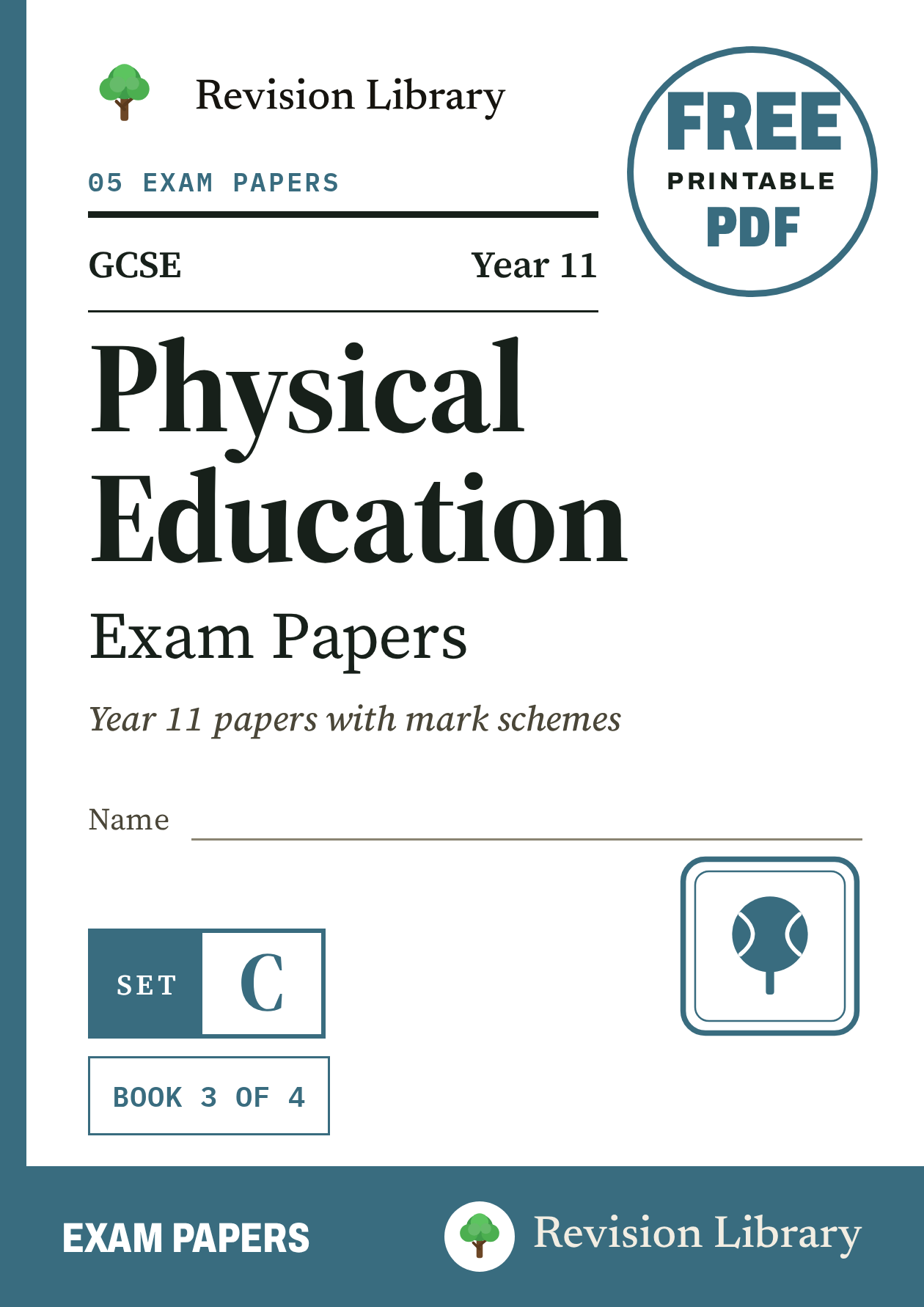
Book 3 of 4

GCSE Physical Education Exam Papers Set C

Year 11 Paper 1: Psychology, Health and Society, Year 11 Paper 2: Body Systems, Fitness Testing and Society, Year 11 Paper 3: Training and Health and the Mind

Level
GCSE · AQA 8582
Series
GCSE Physical Education Exam Papers, book 3 of 4
Suitable for
Years 10-11, AQA (theory)
FreePDF download · 2027 edition · 58 A4 pages
  • One file, prints straight to A4
  • No account, no password

3 papers in the AQA format, mark schemes at the back. This set is one of 558 free PDFs on the shelf.

Pages
58 A4 pages
Papers
3 papers
Questions
48 · 200 marks
Answers
From page 42

What is inside

3 papers · answers from p42

Each paper starts with a page showing its marks and a suggested time, followed by the questions. The mark schemes for all 3 papers are at the back, so you can sit each paper as a mock and mark it afterwards.

  1. 01Year 11 Paper 1: Psychology, Health and Society14 questions · 60 marksp3
  2. 02Year 11 Paper 2: Body Systems, Fitness Testing and Society14 questions · 60 marksp14
  3. 03Year 11 Paper 3: Training, Health and the Mind20 questions · 80 marksp26
  4. AnswersMark schemes for every paperp42

Each paper is drawn from one of our worksheet packs. Follow a paper title for the full pack on its own page, or browse every GCSE Physical Education pack. Every book on the shelf is a complete printable workbook of up to 120 A4 pages.

Explore this volume

GCSE Physical Education Exam Papers Set C includes Year 11 Paper 1: Psychology, Health and Society (from page 3); Year 11 Paper 2: Body Systems, Fitness Testing and Society (from page 14); Year 11 Paper 3: Training, Health and the Mind (from page 26).

Worked question 2 - Year 11 Paper 1: Psychology, Health and Society

A PE teacher tells her class that being fit and healthy is about more than just doing sport twice a week.

State three factors, other than participation in sport, that together make up a balanced, healthy, active lifestyle.

Answer

A balanced diet supplies nutrients and energy; sufficient sleep and rest support recovery; everyday physical activity, such as walking, reduces prolonged inactivity. Avoiding smoking, managing stress and maintaining social contact are also acceptable distinct factors.

Mark scheme

B1for Name one valid lifestyle factor other than sport participation.
B1for Name a second distinct factor, accepting diet, rest, everyday movement, social contact or stress management.
B1for Name a third distinct valid factor; avoidance of harmful substances is also acceptable.

Question 6 - Year 11 Paper 1: Psychology, Health and Society

4 marks

A rugby player finds that her performance in tackling drills is best when she feels a moderate level of nervous energy before training, rather than feeling either completely relaxed or extremely anxious.

Using the inverted U theory, explain why her performance is best at a moderate level of arousal, and explain what tends to happen to her performance at very low arousal.

Answer

Performance peaks at a moderate, optimum level of arousal (inverted U theory); at very low arousal she lacks focus/energy, so performance is also reduced

Mark scheme

B1for the inverted U theory stating that performance improves as arousal rises, up to an optimum (moderate) point
B1for a correct explanation, e.g. at this optimum point she is alert and ready to perform without being overwhelmed by nerves
B1for a correct explanation of very low arousal, e.g. at very low arousal she may lack focus, motivation or energy to perform at her best
B1for a correct overall summary, e.g. performance is worse at both very low and very high arousal, peaking somewhere in between

Question 13 - Year 11 Paper 1: Psychology, Health and Society

6 marks

A long jumper drives explosively from the take-off board, extending fully at the hip, knee and ankle to generate maximum lift.

Identify the muscle acting as the agonist at the hip, at the knee and at the ankle during this extension, and explain why fast twitch muscle fibres are especially important in these muscles for the take-off.

Answer

Gluteus maximus extends the hip, quadriceps extend the knee, and gastrocnemius/soleus plantar-flex the ankle. Rapid high-force fast twitch contractions support a coordinated, brief, powerful take-off.

Mark scheme

B1for gluteals/gluteus maximus as hip-extension agonist
B1for quadriceps as knee-extension agonist
B1for gastrocnemius or soleus as ankle plantar-flexion agonist
B1for fast twitch fibres contracting rapidly with high force to generate power
B1for linking their brief high-power output to the short ground-contact time at take-off
B1for explaining that coordinated hip/knee extension and ankle plantar flexion contribute to an upward ground-reaction impulse; no requirement for identical timing

Question 1 - Year 11 Paper 1: Psychology, Health and Society

3 marks

A PE teacher explains that a healthy diet is not just about eating enough food, but about eating the right balance of nutrients.

Name three of the components that should be present, in the correct proportions, in a balanced diet.

Answer

Three acceptable balanced-diet components are carbohydrate, protein and fat. Vitamins, minerals, fibre and water are other valid components; award credit for any three distinct valid components without requiring one fixed combination.

Mark scheme

B1for Name any valid component: carbohydrate, protein, fat, vitamins, minerals, fibre or water.
B1for Name any second distinct valid component from that set.
B1for Name any third distinct valid component from that set; do not require a particular combination.

Question 11 - Year 11 Paper 2: Body Systems, Fitness Testing and Society

6 marks

A club runner has followed an aerobic training programme for six months.

Explain the long term effects of this training on her cardiovascular and respiratory systems, and how these adaptations improve her performance.

Answer

Cardiac adaptation raises stroke volume, can lower resting heart rate and increase maximal output. Muscular capillarisation and stronger respiratory muscles support oxygen delivery and ventilation, helping sustain aerobic running. Structural lung growth is not required.

Mark scheme

B1for training-related cardiac hypertrophy/stronger cardiac muscle
B1for increased stroke volume and its effect on blood pumped per beat
B1for lower resting heart rate with similar resting output, or greater maximal cardiac output from greater stroke volume
B1for increased capillarisation at working muscles improving exchange/delivery
B1for a valid respiratory adaptation with mechanism, e.g. stronger respiratory muscles supporting effective ventilation during exercise; accept appropriately explained improved ventilatory capacity without requiring universal lung growth
B1for linking improved oxygen supply/use and carbon dioxide removal to sustained aerobic running and delayed fatigue

Question 14 - Year 11 Paper 2: Body Systems, Fitness Testing and Society

6 marks

A rower has trained aerobically for two years. Her resting cardiac output is unchanged, but her resting heart rate is lower and stroke volume higher.

Explain how this combination is possible and why resting output need not increase. Contrast this with the possible change in maximal cardiac output.

Answer

Cardiac output = heart rate x stroke volume. Greater stroke volume from cardiac adaptation permits fewer beats for similar resting output because resting demand is similar. The changes compensate multiplicatively, not by equal percentage changes; maximal output can still rise.

Mark scheme

B1for cardiac output = heart rate x stroke volume
B1for cardiac hypertrophy/stronger cardiac muscle after training
B1for stronger contractions ejecting more blood per beat, increasing stroke volume
B1for explaining that a larger stroke volume allows a lower heart rate for the same output
B1for similar resting metabolic/oxygen demand explaining why resting output need not increase
B1for correctly contrasting resting with maximal exercise: increased stroke volume can raise maximal output even when resting output is unchanged

Question 10 - Year 11 Paper 2: Body Systems, Fitness Testing and Society

5 marks

A gymnast holds a handstand perfectly still on the balance beam, while a surfer constantly adjusts her body position to stay upright on a moving wave.

Name and define the component both performers use. Compare static and dynamic balance, referring to how the body and its support behave in each example.

Answer

Balance maintains controlled body position. The handstand is static balance over stationary hand support; surfing uses dynamic balance as the body and board move and adjustments maintain stability.

Mark scheme

B1for balance
B1for defining balance as maintaining body stability/control, such as centre of mass over support
B1for static balance as stationary control applied to the held handstand
B1for dynamic balance as control during movement applied to surfing
B1for a distinct comparison, such as fixed hand support on the beam versus adjustments over a moving board/wave; accept continual corrective adjustments as development

Question 14 - Year 11 Paper 3: Training, Health and the Mind

5 marks

Two sprinters each complete five 60 m trials, with these times in seconds. Sprinter A: 7.4, 7.6, 7.3, 7.9, 7.3. Sprinter B: 7.5, 7.6, 7.4, 7.5, 7.5.

Calculate the range for each sprinter, and state which sprinter performed more consistently, with a reason.

Answer

Sprinter A's range = 0.6 s; Sprinter B's range = 0.2 s; Sprinter B was more consistent, since a smaller range means less variation between trials

Mark scheme

M1for Sprinter A's range, 7.9 - 7.3
A1for Sprinter A's range = 0.6 seconds
M1for Sprinter B's range, 7.6 - 7.4
A1for Sprinter B's range = 0.2 seconds
B1for identifying Sprinter B as more consistent, because a smaller range shows less variation between trials

Question 20 - Year 11 Paper 3: Training, Health and the Mind

6 marks

A sprinter picks up a minor hamstring injury and has to rest completely from training for three weeks before returning gradually.

Explain the effects of reversibility during her three weeks of rest, and explain the principle of moderation she should apply when returning to training afterwards.

Answer

Some training adaptations may be lost during the break; the exact losses are not given. Return with a manageable reduced load and gradual progression so the recovering hamstring is not suddenly exposed to its former full training demands.

Mark scheme

B1for reversibility as loss of training adaptations when training stops or is reduced
B1for a possible relevant loss, such as strength, power or cardiovascular fitness
B1for applying that possible loss to reduced sprint readiness after the break, without requiring an exact onset or magnitude
B1for moderation as a manageable load appropriate to current capacity
B1for beginning below previous full load and increasing gradually
B1for explaining how that avoids excessive loading of the recovering hamstring and reduces reinjury risk

GCSE Physical Education Exam Papers runs to 4 volumes

Book 3 of 4 · 248 pages in the set

Each set is a separate free PDF with its own mark schemes at the back.

Volume 1

59 pp · 48 Qs

Year 10 Paper 1: Body Systems and Training Basics, Year 10 Paper 2: Muscles, Movement and Training Principles, Year 10 Paper 3: Skeleton and Circulation and Training Methods

Volume 2

64 pp · 56 Qs

Year 10 Paper 4: Skeleton, Muscles and Fitness Testing, Year 10 Paper 5: Physical Training Focus and Year 10 Paper 6: Full Year 10 Review

Volume 3 · this book

58 pp · 48 Qs

Year 11 Paper 1: Psychology, Health and Society, Year 11 Paper 2: Body Systems, Fitness Testing and Society, Year 11 Paper 3: Training and Health and the Mind

Volume 4

67 pp · 58 Qs

Year 11 Paper 4: Movement, Skill and Wellbeing, Year 11 Paper 5: Fitness, Diet and Mental Preparation and Year 11 Paper 6: Full Course Review

More GCSE books

GCSE Physical Education Topic Workbook 1

101 pp · 188 Qs

Musculoskeletal System: Bones, Joints and Muscles, Synovial Joints: Ligaments, Tendons and Cartilage, Cardiovascular System: The Heart and Blood Vessels and 7 more