Revision Library
Choose a subject
Menu
English
Need a new topic?
Missing a topic, found a bug, or want something added?

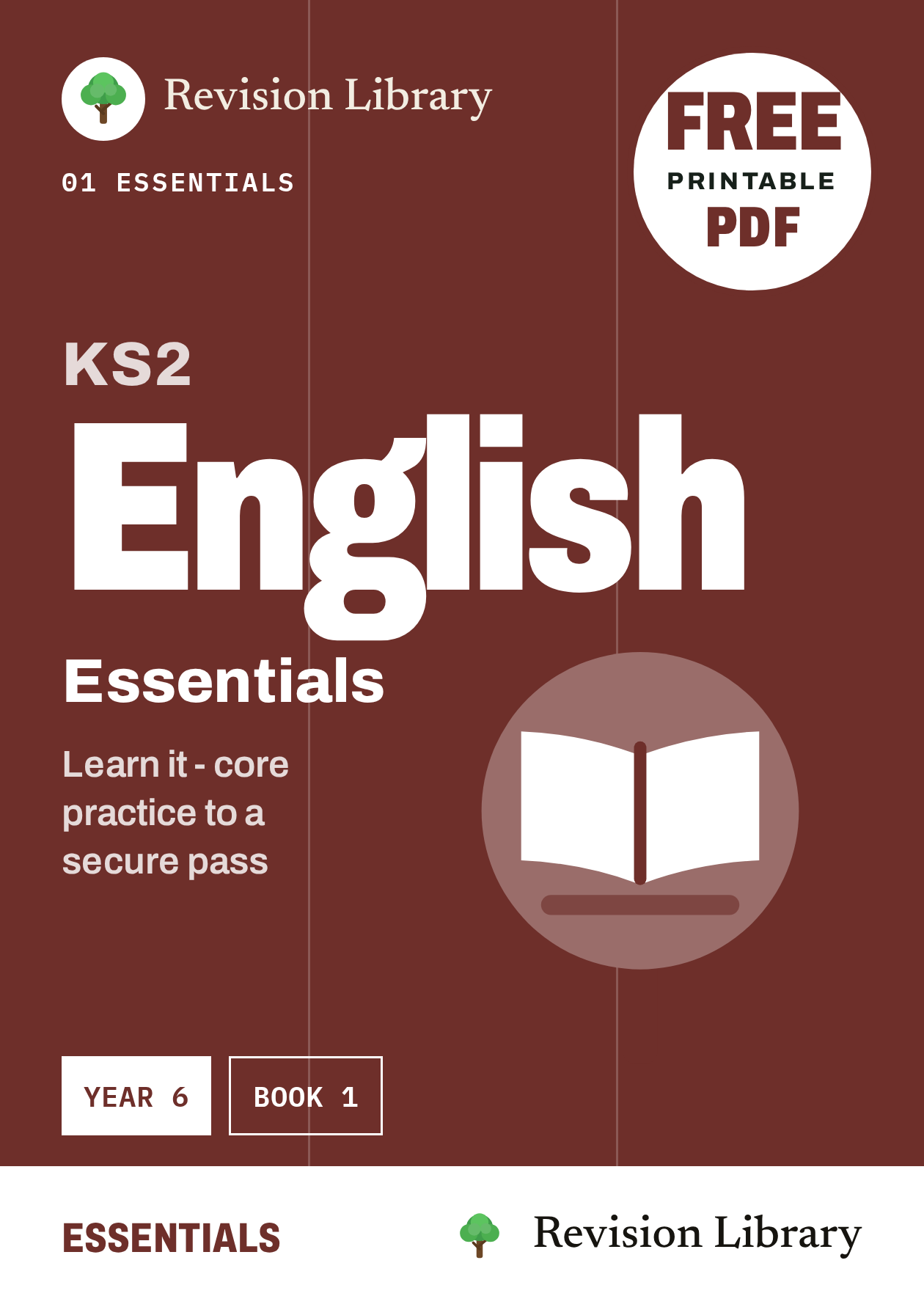
KS2 English Year 6 Topic Workbooks · Book 1 of 2

KS2 English Year 6 Topic Workbook 1

Grammar and Punctuation (KS2), Sentence Types and Word Classes, Reading: Fiction and 5 more

Level
KS2
Series
KS2 English Year 6 Topic Workbooks, book 1 of 2
Suitable for
Years 3-6, ages 7-11
FreePDF download · 2027 edition · 88 A4 pages
  • One file, prints straight to A4
  • No account, no password

Workbooks like this one, with 8 topics, 146 questions and mark schemes at the back, are usually printed and sold by publishers. This one is one of 558 free PDFs on the shelf.

Pages
88 A4 pages
Chapters
8 worksheet chapters
Questions
146 · 446 marks
Answers
From page 72
Working time
About 5h 20m

What is inside

8 chapters · answers from p72

Each chapter starts with a page showing its marks and a suggested time, followed by the questions. The mark schemes for all 8 chapters are at the back, so the book works for homework, a timed test or revision.

  1. 01Grammar and Punctuation (KS2)22 questions · 50 marks · about 35 min Topic guide: Grammar and Punctuation (KS2)p3
  2. 02Sentence Types and Word Classes20 questions · 50 marks · about 35 min Topic guide: Sentence Types and Word Classesp11
  3. 03Reading: Fiction19 questions · 45 marks · about 35 min Topic guide: Reading: Fictionp21
  4. 04Reading: Non-Fiction (KS2)20 questions · 42 marks · about 30 min Topic guide: Reading: Non-Fiction (KS2)p28
  5. 05Spelling15 questions · 78 marks · about 55 min Topic guide: Spellingp36
  6. 06The Subjunctive Mood17 questions · 53 marks · about 40 min Topic guide: The Subjunctive Moodp46
  7. 07Active and Passive Voice17 questions · 71 marks · about 50 min Topic guide: Active and Passive Voicep54
  8. 08Subject and Object16 questions · 57 marks · about 40 min Topic guide: Subject and Objectp63
  9. AnswersMark schemes for every chapterp72

Each chapter is drawn from one of our worksheet packs. Follow a chapter title for the full pack on its own page, or browse every KS2 English (SATs) pack. Every book on the shelf is a complete printable workbook of up to 120 A4 pages.

Explore this volume

KS2 English Year 6 Topic Workbook 1 includes Grammar and Punctuation (KS2) (from page 3); Sentence Types and Word Classes (from page 11); Reading: Fiction (from page 21); Reading: Non-Fiction (KS2) (from page 28); Spelling (from page 36); The Subjunctive Mood (from page 46); Active and Passive Voice (from page 54); Subject and Object (from page 63).

Worked question 19 - Reading: Fiction

Open the included worksheet

The Rock Pool

Source written for Revision Library (original, copyright-free). This short story was written specially for this worksheet and has not been published elsewhere.

Paragraph 1

Priya crouched at the edge of the rock pool, her sandals abandoned somewhere behind her on the dry sand. The tide had slipped away that morning, leaving behind a maze of glistening pools tucked between the rocks like scattered coins. Her grandfather, Bapu, was further along the beach, his trouser legs rolled to the knee, humming to himself as he checked the crab lines he had set the evening before.

Paragraph 2

The pool in front of Priya held its own small world. A hermit crab dragged its borrowed shell across a bed of purple weed, and two tiny fish flickered between the fronds like stitches of silver thread. She dipped one finger into the cold water and watched the ripples spread and settle, spread and settle, until the pool was still again.

Paragraph 3

It was the glint that caught her eye first, a flash of green half buried in the sand at the bottom of the pool. Priya reached in, her sleeve soaking through instantly, and worked the object free. It was a bottle, old and thick, its glass the colour of sea foam left too long in shadow. A stopper of blackened cork sealed the neck, and inside, curled tight as a fern before it opens, was a scrap of paper.

Paragraph 4

'Bapu!' Priya's voice cracked with excitement, and she was on her feet before she had decided to stand. 'Bapu, come and look!'

Paragraph 5

Her grandfather straightened slowly, one hand pressed to his back, and made his way over the slippery rocks with the careful steps of someone who had learned, long ago, not to hurry near the sea. When he saw what she was holding, something shifted in his face, a memory surfacing like the bottle itself.

Paragraph 6

'Well now,' he said quietly. 'I have not seen one of these since I was a boy.'

Paragraph 7

Together they worked the cork loose, and Priya drew out the paper with the tips of two fingers, as though it might crumble if she breathed on it too hard. The ink had faded to the colour of weak tea, but the words still held their shape: I hope whoever finds this is standing somewhere the sea has just left. Keep something small today. Write your own message and send it back out. From a boy who once stood exactly where you are standing now.

Paragraph 8

Priya read it twice, then a third time, before she looked up. 'Do you think he ever found out if anyone read it?'

Paragraph 9

Bapu shook his head, but he was smiling, the kind of smile that reaches further back than the moment it appears in. 'When I was young, folk along this coast used to send bottles out with the spring tide,' he said. 'A message, a coin, whatever they had. Some came back years later, further down the coast or further up. Most were never found at all. I sent one myself, once, though I never told anyone what I wrote.'

Paragraph 10

Priya turned the paper over in her hands, feeling the years pressed into it. She thought of the boy who had written it, standing perhaps on this very stretch of sand, not knowing whether his words would ever reach anyone, and sending them out to sea anyway. It was, she realised, a small and stubborn kind of hope, folded up and corked shut and thrown to the water to look after.

Paragraph 11

'I want to send one back,' she said at last.

Paragraph 12

Bapu found her a stub of pencil in his jacket pocket, and Priya wrote quickly, before she could talk herself out of any of it. She did not show Bapu what she had written. She rolled the new paper tight, pushed it deep into the old green bottle, and pressed the blackened cork firmly back into place. Then, wading out until the cold water reached her knees, she threw the bottle as far as her arm would allow, and watched it bob once, twice, before the tide, patient and unhurried, carried it away.

In paragraph 10, the writer describes the boy's hope as 'a small and stubborn kind of hope, folded up and corked shut and thrown to the water to look after'. Explain how the writer's use of language here helps you understand Priya's feelings about the message.

Answer and mark scheme

Question 19

CreditAnswer or working
3Level 3 Clear explanation of how the language conveys Priya's feelings, referring precisely to word choice.
2Level 2 Reasonable explanation of the effect of the language, with some reference to word choice.
1Level 1 Simple or general comment on the language, with little reference to specific words.
  • Indicative content:
    • The abstract idea of 'hope' is treated as a physical object that can be 'folded up and corked shut', showing how seriously Priya takes it.
    • 'stubborn' suggests hope that persists even without certainty of being found, mirroring the boy's situation.
    • 'thrown to the water to look after' suggests trust, as if the sea is being asked to care for something precious.
    • This shows Priya now sees the message as meaningful and valuable, not just an interesting object.

Answer: By describing hope as something that can be 'folded up and corked shut', the writer makes an abstract feeling feel physical and precious; 'stubborn' shows the hope survives uncertainty, and 'thrown to the water to look after' suggests trust, showing Priya now understands the message as something meaningful, not just exciting.
Question 6 - Reading: Fiction

Open the included worksheet

The Rock Pool

Source written for Revision Library (original, copyright-free). This short story was written specially for this worksheet and has not been published elsewhere.

Paragraph 1

Priya crouched at the edge of the rock pool, her sandals abandoned somewhere behind her on the dry sand. The tide had slipped away that morning, leaving behind a maze of glistening pools tucked between the rocks like scattered coins. Her grandfather, Bapu, was further along the beach, his trouser legs rolled to the knee, humming to himself as he checked the crab lines he had set the evening before.

Paragraph 2

The pool in front of Priya held its own small world. A hermit crab dragged its borrowed shell across a bed of purple weed, and two tiny fish flickered between the fronds like stitches of silver thread. She dipped one finger into the cold water and watched the ripples spread and settle, spread and settle, until the pool was still again.

Paragraph 3

It was the glint that caught her eye first, a flash of green half buried in the sand at the bottom of the pool. Priya reached in, her sleeve soaking through instantly, and worked the object free. It was a bottle, old and thick, its glass the colour of sea foam left too long in shadow. A stopper of blackened cork sealed the neck, and inside, curled tight as a fern before it opens, was a scrap of paper.

Paragraph 4

'Bapu!' Priya's voice cracked with excitement, and she was on her feet before she had decided to stand. 'Bapu, come and look!'

Paragraph 5

Her grandfather straightened slowly, one hand pressed to his back, and made his way over the slippery rocks with the careful steps of someone who had learned, long ago, not to hurry near the sea. When he saw what she was holding, something shifted in his face, a memory surfacing like the bottle itself.

Paragraph 6

'Well now,' he said quietly. 'I have not seen one of these since I was a boy.'

Paragraph 7

Together they worked the cork loose, and Priya drew out the paper with the tips of two fingers, as though it might crumble if she breathed on it too hard. The ink had faded to the colour of weak tea, but the words still held their shape: I hope whoever finds this is standing somewhere the sea has just left. Keep something small today. Write your own message and send it back out. From a boy who once stood exactly where you are standing now.

Paragraph 8

Priya read it twice, then a third time, before she looked up. 'Do you think he ever found out if anyone read it?'

Paragraph 9

Bapu shook his head, but he was smiling, the kind of smile that reaches further back than the moment it appears in. 'When I was young, folk along this coast used to send bottles out with the spring tide,' he said. 'A message, a coin, whatever they had. Some came back years later, further down the coast or further up. Most were never found at all. I sent one myself, once, though I never told anyone what I wrote.'

Paragraph 10

Priya turned the paper over in her hands, feeling the years pressed into it. She thought of the boy who had written it, standing perhaps on this very stretch of sand, not knowing whether his words would ever reach anyone, and sending them out to sea anyway. It was, she realised, a small and stubborn kind of hope, folded up and corked shut and thrown to the water to look after.

Paragraph 11

'I want to send one back,' she said at last.

Paragraph 12

Bapu found her a stub of pencil in his jacket pocket, and Priya wrote quickly, before she could talk herself out of any of it. She did not show Bapu what she had written. She rolled the new paper tight, pushed it deep into the old green bottle, and pressed the blackened cork firmly back into place. Then, wading out until the cold water reached her knees, she threw the bottle as far as her arm would allow, and watched it bob once, twice, before the tide, patient and unhurried, carried it away.

Compare the character of Priya with the boy who wrote the original message, using evidence from across the whole text. In your answer, consider what they have in common and how the writer shows this connection.

Answer and mark scheme

Question 6

CreditAnswer or working
4Level 4 Detailed, well-supported comparison covering more than one point of similarity, with clear explanation of how the writer shows the connection.
3Level 3 Clear comparison covering at least one point of similarity, with some explanation of how the connection is shown.
2Level 2 Reasonable comparison with limited explanation of how the connection is shown.
1Level 1 Simple or partial comparison, with little supporting evidence.
  • Indicative content:
    • Both are children who stand in the same physical place, separated by many years.
    • Both act on hope by sending a message without expecting a reply.
    • The writer directly links them in the boy's own words: 'a boy who once stood exactly where you are standing now'.
    • The structure of the story (finding an old message, then writing and sending a new one) mirrors their situations and connects them across time.
    • The ending suggests the cycle will continue with whoever finds Priya's bottle next, extending the connection further.

Answer: Priya and the boy are alike in that both are children standing in the same spot years apart, both choosing to send a hopeful message without knowing if it will ever be found. The writer shows this connection directly through the boy's words ('a boy who once stood exactly where you are standing now') and through the story's structure, which repeats the same action (finding, then sending, a message), suggesting the cycle will continue with whoever finds Priya's bottle next.

Question 15 - Reading: Fiction

Open the included worksheet

The Rock Pool

Source written for Revision Library (original, copyright-free). This short story was written specially for this worksheet and has not been published elsewhere.

Paragraph 1

Priya crouched at the edge of the rock pool, her sandals abandoned somewhere behind her on the dry sand. The tide had slipped away that morning, leaving behind a maze of glistening pools tucked between the rocks like scattered coins. Her grandfather, Bapu, was further along the beach, his trouser legs rolled to the knee, humming to himself as he checked the crab lines he had set the evening before.

Paragraph 2

The pool in front of Priya held its own small world. A hermit crab dragged its borrowed shell across a bed of purple weed, and two tiny fish flickered between the fronds like stitches of silver thread. She dipped one finger into the cold water and watched the ripples spread and settle, spread and settle, until the pool was still again.

Paragraph 3

It was the glint that caught her eye first, a flash of green half buried in the sand at the bottom of the pool. Priya reached in, her sleeve soaking through instantly, and worked the object free. It was a bottle, old and thick, its glass the colour of sea foam left too long in shadow. A stopper of blackened cork sealed the neck, and inside, curled tight as a fern before it opens, was a scrap of paper.

Paragraph 4

'Bapu!' Priya's voice cracked with excitement, and she was on her feet before she had decided to stand. 'Bapu, come and look!'

Paragraph 5

Her grandfather straightened slowly, one hand pressed to his back, and made his way over the slippery rocks with the careful steps of someone who had learned, long ago, not to hurry near the sea. When he saw what she was holding, something shifted in his face, a memory surfacing like the bottle itself.

Paragraph 6

'Well now,' he said quietly. 'I have not seen one of these since I was a boy.'

Paragraph 7

Together they worked the cork loose, and Priya drew out the paper with the tips of two fingers, as though it might crumble if she breathed on it too hard. The ink had faded to the colour of weak tea, but the words still held their shape: I hope whoever finds this is standing somewhere the sea has just left. Keep something small today. Write your own message and send it back out. From a boy who once stood exactly where you are standing now.

Paragraph 8

Priya read it twice, then a third time, before she looked up. 'Do you think he ever found out if anyone read it?'

Paragraph 9

Bapu shook his head, but he was smiling, the kind of smile that reaches further back than the moment it appears in. 'When I was young, folk along this coast used to send bottles out with the spring tide,' he said. 'A message, a coin, whatever they had. Some came back years later, further down the coast or further up. Most were never found at all. I sent one myself, once, though I never told anyone what I wrote.'

Paragraph 10

Priya turned the paper over in her hands, feeling the years pressed into it. She thought of the boy who had written it, standing perhaps on this very stretch of sand, not knowing whether his words would ever reach anyone, and sending them out to sea anyway. It was, she realised, a small and stubborn kind of hope, folded up and corked shut and thrown to the water to look after.

Paragraph 11

'I want to send one back,' she said at last.

Paragraph 12

Bapu found her a stub of pencil in his jacket pocket, and Priya wrote quickly, before she could talk herself out of any of it. She did not show Bapu what she had written. She rolled the new paper tight, pushed it deep into the old green bottle, and pressed the blackened cork firmly back into place. Then, wading out until the cold water reached her knees, she threw the bottle as far as her arm would allow, and watched it bob once, twice, before the tide, patient and unhurried, carried it away.

Summarise, in your own words, what happens between Priya calling Bapu over and the two of them reading the message (from 'Bapu!' to '...stood exactly where you are standing now').

Answer and mark scheme

Question 15

CreditAnswer or working
3Level 3 Full, accurate summary in the pupil's own words, covering the key events in a sensible order.
2Level 2 Reasonable summary covering some key events, mostly in the pupil's own words.
1Level 1 Minimal or partial summary, possibly limited to one event or largely lifted from the text.
  • Indicative content:
    • Priya calls Bapu over excitedly.
    • Bapu makes his way carefully over the slippery rocks.
    • He recognises the bottle from his own childhood.
    • Together they work the cork loose.
    • Priya carefully draws out the old paper.
    • They read the faded message inside it.

Answer: Priya excitedly calls Bapu over; he comes carefully across the rocks and recognises the bottle from his own childhood; together they loosen the cork and Priya carefully draws out the paper, and they read the faded message.

Question 20 - Reading: Non-Fiction (KS2)

Open the included worksheet

Beavers Return to Britain

Source written for Revision Library (original, copyright-free). An information text about the reintroduction of beavers to the United Kingdom, written in the style of a KS2 non-fiction reading passage.

For over four hundred years, no beaver dam blocked a British stream. Wolves, wild boar and lynx had already vanished from the British countryside, and by the early sixteenth century the beaver had joined them, hunted to extinction for its thick fur, its meat and a musky substance called castoreum that people once used in medicines and perfume. Today, though, something remarkable is happening. Beavers are back, and rivers across the United Kingdom are slowly beginning to change shape once again.

A Long Absence

Britain's last wild beavers were wiped out by around 1526, according to most historians, although a few believe that small, hidden populations survived in remote parts of Scotland for a little longer. Without beavers, many rivers ran straight and fast, rushing floodwater downstream instead of holding onto it. Wetlands dried out, and the plants and animals that depended on slow, marshy water gradually disappeared too.

Nature's Engineers

Beavers earn their nickname of 'nature's engineers' because they reshape their surroundings more dramatically than almost any other wild animal in Britain. Using nothing but their teeth, their front paws and an instinct they are born with, beavers gnaw down small trees and drag branches, mud and stones into rivers to build dams. A single family of beavers can build a dam thirty metres long in just a few nights, and some determined colonies have built dams that stretch for hundreds of metres.

How Beavers Change a River

A beaver dam slows the flow of water, creating a calm pond behind it where the beavers build a domed home called a lodge. The entrance to a lodge is always underwater, which keeps foxes and other predators out. Behind each dam, the pond spreads sideways into the surrounding land, forming shallow pools and soggy wetland. This might sound messy, but it is exactly what many other species need. Frogs, dragonflies, otters and wading birds all move into beaver wetlands within a year or two, and fish often thrive in the cool, oxygen rich pools that dams create.

Why Beavers Matter

Beaver dams do more than provide a home for wildlife. During heavy rain, a dam acts like a natural brake, holding back water that would otherwise rush downstream and flood towns and farmland. During dry spells, the same pond releases water slowly, keeping streams flowing when they might otherwise run dry. Scientists studying a beaver site in Devon found that a single family of beavers reduced the height of floodwater reaching a nearby village by nearly a third. Beaver ponds can also trap mud and pollution before it reaches rivers further downstream, so the water flowing out the other side is often cleaner than the water that flowed in.

The Return

The first beavers to return to the British countryside in centuries were spotted living wild on the River Otter in Devon in around 2008, most likely descendants of animals that had escaped from captivity nearby. Rather than removing them, conservationists asked to study the beavers instead, and in 2020 the government agreed that they could stay permanently. Since then, beavers have been carefully reintroduced to sites in Scotland, Wales and several counties in England, always released under licence and closely monitored by scientists. Not everyone has welcomed their return; some farmers worry about flooded fields and blocked ditches, so conservation groups now work closely with landowners to manage the dams that cause problems while leaving the rest of a beaver's engineering well alone.

Looking Ahead

Four hundred years after the last splash of a beaver's tail disappeared from British rivers, the sound is being heard again. Whether this quiet, hardworking animal can fully reclaim its place in the British countryside still depends on people, but for the rivers, and for the wildlife sheltering within them, the return of the beaver is already making a difference.

Fact File: The Eurasian Beaver

- Latin name: Castor fiber

- Typical weight: up to 30 kg, about the same as a large dog

- Diet: bark, leaves, water plants and grasses (beavers do not eat fish)

- Top swimming speed: about 8 km/h

- Tail: flat, scaly and paddle shaped; used for swimming, steering and as a warning signal when slapped hard on the water

The text is organised using subheadings such as 'A Long Absence' and 'Nature's Engineers'. Explain two ways these subheadings help the reader.

Answer and mark scheme

Question 20

CreditAnswer or working
B1they break the text into clear sections/topics, making it easier to read (oe)
B1they help the reader find or locate a particular piece of information quickly, or show how the writer's ideas are organised in order (oe)
  • Answer: Subheadings break the text into clear topics and let the reader find specific information quickly, while also showing how the writer's ideas develop in order.

Question 17 - Reading: Non-Fiction (KS2)

Open the included worksheet

Beavers Return to Britain

Source written for Revision Library (original, copyright-free). An information text about the reintroduction of beavers to the United Kingdom, written in the style of a KS2 non-fiction reading passage.

For over four hundred years, no beaver dam blocked a British stream. Wolves, wild boar and lynx had already vanished from the British countryside, and by the early sixteenth century the beaver had joined them, hunted to extinction for its thick fur, its meat and a musky substance called castoreum that people once used in medicines and perfume. Today, though, something remarkable is happening. Beavers are back, and rivers across the United Kingdom are slowly beginning to change shape once again.

A Long Absence

Britain's last wild beavers were wiped out by around 1526, according to most historians, although a few believe that small, hidden populations survived in remote parts of Scotland for a little longer. Without beavers, many rivers ran straight and fast, rushing floodwater downstream instead of holding onto it. Wetlands dried out, and the plants and animals that depended on slow, marshy water gradually disappeared too.

Nature's Engineers

Beavers earn their nickname of 'nature's engineers' because they reshape their surroundings more dramatically than almost any other wild animal in Britain. Using nothing but their teeth, their front paws and an instinct they are born with, beavers gnaw down small trees and drag branches, mud and stones into rivers to build dams. A single family of beavers can build a dam thirty metres long in just a few nights, and some determined colonies have built dams that stretch for hundreds of metres.

How Beavers Change a River

A beaver dam slows the flow of water, creating a calm pond behind it where the beavers build a domed home called a lodge. The entrance to a lodge is always underwater, which keeps foxes and other predators out. Behind each dam, the pond spreads sideways into the surrounding land, forming shallow pools and soggy wetland. This might sound messy, but it is exactly what many other species need. Frogs, dragonflies, otters and wading birds all move into beaver wetlands within a year or two, and fish often thrive in the cool, oxygen rich pools that dams create.

Why Beavers Matter

Beaver dams do more than provide a home for wildlife. During heavy rain, a dam acts like a natural brake, holding back water that would otherwise rush downstream and flood towns and farmland. During dry spells, the same pond releases water slowly, keeping streams flowing when they might otherwise run dry. Scientists studying a beaver site in Devon found that a single family of beavers reduced the height of floodwater reaching a nearby village by nearly a third. Beaver ponds can also trap mud and pollution before it reaches rivers further downstream, so the water flowing out the other side is often cleaner than the water that flowed in.

The Return

The first beavers to return to the British countryside in centuries were spotted living wild on the River Otter in Devon in around 2008, most likely descendants of animals that had escaped from captivity nearby. Rather than removing them, conservationists asked to study the beavers instead, and in 2020 the government agreed that they could stay permanently. Since then, beavers have been carefully reintroduced to sites in Scotland, Wales and several counties in England, always released under licence and closely monitored by scientists. Not everyone has welcomed their return; some farmers worry about flooded fields and blocked ditches, so conservation groups now work closely with landowners to manage the dams that cause problems while leaving the rest of a beaver's engineering well alone.

Looking Ahead

Four hundred years after the last splash of a beaver's tail disappeared from British rivers, the sound is being heard again. Whether this quiet, hardworking animal can fully reclaim its place in the British countryside still depends on people, but for the rivers, and for the wildlife sheltering within them, the return of the beaver is already making a difference.

Fact File: The Eurasian Beaver

- Latin name: Castor fiber

- Typical weight: up to 30 kg, about the same as a large dog

- Diet: bark, leaves, water plants and grasses (beavers do not eat fish)

- Top swimming speed: about 8 km/h

- Tail: flat, scaly and paddle shaped; used for swimming, steering and as a warning signal when slapped hard on the water

Using the paragraph headed 'A Long Absence' and the paragraph headed 'How Beavers Change a River', give two differences between what rivers were like without beavers and what they are like when beavers build dams.

Answer and mark scheme

Question 17

CreditAnswer or working
B1without beavers rivers 'ran straight and fast, rushing floodwater downstream'; with beaver dams the water is slowed and forms a calm pond (oe)
B1without beavers 'wetlands dried out'; with beaver dams shallow pools and soggy wetland form, supporting wildlife (oe)
  • Answer: Any two of: rivers ran fast and straight before, but dams slow the water and form ponds; wetlands used to dry out, but beaver wetlands are wet and support wildlife.

KS2 English Year 6 Topic Workbooks runs to 2 volumes

Book 1 of 2 · 182 pages in the set

Each book is a separate free PDF.

Volume 1 · this book

88 pp · 146 Qs

Grammar and Punctuation (KS2), Sentence Types and Word Classes, Reading: Fiction and 5 more

Volume 2

94 pp · 140 Qs

Hyphens, Semicolons, Colons and 5 more

More KS2 books

Want a different mix of topics?