BIDMAS is the order of operations rule that fixes the sequence for working out a calculation: Brackets, Indices, Division and Multiplication, then Addition and Subtraction, which stops an expression like 5 + 2 x 3 from being ambiguous since the multiplication must be done before the addition. GCSE Foundation questions test BIDMAS through mixed calculations, missing brackets and show-that problems.
Work out any calculations inside brackets first, applying BIDMAS again inside the brackets if there is more than one operation there.
Evaluate any indices next, such as squares, cubes and square roots.
Working left to right, carry out all division and multiplication.
Working left to right, carry out all addition and subtraction.
Write down the final value, then check it against the original calculation to catch any order-of-operations slips.
Worked example
Work out 4 + 3 x (8 - 5)2
Work out the brackets first: 8 - 5 = 3.
Apply the index: 32 = 9.
Do the multiplication: 3 x 9 = 27.
Do the addition: 4 + 27 = 31.
Final answer: 31.
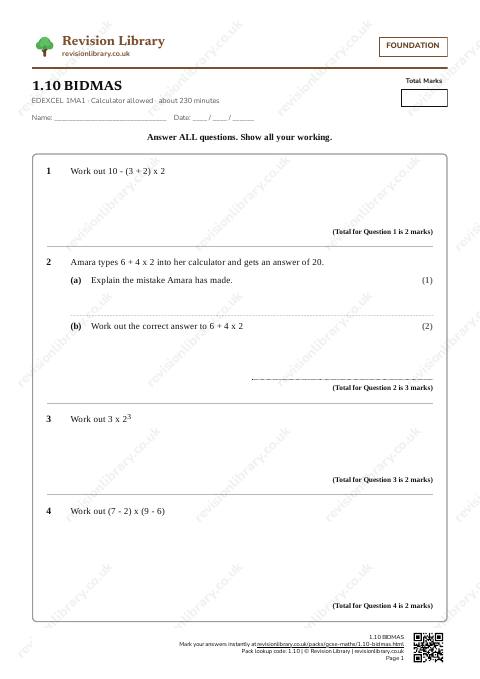
Revision Library
revisionlibrary.co.uk
FOUNDATION
1.10 BIDMAS
EDEXCEL 1MA1 · Calculator allowed · about 230 minutes
Amara types 6 + 4 x 2 into her calculator and gets an answer of 20.
(a)Explain the mistake Amara has made.(1)
(b)Work out the correct answer to 6 + 4 x 2(2)
(Total for Question 2 is 3 marks)
3
Work out 3 x 23
(Total for Question 3 is 2 marks)
4
Work out (7 - 2) x (9 - 6)
(Total for Question 4 is 2 marks)
5
Work out 50 / (2 + 3) - 4
(Total for Question 5 is 2 marks)
6
Work out 2 x 32 - (4 + 1)
(Total for Question 6 is 3 marks)
7
Work out (6 + 11) x 8 - 9
(Total for Question 7 is 3 marks)
8
Work out 20 + 5 x 9
(Total for Question 8 is 2 marks)
9
Here is a calculation: 9 - 6 x 2 = 6. Put one pair of brackets into the left-hand side to make the calculation correct.
(Total for Question 9 is 2 marks)
10
Work out 14 + 32 x 2 - 2
(Total for Question 10 is 3 marks)
11
Work out 7 x 3 + 2
(Total for Question 11 is 2 marks)
12
Work out 3 x (17 - 9) + 2
(Total for Question 12 is 3 marks)
13
Here is a calculation: 5 - 4 x 4 = 4. Put one pair of brackets into the left-hand side to make the calculation correct.
(Total for Question 13 is 2 marks)
14
Work out (6 + 4) x 3
(Total for Question 14 is 1 mark)
15
Work out 11 x 2 + 9
(Total for Question 15 is 2 marks)
16
Here is a calculation: 10 - 7 x 3 = 9. Put one pair of brackets into the left-hand side to make the calculation correct.
(Total for Question 16 is 2 marks)
17
Work out (2 + 12) x 6 - 5
(Total for Question 17 is 3 marks)
18
Work out 11 - 4 x 2
(Total for Question 18 is 2 marks)
19
Work out 12 + 62 x 4 - 3
(Total for Question 19 is 3 marks)
20
Work out 110 - 7 x 8
(Total for Question 20 is 2 marks)
21
Work out 4 + 62 x 4 - 3
(Total for Question 21 is 3 marks)
22
Work out 10 x 9 + 2
(Total for Question 22 is 2 marks)
23
Work out 32 + 4
(Total for Question 23 is 1 mark)
24
Work out 6 x (5 - 2)
(Total for Question 24 is 1 mark)
25
Work out (8 + 12) / 4
(Total for Question 25 is 1 mark)
26
Insert one pair of brackets into 2 + 3 x 4 to make the calculation equal to 20.
(Total for Question 26 is 1 mark)
27
Work out 7 + 6 x 2
(Total for Question 27 is 1 mark)
28
Work out 63 / (9 - 2) - 5
(Total for Question 28 is 2 marks)
29
Work out 24 / 4 + 6
(Total for Question 29 is 2 marks)
30
Work out (16 - 9) x (11 - 5)
(Total for Question 30 is 2 marks)
31
A market stall sells apples at 35p each and bananas at 20p each. Callum buys 4 apples and 3 bananas. Work out the total cost of Callum's shopping.
(Total for Question 31 is 2 marks)
32
Work out (11 - 4) x 5
(Total for Question 32 is 1 mark)
33
Work out 52 - 9
(Total for Question 33 is 1 mark)
34
Circle the correct value of 15 - 2 x 6
A) 3
B) 78
C) 12
D) -3
(Total for Question 34 is 1 mark)
35
Work out 9 x (12 - 8)
(Total for Question 35 is 1 mark)
36
Work out (24 + 16) / 8
(Total for Question 36 is 1 mark)
37
Insert one of the symbols +, -, x, / into the box to make the calculation correct: 10 [ ] 6 / 2 = 13
(Total for Question 37 is 1 mark)
38
Work out 4 x 32 - 11
(Total for Question 38 is 2 marks)
39
Work out (8 + 2) x 4.
(Total for Question 39 is 1 mark)
40
Work out 18 / 3 + 2.
(Total for Question 40 is 1 mark)
41
Work out 5 x 4 + 7.
(Total for Question 41 is 1 mark)
42
Work out (9 - 5) x 6.
(Total for Question 42 is 1 mark)
43
Work out 45 / 9 - 2.
(Total for Question 43 is 1 mark)
44
Work out (5 + 3)2 / 4 x 2
(Total for Question 44 is 3 marks)
45
Work out 100 - 2 x (15 - 42)
(Total for Question 45 is 3 marks)
46
Show that 2 + 3 x (7 - 4)2 - 5 = 24
(Total for Question 46 is 3 marks)
47
Work out 5 x 23 - 40 / 5
(Total for Question 47 is 3 marks)
48
Work out 5 + 100 / (2 + 3)2
(Total for Question 48 is 3 marks)
49
Work out 4 x (3 - 8) + 23
(Total for Question 49 is 3 marks)
50
Insert one pair of brackets into 12 - 4 x 2 + 6 to make the calculation equal to 22.
(Total for Question 50 is 2 marks)
51
A car park charges a flat entry fee of £2 plus £3 for every hour of parking.
(a)Write an expression for the total cost, in pounds, of parking for h hours.(1)
(b)Use your expression to work out the total cost of parking for 5 hours.(2)
(Total for Question 51 is 3 marks)
52
Work out (15 - 7) / 4 + 2.
(Total for Question 52 is 2 marks)
53
Work out 23 x 5.
(Total for Question 53 is 1 mark)
54
Work out 5 + (6 - 2)2.
(Total for Question 54 is 2 marks)
55
Work out 12 / (2 + 1) + 7.
(Total for Question 55 is 2 marks)
56
Work out (9 - 3) x (2 + 5).
(Total for Question 56 is 2 marks)
57
Work out 33 - 10.
(Total for Question 57 is 1 mark)
58
Work out (9 - 4)2 - 10.
(Total for Question 58 is 2 marks)
59
Work out (5 + 3)2 - 4 x (6 - 3).
(Total for Question 59 is 3 marks)
60
Work out 3 + (12 - 4) / 22.
(Total for Question 60 is 3 marks)
61
Work out 3 + 4 x 22.
(Total for Question 61 is 2 marks)
62
Work out 18 - 23 x 2 + 5.
(Total for Question 62 is 3 marks)
63
Work out -12 + 5 x (3 - 7).
(Total for Question 63 is 2 marks)
64
Work out (9 + 32) / 3 - 1.
(Total for Question 64 is 3 marks)
65
A stationery shop sells notebooks at £3 each and pens at £1 each. Aaliyah buys 4 notebooks and 5 pens, and pays with a £20 note. Work out how much change Aaliyah receives.
(Total for Question 65 is 3 marks)
66
Work out 50 - (12 + 4)2 / 8.
(Total for Question 66 is 3 marks)
67
Work out 6 / 2 x (1 + 2).
(Total for Question 67 is 3 marks)
68
Work out 8 - 3 x 22 + (6 / 3).
(Total for Question 68 is 4 marks)
69
Show that (4 + 23) / (3 - 1) = 6.
(Total for Question 69 is 4 marks)
70
Priya calculates (7 + 2) x 32 incorrectly as 7 + 2 x 32. Work out Priya's answer and the correct answer. Find the difference between the two answers.
(Total for Question 70 is 3 marks)
71
Work out 3 x (7 - 2)2 - (20 / 4).
(Total for Question 71 is 3 marks)
72
Work out 40 - (12 - 4) x 3 + 23.
(Total for Question 72 is 4 marks)
73
Show that (18 - 23) / (4 - 2) x 3 = 15.
(Total for Question 73 is 4 marks)
74
Insert one pair of brackets into 4 + 6 x 3 - 2 so that the calculation is equal to 28. Write out the calculation with the brackets in place and show that it equals 28.
(Total for Question 74 is 2 marks)
75
Work out (2 + (32 - 1)) x (5 - 3) + 23.
(Total for Question 75 is 4 marks)
76
Work out (4 x (32 + 1)) - (18 - 23) / 2.
(Total for Question 76 is 4 marks)
Mark scheme · 1.10 BIDMAS
A correct answer earns full marks unless the question asks for working, a method, proof or explanation.
Question 1
3 + 2 = 5 and 5 x 2 = 10 seenM1
0 caoA1
Answer: 0
Question 2
(a) correct reference to the order of operations, e.g. she added 6 + 4 first instead of doing the multiplication first, oeB1
(a) Answer: Amara added 6 + 4 = 10 before multiplying by 2, but multiplication must be done before addition
(b) 4 x 2 = 8 seenM1
(b) 14 caoA1
(b) Answer: 14
Question 3
23 = 8 seenM1
24 caoA1
Answer: 24
Question 4
7 - 2 = 5 and 9 - 6 = 3 both evaluatedM1
15 caoA1
Answer: 15
Question 5
2 + 3 = 5 and 50 / 5 = 10 seenM1
6 caoA1
Answer: 6
Question 6
32 = 9 and 4 + 1 = 5 both evaluatedM1
2 x 9 (= 18) seenM1
13 caoA1
Answer: 13
Question 7
brackets evaluated firstM1
next operation correctM1
127 caoA1
Answer: 127
Question 8
multiplication done before addition or subtractionM1
65 caoA1
Answer: 65
Question 9
tries brackets round the first two numbersM1
(9 - 6) x 2 = 6A1
Answer: (9 - 6) x 2
Question 10
32 = 9 seenM1
9 x 2 = 18 seenM1
30 caoA1
Answer: 30
Question 11
multiplication done before addition or subtractionM1
23 caoA1
Answer: 23
Question 12
brackets evaluated firstM1
next operation correctM1
26 caoA1
Answer: 26
Question 13
tries brackets round the first two numbersM1
(5 - 4) x 4A1
Answer: (5 - 4) x 4
Question 14
30 caoB1
Answer: 30
Question 15
multiplication done before addition or subtractionM1
31 caoA1
Answer: 31
Question 16
tries brackets round the first two numbersM1
(10 - 7) x 3 = 9A1
Answer: (10 - 7) x 3
Question 17
brackets evaluated firstM1
next operation correctM1
79 caoA1
Answer: 79
Question 18
multiplication done before addition or subtractionM1
3 caoA1
Answer: 3
Question 19
62 = 36 seenM1
36 x 4 = 144 seenM1
153 caoA1
Answer: 153
Question 20
multiplication done before addition or subtractionM1
54 caoA1
Answer: 54
Question 21
62 = 36 seenM1
36 x 4 = 144 seenM1
145 caoA1
Answer: 145
Question 22
multiplication done before addition or subtractionM1
92 caoA1
Answer: 92
Question 23
13 caoB1
Answer: 13
Question 24
18 caoB1
Answer: 18
Question 25
5 caoB1
Answer: 5
Question 26
(2 + 3) x 4 written, oeB1
Answer: (2 + 3) x 4
Question 27
19 caoB1
Answer: 19
Question 28
9 - 2 = 7 and 63 / 7 = 9 seenM1
4 caoA1
Answer: 4
Question 29
24 = 16 and 16 / 4 = 4 seenM1
10 caoA1
Answer: 10
Question 30
16 - 9 = 7 and 11 - 5 = 6 both evaluatedM1
42 caoA1
Answer: 42
Question 31
4 x 0.35 (= 1.40) and 3 x 0.20 (= 0.60) both seen, or an equivalent method combining the two costs correctlyM1
£2 cao (accept £2.00 or 200p, ft from a correct method with one arithmetic slip)A1
Answer: £2
Question 32
35 caoB1
Answer: 35
Question 33
16 caoB1
Answer: 16
Question 34
A (3) caoB1
Answer: A) 3
Question 35
36 caoB1
Answer: 36
Question 36
5 caoB1
Answer: 5
Question 37
+ written, oeB1
Answer: +
Question 38
32 = 9 seen, or 4 x 9 (= 36) seenM1
25 caoA1
Answer: 25
Question 39
40 caoB1
Answer: 40
Question 40
8 caoB1
Answer: 8
Question 41
27 caoB1
Answer: 27
Question 42
24 caoB1
Answer: 24
Question 43
3 caoB1
Answer: 3
Question 44
5 + 3 = 8 and 82 = 64 both evaluatedM1
64 / 4 (= 16) seenM1
32 caoA1
Answer: 32
Question 45
42 = 16 and 15 - 16 = -1 both evaluatedM1
2 x (-1) (= -2) seenM1
102 caoA1
Answer: 102
Question 46
7 - 4 = 3 and 32 = 9 both evaluatedM1
3 x 9 (= 27) seenM1
2 + 27 - 5 = 24 shown, csoA1
Answer: 24 (shown)
Question 47
23 = 8 and 40 / 5 = 8 both evaluatedM1
5 x 8 (= 40) seenM1
32 caoA1
Answer: 32
Question 48
2 + 3 = 5 and 52 = 25 both evaluatedM1
100 / 25 (= 4) seenM1
9 caoA1
Answer: 9
Question 49
3 - 8 = -5 evaluated, and 4 x (-5) (= -20) seenM1
23 = 8 seenM1
-12 caoA1
Answer: -12
Question 50
correct trial of a bracket placement shown, e.g. (12 - 4) x 2 + 6M1
(12 - 4) x 2 + 6 written, oe, caoA1
Answer: (12 - 4) x 2 + 6
Question 51
(a) 2 + 3h oeB1
(a) Answer: 2 + 3h
(b) 3 x 5 (= 15) seen, or correct substitution of h = 5 into a correct expression (ft from part a)M1
Put this topic and others into one printable pack.
Open the Pack Builder
Worksheets are written for Revision Library and come with a full mark scheme; a few English packs quote an out-of-copyright text, and name it on the page. Exam board names and specification codes say which qualification a pack suits: we are not affiliated with, endorsed by or approved by any exam board, and no past-paper question is reproduced here. Rights queries: hello@revisionlibrary.co.uk