Coordinates are an ordered pair of numbers, written (x, y), that describe the exact position of a point on a grid relative to the origin (0, 0), with the x-coordinate giving the horizontal distance and the y-coordinate the vertical distance, and negative values marking points left of or below the origin. GCSE Foundation questions test reading, plotting and reasoning about coordinates.
Start at the origin (0, 0), the point where the x-axis and y-axis cross.
Read the x-coordinate first: move that many units left (negative) or right (positive) along the horizontal axis.
Read the y-coordinate second: move that many units down (negative) or up (positive) from there.
Mark the point and label it, or write down its position as (x, y) if the point is already given.
For problems about shapes, use the fact that sides parallel to the axes share an x-coordinate (vertical sides) or a y-coordinate (horizontal sides).
Worked example
A rectangle has three corners at A(2, 1), B(7, 1) and C(7, 4). Find the coordinates of the fourth corner, D.
AB is a horizontal side, since A and B share the y-coordinate 1.
BC is a vertical side, since B and C share the x-coordinate 7.
CD must be horizontal, so D shares C's y-coordinate (4); DA must be vertical, so D shares A's x-coordinate (2).
Final answer: D = (2, 4).
Revision Library
revisionlibrary.co.uk
GCSE · Algebra: graphs and coordinates
1.12 Coordinates
EDEXCEL 1MA1 · Calculator allowed · about 225 minutes
Point M is at (-2, 4). Point N is 5 units to the right and 3 units down from M. Work out the coordinates of N.
(Total for Question 1 is 2 marks)
2
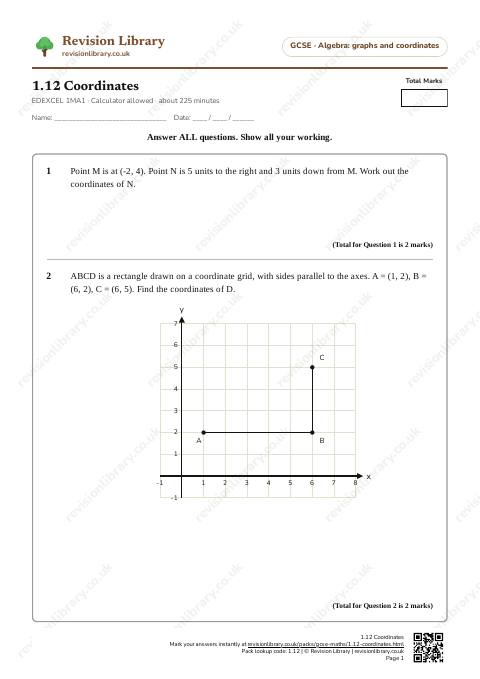
ABCD is a rectangle drawn on a coordinate grid, with sides parallel to the axes. A = (1, 2), B = (6, 2), C = (6, 5). Find the coordinates of D.
(Total for Question 2 is 2 marks)
3
PQRS is a square drawn on a coordinate grid, with sides parallel to the axes. P = (-4, -1), Q = (2, -1), R = (2, 5). Find the coordinates of S.
Diagram NOT accurately drawn
(Total for Question 3 is 3 marks)
4
A is the point (6, 2) and B is the point (-7, -3). Find the coordinates of the midpoint of AB.
(Total for Question 4 is 2 marks)
5
ABCD is a rectangle with sides parallel to the axes. A is the point (-4, -3), B is the point (-2, -3) and C is the point (-2, 2). Find the coordinates of D.
(Total for Question 5 is 2 marks)
6
M is the midpoint of the line AB. A is the point (3, 6) and M is the point (-2, -2). Find the coordinates of B.
(Total for Question 6 is 3 marks)
7
A rectangle has vertices at (-2, -1), (6, -1), (6, 5) and (-2, 5). Work out (a) the perimeter and (b) the area of the rectangle. Each unit on the axes is 1 cm.
(Total for Question 7 is 3 marks)
8
ABCD is a rectangle with sides parallel to the axes. A is the point (1, 0), B is the point (5, 0) and C is the point (5, 7). Find the coordinates of D.
(Total for Question 8 is 2 marks)
9
A is the point (-5, 0) and B is the point (-1, 2). Find the coordinates of the midpoint of AB.
(Total for Question 9 is 2 marks)
10
M is the midpoint of the line AB. A is the point (0, -6) and M is the point (-1, -2). Find the coordinates of B.
(Total for Question 10 is 3 marks)
11
A rectangle has vertices at (-4, -1), (5, -1), (5, 3) and (-4, 3). Work out (a) the perimeter and (b) the area of the rectangle. Each unit on the axes is 1 cm.
(Total for Question 11 is 3 marks)
12
ABCD is a rectangle with sides parallel to the axes. A is the point (-5, -2), B is the point (3, -2) and C is the point (3, 1). Find the coordinates of D.
(Total for Question 12 is 2 marks)
13
M is the midpoint of the line AB. A is the point (-4, 3) and M is the point (2, 2). Find the coordinates of B.
(Total for Question 13 is 3 marks)
14
A is the point (7, 0) and B is the point (2, 5). Find the coordinates of the midpoint of AB.
(Total for Question 14 is 2 marks)
15
Answer the following questions about a coordinate grid.
(a)Write down the coordinates of the origin.(1)
(b)A point lies on the y-axis, 5 units above the origin. Write down the coordinates of this point.(1)
(Total for Question 15 is 2 marks)
16
ABCD is a rectangle with sides parallel to the axes. A is the point (0, 0), B is the point (4, 0) and C is the point (4, 7). Find the coordinates of D.
(Total for Question 16 is 2 marks)
17
A rectangle has vertices at (3, 3), (12, 3), (12, 9) and (3, 9). Work out (a) the perimeter and (b) the area of the rectangle. Each unit on the axes is 1 cm.
(Total for Question 17 is 3 marks)
18
M is the midpoint of the line AB. A is the point (-1, -2) and M is the point (5, 0). Find the coordinates of B.
(Total for Question 18 is 3 marks)
19
A is the point (5, 8) and B is the point (5, 0). Find the coordinates of the midpoint of AB.
(Total for Question 19 is 2 marks)
20
ABCD is a rectangle with sides parallel to the axes. A is the point (3, -1), B is the point (10, -1) and C is the point (10, 4). Find the coordinates of D.
(Total for Question 20 is 2 marks)
21
ABCD is a rectangle with sides parallel to the axes. A is the point (-2, 4), B is the point (5, 4) and C is the point (5, 7). Find the coordinates of D.
(Total for Question 21 is 2 marks)
22
The diagram shows a coordinate grid. The x-axis and y-axis are both numbered from -6 to 6. Point P is plotted 3 squares to the left of the y-axis and 4 squares above the x-axis. Point Q is plotted 5 squares to the right of the y-axis and 2 squares below the x-axis. Point R is plotted 4 squares to the left of the y-axis and 5 squares below the x-axis. Point S is plotted 3 squares to the right of the y-axis and 6 squares above the x-axis.
(a)Write down the coordinates of point P.(1)
(b)Write down the coordinates of point Q.(1)
(c)Write down the coordinates of point R.(1)
(d)Write down the coordinates of point S.(1)
(Total for Question 22 is 4 marks)
23
A coordinate grid has the x-axis and y-axis both numbered from -6 to 6. Plot each of the following points on the grid and label it with the correct letter.
(a)Plot the point T(-5, -3).(1)
(b)Plot the point U(4, 5).(1)
(c)Plot the point V(-2, 6).(1)
(d)Plot the point W(6, -4).(1)
(Total for Question 23 is 4 marks)
24
For each point below, state whether it lies in the top-right, top-left, bottom-left or bottom-right region of a coordinate grid.
(a)(-4, 2)(1)
(b)(5, -6)(1)
(c)(-7, -1)(1)
(Total for Question 24 is 3 marks)
25
The point (-3, 8) is plotted on a coordinate grid. Decide whether each statement is True or False.
(a)The point lies to the left of the y-axis.(1)
(b)The point lies below the x-axis.(1)
(c)The x-coordinate is negative.(1)
(d)The y-coordinate is negative.(1)
(Total for Question 25 is 4 marks)
26
On a treasure map, positions are given as coordinates (across, up) on a grid. The chest is at (2, 3). The key is 5 units to the right and 4 units up from the chest.
(a)Work out the coordinates of the key.(2)
(b)The cave entrance lies on the y-axis, 6 units above the origin. Write down the coordinates of the cave entrance.(1)
(Total for Question 26 is 3 marks)
27
Four points are described below. Complete the table by writing down the coordinates of each point.
(a)Point E is 6 units to the right and 3 units up from the origin.(1)
(b)Point F is on the x-axis, 8 units to the left of the origin.(1)
(c)Point G is 4 units to the left and 5 units up from the origin.(1)
(d)Point H is on the y-axis, 7 units below the origin.(1)
(Total for Question 27 is 4 marks)
28
Answer the following questions about coordinates.
(a)Circle the letter of the point that lies in the fourth quadrant. A) (-3, 5) B) (4, -6) C) (-2, -7) D) (0, 8)(1)
A) (-3, 5)
B) (4, -6)
C) (-2, -7)
D) (0, 8)
(b)Circle the letter of the point that lies exactly on the x-axis. A) (0, -5) B) (5, 0) C) (-5, 5) D) (5, 5)(1)
A) (0, -5)
B) (5, 0)
C) (-5, 5)
D) (5, 5)
(Total for Question 28 is 2 marks)
29
A stage designer places props on a grid marked out on the floor of a school hall, where the corner of the hall is the origin.
(a)The piano is placed 7 units from the left wall and 3 units from the front wall. Write down the coordinates of the piano.(1)
(b)The microphone stand is placed on the front-wall line (the x-axis), 4 units to the left of the corner. Write down the coordinates of the microphone stand.(1)
(Total for Question 29 is 2 marks)
30
Point J is at (6, 2). For each point below, state whether it is above, below, to the left of, or to the right of point J.
(a)(6, 9)(1)
(b)(2, 2)(1)
(c)(6, -3)(1)
(d)(11, 2)(1)
(Total for Question 30 is 4 marks)
31
A vertical line has the equation x = 4. A horizontal line has the equation y = -3. Write down the coordinates of the point where these two lines cross.
(Total for Question 31 is 2 marks)
32
Each part gives the coordinates of a point. Write down which quadrant (1, 2, 3 or 4) the point lies in. If the point lies on an axis, write 'on an axis' instead of a quadrant number.
(a)(5, -3)(1)
(b)(-6, 2)(1)
(c)(-1, -8)(1)
(d)(0, 4)(1)
(Total for Question 32 is 4 marks)
33
Find the equation of the straight line that passes through the points (-3, 2) and (-3, 9).
(Total for Question 33 is 2 marks)
34
Point U is at (2, 3) and point V is at (8, 11). Work out the coordinates of the midpoint of the line segment UV.
(Total for Question 34 is 2 marks)
35
Point A is at the intersection of the vertical line x = -2 and the horizontal line y = 5. Write down the coordinates of A.
(Total for Question 35 is 1 mark)
36
Which quadrant contains the point C with coordinates (-6, 2)?
(Total for Question 36 is 1 mark)
37
The diagram shows a coordinate grid. Point J is marked with a cross. Write down the coordinates of point J.
(Total for Question 37 is 1 mark)
38
Point K lies on the x-axis, 5 units to the left of the origin. Write down the coordinates of K.
(Total for Question 38 is 1 mark)
39
Point A is at (5, 3).
(a)Point A is reflected in the x-axis to give point B. Write down the coordinates of B.(1)
(b)Point A is reflected in the y-axis to give point C. Write down the coordinates of C.(1)
(Total for Question 39 is 2 marks)
40
A sequence of points is generated on a grid. The first point is (1, -2). Each new point is formed by adding 3 to the x-coordinate and adding 2 to the y-coordinate of the previous point.
(a)Write down the coordinates of the second point in the sequence.(1)
(b)Write down the coordinates of the third point in the sequence.(1)
(c)One of the points in the sequence has coordinates (16, y). Work out the value of y.(2)
(Total for Question 40 is 4 marks)
41
Kwame says: 'The point (-2, 0) lies on the x-axis because the x-coordinate is negative.' Kwame's reasoning is incorrect. Explain why.
(Total for Question 41 is 2 marks)
42
A rectangular garden is drawn on a coordinate grid, where 1 unit represents 1 metre. Three corners of the garden are at (1, 1), (9, 1) and (9, 6).
Diagram NOT accurately drawn
(a)Find the coordinates of the fourth corner of the garden.(2)
(b)Work out the perimeter of the garden.(2)
(Total for Question 42 is 4 marks)
43
A robot starts at point (-4, -3) on a grid, where each unit represents 1 metre.
(a)The robot moves 6 metres to the right and 5 metres up to reach point R. Work out the coordinates of R.(2)
(b)The robot then moves in a straight vertical line from R to point S(2, -6). Work out the distance the robot moves from R to S.(2)
(Total for Question 43 is 4 marks)
44
KLMN is a parallelogram. K = (-3, 1), L = (2, 1), M = (5, 6). The diagonals of a parallelogram bisect each other.
(a)Work out the coordinates of N.(3)
(b)Show that side KL is parallel to side NM.(1)
(Total for Question 44 is 4 marks)
45
Point Y is at (3, -5). Point Y is reflected in the x-axis to give point Z. Work out the distance YZ.
(Total for Question 45 is 2 marks)
46
Answer the following questions, where each point has one coordinate given as a letter.
(a)The point (k, 7) lies on the same vertical line as the point (3, -2). Write down the value of k.(1)
(b)The point (5, m) lies on the same horizontal line as the point (-9, 12). Write down the value of m.(1)
(c)The point (2k, 9) lies on the same vertical line as the point (-8, 1). Work out the value of k.(2)
(Total for Question 46 is 4 marks)
47
Point A is at (6, -2). Point A is reflected in the x-axis to give point B. Point B is then reflected in the y-axis to give point C. Work out the coordinates of point C.
(Total for Question 47 is 2 marks)
48
A search-and-rescue drone starts at point (-6, 5) on a grid, where each grid unit represents 10 metres.
(a)The drone flies 9 units to the right and 8 units down to hover above point S. Work out the coordinates of S.(2)
(b)The drone then flies in a straight horizontal line from S to point T(-5, -3). Work out the real-world distance flown from S to T, in metres.(2)
(Total for Question 48 is 4 marks)
49
The midpoint of the line segment WX is (4, -1). Point W is at (-2, 5). Work out the coordinates of point X.
(Total for Question 49 is 3 marks)
50
Work out the length of the horizontal segment joining the points (-4, 2) and (3, 2).
(Total for Question 50 is 2 marks)
51
The table shows the coordinates of four points on a grid.
Point
x
y
E
-4
3
F
5
3
G
2
-5
H
-1
-2
Write down the letter of the point that lies in the third quadrant, and state its coordinates.
(Total for Question 51 is 2 marks)
52
Point P(-2, 3) is translated by the vector (5, -7). Find the coordinates of the image of P after the translation.
(Total for Question 52 is 3 marks)
53
Find the midpoint of the line segment with endpoints A(2, -3) and B(6, 5).
(Total for Question 53 is 2 marks)
54
On a scale map of a park (1 unit = 100 m), the tutoring centre is at (2, 6) and the cafe is at (10, 2). A bench is to be placed at the midpoint of the straight path joining them. Work out the coordinates of the bench.
(Total for Question 54 is 2 marks)
55
Point A is at (-3, 5) and point B is at (4, -2). Find the column vector that translates point A onto point B.
(Total for Question 55 is 2 marks)
56
Find the coordinates of D to complete the rectangle with vertices A(-2, 1), B(4, 1) and C(4, 6).
(Total for Question 56 is 3 marks)
57
A rectangle has vertices at A(2, 1), B(6, 1) and C(6, 4). Find the coordinates of the fourth vertex D.
(Total for Question 57 is 3 marks)
58
Show that the midpoint of the diagonal AC is (1, 2) for the rectangle with vertices A(-3, 0), B(5, 0), C(5, 4) and D(-3, 4).
(Total for Question 58 is 3 marks)
59
A school marks out a square flower bed on a coordinate grid, where 1 unit represents 1 metre. Three of its corners are at A(-3, -3), B(2, -3) and C(2, 2). Find the coordinates of the fourth corner D, and work out the perimeter of the flower bed.
(Total for Question 59 is 3 marks)
60
The midpoint of the line segment AB is (3, -1). Point A is at (-2, 4). Find the coordinates of point B.
(Total for Question 60 is 3 marks)
61
Given points A(-1, 2), B(3, 5) and C(6, 1) are three consecutive vertices of a parallelogram ABCD in that order. Find the coordinates of D.
(Total for Question 61 is 3 marks)
62
Triangle ABC has vertices A(-4, 1), B(2, 1) and C(-4, 6).
(a)Work out the length of AB.(1)
(b)Work out the length of AC.(1)
(c)Given that angle BAC is a right angle, work out the area of triangle ABC.(2)
(Total for Question 62 is 4 marks)
63
A(1, 2), B(4, 5) and C(7, 2) are three vertices of a rectangle in that order. Find the coordinates of the fourth vertex D. Show your working.
(Total for Question 63 is 4 marks)
Mark scheme · 1.12 Coordinates
A correct answer earns full marks unless the question asks for working, a method, proof or explanation.
Question 1
correct method, e.g. -2 + 5 and/or 4 - 3M1
(3, 1) caoA1
Answer: (3, 1)
Question 2
recognising D has the same x-coordinate as A and the same y-coordinate as C, oeM1
(1, 5) caoA1
Answer: (1, 5)
Question 3
side length of the square found, e.g. PQ = 6 or QR = 6, oeM1
correct method for S, e.g. same x-coordinate as P and same y-coordinate as RM1
(-4, 5) caoA1
Answer: (-4, 5)
Question 4
adds the x-coordinates and divides by 2, or the y-coordinatesM1
(-0.5, -0.5) caoA1
Answer: (-0.5, -0.5)
Question 5
uses the fact that D has the same x as A and same y as CM1
(-4, 2) caoA1
Answer: (-4, 2)
Question 6
finds the change from A to MM1
adds the same change again to MM1
(-7, -10) caoA1
Answer: (-7, -10)
Question 7
finds side lengthsM1
perimeter 28 cmA1
area 48 cm²A1
Answer: perimeter 28 cm, area 48 cm2
Question 8
uses the fact that D has the same x as A and same y as CM1
(1, 7) caoA1
Answer: (1, 7)
Question 9
adds the x-coordinates and divides by 2, or the y-coordinatesM1
(-3, 1) caoA1
Answer: (-3, 1)
Question 10
finds the change from A to MM1
adds the same change again to MM1
(-2, 2) caoA1
Answer: (-2, 2)
Question 11
finds side lengthsM1
perimeter 26 cmA1
area 36 cm²A1
Answer: perimeter 26 cm, area 36 cm2
Question 12
uses the fact that D has the same x as A and same y as CM1
(-5, 1) caoA1
Answer: (-5, 1)
Question 13
finds the change from A to MM1
adds the same change again to MM1
(8, 1) caoA1
Answer: (8, 1)
Question 14
adds the x-coordinates and divides by 2, or the y-coordinatesM1
(4.5, 2.5) caoA1
Answer: (4.5, 2.5)
Question 15
(a) (0, 0) caoB1
(a) Answer: (0, 0)
(b) (0, 5) caoB1
(b) Answer: (0, 5)
Question 16
uses the fact that D has the same x as A and same y as CM1
(0, 7) caoA1
Answer: (0, 7)
Question 17
finds side lengthsM1
perimeter 30 cmA1
area 54 cm²A1
Answer: perimeter 30 cm, area 54 cm2
Question 18
finds the change from A to MM1
adds the same change again to MM1
(11, 2) caoA1
Answer: (11, 2)
Question 19
adds the x-coordinates and divides by 2, or the y-coordinatesM1
(5, 4) caoA1
Answer: (5, 4)
Question 20
uses the fact that D has the same x as A and same y as CM1
(3, 4) caoA1
Answer: (3, 4)
Question 21
uses the fact that D has the same x as A and same y as CM1
(-2, 7) caoA1
Answer: (-2, 7)
Question 22
(a) (-3, 4) caoB1
(a) Answer: (-3, 4)
(b) (5, -2) caoB1
(b) Answer: (5, -2)
(c) (-4, -5) caoB1
(c) Answer: (-4, -5)
(d) (3, 6) caoB1
(d) Answer: (3, 6)
Question 23
(a) point plotted at (-5, -3), labelled TB1
(a) Answer: Point plotted 5 left, 3 down
(b) point plotted at (4, 5), labelled UB1
(b) Answer: Point plotted 4 right, 5 up
(c) point plotted at (-2, 6), labelled VB1
(c) Answer: Point plotted 2 left, 6 up
(d) point plotted at (6, -4), labelled WB1
(d) Answer: Point plotted 6 right, 4 down
Question 24
(a) top-left caoB1
(a) Answer: Top-left
(b) bottom-right caoB1
(b) Answer: Bottom-right
(c) bottom-left caoB1
(c) Answer: Bottom-left
Question 25
(a) True caoB1
(a) Answer: True
(b) False caoB1
(b) Answer: False
(c) True caoB1
(c) Answer: True
(d) False caoB1
(d) Answer: False
Question 26
(a) correct method, e.g. 2 + 5 and/or 3 + 4M1
(a) (7, 7) caoA1
(a) Answer: (7, 7)
(b) (0, 6) caoB1
(b) Answer: (0, 6)
Question 27
(a) (6, 3) caoB1
(a) Answer: (6, 3)
(b) (-8, 0) caoB1
(b) Answer: (-8, 0)
(c) (-4, 5) caoB1
(c) Answer: (-4, 5)
(d) (0, -7) caoB1
(d) Answer: (0, -7)
Question 28
(a) B caoB1
(a) Answer: B
(b) B caoB1
(b) Answer: B
Question 29
(a) (7, 3) caoB1
(a) Answer: (7, 3)
(b) (-4, 0) caoB1
(b) Answer: (-4, 0)
Question 30
(a) above caoB1
(a) Answer: Above
(b) to the left caoB1
(b) Answer: To the left
(c) below caoB1
(c) Answer: Below
(d) to the right caoB1
(d) Answer: To the right
Question 31
x-coordinate 4 identifiedB1
(4, -3) caoB1
Answer: (4, -3)
Question 32
(a) quadrant 4 caoB1
(a) Answer: Quadrant 4
(b) quadrant 2 caoB1
(b) Answer: Quadrant 2
(c) quadrant 3 caoB1
(c) Answer: Quadrant 3
(d) on an axis cao (the y-axis)B1
(d) Answer: On an axis (the y-axis)
Question 33
recognising both points have the same x-coordinate, oeM1
x = -3 caoA1
Answer: x = -3
Question 34
correct method, e.g. (2 + 8)/2 and/or (3 + 11)/2M1
(5, 7) caoA1
Answer: (5, 7)
Question 35
(-2, 5) caoB1
Answer: (-2, 5)
Question 36
Quadrant II or Q2 oeB1
Answer: Quadrant II
Question 37
(4, -3) caoB1
Answer: (4, -3)
Question 38
(-5, 0) caoB1
Answer: (-5, 0)
Question 39
(a) (5, -3) caoB1
(a) Answer: (5, -3)
(b) (-5, 3) caoB1
(b) Answer: (-5, 3)
Question 40
(a) (4, 0) caoB1
(a) Answer: (4, 0)
(b) (7, 2) caoB1
(b) Answer: (7, 2)
(c) correct method to find which term has x = 16, e.g. 1 + 3n = 16 so n = 5, oeM1
(c) y = 8 caoA1
(c) Answer: y = 8
Question 41
correctly identifies that the point does lie on the x-axis, but for the wrong reason: it is because the y-coordinate is 0B1
valid supporting explanation/counter-example that the sign of the x-coordinate does not determine whether a point is on the x-axis, e.g. (3, 0) also lies on the x-axis despite having a positive x-coordinateB1
Answer: The point does lie on the x-axis, but this is because its y-coordinate is 0, not because the x-coordinate is negative. Any point with y = 0 lies on the x-axis, whatever the sign of x.
Question 42
(a) recognising the fourth corner shares an x-coordinate with (1,1) and a y-coordinate with (9,6), oeM1
(a) (1, 6) caoA1
(a) Answer: (1, 6)
(b) length = 8 and width = 5 found, oeM1
(b) 26 metres caoA1
(b) Answer: 26 metres
Question 43
(a) correct method, e.g. -4 + 6 and/or -3 + 5M1
(a) (2, 2) caoA1
(a) Answer: (2, 2)
(b) correct method, e.g. 2 - (-6) oeM1
(b) 8 metres caoA1
(b) Answer: 8 metres
Question 44
(a) finding the midpoint of diagonal KM, e.g. ((-3+5)/2, (1+6)/2) = (1, 3.5)M1
(a) dep on the first M1: setting this equal to the midpoint of LN and forming an equation for N, oeM1
(a) (0, 6) caoA1
(a) Answer: (0, 6)
(b) KL and NM are both horizontal (or have the same direction), e.g. K to L is (5, 0) and N to M is (5, 0)B1
(b) Answer: KL and NM are both horizontal, so they are parallel.
Question 45
correct reflection, e.g. Z = (3, 5) seen, or correct method for the distanceM1
10 units caoA1
Answer: 10 units
Question 46
(a) k = 3 caoB1
(a) Answer: k = 3
(b) m = 12 caoB1
(b) Answer: m = 12
(c) correct equation, e.g. 2k = -8, oeM1
(c) k = -4 caoA1
(c) Answer: k = -4
Question 47
reflecting A in the x-axis correctly, e.g. B = (6, 2) seenM1
(-6, 2) cao, ft their B if M1 awardedA1
Answer: (-6, 2)
Question 48
(a) correct method, e.g. -6 + 9 and/or 5 - 8M1
(a) (3, -3) caoA1
(a) Answer: (3, -3)
(b) correct method using their value of S, e.g. their Sx - (-5), oe, ftM1
(b) 80 metres cao (dep on a correct S)A1
(b) Answer: 80 metres
Question 49
correct method for the x-coordinate, e.g. 2 x 4 - (-2), oeM1
correct method for the y-coordinate, e.g. 2 x (-1) - 5, oeM1
(10, -7) caoA1
Answer: (10, -7)
Question 50
find difference in x-coordinates: 3 - (-4) or equivalentM1
7 caoA1
Answer: 7
Question 51
HB1
(-1, -2) caoB1
Answer: H, (-1, -2)
Question 52
add vector components: x: -2 + 5 shownM1
add vector components: y: 3 + (-7) shownM1
(3, -4) caoA1
Answer: (3, -4)
Question 53
add x-coordinates and divide by 2, and add y-coordinates and divide by 2 (method shown)M1
(4, 1) caoA1
Answer: (4, 1)
Question 54
((2+10)/2, (6+2)/2) shownM1
(6, 4) caoA1
Answer: (6, 4)
Question 55
subtract coordinates: (4 - (-3), -2 - 5) shownM1
(7, -7) caoA1
Answer: (7, -7)
Question 56
recognise x-coordinate of D equals x of A (-2) or vector methodM1
recognise y-coordinate of D equals y of C (6)M1
(-2, 6) caoA1
Answer: (-2, 6)
Question 57
recognise x-coordinate of D equals x of A (2) or use vector methodM1
recognise y-coordinate of D equals y of C (4)M1
(2, 4) caoA1
Answer: (2, 4)
Question 58
show x-midpoint: (-3 + 5)/2 = 1M1
show y-midpoint: (0 + 4)/2 = 2M1
(1, 2) csoA1
Answer: (1, 2)
Question 59
recognise D has x-coordinate -3 (same as A) and y-coordinate 2 (same as C), or use vector methodM1
D = (-3, 2) caoA1
perimeter = 4 x 5 = 20 m ft their side lengthB1
Answer: D = (-3, 2); perimeter = 20 m
Question 60
set up 3 = (-2 + x)/2, or double the midpoint x-coordinate and subtract A's x-coordinate, shownM1
set up -1 = (4 + y)/2, or double the midpoint y-coordinate and subtract A's y-coordinate, shownM1
(8, -6) caoA1
Answer: (8, -6)
Question 61
calculate vector BC = C - B = (3, -4) or show methodM1
apply vector to A: D = A + BC shownM1
(2, -2) caoA1
Answer: (2, -2)
Question 62
(a) 6 caoB1
(a) Answer: 6
(b) 5 caoB1
(b) Answer: 5
(c) 0.5 x 6 x 5 shown, using AB and AC as the base and heightM1
(c) 15 (square units) caoA1
(c) Answer: 15 square units
Question 63
calculate vector BC = C - B = (3, -3) or show equivalent methodM1
Put this topic and others into one printable pack.
Open the Pack Builder
Worksheets are written for Revision Library and come with a full mark scheme; a few English packs quote an out-of-copyright text, and name it on the page. Exam board names and specification codes say which qualification a pack suits: we are not affiliated with, endorsed by or approved by any exam board, and no past-paper question is reproduced here. Rights queries: hello@revisionlibrary.co.uk