Metric conversion questions require changing between units of length, mass and capacity, such as millimetres, centimetres, metres and kilometres, or grams, kilograms, millilitres and litres, using the standard metric relationships. These conversions underpin later GCSE topics including area, volume, speed and density.
Learn the key conversion facts: 10 mm = 1 cm, 100 cm = 1 m, 1000 m = 1 km; 1000 g = 1 kg; 1000 ml = 1 litre; 1000 kg = 1 tonne.
To convert from a smaller unit to a larger unit, divide by the conversion number (e.g. cm to m, divide by 100).
To convert from a larger unit to a smaller unit, multiply by the conversion number (e.g. kg to g, multiply by 1000).
When comparing or ordering quantities given in different units, convert them all to the same unit first.
In worded problems, decide which unit the final answer should be given in, and convert at the end rather than partway through.
Check your converted answer is a sensible size for the context; a person's height should never come out as 1800 m.
Worked example
A ribbon is 2.4 m long. Priya cuts off 65 cm. Work out the length of ribbon remaining, in centimetres.
Convert 2.4 m to centimetres: 2.4 x 100 = 240 cm.
Subtract the length cut off: 240 - 65.
240 - 65 = 175.
Final answer: 175 cm of ribbon remains.
Revision Library
revisionlibrary.co.uk
FOUNDATION
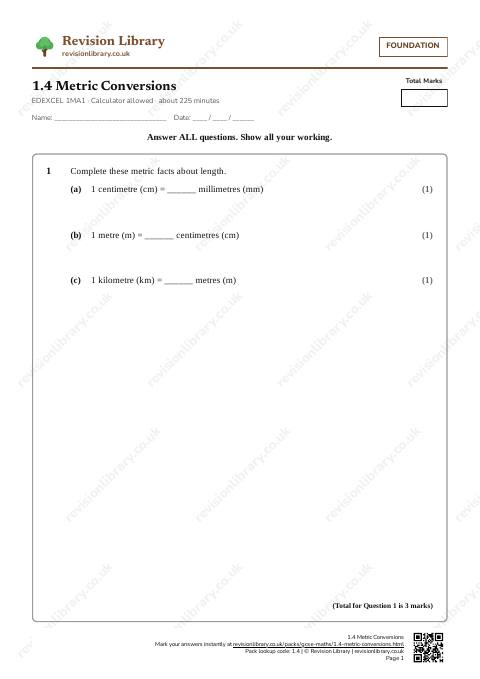
1.4 Metric Conversions
EDEXCEL 1MA1 · Calculator allowed · about 225 minutes
The diagram shows the dial of a kitchen scale, marked from 0 to 1000 g. The pointer is resting exactly on the 350 g mark.
(a)Write down the mass shown on the scale, in grams.(1)
(b)Convert this mass to kilograms.(1)
(Total for Question 2 is 2 marks)
3
Change 5500 mm into m.
(Total for Question 3 is 2 marks)
4
A recipe uses 450 g of flour. A shop has a 2.1 kg bag of flour. How many complete batches of the recipe can be made from the bag?
(Total for Question 4 is 3 marks)
5
Which is greater, 1.4 kg or 1409 g? You must show how you decide. Then write down the difference in g.
(Total for Question 5 is 3 marks)
6
Complete these metric facts about mass and capacity.
(a)1 kilogram (kg) = ______ grams (g)(1)
(b)1 litre (l) = ______ millilitres (ml)(1)
(c)1 tonne = ______ kilograms (kg)(1)
(Total for Question 6 is 3 marks)
7
Aisha walks 1.9 km and then 546 m. Work out the total distance she walks, in m.
(Total for Question 7 is 3 marks)
8
A recipe uses 200 g of butter. A shop has a 3.9 kg bag of butter. How many complete batches of the recipe can be made from the bag?
(Total for Question 8 is 3 marks)
9
A shop sells bottles of juice. Each bottle holds 375 ml. Work out the total volume, in litres, of 26 bottles.
(Total for Question 9 is 3 marks)
10
A recipe uses 150 g of sugar. A shop has a 6.6 kg bag of sugar. How many complete batches of the recipe can be made from the bag?
(Total for Question 10 is 3 marks)
11
Which is greater, 9.2 m or 941 cm? You must show how you decide. Then write down the difference in cm.
(Total for Question 11 is 3 marks)
12
Aisha walks 1.5 km and then 327 m. Work out the total distance she walks, in m.
(Total for Question 12 is 3 marks)
13
A recipe uses 250 g of rice. A shop has a 4.5 kg bag of rice. How many complete batches of the recipe can be made from the bag?
(Total for Question 13 is 3 marks)
14
A shop sells bottles of juice. Each bottle holds 330 ml. Work out the total volume, in litres, of 19 bottles.
(Total for Question 14 is 3 marks)
15
Priti says that 3000 g is the same mass as one of these amounts. Circle the correct amount.
A) 0.3 kg
B) 3 kg
C) 30 kg
D) 300 kg
(Total for Question 15 is 1 mark)
16
A recipe uses 120 g of sugar. A shop has a 4.4 kg bag of sugar. How many complete batches of the recipe can be made from the bag?
(Total for Question 16 is 3 marks)
17
Which is greater, 5.5 km or 5535 m? You must show how you decide. Then write down the difference in m.
(Total for Question 17 is 3 marks)
18
A recipe uses 150 g of flour. A shop has a 2.1 kg bag of flour. How many complete batches of the recipe can be made from the bag?
(Total for Question 18 is 3 marks)
19
A shop sells bottles of juice. Each bottle holds 400 ml. Work out the total volume, in litres, of 16 bottles.
(Total for Question 19 is 3 marks)
20
A recipe uses 450 g of butter. A shop has a 4.9 kg bag of butter. How many complete batches of the recipe can be made from the bag?
(Total for Question 20 is 3 marks)
21
Which is greater, 4.3 litres or 4293 ml? You must show how you decide. Then write down the difference in ml.
(Total for Question 21 is 3 marks)
22
Aisha walks 3.2 km and then 906 m. Work out the total distance she walks, in km.
(Total for Question 22 is 3 marks)
23
A recipe uses 300 g of butter. A shop has a 3.6 kg bag of butter. How many complete batches of the recipe can be made from the bag?
(Total for Question 23 is 3 marks)
24
A shop sells bottles of juice. Each bottle holds 200 ml. Work out the total volume, in litres, of 7 bottles.
(Total for Question 24 is 3 marks)
25
Convert each length to the unit shown.
(a)Convert 8 cm to mm(1)
(b)Convert 5 m to cm(1)
(c)Convert 360 cm to m(1)
(Total for Question 25 is 3 marks)
26
Aisha walks 1.3 km and then 645 m. Work out the total distance she walks, in km.
(Total for Question 26 is 3 marks)
27
A shop sells bottles of juice. Each bottle holds 375 ml. Work out the total volume, in litres, of 23 bottles.
(Total for Question 27 is 3 marks)
28
Which is greater, 6 litres or 6033 ml? You must show how you decide. Then write down the difference in ml.
(Total for Question 28 is 3 marks)
29
Aisha walks 0.9 km and then 550 m. Work out the total distance she walks, in m.
(Total for Question 29 is 3 marks)
30
A shop sells bottles of juice. Each bottle holds 150 ml. Work out the total volume, in litres, of 11 bottles.
(Total for Question 30 is 3 marks)
31
Which is greater, 5.7 litres or 5732 ml? You must show how you decide. Then write down the difference in ml.
(Total for Question 31 is 3 marks)
32
Aisha walks 1.1 km and then 602 m. Work out the total distance she walks, in km.
(Total for Question 32 is 3 marks)
33
Which is greater, 4.9 m or 458 cm? You must show how you decide. Then write down the difference in cm.
(Total for Question 33 is 3 marks)
34
Convert each distance or mass as shown.
(a)Convert 4000 m to km(1)
(b)Convert 2 kg to g(1)
(Total for Question 34 is 2 marks)
35
Aisha walks 0.8 km and then 517 m. Work out the total distance she walks, in m.
(Total for Question 35 is 3 marks)
36
A shop sells bottles of juice. Each bottle holds 375 ml. Work out the total volume, in litres, of 17 bottles.
(Total for Question 36 is 3 marks)
37
Which is greater, 3.4 kg or 3436 g? You must show how you decide. Then write down the difference in g.
(Total for Question 37 is 3 marks)
38
Aisha walks 1.6 km and then 343 m. Work out the total distance she walks, in m.
(Total for Question 38 is 3 marks)
39
Convert 5000 ml to litres.
(Total for Question 39 is 1 mark)
40
A pencil is 15 cm long. Ben places 4 identical pencils end to end in a straight line. Work out the total length of the 4 pencils in metres.
(Total for Question 40 is 2 marks)
41
Amara has a 2 litre bottle of milk. She uses 750 ml of the milk to make a batch of pancakes. Work out how much milk, in millilitres, is left in the bottle.
(Total for Question 41 is 2 marks)
42
Convert 3500 metres to kilometres.
(Total for Question 42 is 1 mark)
43
Convert 7.25 kilograms to grams.
(Total for Question 43 is 1 mark)
44
Convert 0.06 kilometres to metres.
(Total for Question 44 is 1 mark)
45
Convert 250 centimetres to metres.
(Total for Question 45 is 1 mark)
46
Convert 5.2 litres to millilitres.
(Total for Question 46 is 1 mark)
47
Convert 1250 grams to kilograms.
(Total for Question 47 is 1 mark)
48
Convert 6300 millimetres to metres.
(Total for Question 48 is 1 mark)
49
Convert 3.2 metres to centimetres.
(Total for Question 49 is 1 mark)
50
Convert 480 milligrams to grams.
(Total for Question 50 is 1 mark)
51
Convert 12.6 centimetres to millimetres.
(Total for Question 51 is 1 mark)
52
A bottle of squash concentrate holds 275 millilitres of liquid. Write this volume in litres.
(Total for Question 52 is 1 mark)
53
Here are three lengths. 2500 mm 3 m 280 cm Put the three lengths in order of size, starting with the smallest. You must show your working.
(Total for Question 53 is 2 marks)
54
A road sign shows that the distance to Leeds is 1200 m. A satnav shows that the distance to Leeds is 1.3 km. Which distance is longer? You must show your working and give a reason.
(Total for Question 54 is 2 marks)
55
A bag of flour has a mass of 1.2 kg. A recipe for one cake needs 350 g of flour. Work out the greatest number of whole cakes that can be made from the bag of flour. You must show your working.
(Total for Question 55 is 3 marks)
56
Convert each amount. You must show your method.
(a)Convert 1.5 kg to grams(1)
(b)Convert 2.25 litres to millilitres(1)
(c)Convert 3200 g to kilograms(1)
(Total for Question 56 is 3 marks)
57
A small water tank has a volume of 2.5 m³. Convert this volume to litres.
(Total for Question 57 is 2 marks)
58
Convert 1500 cm² to m2.
(Total for Question 58 is 2 marks)
59
Convert 0.00032 kilograms to milligrams.
(Total for Question 59 is 2 marks)
60
Convert 0.0135 grams to milligrams.
(Total for Question 60 is 2 marks)
61
A carton contains 1.5 litres of milk. Given that 1 cm³ = 1 ml, convert this volume to cm3.
(Total for Question 61 is 2 marks)
62
Convert 45 000 cm³ to m3.
(Total for Question 62 is 2 marks)
63
Convert 2900 kilograms to tonnes.
(Total for Question 63 is 1 mark)
64
A plank of wood is 2.4 metres long. Priya cuts it into 3 equal pieces. Work out the length of each piece in centimetres.
(Total for Question 64 is 2 marks)
65
The diagram shows a rectangle. The longer side is 1.2 m. The shorter side is 45 cm.
Diagram NOT accurately drawn
(a)Convert the length of the longer side to centimetres.(1)
(b)Work out the perimeter of the rectangle. Give your answer in metres.(3)
(Total for Question 65 is 4 marks)
66
A shop sells paint in two ways. Tin A: one tin containing 2.5 litres of paint. Pack B: a pack of 3 tins, each containing 800 ml of paint. Jake wants to buy whichever option gives the greater total amount of paint. Work out which option gives the greater amount of paint, and find the difference in millilitres. You must show your working.
(Total for Question 66 is 4 marks)
67
The table shows the length of four garden hoses.
Hose
Length
A
350 cm
B
2.9 m
C
190 cm
D
3.05 m
Work out the letter of the longest hose, and give its length in metres.
(Total for Question 67 is 2 marks)
68
A fish tank is a cuboid with internal dimensions 60 cm long, 30 cm wide and 40 cm deep. Bilal fills the tank completely with water. Work out the volume of water in the tank, giving your answer in litres.
Diagram NOT accurately drawn
(Total for Question 68 is 3 marks)
69
A school hall needs new square floor tiles for a stage area measuring 3.6 m by 2.7 m. Each tile has a side length of 30 cm. Work out how many tiles are needed to cover the stage area exactly.
(Total for Question 69 is 3 marks)
70
A farmer has a field of area 0.72 hectares. Work out the area in square metres.
(Total for Question 70 is 2 marks)
Mark scheme · 1.4 Metric Conversions
Question 1
(a) 10 caoB1
(a) Answer: 10
(b) 100 caoB1
(b) Answer: 100
(c) 1000 caoB1
(c) Answer: 1000
Question 2
(a) 350 g caoB1
(a) Answer: 350 g
(b) 0.35 kg cao (ft from part a)B1
(b) Answer: 0.35 kg
Question 3
divide by 1000M1
5.5 m caoA1
Answer: 5.5 m
Question 4
converts 2.1 kg to 2100 gM1
divides by 450M1
4 caoA1
Answer: 4
Question 5
converts one quantity to the unit of the otherM1
1409 g is greaterA1
9 gB1
Answer: 1409 g is greater; difference 9 g
Question 6
(a) 1000 caoB1
(a) Answer: 1000
(b) 1000 caoB1
(b) Answer: 1000
(c) 1000 caoB1
(c) Answer: 1000
Question 7
converts to the same unitM1
adds the two distancesM1
2446 m caoA1
Answer: 2446 m
Question 8
converts 3.9 kg to 3900 gM1
divides by 200M1
19 caoA1
Answer: 19
Question 9
375 x 26M1
divides by 1000M1
9.75 litres caoA1
Answer: 9.75 litres
Question 10
converts 6.6 kg to 6600 gM1
divides by 150M1
44 caoA1
Answer: 44
Question 11
converts one quantity to the unit of the otherM1
941 cm is greaterA1
21 cmB1
Answer: 941 cm is greater; difference 21 cm
Question 12
converts to the same unitM1
adds the two distancesM1
1827 m caoA1
Answer: 1827 m
Question 13
converts 4.5 kg to 4500 gM1
divides by 250M1
18 caoA1
Answer: 18
Question 14
330 x 19M1
divides by 1000M1
6.27 litres caoA1
Answer: 6.27 litres
Question 15
B (3 kg) caoB1
Answer: B) 3 kg
Question 16
converts 4.4 kg to 4400 gM1
divides by 120M1
36 caoA1
Answer: 36
Question 17
converts one quantity to the unit of the otherM1
5535 m is greaterA1
35 mB1
Answer: 5535 m is greater; difference 35 m
Question 18
converts 2.1 kg to 2100 gM1
divides by 150M1
14 caoA1
Answer: 14
Question 19
400 x 16M1
divides by 1000M1
6.4 litres caoA1
Answer: 6.4 litres
Question 20
converts 4.9 kg to 4900 gM1
divides by 450M1
10 caoA1
Answer: 10
Question 21
converts one quantity to the unit of the otherM1
4.3 litres is greaterA1
7 mlB1
Answer: 4.3 litres is greater; difference 7 ml
Question 22
converts to the same unitM1
adds the two distancesM1
4.106 km caoA1
Answer: 4.106 km
Question 23
converts 3.6 kg to 3600 gM1
divides by 300M1
12 caoA1
Answer: 12
Question 24
200 x 7M1
divides by 1000M1
1.4 litres caoA1
Answer: 1.4 litres
Question 25
(a) 80 mm caoB1
(a) Answer: 80 mm
(b) 500 cm caoB1
(b) Answer: 500 cm
(c) 3.6 m caoB1
(c) Answer: 3.6 m
Question 26
converts to the same unitM1
adds the two distancesM1
1.945 km caoA1
Answer: 1.945 km
Question 27
375 x 23M1
divides by 1000M1
8.625 litres caoA1
Answer: 8.625 litres
Question 28
converts one quantity to the unit of the otherM1
6033 ml is greaterA1
33 mlB1
Answer: 6033 ml is greater; difference 33 ml
Question 29
converts to the same unitM1
adds the two distancesM1
1450 m caoA1
Answer: 1450 m
Question 30
150 x 11M1
divides by 1000M1
1.65 litres caoA1
Answer: 1.65 litres
Question 31
converts one quantity to the unit of the otherM1
5732 ml is greaterA1
32 mlB1
Answer: 5732 ml is greater; difference 32 ml
Question 32
converts to the same unitM1
adds the two distancesM1
1.702 km caoA1
Answer: 1.702 km
Question 33
converts one quantity to the unit of the otherM1
4.9 m is greaterA1
32 cmB1
Answer: 4.9 m is greater; difference 32 cm
Question 34
(a) 4 km caoB1
(a) Answer: 4 km
(b) 2000 g caoB1
(b) Answer: 2000 g
Question 35
converts to the same unitM1
adds the two distancesM1
1317 m caoA1
Answer: 1317 m
Question 36
375 x 17M1
divides by 1000M1
6.375 litres caoA1
Answer: 6.375 litres
Question 37
converts one quantity to the unit of the otherM1
3436 g is greaterA1
36 gB1
Answer: 3436 g is greater; difference 36 g
Question 38
converts to the same unitM1
adds the two distancesM1
1943 m caoA1
Answer: 1943 m
Question 39
5 litres caoB1
Answer: 5 litres
Question 40
15 x 4 (= 60) or equivalent method to find total length in cmM1
0.6 m cao (oe 60 cm converted correctly)A1
Answer: 0.6 m
Question 41
2 litres converted to 2000 ml (or equivalent method)M1
1250 ml caoA1
Answer: 1250 ml
Question 42
3.5 km caoB1
Answer: 3.5 km, or 3.5 kilometres (cao).
Question 43
7250 g caoB1
Answer: 7250 g
Question 44
60 m caoB1
Answer: 60 m
Question 45
2.5 m caoB1
Answer: 2.5 m
Question 46
5200 ml caoB1
Answer: 5200 ml
Question 47
1.25 kg caoB1
Answer: 1.25 kg
Question 48
6.3 m caoB1
Answer: 6.3 m
Question 49
320 cm caoB1
Answer: 320 cm
Question 50
0.48 g caoB1
Answer: 0.48 g
Question 51
126 mm caoB1
Answer: 126 mm
Question 52
0.275 litres oe caoB1
Answer: 0.275 litres
Question 53
all three lengths correctly converted to a common unit, e.g. 250 cm, 280 cm, 300 cmM1
2500 mm, 280 cm, 3 m (smallest to largest) caoA1
Answer: 2500 mm, 280 cm, 3 m
Question 54
1.3 km converted to 1300 m (or 1200 m converted to 1.2 km)M1
correct conclusion that 1.3 km (1300 m) is longer, with 1300 > 1200 stated or impliedA1
Answer: 1.3 km is longer
Question 55
1.2 kg converted to 1200 gM1
1200 / 350 (= 3.42... or 1050 g used for 3 cakes with 150 g remaining)M1
3 cakes cao (correctly rounded down, not 3.43)A1
Answer: 3 cakes
Question 56
(a) 1.5 x 1000 = 1500 g caoM1
(a) Answer: 1500 g
(b) 2.25 x 1000 = 2250 ml caoM1
(b) Answer: 2250 ml
(c) 3200 / 1000 = 3.2 kg caoM1
(c) Answer: 3.2 kg
Question 57
use 1 m³ = 1000 litres, so 2.5 x 1000M1
2500 litres caoA1
Answer: 2500 litres
Question 58
recognise 1 m² = 10000 cm² and divide 1500 by 10000M1
0.15 m² caoA1
Answer: 0.15 m2
Question 59
use 1 kg = 1 000 000 mg and multiply 0.00032 x 1 000 000M1
320 mg caoA1
Answer: 320 mg
Question 60
use 1 g = 1000 mg and multiply 0.0135 x 1000M1
13.5 mg caoA1
Answer: 13.5 mg
Question 61
convert litres to millilitres: 1.5 x 1000 = 1500M1
1500 cm³ caoA1
Answer: 1500 cm3
Question 62
recognise 1 m³ = 1 000 000 cm³M1
0.045 m³ caoA1
Answer: 0.045 m3
Question 63
2.9 tonnes caoB1
Answer: 2.9 tonnes
Question 64
convert 2.4 m to 240 cm, or divide first, oeM1
80 cm caoA1
Answer: 80 cm
Question 65
(a) 120 cm caoB1
(a) Answer: 120 cm
(b) 120 + 45 (= 165) or equivalent, using consistent unitsM1
(b) 2 x 165 (= 330) to find the perimeter in cm, ft from part aM1
(b) 3.3 m caoA1
(b) Answer: 3.3 m
Question 66
2.5 litres converted to 2500 mlM1
3 x 800 (= 2400 ml) for Pack B totalM1
correct comparison, 2500 ml > 2400 mlA1
correct conclusion: Tin A gives more paint, by 100 ml, oeB1
Answer: Tin A gives more paint, by 100 ml
Question 67
convert all lengths to a common unit, e.g. A = 3.5 m, C = 1.9 m, oeM1
A, 3.5 m caoA1
Answer: Hose A, 3.5 m
Question 68
volume = 60 x 30 x 40M1
72 000 (cm3) oe, allow answer left in cm3 at this stageM1
72 litres cao, dividing their cm3 volume by 1000A1
Answer: 72 litres
Question 69
convert tile side to metres: 30 cm = 0.3 m, oeM1
area of one tile = 0.3 x 0.3 = 0.09 m², or area of stage = 3.6 x 2.7 = 9.72 m², oeM1
108 tiles caoA1
Answer: 108 tiles
Question 70
use 1 hectare = 10 000 m² and multiply 0.72 x 10 000M1
Put this topic and others into one printable pack.
Open the Pack Builder
Worksheets are written for Revision Library and come with a full mark scheme; a few English packs quote an out-of-copyright text, and name it on the page. Exam board names and specification codes say which qualification a pack suits: we are not affiliated with, endorsed by or approved by any exam board, and no past-paper question is reproduced here. Rights queries: hello@revisionlibrary.co.uk