Time problems test converting between units of time (seconds, minutes, hours, days), reading and converting between 12-hour and 24-hour clocks, and calculating durations using timetables. Time appears frequently on GCSE Foundation papers as calculator-allowed structured word problems involving journeys, appointments and events.
To convert 12-hour to 24-hour time, add 12 to any pm hour after 12 (e.g. 3:15 pm = 15:15); am times before 12 stay the same, except 12 am which becomes 00:00.
When finding a duration, count up in convenient chunks (e.g. to the next hour, then in hours, then in remaining minutes) rather than subtracting the times like decimals.
Remember time is not decimal: 1.5 hours means 1 hour 30 minutes, not 1 hour 50 minutes, so convert minutes using out of 60, not out of 100.
For timetable questions, read the correct row and column carefully, and check whether a journey crosses midnight.
Check your final answer makes sense in context; a journey or lesson lasting an unreasonable number of hours signals an error.
Worked example
A train leaves Bristol at 14:35. The journey to Cardiff takes 1 hour 50 minutes. Work out the time the train arrives in Cardiff.
Add 1 hour to 14:35: 14:35 + 1 hour = 15:35.
There are 50 minutes left to add.
Add 25 minutes to reach the next hour: 15:35 + 25 minutes = 16:00.
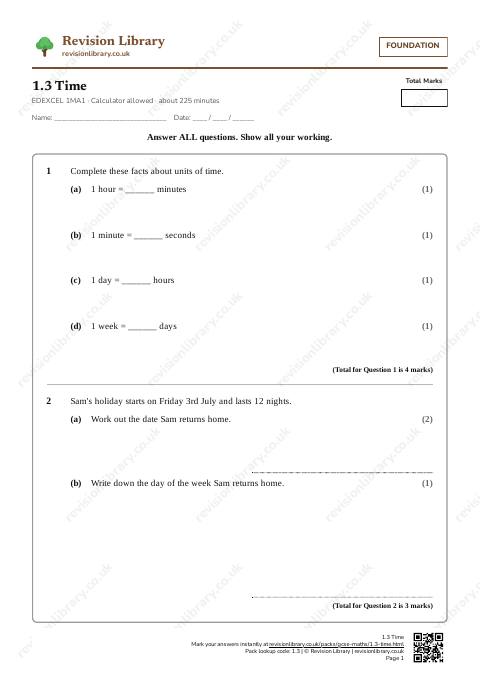
Sam's holiday starts on Friday 3rd July and lasts 12 nights.
(a)Work out the date Sam returns home.(2)
(b)Write down the day of the week Sam returns home.(1)
(Total for Question 2 is 3 marks)
3
A train leaves Manchester at 13:45. The journey to Leeds takes 2 hours 50 minutes. Work out the time the train arrives in Leeds.
(Total for Question 3 is 2 marks)
4
A meeting must finish by 15:15. The meeting lasts 1 hour 40 minutes. Work out the latest time the meeting can start.
(Total for Question 4 is 2 marks)
5
A decorating job takes 1.75 hours.
(a)Write this time in hours and minutes.(2)
(b)Write 45 minutes as a decimal fraction of an hour.(1)
(Total for Question 5 is 3 marks)
6
Here is part of a train timetable. Norbury 10:12 Ashfield 10:29 Kingsmere 10:47 Dunholt 11:05 A second train on the same route runs 25 minutes earlier at every station, leaving Norbury at 09:47.
(a)Work out how long the 10:12 train from Norbury takes to travel from Ashfield to Dunholt.(2)
(b)Ellie needs to arrive at Kingsmere before 10:45 for an appointment. Explain, giving a reason, which of the two trains she should catch.(2)
(Total for Question 6 is 4 marks)
7
Priya is cooking a roast dinner for lunch at 13:00. The joint of meat needs 15 minutes to prepare, then 1 hour 50 minutes in the oven, then 20 minutes to rest before serving. Work out the latest time Priya must start preparing the meat so that lunch is ready at 13:00.
(Total for Question 7 is 4 marks)
8
Four runners' finish times in a race are: 24 minutes 10 seconds, 25 minutes 40 seconds, 23 minutes 55 seconds, 26 minutes 15 seconds. Work out the mean finish time for the four runners.
(Total for Question 8 is 3 marks)
9
Convert each amount of time as shown.
(a)Convert 3 hours to minutes.(1)
(b)Convert 150 seconds to minutes and seconds.(1)
(c)Convert 2 days to hours.(1)
(Total for Question 9 is 3 marks)
10
A film starts at 10:40. It lasts 3 hours and 44 minutes. At what time does the film end? Give your answer in the 24-hour clock.
(Total for Question 10 is 2 marks)
11
A film starts at 16:25. It lasts 2 hours and 19 minutes. At what time does the film end? Give your answer in the 24-hour clock.
(Total for Question 11 is 2 marks)
12
The diagram shows a clock face. The hour hand points exactly at the 7. The minute hand points exactly at the 12.
(a)Write down the time shown on the clock.(1)
(b)Chloe looks at this clock as she leaves home to catch the school bus. State whether it is more likely to be am or pm, giving a reason.(1)
(Total for Question 12 is 2 marks)
13
Convert each time from the 12-hour clock to the 24-hour clock.
(a)3:15 pm(1)
(b)9:40 am(1)
(c)11:05 pm(1)
(d)12:30 am(1)
(Total for Question 13 is 4 marks)
14
Convert each time from the 24-hour clock to the 12-hour clock.
(a)14:20(1)
(b)06:55(1)
(c)23:45(1)
(d)00:10(1)
(Total for Question 14 is 4 marks)
15
Here is part of a bus timetable for buses from Elmswood to Radcastle. Elmswood 08:05 08:35 09:05 Kings Road 08:14 08:44 09:14 Radcastle 08:33 09:03 09:33
(a)Priya catches the 08:35 bus from Elmswood. Write down the time she should expect to arrive at Radcastle.(1)
(b)Work out how long the journey from Elmswood to Radcastle takes.(2)
(c)The 09:05 bus is delayed and leaves Elmswood 12 minutes late, but still takes the same journey time to Radcastle. Work out the time it arrives at Radcastle.(2)
(Total for Question 15 is 5 marks)
16
A dentist appointment starts at 9:20 am and ends at 11:55 am. Work out how long the appointment lasts.
(Total for Question 16 is 2 marks)
17
A car journey starts at 11:40 am and ends at 2:05 pm. Work out the duration of the journey.
(Total for Question 17 is 2 marks)
18
A late-night film starts at 22:40 and finishes at 00:55 the following day. Show that the film lasts 2 hours 15 minutes.
(Total for Question 18 is 3 marks)
19
Complete these facts about units of time.
(a)1 year = ______ months(1)
(b)1 leap year = ______ days(1)
(c)1 fortnight = ______ days(1)
(d)1 decade = ______ years(1)
(Total for Question 19 is 4 marks)
20
Oliwia starts a 17-day work placement on Monday 8th September.
(a)Work out the date that is 17 days after 8th September.(2)
(b)Write down the day of the week for this date.(1)
(Total for Question 20 is 3 marks)
21
A coach leaves Bristol at 09:20. The journey to Newquay takes 3 hours 35 minutes. Work out the time the coach arrives in Newquay.
(Total for Question 21 is 2 marks)
22
A parcel must be dropped off at a depot by 16:20. It takes 55 minutes to drive to the depot. Work out the latest time the driver can leave home to arrive by 16:20.
(Total for Question 22 is 2 marks)
23
A running club session lasts 2.4 hours.
(a)Write this time in hours and minutes.(2)
(b)Write 24 minutes as a decimal fraction of an hour.(1)
(Total for Question 23 is 3 marks)
24
Callum works out the length of his piano lesson, which starts at 14:35 and finishes at 15:20, like this: 15.20 - 14.35 = 0.85 hours = 51 minutes
(a)Explain the error in Callum's method.(2)
(b)Work out the correct length of the lesson.(2)
(Total for Question 24 is 4 marks)
25
A florist needs the flowers ready in time for a 13:15 ceremony. Preparing each of the 3 bouquets takes 20 minutes, and the delivery van journey to the venue takes 25 minutes. Work out the latest time the florist must start preparing the bouquets so that everything is ready for the ceremony.
(Total for Question 25 is 4 marks)
26
Four parcels take these times to be delivered: 18 minutes 40 seconds, 22 minutes 5 seconds, 19 minutes 55 seconds, 21 minutes 20 seconds. Work out the mean delivery time.
(Total for Question 26 is 3 marks)
27
Convert each amount of time as shown.
(a)Convert 100 minutes to hours and minutes.(1)
(b)Convert 3.5 days to hours.(1)
(c)Convert 3 weeks to days.(1)
(Total for Question 27 is 3 marks)
28
The diagram shows a clock face. The hour hand points between the 6 and the 7, closer to the 7. The minute hand points exactly at the 10.
(a)Write down the time shown on the clock, using the 12-hour clock.(1)
(b)Yusuf sees this clock as he gets on the bus home after visiting a friend, after dark. State whether it is more likely to be am or pm, giving a reason.(1)
(c)Write the time shown using the 24-hour clock.(1)
(Total for Question 28 is 3 marks)
29
Convert each time from the 12-hour clock to the 24-hour clock.
(a)8:05 am(1)
(b)12:15 pm(1)
(c)7:50 pm(1)
(d)12:05 am(1)
(Total for Question 29 is 4 marks)
30
Convert each time from the 24-hour clock to the 12-hour clock.
(a)12:00(1)
(b)00:00(1)
(c)19:35(1)
(d)08:05(1)
(Total for Question 30 is 4 marks)
31
Here is part of a tram timetable for trams from Norwood to Kingsbridge. Norwood 07:52 08:22 08:52 Fenwick 08:01 08:31 09:01 Kingsbridge 08:19 08:49 09:19
(a)Nadia catches the 08:22 tram from Norwood. Write down the time she should expect to arrive at Kingsbridge.(1)
(b)Work out how long the journey from Norwood to Kingsbridge takes.(2)
(c)The 08:52 tram is delayed and leaves Norwood 9 minutes late, but still takes the same journey time to Kingsbridge. Work out the time it arrives at Kingsbridge.(2)
(Total for Question 31 is 5 marks)
32
A hair appointment starts at 10:15 am and ends at 12:05 pm. Work out how long the appointment lasts.
(Total for Question 32 is 2 marks)
33
A flight leaves at 11:50 am and lands at 1:35 pm. Work out the duration of the flight.
(Total for Question 33 is 2 marks)
34
A firework display starts at 23:15 and finishes at 00:40 the following day. Show that the display lasts 1 hour 25 minutes.
(Total for Question 34 is 3 marks)
35
Write down 7:45 pm in 24-hour clock notation.
(Total for Question 35 is 1 mark)
36
Write down 12:00 midnight in 24-hour clock notation.
(Total for Question 36 is 1 mark)
37
Work out the time 6:20 plus 45 minutes.
(Total for Question 37 is 1 mark)
38
How many minutes are there in 2 hours 35 minutes?
(Total for Question 38 is 1 mark)
39
A cinema screening is listed on the board as 20:50. Write down 20:50 in 12-hour clock notation. Include am or pm.
(Total for Question 39 is 1 mark)
40
A bus is scheduled to leave at 2:40 but is delayed by 35 minutes. Work out the time the bus actually leaves.
(Total for Question 40 is 1 mark)
41
Write each time in 24-hour clock notation.
(a)9:30 am(1)
(b)9:30 pm(1)
(Total for Question 41 is 2 marks)
42
Jake wants to travel from Elmswood to Milbury for a meeting that starts at 10:30. He will use the bus timetable from Question 15 to travel from Elmswood to Radcastle, then catch a train from Radcastle to Milbury. Here is the train timetable from Radcastle to Milbury. Radcastle depart 09:15 09:45 10:00 Milbury arrive 09:50 10:20 10:35 Jake needs to arrive in Milbury at least 10 minutes before his meeting starts. Using the bus timetable from Question 15 and the train timetable above, work out the latest bus Jake can catch from Elmswood so that he arrives in Milbury in time for his meeting. You must show your working.
(Total for Question 42 is 6 marks)
43
A swimming pool opens at 06:30 and closes at 21:00 every day. Each day the pool is closed for cleaning between 13:00 and 14:15.
(a)Work out the total time, in hours and minutes, that the pool is open in one day.(4)
(b)Work out the total time, in hours, that the pool is open during one week (7 days). Give your answer correct to 1 decimal place.(2)
(Total for Question 43 is 6 marks)
44
Here is part of a school day timetable. 08:50 to 09:00 Registration 09:00 to 09:50 Lesson 1 09:50 to 10:40 Lesson 2 10:40 to 11:00 Break 11:00 to 12:15 Lesson 3 12:15 to 13:00 Lunch 13:00 to 13:50 Lesson 4 13:50 to 14:40 Lesson 5
(a)Work out the total time spent in lessons (Lesson 1 to Lesson 5 only) during the school day. Give your answer in hours and minutes.(3)
(b)Work out the total length of the school day, from the start of registration to the end of Lesson 5. Give your answer in hours and minutes.(1)
(Total for Question 44 is 4 marks)
45
This question is about converting between different time formats.
(a)A cake needs to bake for 2 3/4 hours. Work out how many minutes this is.(2)
(b)A marathon runner's finish time is recorded as 3:47:52 (hours:minutes:seconds). Work out this time in minutes, giving your answer correct to the nearest minute.(2)
(Total for Question 45 is 4 marks)
46
Leah wants to travel from Sandbay to Wraxton for a meeting that starts at 13:30. She will use the timetable below to catch a ferry from Sandbay to Millport, then catch a bus from Millport to Wraxton. Here is the ferry timetable from Sandbay to Millport. Sandbay depart 11:05 11:35 12:05 Millport arrive 11:27 11:57 12:27 Here is the bus timetable from Millport to Wraxton. Millport depart 11:40 12:10 12:40 Wraxton arrive 12:15 12:45 13:15 Leah needs to arrive in Wraxton at least 10 minutes before her meeting starts. Using both timetables, work out the latest ferry Leah can catch from Sandbay so that she arrives in Wraxton in time for her meeting. You must show your working.
(Total for Question 46 is 6 marks)
47
A gym opens at 06:00 and closes at 22:30 every day. Each day the gym is closed for maintenance between 12:30 and 13:45.
(a)Work out the total time, in hours and minutes, that the gym is open in one day.(4)
(b)Work out the total time, in hours, that the gym is open during one week (7 days). Give your answer correct to 1 decimal place.(2)
(Total for Question 47 is 6 marks)
48
Here is part of a college timetable. 09:15 to 09:20 Registration 09:20 to 10:15 Session 1 10:15 to 11:05 Session 2 11:05 to 11:25 Break 11:25 to 12:40 Session 3 12:40 to 13:20 Lunch 13:20 to 14:05 Session 4
(a)Work out the total time spent in taught sessions (Session 1 to Session 4 only) during the day. Give your answer in hours and minutes.(3)
(b)Work out the total length of the day, from the start of registration to the end of Session 4. Give your answer in hours and minutes.(1)
(Total for Question 48 is 4 marks)
49
This question is about converting between different time formats.
(a)A yoga class lasts 1 5/6 hours. Work out how many minutes this is.(2)
(b)A cyclist's finish time is recorded as 2:18:37 (hours:minutes:seconds). Work out this time in minutes, giving your answer correct to the nearest minute.(2)
(Total for Question 49 is 4 marks)
50
A train leaves at 11:55 am and arrives at 14:05. Work out the duration of the journey.
(Total for Question 50 is 2 marks)
51
A bus leaves at 09:15 and the journey takes 2 hours 40 minutes. At what time does the bus arrive?
(Total for Question 51 is 1 mark)
52
A coach departs Sheffield at 08:05. The journey to Nottingham takes 1 hour 40 minutes. Work out the arrival time.
(Total for Question 52 is 1 mark)
53
A train arrives at 15:50 after a journey lasting 3 hours 15 minutes. Work out the time the train departed.
(Total for Question 53 is 2 marks)
54
A delivery van arrives at a warehouse at 13:10 after a journey lasting 2 hours 45 minutes. Work out the time the van left.
(Total for Question 54 is 2 marks)
55
Priya can travel from Town X to Town Z in two ways. Direct: depart X 17:40, journey time 1 hour 50 minutes. Via Town Y: depart X 17:20 to Y (journey 40 minutes), then a connection Y to Z departs 18:15 and takes 35 minutes. Work out the arrival time for each route and state which route gets Priya to Town Z earlier.
(Total for Question 55 is 3 marks)
56
An overnight service departs Monday at 23:55 and the scheduled duration is 18 hours 40 minutes. On which day and at what time does it arrive?
(Total for Question 56 is 3 marks)
Mark scheme · 1.3 Time
Question 1
(a) 60 caoB1
(a) Answer: 60
(b) 60 caoB1
(b) Answer: 60
(c) 24 caoB1
(c) Answer: 24
(d) 7 caoB1
(d) Answer: 7
Question 2
(a) 3 + 12 (= 15) or equivalent method to add 12 days to 3rd JulyM1
(a) 15th July caoA1
(a) Answer: 15th July
(b) Wednesday cao ft from part aB1
(b) Answer: Wednesday
Question 3
13:45 + 2 hours (= 15:45) or equivalent partial methodM1
16:35 caoA1
Answer: 16:35
Question 4
15:15 - 1 hour (= 14:15) or equivalent partial methodM1
13:35 caoA1
Answer: 13:35
Question 5
(a) 0.75 x 60 (= 45) or equivalent method to convert the decimal part to minutesM1
(a) 1 hour 45 minutes caoA1
(a) Answer: 1 hour 45 minutes
(b) 0.75 cao (oe 3/4)B1
(b) Answer: 0.75
Question 6
(a) 10:29 to 11:05, correctly identified as the relevant timesM1
(a) 36 minutes caoA1
(a) Answer: 36 minutes
(b) 09:47 + 35 minutes (= 10:22), the arrival time of the earlier train at Kingsmere, ft from the 25 minute offsetM1
(b) correct conclusion: the 09:47 train, because it arrives at 10:22 (before 10:45), whereas the 10:12 train arrives at 10:47 (after 10:45)A1
(b) Answer: the 09:47 train
Question 7
15 + 110 + 20 (= 145 minutes) or equivalent method to find the total time neededM1
(a) 8 + 17 (= 25) or equivalent method to add 17 days to 8th SeptemberM1
(a) 25th September caoA1
(a) Answer: 25th September
(b) Thursday cao ft from part aB1
(b) Answer: Thursday
Question 21
09:20 + 3 hours (= 12:20) or equivalent partial methodM1
12:55 caoA1
Answer: 12:55
Question 22
16:20 - 1 hour (= 15:20) or equivalent partial methodM1
15:25 caoA1
Answer: 15:25
Question 23
(a) 0.4 x 60 (= 24) or equivalent method to convert the decimal part to minutesM1
(a) 2 hours 24 minutes caoA1
(a) Answer: 2 hours 24 minutes
(b) 0.4 cao (oe 2/5)B1
(b) Answer: 0.4
Question 24
(a) identifies that Callum has treated the times as decimal numbers (e.g. treating 35 minutes as 0.35 and 20 minutes as 0.20) rather than using the fact that there are 60 minutes in an hourC1
(a) states that this means the subtraction does not give a correct number of minutes, so his answer of 51 minutes is wrongC1
(a) Answer: Callum has treated the minutes as decimals instead of using 60 minutes in an hour, so his answer is wrong
(b) 14:35 to 15:00 (= 25 minutes) or equivalent partial methodM1
(b) 45 minutes caoA1
(b) Answer: 45 minutes
Question 25
3 x 20 (= 60 minutes) or equivalent method to find the total preparation timeM1
60 + 25 (= 85 minutes) or equivalent method to find the total time neededM1
85 minutes converted to 1 hour 25 minutes, then 13:15 - 1 hour 25 minutes attemptedM1
11:50 caoA1
Answer: 11:50
Question 26
each time converted to a consistent unit, e.g. seconds: 1120, 1325, 1195, 1280M1
sum of the four times (= 4920 seconds) divided by 4M1
20 minutes 30 seconds caoA1
Answer: 20 minutes 30 seconds
Question 27
(a) 1 hour 40 minutes caoB1
(a) Answer: 1 hour 40 minutes
(b) 84 hours caoB1
(b) Answer: 84 hours
(c) 21 days caoB1
(c) Answer: 21 days
Question 28
(a) 6:50 cao (oe 10 minutes to 7)B1
(a) Answer: 6:50
(b) pm, with a valid reason (e.g. it is already dark, and people usually travel home from a friend's house in the evening rather than at 6:50 am) ft from part aB1
(b) Answer: pm
(c) 18:50 cao ft from part aB1
(c) Answer: 18:50
Question 29
(a) 08:05 caoB1
(a) Answer: 08:05
(b) 12:15 caoB1
(b) Answer: 12:15
(c) 19:50 caoB1
(c) Answer: 19:50
(d) 00:05 caoB1
(d) Answer: 00:05
Question 30
(a) 12 noon cao (oe 12:00 pm)B1
(a) Answer: 12 noon
(b) 12 midnight cao (oe 12:00 am)B1
(b) Answer: 12 midnight
(c) 7:35 pm caoB1
(c) Answer: 7:35 pm
(d) 8:05 am caoB1
(d) Answer: 8:05 am
Question 31
(a) 08:49 caoB1
(a) Answer: 08:49
(b) correct attempt to find the difference between a Norwood departure time and its matching Kingsbridge arrival time, e.g. 07:52 to 08:19M1
(b) 27 minutes caoA1
(b) Answer: 27 minutes
(c) 09:19 + 9 minutes, or equivalent method using the 27 minute journey time from a new departure of 09:01M1
(c) 09:28 caoA1
(c) Answer: 09:28
Question 32
10:15 am to 11:15 am (= 1 hour) or equivalent partial methodM1
1 hour 50 minutes caoA1
Answer: 1 hour 50 minutes
Question 33
11:50 am to 12:50 pm (= 1 hour) or equivalent partial methodM1
1 hour 45 minutes caoA1
Answer: 1 hour 45 minutes
Question 34
23:15 to 00:00 (= 45 minutes)M1
00:00 to 00:40 (= 40 minutes) added to the previous stageM1
cso: correctly shows 45 minutes + 40 minutes = 1 hour 25 minutes, with the printed answer clearly reachedA1
Answer: 1 hour 25 minutes
Question 35
19:45 caoB1
Answer: 19:45
Question 36
00:00 caoB1
Answer: 00:00
Question 37
7:05 caoB1
Answer: 7:05
Question 38
155 minutes caoB1
Answer: 155 minutes
Question 39
8:50 pm caoB1
Answer: 8:50 pm
Question 40
3:15 caoB1
Answer: 3:15
Question 41
(a) 09:30 caoB1
(a) Answer: 09:30
(b) 21:30 caoB1
(b) Answer: 21:30
Question 42
correctly finds the latest permitted arrival time in Milbury: 10:30 - 10 minutes = 10:20M1
correctly identifies the train departing Radcastle at 09:45 (arriving Milbury 10:20) as the latest suitable train, since the 10:00 train arrives at 10:35, which is too lateM1
correctly identifies that Jake must arrive at Radcastle before the 09:45 train departsM1
correctly reads the Question 15 timetable to find Radcastle arrival times: 08:33, 09:03, 09:33 for the three busesM1
correctly identifies the 09:05 bus from Elmswood (arriving Radcastle 09:33) as the latest bus that still allows Jake to catch the 09:45 trainA1
clear supporting reason given, e.g. the 09:05 bus arrives at Radcastle at 09:33, in time for the 09:45 train, which reaches Milbury at 10:20, exactly 10 minutes before the 10:30 meetingB1
Answer: the 09:05 bus from Elmswood
Question 43
(a) 06:30 to 21:00 (= 14 hours 30 minutes) found as the total opening period before the closure is removedM1
(a) 13:00 to 14:15 (= 1 hour 15 minutes) found as the length of the cleaning closureM1
(a) sum of the five lesson lengths (= 275 minutes)M1
(a) 4 hours 35 minutes caoA1
(a) Answer: 4 hours 35 minutes
(b) 5 hours 50 minutes caoB1
(b) Answer: 5 hours 50 minutes
Question 45
(a) 2 3/4 x 60, or 2 hours (= 120 minutes) plus 3/4 hour (= 45 minutes)M1
(a) 165 minutes caoA1
(a) Answer: 165 minutes
(b) 3 x 60 + 47 + 52/60 (= 227.86... minutes), correct method to combine all three units into minutesM1
(b) awrt 228 minutesA1
(b) Answer: 228 minutes (awrt)
Question 46
correctly finds the latest permitted arrival time in Wraxton: 13:30 - 10 minutes = 13:20M1
correctly identifies the bus arriving Wraxton at 13:15 (departing Millport at 12:40) as the latest suitable bus, since there is no later bus arriving by 13:20M1
correctly identifies that Leah must arrive at Millport before the 12:40 bus departsM1
correctly reads the ferry timetable to find Millport arrival times: 11:27, 11:57, 12:27 for the three ferriesM1
correctly identifies the 12:05 ferry from Sandbay (arriving Millport 12:27) as the latest ferry that still allows Leah to catch the 12:40 busA1
clear supporting reason given, e.g. the 12:05 ferry arrives at Millport at 12:27, in time for the 12:40 bus, which reaches Wraxton at 13:15, before the 13:20 deadlineB1
Answer: the 12:05 ferry from Sandbay
Question 47
(a) 06:00 to 22:30 (= 16 hours 30 minutes) found as the total opening period before the closure is removedM1
(a) 12:30 to 13:45 (= 1 hour 15 minutes) found as the length of the maintenance closureM1
Put this topic and others into one printable pack.
Open the Pack Builder
Worksheets are written for Revision Library and come with a full mark scheme; a few English packs quote an out-of-copyright text, and name it on the page. Exam board names and specification codes say which qualification a pack suits: we are not affiliated with, endorsed by or approved by any exam board, and no past-paper question is reproduced here. Rights queries: hello@revisionlibrary.co.uk