Fractions are numbers written as one whole number, the numerator, over another, the denominator, representing a part of a whole, including adding, subtracting, multiplying and dividing fractions and mixed numbers. This is tested throughout GCSE Foundation and Higher papers, often inside money or measurement word problems.
For addition or subtraction, convert both fractions to a common denominator (using the LCM of the two denominators) before combining the numerators.
For multiplication, multiply the numerators together and multiply the denominators together, then simplify.
For division, keep the first fraction, change divide to multiply, and use the reciprocal (flip the numerator and denominator) of the second fraction.
Convert any mixed numbers to improper fractions before multiplying or dividing; for adding or subtracting you can also deal with whole numbers and fraction parts separately.
Simplify your final answer by dividing the numerator and denominator by their highest common factor, then convert back to a mixed number if the question asks for one.
When a question asks for a fraction of an amount, multiply the amount by the fraction, or equivalently divide by the denominator and then multiply by the numerator.
Worked example
Work out 2 1/3 + 1 3/4. Give your answer as a mixed number in its simplest form.
Convert each mixed number to an improper fraction: 2 1/3 = 7/3 and 1 3/4 = 7/4.
Find a common denominator for 3 and 4, which is 12.
Rewrite each fraction with denominator 12: 7/3 = 28/12 and 7/4 = 21/12.
Add the numerators: 28/12 + 21/12 = 49/12.
Convert 49/12 back to a mixed number: 49 divided by 12 is 4 remainder 1, so 49/12 = 4 1/12.
Check that 1/12 cannot be simplified further, so the final answer is 4 1/12.
Revision Library
revisionlibrary.co.uk
GCSE · Number - Fractions
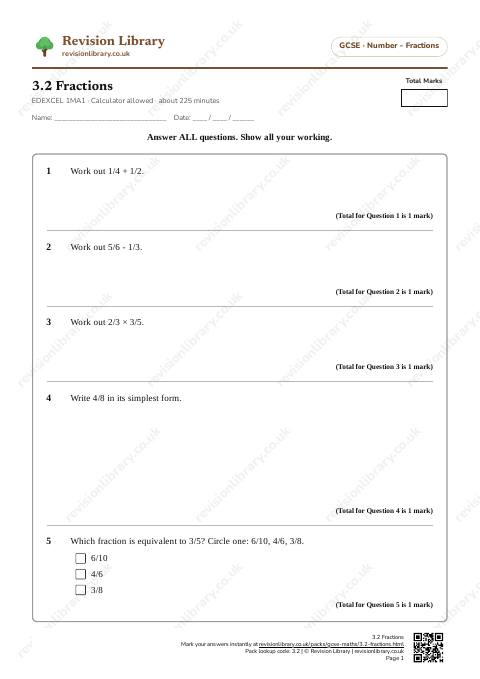
3.2 Fractions
EDEXCEL 1MA1 · Calculator allowed · about 225 minutes
Which fraction is equivalent to 3/5? Circle one: 6/10, 4/6, 3/8.
6/10
4/6
3/8
(Total for Question 5 is 1 mark)
6
Work out 7/9 - 4/9. Give your answer in its simplest form.
(Total for Question 6 is 2 marks)
7
Write 29/6 as a mixed number.
(Total for Question 7 is 1 mark)
8
Work out 3/5 ÷ 3.
(Total for Question 8 is 2 marks)
9
Work out 7/8 of 24.
(Total for Question 9 is 2 marks)
10
Work out 2 2/5 + 1 4/5. Give your answer as a mixed number.
(Total for Question 10 is 2 marks)
11
Work out 1/4 + 1/4.
(Total for Question 11 is 2 marks)
12
Work out 5/6 - 1/6.
(Total for Question 12 is 2 marks)
13
Work out 2 x 3/7.
(Total for Question 13 is 2 marks)
14
Work out 5 1/4 - 2 5/6. Give your answer as a mixed number in its simplest form.
(Total for Question 14 is 3 marks)
15
Work out 2 1/2 x 1 1/3. Give your answer as a mixed number in its simplest form.
(Total for Question 15 is 3 marks)
16
Work out 3 1/3 divided by 1 2/5. Give your answer as a mixed number in its simplest form.
(Total for Question 16 is 3 marks)
17
Priya has £84. She spends 2/7 of it on a coat. She then spends 1/4 of what remains on a book. Work out how much money Priya has left.
(Total for Question 17 is 3 marks)
18
A recipe for 8 people needs 2 1/2 cups of flour and 3/4 cup of sugar. Aisha wants to make enough of the recipe for 20 people.
(a)Work out how many cups of flour Aisha needs for 20 people.(2)
(b)Work out how many cups of sugar Aisha needs for 20 people.(2)
(Total for Question 18 is 4 marks)
19
A piece of ribbon is 96 cm long. Ben cuts off 3/8 of the ribbon.
(a)Work out the length of ribbon that Ben cuts off.(2)
(b)Chloe then cuts off 3/5 of the ribbon that remains after Ben's cut. Work out the length of ribbon that is left.(2)
(Total for Question 19 is 4 marks)
20
Work out 2 2/5 - 1 3/5 Give your answer as a mixed number in its simplest form.
(Total for Question 20 is 3 marks)
21
Work out 1/2 - 2/9 Give your answer as a fraction in its simplest form.
(Total for Question 21 is 2 marks)
22
Work out 4 1/3 x 1 5/6 Give your answer as a mixed number in its simplest form.
(Total for Question 22 is 3 marks)
23
Work out 3/4 / 5/9 Give your answer as a fraction in its simplest form.
(Total for Question 23 is 2 marks)
24
Work out 3 1/2 + 3 3/4 Give your answer as a mixed number in its simplest form.
(Total for Question 24 is 3 marks)
25
Maya spends 2/3 of her wages on travel. She then spends 1/2 of the money she has left on books. What fraction of her wages does Maya have left? Give your answer in its simplest form.
(Total for Question 25 is 3 marks)
26
Work out 3 1/2 x 3 2/3 Give your answer as a mixed number in its simplest form.
(Total for Question 26 is 3 marks)
27
Work out 4/5 - 7/10 Give your answer as a fraction in its simplest form.
(Total for Question 27 is 2 marks)
28
Maya spends 5/8 of her wages on rent. She then spends 1/2 of the money she has left on clothes. What fraction of her wages does Maya have left? Give your answer in its simplest form.
(Total for Question 28 is 3 marks)
29
Work out 2 1/3 - 1 2/3 Give your answer as a mixed number in its simplest form.
(Total for Question 29 is 3 marks)
30
Work out 1/4 x 1/3 Give your answer as a fraction in its simplest form.
(Total for Question 30 is 2 marks)
31
Work out 4 2/3 - 3 3/4 Give your answer as a mixed number in its simplest form.
(Total for Question 31 is 3 marks)
32
Maya spends 1/10 of her wages on food. She then spends 3/8 of the money she has left on games. What fraction of her wages does Maya have left? Give your answer in its simplest form.
(Total for Question 32 is 3 marks)
33
Work out 1/4 - 2/9 Give your answer as a fraction in its simplest form.
(Total for Question 33 is 2 marks)
34
Maya spends 1/3 of her wages on rent. She then spends 1/2 of the money she has left on games. What fraction of her wages does Maya have left? Give your answer in its simplest form.
(Total for Question 34 is 3 marks)
35
Work out 1/5 / 1/4 Give your answer as a fraction in its simplest form.
(Total for Question 35 is 2 marks)
36
Maya spends 1/4 of her wages on travel. She then spends 2/3 of the money she has left on gifts. What fraction of her wages does Maya have left? Give your answer in its simplest form.
(Total for Question 36 is 3 marks)
37
Work out 2/3 - 1/6 Give your answer as a fraction in its simplest form.
(Total for Question 37 is 2 marks)
38
Work out 3/5 x 2/3. Give your answer in its simplest form.
(Total for Question 38 is 2 marks)
39
Work out 4/5 divided by 2/3. Give your answer as a mixed number in its simplest form.
(Total for Question 39 is 2 marks)
40
Work out 2/5 + 1/4. Give your answer as a single fraction in its simplest form.
(Total for Question 40 is 2 marks)
41
Work out 5/6 - 3/8. Give your answer as a single fraction in its simplest form.
(Total for Question 41 is 2 marks)
42
Work out 2 3/4 + 1 5/6. Give your answer as a mixed number in its simplest form.
(Total for Question 42 is 3 marks)
43
Work out 14/15 - 1/3. Give your answer in simplest form.
(Total for Question 43 is 3 marks)
44
Work out 5 1/3 - 2 5/6.
(Total for Question 44 is 3 marks)
45
Work out 2 ÷ 3/8. Give your answer as a mixed number.
(Total for Question 45 is 3 marks)
46
Simplify 12/18. Show your working.
(Total for Question 46 is 4 marks)
47
Write 7/4 as a mixed number.
(Total for Question 47 is 2 marks)
48
Work out 1/3 of 36.
(Total for Question 48 is 3 marks)
49
A recipe needs 3/4 litre of milk. Priya has a jug of 2 litres. How much milk remains after she uses the amount for the recipe?
(Total for Question 49 is 3 marks)
50
3/8 of a number is 27. Work out the number.
(Total for Question 50 is 2 marks)
51
A smoothie recipe makes 6 servings and uses 5/6 litre of milk in total.
(a)Work out how much milk is used for one serving.(2)
(b)Work out how much milk is needed to make 9 servings. Give your answer as a mixed number where appropriate.(2)
(Total for Question 51 is 4 marks)
52
A class completed 5/8 of a test. Later, 3/10 of the pupils who had not completed it finished the test. What fraction of the class have now completed the test?
(Total for Question 52 is 3 marks)
53
Work out 1 2/3 × 2 1/4. Give your answer as a mixed number in simplest form.
(Total for Question 53 is 3 marks)
54
Work out 2/5 + 1/3. Give your answer as a fraction in its simplest form.
(Total for Question 54 is 3 marks)
55
Work out 3/8 of 64.
(Total for Question 55 is 4 marks)
56
A cake is cut into 8 equal slices. Kwame eats 3 slices and Erin eats 2 slices. What fraction of the cake is left? Show your working and give the answer in simplest form.
(Total for Question 56 is 6 marks)
57
Work out 5/6 + 1/3. Give your answer as an improper fraction.
(Total for Question 57 is 2 marks)
58
A recipe requires 2/3 cup of sugar for one batch of cookies. Olivia has 5 1/2 cups of sugar. What is the maximum number of full batches she can make?
(Total for Question 58 is 2 marks)
59
Rohan spends 2/5 of his monthly pay on rent. He then spends 1/4 of what remains on bills. He saves the rest of his pay, which comes to £540. Work out Rohan's monthly pay.
(Total for Question 59 is 4 marks)
60
Work out 4 1/2 ÷ 3/8. Give your answer in simplest form.
(Total for Question 60 is 3 marks)
61
A painter makes a mix of paints using 5/12 red and 1/3 blue with the rest white. If the total mix is 48 litres, work out how many litres of white paint are used.
(Total for Question 61 is 4 marks)
62
Work out 5 1/4 - 2 3/8. Give your answer as an improper fraction.
(Total for Question 62 is 2 marks)
63
Work out (3/5) x (25/6). Simplify your answer.
(Total for Question 63 is 2 marks)
64
Work out (7/8) ÷ (3/4). Simplify your answer.
(Total for Question 64 is 3 marks)
Mark scheme · 3.2 Fractions
Question 1
3/4 caoB1
Answer: 3/4
Question 2
1/2 caoB1
Answer: 1/2
Question 3
2/5 caoB1
Answer: 2/5
Question 4
1/2 caoB1
Answer: 1/2
Question 5
6/10 caoB1
Answer: 6/10
Question 6
3/9 oe (subtracting the numerators, same denominator)M1
1/3 cao (simplest form)A1
Answer: 1/3
Question 7
4 5/6 caoB1
Answer: 4 5/6
Question 8
correct method, e.g. 3/5 × 1/3 or showing division by 3 as multiply by 1/3M1
1/5 caoA1
Answer: 1/5
Question 9
method: 7/8 × 24 or (24 ÷ 8) × 7 shownM1
21 caoA1
Answer: 21
Question 10
convert or add whole and fractions correctly, e.g. 2 + 1 and 2/5 + 4/5 = 6/5 shownM1
4 1/5 caoA1
Answer: 4 1/5
Question 11
correct addition of numerators with common denominator, 1/4 + 1/4 = 2/4 (ft)M1
1/2 cao (or 2/4 simplified)A1
Answer: 1/2
Question 12
subtract numerators with common denominator 5/6 - 1/6 = 4/6M1
2/3 cao (4/6 simplified to 2/3)A1
Answer: 2/3
Question 13
multiply numerator by 2: 2 x 3/7 = 6/7 or equivalent methodM1
6/7 caoA1
Answer: 6/7
Question 14
converts both mixed numbers to improper fractions, 21/4 and 17/6M1
63/12 - 34/12 oe (common denominator of 12 used)M1
2 5/12 caoA1
Answer: 2 5/12
Question 15
converts both mixed numbers to improper fractions, 5/2 and 4/3M1
(5 x 4)/(2 x 3) = 20/6 oe (multiplying numerators and denominators)M1
3 1/3 caoA1
Answer: 3 1/3
Question 16
converts both mixed numbers to improper fractions, 10/3 and 7/5M1
10/3 x 5/7 oe (multiplying by the reciprocal of 7/5)M1
2 8/21 caoA1
Answer: 2 8/21
Question 17
84/7 = 12, 12 x 2 = 24 oe, the cost of the coatM1
84 - 24 = 60 (dep), then 60/4 = 15 oe, the cost of the bookM1
45 (pounds) caoA1
Answer: £45
Question 18
(a) scale factor 20/8 = 2.5 oe, used with 2 1/2M1
(a) 6 1/4 cups oe (e.g. 6.25 cups), caoA1
(a) Answer: 6 1/4 cups (6.25 cups)
(b) 2.5 x 3/4 oe (ft scale factor from part (a))M1
(b) 1 7/8 cups oe (e.g. 1.875 cups), caoA1
(b) Answer: 1 7/8 cups (1.875 cups)
Question 19
(a) 96/8 = 12 oe (dividing by the denominator)M1
(a) 36 (cm) caoA1
(a) Answer: 36 cm
(b) 96 - 36 = 60 (ft from part (a)), then 3/5 x 60 = 36 oe, Chloe's cutM1
(b) 24 (cm) caoA1
(b) Answer: 24 cm
Question 20
converts to improper fractionsM1
correct operation on the fractionsM1
4/5 caoA1
Answer: 4/5
Question 21
common denominator 18 or equivalent fractionsM1
5/18 caoA1
Answer: 5/18
Question 22
converts to improper fractionsM1
correct operation on the fractionsM1
7 17/18 caoA1
Answer: 7 17/18
Question 23
multiply by the reciprocal numerators/denominators correctlyM1
1 7/20 or 27/20 caoA1
Answer: 1 7/20
Question 24
converts to improper fractionsM1
correct operation on the fractionsM1
7 1/4 caoA1
Answer: 7 1/4
Question 25
1 - 2/3 = 1/3M1
1/2 of the remainder or 1/2 x 1/3M1
1/6 caoA1
Answer: 1/6
Question 26
converts to improper fractionsM1
correct operation on the fractionsM1
12 5/6 caoA1
Answer: 12 5/6
Question 27
common denominator 10 or equivalent fractionsM1
1/10 caoA1
Answer: 1/10
Question 28
1 - 5/8 = 3/8M1
1/2 of the remainder or 1/2 x 3/8M1
3/16 caoA1
Answer: 3/16
Question 29
converts to improper fractionsM1
correct operation on the fractionsM1
2/3 caoA1
Answer: 2/3
Question 30
multiply numerators/denominators correctlyM1
1/12 caoA1
Answer: 1/12
Question 31
converts to improper fractionsM1
correct operation on the fractionsM1
11/12 caoA1
Answer: 11/12
Question 32
1 - 1/10 = 9/10M1
3/8 of the remainder or 5/8 x 9/10M1
9/16 caoA1
Answer: 9/16
Question 33
common denominator 36 or equivalent fractionsM1
1/36 caoA1
Answer: 1/36
Question 34
1 - 1/3 = 2/3M1
1/2 of the remainder or 1/2 x 2/3M1
1/3 caoA1
Answer: 1/3
Question 35
multiply by the reciprocal numerators/denominators correctlyM1
4/5 caoA1
Answer: 4/5
Question 36
1 - 1/4 = 3/4M1
2/3 of the remainder or 1/3 x 3/4M1
1/4 caoA1
Answer: 1/4
Question 37
common denominator 6 or equivalent fractionsM1
1/2 caoA1
Answer: 1/2
Question 38
(3 x 2)/(5 x 3) = 6/15 oe (multiplying numerators and denominators)M1
2/5 cao (simplest form)A1
Answer: 2/5
Question 39
4/5 x 3/2 oe (multiplying by the reciprocal of 2/3)M1
1 1/5 caoA1
Answer: 1 1/5
Question 40
8/20 + 5/20 oe (common denominator of 20 used)M1
13/20 caoA1
Answer: 13/20
Question 41
20/24 - 9/24 oe (common denominator of 24 used)M1
11/24 caoA1
Answer: 11/24
Question 42
converts both mixed numbers to improper fractions, 11/4 and 11/6M1
33/12 + 22/12 oe (common denominator of 12 used)M1
4 7/12 caoA1
Answer: 4 7/12
Question 43
use common denominator, e.g. convert 1/3 to 5/15M1
subtract numerators correctly, e.g. 14/15 - 5/15 = 9/15M1
3/5 caoA1
Answer: 3/5
Question 44
convert to improper fractions or use common denominator, e.g. 5 1/3 = 16/3 and 2 5/6 = 17/6 shownM1
perform subtraction with common denominator, e.g. 32/6 - 17/6 shownM1
2 1/2 or 5/2 caoA1
Answer: 2 1/2
Question 45
use reciprocal: 2 × 8/3 or equivalent method shownM1
multiply and simplify to improper fraction, e.g. 16/3 shownM1
5 1/3 caoA1
Answer: 5 1/3
Question 46
divide numerator and denominator by a common factor, e.g. 6M1
show 12/18 = (12/6)/(18/6) or 2/3 by methodM1
2/3 caoA1
explicit working shown or equivalent explanationB1
Answer: 2/3
Question 47
divide 7 by 4 to get 1 remainder 3 (method shown or implied)M1
1 3/4 caoA1
Answer: 1 3/4
Question 48
correct method: divide 36 by 3 to find one third (36/3)M1
12 caoA1
correct check: 12 x 3 = 36 or statement of answerB1
Answer: 12
Question 49
subtract 3/4 from 2 by converting 2 to 8/4 or similar methodM1
5/4 caoA1
give mixed number 1 1/4 or 1.25 as acceptable (awrt 1.25)B1
Answer: 1 1/4
Question 50
27/3 = 9 oe (finding 1/8 of the number)M1
72 caoA1
Answer: 72
Question 51
(a) divide 5/6 by 6 or show 5/6 × 1/6M1
(a) 5/36 litre caoA1
(a) Answer: 5/36 litre
(b) multiply 5/36 by 9 or equivalent method shownM1
(b) 1 1/4 litres caoA1
(b) Answer: 1 1/4 litres
Question 52
find fraction remaining 1 - 5/8 = 3/8 and find 3/10 of that, 3/10 × 3/8M1
add new completions to original, e.g. 5/8 + 9/80M1
59/80 caoA1
Answer: 59/80
Question 53
convert to improper fractions and multiply, e.g. 5/3 × 9/4 shownM1
simplify product to improper fraction, e.g. 45/12 or equivalentM1
3 3/4 caoA1
Answer: 3 3/4
Question 54
find common denominator 15 and add: 2/5 = 6/15, 1/3 = 5/15M1
add numerators to get 11/15M1
11/15 caoA1
Answer: 11/15
Question 55
method: divide 64 by 8 to find 1/8 or multiply 64 x 3/8M1
1/8 of 64 = 8M1
3 x 8 = 24 (or 64 x 3/8 = 24)M1
24 caoA1
Answer: 24
Question 56
find total eaten: 3 + 2 = 5 slicesM1
subtract eaten from 8: 8 - 5 = 3 slices leftM1
write fraction of cake left as 3/8M1
3/8 caoA1
show any check or state fraction cannot be simplified furtherM1
clear working shownB1
Answer: 3/8
Question 57
common denominator 6, 5/6 + 2/6 or equivalent methodM1
7/6 caoA1
Answer: 7/6
Question 58
divide 5.5 by 2/3 or equivalent: 5 1/2 * 3/2M1
8 caoA1
Answer: 8
Question 59
identifies remainder after rent as 3/5 (of the pay) oeM1
bills = 1/4 x 3/5 = 3/20 (of the pay) oeM1
savings fraction = 3/5 - 3/20 = 9/20 (of the pay), leading to 9/20 x T = 540 oeM1
1200 (pounds) caoA1
Answer: £1200
Question 60
convert 4 1/2 to improper fraction 9/2M1
divide by 3/8 using reciprocal: 9/2 × 8/3 shownM1
12 caoA1
Answer: 12
Question 61
convert 1/3 to twelfths or find combined coloured fraction, e.g. 1/3 = 4/12 so combined = 9/12M1
find white fraction 1 - 9/12 = 3/12 = 1/4M1
multiply 1/4 × 48 shownM1
12 litres caoA1
Answer: 12 litres
Question 62
convert to improper fractions or use common denominator: 21/4 - 19/8 or equivalentM1
23/8 caoA1
Answer: 23/8
Question 63
multiply numerators and denominators or cancel then multiply, e.g. 3*25 / 5*6 oeM1
5/2 caoA1
Answer: 5/2
Question 64
use reciprocal: (7/8) * (4/3) or equivalentM1
multiply to get 28/24 or show cancellation 7*4 / 8*3M1
Put this topic and others into one printable pack.
Open the Pack Builder
Worksheets are written for Revision Library and come with a full mark scheme; a few English packs quote an out-of-copyright text, and name it on the page. Exam board names and specification codes say which qualification a pack suits: we are not affiliated with, endorsed by or approved by any exam board, and no past-paper question is reproduced here. Rights queries: hello@revisionlibrary.co.uk