Percentage change measures how much a quantity has increased or decreased compared with its original value, expressed as a percentage. It is calculated using the formula (change divided by original value) x 100, and is commonly used for profit, loss, price rises and population changes on GCSE papers.
Find the difference between the two values, new value minus original value, to find the actual increase or decrease.
Divide this difference by the original (starting) value, not the new value.
Multiply the result by 100 to convert it to a percentage.
State whether it is a percentage increase or a percentage decrease based on whether the value went up or down.
For profit or loss questions, treat the buying price as the original value and the selling price as the new value.
Round your final percentage as instructed by the question, for example to 1 decimal place, only at the very last step.
Worked example
Last year a laptop cost 480 pounds. This year it costs 552 pounds. Work out the percentage increase in the cost of the laptop.
Find the difference between the two prices: 552 - 480 = 72.
Divide the difference by the original price: 72 / 480 = 0.15.
Multiply by 100 to convert to a percentage: 0.15 x 100 = 15.
State the final answer: the price has increased by 15%.
Revision Library
revisionlibrary.co.uk
GCSE · Number
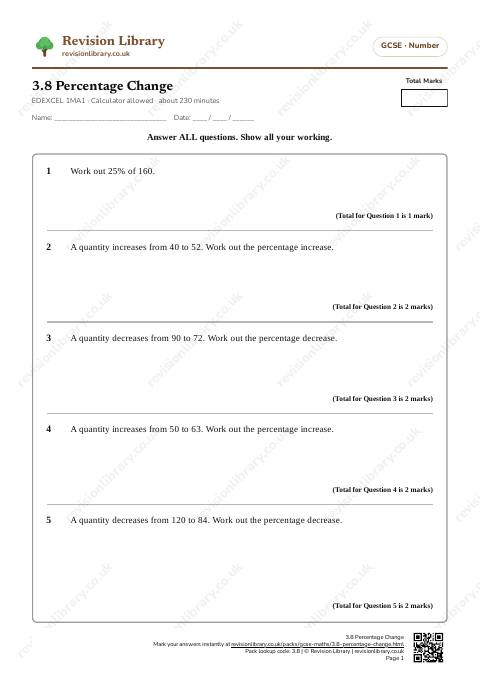
3.8 Percentage Change
EDEXCEL 1MA1 · Calculator allowed · about 230 minutes
A quantity increases from 40 to 52. Work out the percentage increase.
(Total for Question 2 is 2 marks)
3
A quantity decreases from 90 to 72. Work out the percentage decrease.
(Total for Question 3 is 2 marks)
4
A quantity increases from 50 to 63. Work out the percentage increase.
(Total for Question 4 is 2 marks)
5
A quantity decreases from 120 to 84. Work out the percentage decrease.
(Total for Question 5 is 2 marks)
6
Increase 150 by 20%.
(Total for Question 6 is 2 marks)
7
Decrease 80 by 15%.
(Total for Question 7 is 2 marks)
8
A company sold 24 800 tablet computers in one year and 23 150 tablet computers the next year. Work out the percentage decrease in the number sold. Give your answer correct to 3 significant figures.
(Total for Question 8 is 3 marks)
9
Olamide buys a car for £9200. She sells it for £7820. Work out Olamide's percentage loss.
(Total for Question 9 is 3 marks)
10
Last year an annual rail season ticket cost £3120. This year it costs £3245. Work out the percentage increase in the cost of the ticket. Give your answer correct to 1 decimal place.
(Total for Question 10 is 3 marks)
11
A tenant's monthly rent increases from £850 to £918. Work out the percentage increase in the rent.
(Total for Question 11 is 3 marks)
12
A phone was valued at £600. One year later it was valued at £480. Work out the percentage decrease in its value.
(Total for Question 12 is 3 marks)
13
Two shops each had a fall in customer numbers last month. Shop A had 220 customers and now has 187 customers. Shop B had 340 customers and now has 292 customers. Work out which shop had the greater percentage decrease in customers. You must show your working.
(Total for Question 13 is 3 marks)
14
A trader buys a table for £80 and sells it for £52.00. Work out the percentage loss.
(Total for Question 14 is 3 marks)
15
Last month a magazine cost £2. This month it costs £2.50. Work out the percentage increase in the price of the magazine.
(Total for Question 15 is 3 marks)
16
A shop's weekly sales fall from 400 units to 340 units. Work out the percentage decrease in weekly sales.
(Total for Question 16 is 3 marks)
17
Deepak buys a guitar for £80. He sells it for £92. Work out Deepak's percentage profit.
(Total for Question 17 is 3 marks)
18
Farah buys a painting for £250. She later sells it for £210. Work out Farah's percentage loss.
(Total for Question 18 is 3 marks)
19
Last year a gym membership cost £420. This year it costs £462. Work out the percentage increase in the cost of the membership.
(Total for Question 19 is 3 marks)
20
Last year Chidi paid £1380 for his car insurance. This year he pays £1195. Work out the percentage decrease in his car insurance. Give your answer correct to 1 decimal place.
(Total for Question 20 is 3 marks)
21
A train ticket cost £45 last year. This year it costs £51.75. Work out the percentage increase in the price of the ticket.
(Total for Question 21 is 3 marks)
22
A blender was priced at £68. In a sale it is now priced at £57.80. Work out the percentage decrease in the price of the blender.
(Total for Question 22 is 3 marks)
23
Marcus buys a bicycle for £140 and sells it for £168. Work out Marcus's percentage profit.
(Total for Question 23 is 3 marks)
24
Elif buys a laptop for £480 and sells it for £372. Work out Elif's percentage loss.
(Total for Question 24 is 3 marks)
25
A jacket cost £45 last month. This month it costs £54. Work out the percentage increase in price. Give your answer to the nearest whole percent if necessary.
(Total for Question 25 is 3 marks)
26
A pair of trainers is reduced by 20% and now costs £56. Work out the original price of the trainers.
(Total for Question 26 is 2 marks)
27
Yara buys a 5 kg bag of rice for £8. She repackages it into 250 g bags and sells each bag for 65p. Work out Yara's percentage profit.
(Total for Question 27 is 4 marks)
28
Priya buys 12 kg of coffee beans for £96. She packages it into 200 g bags and sells each bag for £1.20. Work out whether Priya makes a percentage profit or a percentage loss, and calculate it.
(Total for Question 28 is 4 marks)
29
Aaliyah buys 80 candles for £60. She sells 50 of the candles for £1.40 each. She sells the remaining candles for 90p each. Work out Aaliyah's percentage profit. Give your answer correct to 1 decimal place.
(Total for Question 29 is 4 marks)
30
Increase £250 by 18%.
(Total for Question 30 is 3 marks)
31
Decrease £340 by 35%.
(Total for Question 31 is 3 marks)
32
A cafe's weekly takings rise from £2150 to £2310. Work out the percentage increase in the takings. Give your answer correct to 1 decimal place.
(Total for Question 32 is 3 marks)
33
A charity's donations fall from £18400 to £16950. Work out the percentage decrease in donations. Give your answer correct to 3 significant figures.
(Total for Question 33 is 3 marks)
34
Two football clubs both increased their season ticket prices. Club A: from £24 to £27.60. Club B: from £30 to £34.20. Work out which club had the greater percentage increase. You must show your working.
(Total for Question 34 is 4 marks)
35
The population of a small town is 1200. It falls by 5% one year and then rises by 10% the next year. Work out the population after these two changes. Give your answer to the nearest whole person.
(Total for Question 35 is 3 marks)
36
A jacket costs £85. It is reduced by 15% in a sale. Work out the sale price of the jacket to the nearest penny.
(Total for Question 36 is 2 marks)
37
Tariq buys a 4 kg bag of sweets for £10. He repackages it into 80 g bags and sells each bag for 45p. Work out Tariq's percentage profit.
(Total for Question 37 is 4 marks)
38
Nadia buys 90 second-hand paperback books for £45. She is unable to sell 15 of them and donates them to a charity shop. She sells each of the remaining books for 90p. Work out Nadia's percentage profit.
(Total for Question 38 is 4 marks)
39
A shirt originally costs £30. It is reduced by 40% in a sale and the reduced price is then further reduced to £9 by a second sale. Work out the percentage reduction in the second sale. Give your answer as a percentage.
(Total for Question 39 is 3 marks)
40
A TV is sold with 20% discount and then a further 10% off the reduced price. The original price was £450. Work out the final selling price. Give your answer to the nearest penny.
(Total for Question 40 is 3 marks)
41
A smartphone price increases from £320 to £400. Work out the percentage increase. Give your answer correct to 1 decimal place.
(Total for Question 41 is 3 marks)
42
A shop increases the price of a kettle by 25%. In a clearance sale, the new price is then reduced by 20%. The original price of the kettle was £32.
(a)Work out the sale price of the kettle.(3)
(b)Comment on how the sale price compares with the original price of £32, and explain why this happens.(1)
(Total for Question 42 is 4 marks)
43
A car's value is depreciated by 12% each year. Its current value is £16,200. Work out the value of the car after 2 years. Give your answer to the nearest pound.
(Total for Question 43 is 4 marks)
44
A shop shows an item with price £48 including 20% VAT. Work out the price of the item before VAT. Give your answer to the nearest penny.
(Total for Question 44 is 5 marks)
45
A car's value decreased by 22% over one year. At the end of the year it was worth £10530. Work out the value of the car at the start of the year.
(Total for Question 45 is 4 marks)
46
A trader buys a batch of 200 garden ornaments for a total of £900. She also pays a delivery charge of £60. She wants to make an overall percentage profit of 45% on her total costs, including delivery. Work out the price she should charge for each ornament, if she sells all 200 of them.
(Total for Question 46 is 4 marks)
47
A population increases by 8% each year for 3 years and then decreases by 5% in the fourth year. Starting population = 12 500. Work out the population after the 4 years. Give your answer to the nearest whole number.
(Total for Question 47 is 6 marks)
48
The price of a laptop is increased by 30%. It is then reduced by y% in a clearance sale. The final price is 4% more than the original price. Work out the value of y.
(Total for Question 48 is 4 marks)
49
A company's revenue increased by 12% in its first year of trading, then increased by a further 8% in its second year. At the end of the second year, the revenue was £302400. Work out the company's revenue before either increase, that is, at the start of the first year.
(Total for Question 49 is 4 marks)
50
The price of a commodity first increases by p% then decreases by q% and ends up at the same price as it started. Show that to first order (neglecting the small product term pq/100), q approximately equals p. You must show the algebraic steps leading to the approximation.
(Total for Question 50 is 7 marks)
51
A piece of machinery depreciates in value by the same percentage each year. After 2 years its value is £2178. After 3 years its value is £1960.20. Work out the annual percentage rate of depreciation. Give your answer correct to 1 decimal place.
(Total for Question 51 is 4 marks)
52
A shop's revenue changed over three consecutive years. Year 1 to Year 2: increased by 15%. Year 2 to Year 3: decreased by 8%. Year 3 to Year 4: increased by r%. Over the three years, from Year 1 to Year 4, the overall percentage change in revenue was an increase of 26.96%. Work out the value of r.
(Total for Question 52 is 4 marks)
Mark scheme · 3.8 Percentage Change
A correct answer earns full marks unless the question asks for working, a method, proof or explanation.
Question 1
40 caoB1
Answer: 40
Question 2
12 seen (52 - 40), or equivalent methodM1
30% caoA1
Answer: 30%
Question 3
18 seen (90 - 72), or equivalent methodM1
20% caoA1
Answer: 20%
Question 4
13 seen (63 - 50), or equivalent methodM1
26% caoA1
Answer: 26%
Question 5
36 seen (120 - 84), or equivalent methodM1
30% caoA1
Answer: 30%
Question 6
multiply 150 by 1.20 or show correct method to find 20% and add to 150M1
180 caoA1
Answer: 180
Question 7
find 15% of 80 or multiply 80 by 0.85M1
68 caoA1
Answer: 68
Question 8
1650 seen (24800 - 23150)M1
1650/24800 x 100 (oe)M1
awrt 6.65% (3sf)A1
Answer: 6.65%
Question 9
1380 seen (9200 - 7820)M1
1380/9200 x 100 (oe)M1
15% caoA1
Answer: 15%
Question 10
125 seen (3245 - 3120)M1
125/3120 x 100 (oe)M1
awrt 4.0%A1
Answer: 4.0%
Question 11
68 seen (918 - 850)M1
68/850 x 100 (oe)M1
8% caoA1
Answer: 8%
Question 12
120 seen (600 - 480)M1
120/600 x 100 (oe)M1
20% caoA1
Answer: 20%
Question 13
Shop A: 33/220 x 100 (= 15%)M1
Shop B: 48/340 x 100 (awrt 14.1%)M1
Shop A, with correct comparison (15% > 14.1%), oe ft from their two correctly found percentagesA1
Answer: Shop A (15% decrease vs 14.1% decrease)
Question 14
28 loss foundM1
28 / 80 x 100M1
35%A1
Answer: 35%
Question 15
0.50 seen (2.50 - 2)M1
0.50/2 x 100 (oe)M1
25% caoA1
Answer: 25%
Question 16
60 seen (400 - 340)M1
60/400 x 100 (oe)M1
15% caoA1
Answer: 15%
Question 17
12 seen (92 - 80)M1
12/80 x 100 (oe)M1
15% caoA1
Answer: 15%
Question 18
40 seen (250 - 210)M1
40/250 x 100 (oe)M1
16% caoA1
Answer: 16%
Question 19
42 seen (462 - 420)M1
42/420 x 100 (oe)M1
10% caoA1
Answer: 10%
Question 20
185 seen (1380 - 1195)M1
185/1380 x 100 (oe)M1
awrt 13.4%A1
Answer: 13.4%
Question 21
6.75 seen (51.75 - 45)M1
6.75/45 x 100 (oe)M1
15% caoA1
Answer: 15%
Question 22
10.20 seen (68 - 57.80)M1
10.20/68 x 100 (oe)M1
15% caoA1
Answer: 15%
Question 23
28 seen (168 - 140)M1
28/140 x 100 (oe)M1
20% caoA1
Answer: 20%
Question 24
108 seen (480 - 372)M1
108/480 x 100 (oe)M1
22.5% caoA1
Answer: 22.5%
Question 25
find change 54 - 45 = 9M1
express change as fraction of original 9/45 and convert to percentM1
20% caoA1
Answer: 20%
Question 26
recognise original = 56 ÷ 0.8 or equivalent methodM1
£70 caoA1
Answer: £70
Question 27
5000/250 = 20 bagsM1
20 x 0.65 = 13 (total revenue)M1
13 - 8 = 5 (profit), dependent on both M1sdM1
62.5% caoA1
Answer: 62.5%
Question 28
12000/200 = 60 bagsM1
60 x 1.20 = 72 (total revenue)M1
96 - 72 = 24 (loss), dependent on both M1sdM1
25% loss, cao (must state loss)A1
Answer: 25% loss
Question 29
50 x 1.40 = 70 and 30 x 0.90 = 27, both seenM1
70 + 27 = 97 (total revenue)M1
97 - 60 = 37 (profit), dependent on both M1sdM1
awrt 61.7%A1
Answer: 61.7%
Question 30
finds 18% of 250 (= 45), or uses multiplier 1.18M1
adds their 18% to 250 (oe)M1
295 (pounds) caoA1
Answer: £295
Question 31
finds 35% of 340 (= 119), or uses multiplier 0.65M1
subtracts their 35% from 340 (oe)M1
221 (pounds) caoA1
Answer: £221
Question 32
160 seen (2310 - 2150)M1
160/2150 x 100 (oe)M1
awrt 7.4%A1
Answer: 7.4%
Question 33
1450 seen (18400 - 16950)M1
1450/18400 x 100 (oe)M1
awrt 7.88% (3sf)A1
Answer: 7.88%
Question 34
3.60 seen (27.60 - 24) and 4.20 seen (34.20 - 30)M1
Club A: 3.60/24 x 100 (= 15%)M1
Club B: 4.20/30 x 100 (= 14%)M1
Club A, with correct comparison (15% > 14%), ft from their two percentagesA1
Answer: Club A (15% increase vs 14% increase)
Question 35
apply decrease: 1200 x 0.95 = 1140M1
apply increase: 1140 x 1.10 = 1254M1
1254 people caoA1
Answer: 1254 people
Question 36
calculate 15% of 85 or apply 85 x 0.85 methodM1
£72.25 caoA1
Answer: 72.25
Question 37
4000/80 = 50 (bags)M1
50 x 0.45 = 22.50 (total revenue)M1
22.50 - 10 = 12.50 (profit), dependent on both M1sdM1
125% caoA1
Answer: 125%
Question 38
90 - 15 = 75 (books sold)M1
75 x 0.90 = 67.50 (total revenue)M1
67.50 - 45 = 22.50 (profit), dependent on both M1sdM1
50% caoA1
Answer: 50%
Question 39
find price after first reduction: 30 x 0.60 = 18M1
find fraction for second reduction: (18 - 9) / 18 or 9/18M1
50% caoA1
Answer: 50%
Question 40
apply first reduction: 450 x 0.80 = 360 or show methodM1
apply second reduction: 360 x 0.90 = 324 or equivalentM1
£324.00 caoA1
Answer: 324.00
Question 41
calculate change 400 - 320 = 80 and form 80/320M1
evaluate 80/320 = 0.25 and convert to percentM1
25.0% caoA1
Answer: 25.0
Question 42
(a) 32 x 1.25 (= 40)M1
(a) their 40 x 0.8 (oe)M1
(a) 32 (pounds) caoA1
(a) Answer: £32
(b) states the sale price equals the original price, because the combined multiplier 1.25 x 0.8 = 1, so the two percentage changes exactly cancel outB1
(b) Answer: The sale price equals the original price (1.25 x 0.8 = 1, so the changes exactly cancel)
Question 43
use factor 0.88 for one year and show one stepM1
apply factor twice: 16200 x 0.88 x 0.88 or 16200 x 0.882M1
12545.28 to 2 d.p. (intermediate) ftA1
£12545 (nearest pound) caoA1
Answer: 12545
Question 44
identify that 48 is 120% of the pre-VAT price or use reverse percentageM1
set up 48 = 1.20 x original and divide: original = 48 / 1.20M1
calculate 48 / 1.20 = 40.0M1
£40.00 caoA1
state check: 40 x 1.20 = 48 oeB1
Answer: 40.00
Question 45
recognises 10530 represents 78% (0.78) of the value at the start of the yearM1
sets up start value x 0.78 = 10530 (oe)M1
10530/0.78 (oe)M1
13500 (pounds) caoA1
Answer: £13500
Question 46
900 + 60 = 960 (total cost)M1
960 x 1.45 (oe, total revenue needed = 1392)M1
1392/200 (oe)M1
6.96 (pounds) caoA1
Answer: £6.96 (per ornament)
Question 47
use growth factor 1.08 for each of first 3 yearsM1
use decrease factor 0.95 for year 4M1
combine factors: 12500 x 1.083 x 0.95M1
evaluate 1.083 = 1.259712 (or equivalent) and multiply throughM1
14959.08 (intermediate) ftA1
14959 people (nearest whole number) caoA1
Answer: 14959
Question 48
sets up 1.3(1 - y/100) = 1.04 (oe)M1
(1 - y/100) = 1.04/1.3 = 0.8 (oe, evaluated)M1
y/100 = 1 - 0.8 = 0.2 (oe)M1
y = 20, caoA1
Answer: y = 20
Question 49
recognises the combined multiplier 1.12 x 1.08 = 1.2096 (oe)M1
sets up original x 1.2096 = 302400 (oe)M1
302400/1.2096 (oe)M1
250000 (pounds) caoA1
Answer: £250000
Question 50
state final price = initial x (1 + p/100) x (1 - q/100)M1
set (1 + p/100)(1 - q/100) = 1 since final = initialM1
expand: 1 + p/100 - q/100 - (pq)/10000 = 1M1
cancel 1 and rearrange to p/100 - q/100 - (pq)/10000 = 0M1
rearrange to q/100 = p/100 - (pq)/10000M1
neglect (pq)/10000 as small to get q/100 approx= p/100M1
conclude q approx= p with brief justification caoA1
Answer: q approx= p
Question 51
recognises that dividing the year-3 value by the year-2 value gives the annual multiplier (1 - r/100), independent of the original valueM1
1960.20/2178 correctly set up and evaluatedM1
0.9 (or 90%) for the multiplierA1
10.0% cao (1dp)A1
Answer: 10.0% per annum
Question 52
combines the first two multipliers: 1.15 x 0.92 = 1.058 (oe)M1
Put this topic and others into one printable pack.
Open the Pack Builder
Worksheets are written for Revision Library and come with a full mark scheme; a few English packs quote an out-of-copyright text, and name it on the page. Exam board names and specification codes say which qualification a pack suits: we are not affiliated with, endorsed by or approved by any exam board, and no past-paper question is reproduced here. Rights queries: hello@revisionlibrary.co.uk