Estimating means rounding the numbers in a calculation, usually to 1 significant figure, to work out an approximate answer quickly without a calculator. It is used to check whether a calculator answer is sensible, and it is tested throughout GCSE non-calculator and calculator papers, including with roots and standard form.
Round every number in the calculation to 1 significant figure, unless the question asks for a different degree of accuracy.
Rewrite the whole calculation using only the rounded values.
Use the order of operations (BIDMAS) to work out the estimate, dealing with any brackets, powers or roots first.
For a square root, identify the two nearest square numbers either side of the value and use them to estimate the root.
State your estimate clearly as your final answer, since the question is asking for an approximate value, not the exact one.
If asked whether an estimate is an overestimate or an underestimate, check whether each rounded value went up or down before combining them.
Worked example
By rounding each number to 1 significant figure, work out an estimate for (58.3 + 21.7) / 3.9
Round each number to 1 significant figure: 58.3 rounds to 60, 21.7 rounds to 20, and 3.9 rounds to 4.
Rewrite the calculation using these rounded values: (60 + 20) / 4.
Work out the bracket first: 60 + 20 = 80.
Divide by the rounded denominator: 80 / 4 = 20.
State the final answer: the estimate is 20.
Revision Library
revisionlibrary.co.uk
GCSE · Number
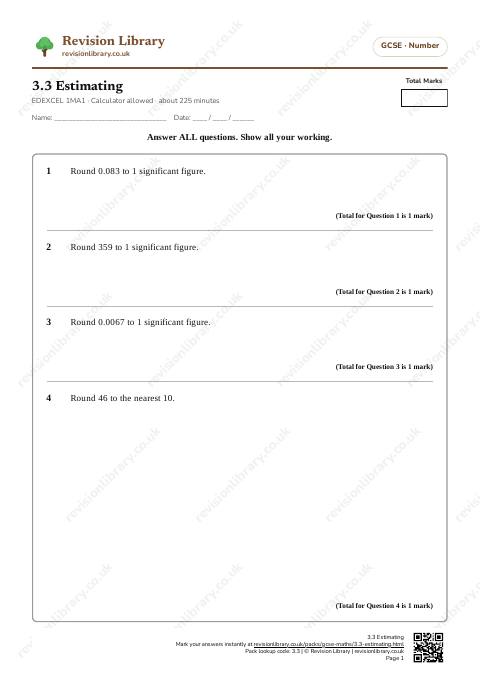
3.3 Estimating
EDEXCEL 1MA1 · Calculator allowed · about 225 minutes
By rounding each number to 1 significant figure, put a ring around the best estimate for 612 x 0.48
A) 600
B) 300
C) 1200
D) 30
(Total for Question 6 is 1 mark)
7
Round 0.995 to 1 significant figure.
(Total for Question 7 is 1 mark)
8
Round 3.76 to 1 decimal place.
(Total for Question 8 is 1 mark)
9
By rounding to 1 significant figure, work out an estimate for 3.872
(Total for Question 9 is 2 marks)
10
By rounding each number to 1 significant figure, work out an estimate for (6.2 x 19.8) / 3.9
(Total for Question 10 is 3 marks)
11
A recipe for 8 people uses 3.85 kg of flour. By rounding suitable values to 1 significant figure, estimate the amount of flour needed for 31 people.
(Total for Question 11 is 3 marks)
12
James is organising a coach trip for 187 people. Each coach holds 48 seats. By rounding both numbers to 1 significant figure, find an estimate for the number of coaches needed.
(Total for Question 12 is 2 marks)
13
A train travels at an average speed of 68 km/h for 3.9 hours. By rounding each number to 1 significant figure, estimate the distance travelled.
(Total for Question 13 is 2 marks)
14
By rounding each number to 1 significant figure, put a ring around the best estimate for 0.612 / 0.19
A) 3
B) 30
C) 0.3
D) 6
(Total for Question 14 is 1 mark)
15
Estimate the value of (0.741 x 497) / 35.8 You must show your rounding.
(Total for Question 15 is 3 marks)
16
A school buys 51 notebooks. Each one costs £9.07. (a) Estimate the total cost by rounding each number to 1 significant figure. (b) State whether your estimate is an over-estimate or an under-estimate. Give a reason.
(Total for Question 16 is 3 marks)
17
Estimate the value of √6.37 x 6.36 You must show your rounding.
(Total for Question 17 is 3 marks)
18
A school buys 41 t-shirts. Each one costs £5.02. (a) Estimate the total cost by rounding each number to 1 significant figure. (b) State whether your estimate is an over-estimate or an under-estimate. Give a reason.
(Total for Question 18 is 3 marks)
19
Estimate the value of (4.02 x 8.85) / 0.301 You must show your rounding.
(Total for Question 19 is 3 marks)
20
A school buys 56 bags of compost. Each one costs £1.84. (a) Estimate the total cost by rounding each number to 1 significant figure. (b) State whether your estimate is an over-estimate or an under-estimate. Give a reason.
(Total for Question 20 is 3 marks)
21
By rounding each number to 1 significant figure, work out an estimate for 78 x 213
(Total for Question 21 is 2 marks)
22
Estimate the value of (0.617 x 5.84) / 7.79 You must show your rounding.
(Total for Question 22 is 3 marks)
23
A school buys 93 bags of compost. Each one costs £2.26. (a) Estimate the total cost by rounding each number to 1 significant figure. (b) State whether your estimate is an over-estimate or an under-estimate. Give a reason.
(Total for Question 23 is 3 marks)
24
Estimate the value of √685 x 736 You must show your rounding.
(Total for Question 24 is 3 marks)
25
Estimate the value of (76.6 x 6.43) / 0.496 You must show your rounding.
(Total for Question 25 is 3 marks)
26
A school buys 41 notebooks. Each one costs £5.15. (a) Estimate the total cost by rounding each number to 1 significant figure. (b) State whether your estimate is an over-estimate or an under-estimate. Give a reason.
(Total for Question 26 is 3 marks)
27
A school buys 32 tickets. Each one costs £8.22. (a) Estimate the total cost by rounding each number to 1 significant figure. (b) State whether your estimate is an over-estimate or an under-estimate. Give a reason.
(Total for Question 27 is 3 marks)
28
Estimate the value of √79.6 x 19.8 You must show your rounding.
(Total for Question 28 is 3 marks)
29
Estimate the value of √0.171 x 81.1 You must show your rounding.
(Total for Question 29 is 3 marks)
30
A school buys 16 notebooks. Each one costs £3.81. (a) Estimate the total cost by rounding each number to 1 significant figure. (b) State whether your estimate is an over-estimate or an under-estimate. Give a reason.
(Total for Question 30 is 3 marks)
31
By rounding each number to 1 significant figure, work out an estimate for 5187 / 51
(Total for Question 31 is 2 marks)
32
Estimate the value of √76.3 x 22.8 You must show your rounding.
(Total for Question 32 is 3 marks)
33
A school buys 41 notebooks. Each one costs £8.12. (a) Estimate the total cost by rounding each number to 1 significant figure. (b) State whether your estimate is an over-estimate or an under-estimate. Give a reason.
(Total for Question 33 is 3 marks)
34
By rounding each number to 1 significant figure, work out an estimate for (39.4 + 58.9) / 9.7
(Total for Question 34 is 3 marks)
35
Nadia buys 48.6 litres of petrol at £3.15 per litre. By rounding each number to 1 significant figure, estimate the total cost.
(Total for Question 35 is 2 marks)
36
Put a ring around the best estimate for √83
A) 8
B) 9
C) 10
D) 7
(Total for Question 36 is 1 mark)
37
Without using a calculator, estimate the value of √146. Show working to support your answer.
(Total for Question 37 is 2 marks)
38
Estimate 12.7 × 3.9 by rounding each number to 1 significant figure, then multiply.
(Total for Question 38 is 2 marks)
39
Estimate 0.049 ÷ 0.012 to 1 significant figure. Show your rounding and the calculation.
(Total for Question 39 is 2 marks)
40
A square rug has side length 4.8 m. Estimate the area by rounding the side to 1 significant figure, and state whether your estimate is an over-estimate or an under-estimate of the exact area.
(Total for Question 40 is 2 marks)
41
Estimate 6.37 × 4.9 by rounding each number to 1 significant figure.
(Total for Question 41 is 2 marks)
42
A small shop sells jars of jam priced at £2.49 each. A customer buys 8 jars. Use rounding to estimate the total cost. State your rounded price and the estimated total.
(a)Rounded price used(1)
(b)Estimated total cost(2)
(Total for Question 42 is 3 marks)
43
By rounding each number to 1 significant figure, estimate the value of 82 x 53. State, giving a reason, whether your estimate is an overestimate or an underestimate of the exact answer.
(Total for Question 43 is 3 marks)
44
By rounding suitable values to 1 significant figure, estimate the value of 58.72 / √83
(Total for Question 44 is 4 marks)
45
By rounding each number to 1 significant figure, estimate the value of (6.9 x 103) x (3.8 x 10-5). Give your answer in standard form.
(Total for Question 45 is 3 marks)
46
A bakery uses 18.7 g of yeast for each loaf. They bake 320 loaves. Use 1 significant figure to estimate the total mass of yeast used and state whether this estimate is an over-estimate or an under-estimate.
(Total for Question 46 is 3 marks)
47
Estimate 246 × 78 by rounding each number to 1 significant figure before multiplying.
(Total for Question 47 is 2 marks)
48
Estimate 5325 ÷ 18 by rounding each number to 1 significant figure before dividing.
(Total for Question 48 is 2 marks)
49
A model car travels at 14.6 m/s for 3.2 s. Estimate the distance travelled by rounding both values to 1 significant figure. Say whether your estimate is likely to be an over-estimate or an under-estimate.
(Total for Question 49 is 3 marks)
50
A delivery van has load mass 1270 kg. Each parcel has mass about 3.6 kg. Using 1 significant figure for each value, estimate how many parcels the van could carry.
(Total for Question 50 is 3 marks)
51
A delivery van travels 47.6 km, then 32.9 km, then 19.8 km. Estimate the total distance by rounding each distance to the nearest 10 km before adding.
(Total for Question 51 is 3 marks)
52
Estimate the value of 83 ÷ 4.1 by rounding the divisor to 1 significant figure and carrying out the division. Show the rounded divisor you use.
(a)Rounded divisor used(1)
(b)Estimated quotient(3)
(Total for Question 52 is 4 marks)
53
A recipe needs 0.345 kg of flour for one batch. Estimate how much flour is needed for 12 batches by rounding the quantity for one batch to 1 significant figure first.
(Total for Question 53 is 3 marks)
54
A small cylinder has radius 1.4 cm and height 12 cm. Estimate its volume to 1 significant figure for each measurement. Give your estimate (to 3 significant figures where appropriate) and say whether it is an over- or under-estimate.
(Total for Question 54 is 3 marks)
55
The prices of three dishes are £4.95, £12.40 and £23.80. Estimate the total cost by rounding each price to 1 significant figure. Give your estimate and explain whether it is likely to be an over-estimate or an under-estimate.
(Total for Question 55 is 4 marks)
56
A large cylindrical water tank has radius 3.6 m and height 8.4 m. Estimate the volume using 1 significant figure for radius and height. State whether your estimate is an over-estimate or an under-estimate.
(Total for Question 56 is 3 marks)
57
Three wooden boards measure 4.12 m, 6.89 m and 5.47 m. Using 1 significant figure for each length, estimate the total length required and decide how many 5 m rolls of material the builder should buy. Show your working.
(Total for Question 57 is 4 marks)
58
A school orders 156 exercise books priced at 1.95 each. The finance team decide to estimate the total cost by rounding the price to the nearest whole pound and rounding the number of books to 2 significant figures. Give the estimated cost.
(a)Rounded price and rounded number of books used(2)
(b)Estimated total cost(2)
(Total for Question 58 is 4 marks)
59
You have three measurements: 4.87 m, 5.12 m and 4.95 m. Use appropriate rounding to estimate the mean (average) of these three measurements. State your rounding and your estimated mean.
(a)State the rounded values you will use(2)
(b)Calculate the estimated mean using your rounded values(4)
(Total for Question 59 is 6 marks)
60
Estimate the value of √198 to the nearest whole number. Show your method.
(Total for Question 60 is 2 marks)
61
A recipe needs 0.375 kg of flour per batch. A chef will make 28 batches. Use an appropriate rounding to estimate the total mass of flour needed in kg and state why your rounding is suitable.
(Total for Question 61 is 3 marks)
62
A car journey of 315 km takes 3 hours 12 minutes. The driver records the journey time with a stopwatch to the nearest minute. Estimate the average speed in km/h and give an upper and lower estimate for the speed using bounds from the timing measurement. Give answers to 3 significant figures.
(Total for Question 62 is 5 marks)
Mark scheme · 3.3 Estimating
Question 1
0.08 caoB1
Answer: 0.08 (to 1 s.f.)
Question 2
400 caoB1
Answer: 400 (to 1 s.f.)
Question 3
0.007 caoB1
Answer: 0.007 (to 1 s.f.)
Question 4
50 caoB1
Answer: 50 (nearest 10). Check: 46 rounds up to 50 because the units digit 6 ≥ 5.
(a) 2.5 (accept 2 or another sensible rounded price)B1
(a) Answer: 2.5
(b) multiply rounded price by 8, e.g. 2.5 × 8M1
(b) £20 (or the correct total for the rounded price used, e.g. £16 from £2)A1
(b) Answer: £20.00
Question 43
rounding both values to 1 sf, 80 and 50M1
4000 caoA1
underestimate, with reason that both 82 and 53 were rounded down, so the estimate is smaller than the exact answerB1
Answer: 4000; underestimate
Question 44
rounding 58.7 to 60 and squaring, 602 = 3600M1
identifying 81 = 92 as the nearest square number to 83, so √83 is approximately 9M1
dep, 3600 / 9M1
400 caoA1
Answer: 400
Question 45
rounding both values to 1 sf, 7 and 4M1
dep, 7 x 4 = 28 with powers of 10 combined, 103 x 10-5 = 10-2M1
2.8 x 10⁻¹ cao (accept 0.28)A1
Answer: 2.8 x 10⁻¹
Question 46
round 18.7->20 g and 320->300 to 1 s.f.M1
multiply 20 × 300 = 6000 gM1
6000 g cao; over-estimate (6000 > exact 5984 g) oeA1
Answer: 6000 g (6.0 kg), over-estimate
Question 47
round 246->200 and 78->80 to 1 s.f. and multiply oeM1
16000 caoA1
Answer: 16000
Question 48
round 5325->5000 and 18->20 to 1 s.f. and divide oeM1
250 caoA1
Answer: 250
Question 49
round 14.6->10 and 3.2->3 to 1 s.f.M1
multiply 10 × 3 = 30 oeM1
30 m cao; under-estimateA1
Answer: 30 m; under-estimate
Question 50
round total mass 1270->1000 to 1 s.f.M1
round parcel mass 3.6->4 to 1 s.f. and divide 1000/4 oeM1
250 caoA1
Answer: 250 parcels
Question 51
round 47.6 -> 50, 32.9 -> 30, 19.8 -> 20 or state rounded valuesM1
add rounded valuesM1
100 km caoA1
Answer: 100 km. Working: 47.6 -> 50, 32.9 -> 30, 19.8 -> 20; 50 + 30 + 20 = 100. Check: exact total 100.3 km so estimate 100 km is sensible.
Question 52
(a) 4.0 oeB1
(a) Answer: 4.0
(b) divide 83 by rounded divisor 4.0 or equivalent methodM1
(b) show calculation 83 ÷ 4 = 20.75 or state intermediateM1
(b) 20.8 awrt or 21 oeA1
(b) Answer: Approximately 20.8 (using 4.0). Working: 83 ÷ 4.0 = 20.75 so estimate 20.8 or 21. Check: exact 83 ÷ 4.1 = 20.244..., using 4 gives 20.75 so 20.8 awrt is acceptable.
Question 53
round 0.345 to 0.3 (1 significant figure)M1
multiply rounded amount by 12M1
3.6 kg caoA1
Answer: Using 1 significant figure: 0.345 -> 0.3 so 0.3 × 12 = 3.6 kg (estimate). Check: exact 0.345 × 12 = 4.14 kg, so 3.6 is the estimate when rounding to 1 sf.
Question 54
round radius 1.4->1 and height 12->10 to 1 s.f.M1
use V = π r2 h and substitute to give V = π × 12 × 10 = 10piM1
31.4 cm³ awrt and under-estimate caoA1
Answer: Approximately 31.4 cm3 (under-estimate)
Question 55
round 4.95->5, 12.40->10, 23.80->20 to 1 s.f.M1
add the rounded values 5 + 10 + 20M1
state whether under/over with reason, e.g. two numbers were rounded down and one up so total is likely downM1
£35 caoA1
Answer: £35; under-estimate (net rounding down)
Question 56
round radius 3.6->4 and height 8.4->8 to 1 s.f.M1
substitute into V = π r2 h to give V = π × 42 × 8 = 128piM1
402.1 m³ awrt; over-estimate caoA1
Answer: Approximately 402.1 m3; over-estimate
Question 57
round 4.12->4, 6.89->7, 5.47->5 to 1 s.f.M1
add rounded lengths 4 + 7 + 5 = 16 mM1
divide by roll length 16/5 = 3.2 and use correct method to find number of rollsM1
4 rolls caoA1
Answer: Estimated total 16 m, so 4 rolls
Question 58
(a) price rounded to £2.00 caoB1
(a) 156 to 2 sf = 160 oeB1
(a) Answer: Price = £2.00, Number = 160
(b) multiply rounded values 2 × 160M1
(b) £320 caoA1
(b) Answer: £320
Question 59
(a) round values to 1 dp or 1 sf given a clear choice (eg 4.9, 5.1, 5.0)B1
(a) state the chosen rounded numbers explicitlyB1
(a) Answer: Use 4.9, 5.1 and 5.0 (rounded to 1 dp).
(b) add the rounded values correctlyM1
(b) divide the sum by 3 or show method to find meanM1
Put this topic and others into one printable pack.
Open the Pack Builder
Worksheets are written for Revision Library and come with a full mark scheme; a few English packs quote an out-of-copyright text, and name it on the page. Exam board names and specification codes say which qualification a pack suits: we are not affiliated with, endorsed by or approved by any exam board, and no past-paper question is reproduced here. Rights queries: hello@revisionlibrary.co.uk