Proportion describes how two quantities are related: in direct proportion both quantities increase or decrease together at the same rate, while in inverse proportion one increases as the other decreases. GCSE questions cover unit pricing, recipes, best buys and inverse proportion problems such as workers completing a job.
Decide whether the two quantities are in direct proportion (both increase or decrease together) or inverse proportion (one increases as the other decreases).
For direct proportion, find the value for one unit first, then multiply by the number of units you need.
For inverse proportion, multiply the two given values together to find a constant total, then divide by the new value.
For best value questions, find the cost (or amount) per common unit for each option, then compare.
Round sensibly at the end, for example round up when you need a whole number of items such as tins or coaches.
Check your answer makes sense in the context of the question, for example more hours worked should mean more pay.
Worked example
A recipe for pastry that serves 6 people uses 240 g of flour and 150 g of butter. Katya wants to make enough pastry for 15 people. Work out how much flour and how much butter she needs.
Find the scale factor by dividing the new number of people by the original number of people: 15 / 6 = 2.5.
Multiply the flour amount by the scale factor: 240 x 2.5 = 600 g.
Multiply the butter amount by the scale factor: 150 x 2.5 = 375 g.
State the final answer: Katya needs 600 g of flour and 375 g of butter.
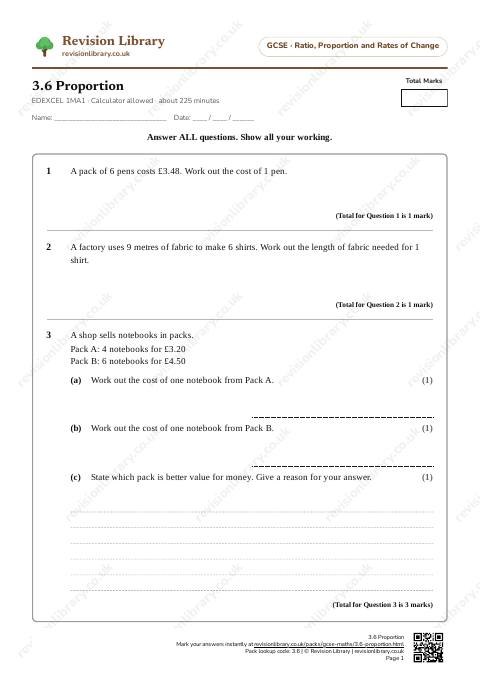
Revision Library
revisionlibrary.co.uk
GCSE · Ratio, Proportion and Rates of Change
3.6 Proportion
EDEXCEL 1MA1 · Calculator allowed · about 225 minutes
A pack of 6 pens costs £3.48. Work out the cost of 1 pen.
(Total for Question 1 is 1 mark)
2
A factory uses 9 metres of fabric to make 6 shirts. Work out the length of fabric needed for 1 shirt.
(Total for Question 2 is 1 mark)
3
A shop sells notebooks in packs. Pack A: 4 notebooks for £3.20 Pack B: 6 notebooks for £4.50
(a)Work out the cost of one notebook from Pack A.(1)
(b)Work out the cost of one notebook from Pack B.(1)
(c)State which pack is better value for money. Give a reason for your answer.(1)
(Total for Question 3 is 3 marks)
4
A recipe for a fruit crumble that serves 4 people uses: 300 g of apples 120 g of flour 80 g of butter 60 g of sugar
Aisha wants to make the crumble for 8 people.
(a)Work out the mass of apples needed for 8 people.(1)
(b)Work out the mass of flour needed for 8 people.(1)
(c)Work out the total mass of the crumble mixture (apples, flour, butter and sugar) needed for 8 people. Give your answer in kilograms.(1)
(Total for Question 4 is 3 marks)
5
The table shows the cost of buying ribbon. The cost is in direct proportion to the length.
Length (m)
Cost (£)
2
3.00
5
?
8
?
(a)Work out the cost of 5 m of ribbon.(1)
(b)Work out the cost of 8 m of ribbon.(1)
(Total for Question 5 is 2 marks)
6
Which of these graphs could show two quantities that are in direct proportion?
A) A straight line through the origin
B) A straight line that does not pass through the origin
C) A curve that passes through the origin
D) A horizontal line
(Total for Question 6 is 1 mark)
7
y is directly proportional to x. Given y = 15 when x = 3, find y when x = 7.
(Total for Question 7 is 2 marks)
8
Priya uses 300 g of sugar to make 24 cupcakes. Work out how much sugar she needs to make 10 cupcakes.
(Total for Question 8 is 2 marks)
9
A paint covers 18 m² with 3 litres. How many litres are needed to cover 25 m²? Give your answer to 2 decimal places.
(Total for Question 9 is 2 marks)
10
A recipe for 8 people uses 480 g of flour. Find the amount of flour needed for 5 people.
(Total for Question 10 is 2 marks)
11
Amina and Yusuf share 12 biscuits in the ratio 2:1. Work out how many biscuits Amina gets and how many Yusuf gets.
(Total for Question 11 is 2 marks)
12
Five pens cost £3.00. Work out the cost of one pen, then the cost of eight pens.
(Total for Question 12 is 2 marks)
13
On a map the scale is 1 cm represents 5 km. The real-life distance between two towns is 14 km. What is the distance between the two towns on the map, in centimetres?
(Total for Question 13 is 2 marks)
14
A car uses 6 litres of petrol to travel 84 km. Assume the amount of petrol used is directly proportional to the distance travelled.
(a)Work out the distance that can be travelled using 20 litres of petrol.(2)
(b)Work out how much petrol is needed to travel 175 km.(2)
(Total for Question 14 is 4 marks)
15
A map has a scale of 1 : 25000.
Diagram NOT accurately drawn
(a)The distance between two villages on the map is 6.4 cm. Work out the real distance between the villages, in kilometres.(2)
(b)The real distance between two towns is 12 km. Work out the distance between the towns on the map, in centimetres.(2)
(Total for Question 15 is 4 marks)
16
While on holiday in the USA, Tom sees a jacket priced at $84. The exchange rate is £1 = $1.40. In the UK, the same jacket costs £54. Work out the difference in price, in pounds, between buying the jacket in the USA and in the UK.
(Total for Question 16 is 3 marks)
17
A recipe for lemonade that makes 6 glasses needs 3 lemons and 250 ml of water. Nadia has 8 lemons and 900 ml of water. Work out the greatest number of glasses of lemonade Nadia can make, assuming she can only make whole batches of the recipe.
(Total for Question 17 is 4 marks)
18
The cost of hiring a bouncy castle for a party is directly proportional to the number of hours it is hired for. It costs £45 to hire for 3 hours.
(a)Work out the cost of hiring the bouncy castle for 7 hours.(2)
(b)Sam has a budget of £100. Work out the maximum whole number of hours he can hire the bouncy castle for.(2)
(Total for Question 18 is 4 marks)
19
To make a shade of green paint, blue paint and yellow paint are mixed in direct proportion. 80 ml of blue paint is mixed with 120 ml of yellow paint to make one batch of the shade.
(a)Bilal has 200 ml of blue paint. Work out how much yellow paint he needs to make the same shade, using all the blue paint.(2)
(b)Bilal has an unlimited supply of blue paint but only 300 ml of yellow paint. Work out the maximum total amount of the green paint mixture he can make.(2)
(Total for Question 19 is 4 marks)
20
A hosepipe fills a paddling pool at a constant rate. It takes 15 minutes to fill the pool with 180 litres of water.
(a)Work out how many litres of water flow through the hosepipe in 1 minute.(1)
(b)Work out how long it will take to fill a larger pool that holds 310 litres. Give your answer in minutes and seconds.(3)
(Total for Question 20 is 4 marks)
21
The number of pages printed by a printer is directly proportional to the amount of ink used. The printer uses 24 ml of ink to print 400 pages.
(a)Work out how many pages can be printed using 60 ml of ink.(2)
(b)Work out how much ink, in ml, is needed to print 1500 pages.(2)
(Total for Question 21 is 4 marks)
22
Here are the ingredients for 6 people. Tomatoes 150 g, onions 60 g. Work out how much of each ingredient is needed to make the same curry for 20 people.
(Total for Question 22 is 3 marks)
23
A car uses 12 litres of petrol to travel 180 km. How many litres are needed for a journey of 1440 km, at the same rate?
(Total for Question 23 is 2 marks)
24
12 workers take 8 days to pack an order. All the workers work at the same rate. How many days would it take 24 workers to do the same job?
(Total for Question 24 is 3 marks)
25
Here are the ingredients for 4 people. Tomatoes 350 g, onions 20 g. Work out how much of each ingredient is needed to make the same curry for 18 people.
(Total for Question 25 is 3 marks)
26
Here are the ingredients for 10 people. Tomatoes 375 g, onions 10 g. Work out how much of each ingredient is needed to make the same curry for 16 people.
(Total for Question 26 is 3 marks)
27
20 workers take 2 days to paint a fence. All the workers work at the same rate. How many days would it take 5 workers to do the same job?
(Total for Question 27 is 3 marks)
28
Here are the ingredients for 12 people. Tomatoes 125 g, onions 40 g. Work out how much of each ingredient is needed to make the same pasta sauce for 36 people.
(Total for Question 28 is 3 marks)
29
20 workers take 5 days to dig a trench. All the workers work at the same rate. How many days would it take 10 workers to do the same job?
(Total for Question 29 is 3 marks)
30
Here are the ingredients for 6 people. Tomatoes 100 g, onions 120 g. Work out how much of each ingredient is needed to make the same soup for 9 people.
(Total for Question 30 is 3 marks)
31
3 apples cost £2.61. Work out the cost of 7 apples.
(Total for Question 31 is 2 marks)
32
6 workers take 9 days to tile a floor. All the workers work at the same rate. How many days would it take 18 workers to do the same job?
(Total for Question 32 is 3 marks)
33
A car uses 10 litres of petrol to travel 130 km. How far can it travel on 80 litres of petrol, at the same rate?
(Total for Question 33 is 2 marks)
34
17 workers take 15 days to dig a trench. All the workers work at the same rate. How many days would it take 3 workers to do the same job?
(Total for Question 34 is 3 marks)
35
A supermarket sells bags of rice: Small bag: 500 g for £1.20 Medium bag: 800 g for £1.84 Large bag: 1.5 kg for £3.30
Work out which bag gives the best value for money. You must show your working.
(Total for Question 35 is 4 marks)
36
The exchange rate is £1 = $1.28
(a)Convert £250 to dollars.(2)
(b)Convert $60 to pounds. Give your answer to the nearest penny.(2)
(Total for Question 36 is 4 marks)
37
A recipe for pancake batter serves 5 people and uses 250 g of flour and 2 eggs. Ben wants to make enough batter for 8 people.
(a)Work out how much flour Ben needs for 8 people.(2)
(b)Work out the least number of whole eggs Ben needs for 8 people. Give a reason for rounding as you did.(2)
(Total for Question 37 is 4 marks)
38
1 tin of paint covers 12 m² of wall. Priya needs to paint a wall with area 30 m². Paint is only sold in whole tins. Work out the least number of tins Priya needs to buy.
(Total for Question 38 is 3 marks)
39
Chloe is paid at a rate that is directly proportional to the number of hours she works. She is paid £38.25 for 5 hours of work.
(a)Work out how much Chloe is paid for 8 hours of work.(2)
(b)One week Chloe is paid £68.85. Work out how many hours she worked.(2)
(Total for Question 39 is 4 marks)
40
250 g of coffee beans cost £2.50. How many grams can be bought with £45? Give your answer in grams and in kilograms.
(Total for Question 40 is 3 marks)
41
Which is better value: Pack A, 750 g cheese for £4.50, or Pack B, 500 g cheese for £3.20? Show your working.
(Total for Question 41 is 2 marks)
42
A cake recipe for 6 people uses 125 g butter. Work out the amount of butter needed to make the cake for 9 people.
(Total for Question 42 is 3 marks)
43
A muffin recipe uses 150 g of flour to make 3 muffins. How much flour is needed to make 10 muffins?
(Total for Question 43 is 2 marks)
44
Three friends share £36 in the ratio 3:2:1. Work out the smallest share.
(Total for Question 44 is 2 marks)
45
It takes 6 builders 15 days to build a wall. Assume all builders work at the same constant rate, and the time taken is inversely proportional to the number of builders.
(a)Work out how many days it would take 9 builders to build the same wall.(3)
(b)The wall needs to be completed in 5 days. Work out the minimum number of builders needed.(2)
(Total for Question 45 is 5 marks)
46
y is directly proportional to x. When x = 5, y = 40.
(a)Find a formula for y in terms of x.(2)
(b)Work out the value of y when x = 12.(1)
(c)Work out the value of x when y = 100.(2)
(Total for Question 46 is 5 marks)
47
The cost of catering for a conference is directly proportional to both the number of delegates and the number of days. Catering for 40 delegates for 3 days costs £2160.
(a)Work out the cost of catering for 40 delegates for 5 days.(2)
(b)Work out the cost of catering for 75 delegates for 3 days.(2)
(c)A different conference has a catering budget of £3600 for 60 delegates. Work out the maximum whole number of days the catering budget will allow.(3)
(Total for Question 47 is 7 marks)
48
Show that a smoothie recipe for 4 people using 360 ml milk and 120 g banana would need 990 ml milk and 330 g banana to serve 11 people.
(Total for Question 48 is 4 marks)
49
A car travels 90 miles using 6 gallons of petrol.
(a)Work out how many miles the car travels per gallon.(1)
(b)How many gallons are needed for 300 miles? Give answer to 1 decimal place.(2)
(Total for Question 49 is 3 marks)
50
A jacket is reduced by 20% and now costs £24. Work out the original price of the jacket.
(Total for Question 50 is 3 marks)
51
A car uses fuel at a rate directly proportional to distance travelled. If the car uses 8.4 litres of fuel for 60 km, work out how many litres it uses for 225 km.
(Total for Question 51 is 2 marks)
52
A cafe makes milkshakes. Each shake uses 200 ml milk, 50 g sugar and 100 g fruit. Costs are: milk £0.65 per litre, sugar £0.80 per kg, fruit £2.40 per kg.
(a)Calculate the cost of ingredients for one shake, giving your answer to the nearest penny.(3)
(b)The cafe sells each shake for £2.20. Calculate the profit made from selling 5 shakes. Give your answer to the nearest penny.(3)
(Total for Question 52 is 6 marks)
53
Two quantities are in the ratio 4:7. If their total is 99, find the smaller quantity.
(Total for Question 53 is 3 marks)
54
A recipe for a sauce uses ingredients in the ratio tomato:oil:vinegar = 6:1:0.5 by mass. Ava wants to make 1.2 kg of the sauce. Calculate the mass of oil she should use, giving your answer in grams.
(Total for Question 54 is 2 marks)
55
Quantities A and B are inversely proportional. When A = 12, B = 5. Work out the value of B when A = 18.
(Total for Question 55 is 3 marks)
Mark scheme · 3.6 Proportion
Question 1
£0.58 caoB1
Answer: £0.58 (3.48 / 6 = 0.58).
Question 2
1.5 metres caoB1
Answer: 1.5 m (9 m / 6 = 1.5 m).
Question 3
(a) 0.80 (£) oe caoB1
(a) Answer: £0.80
(b) 0.75 (£) oe caoB1
(b) Answer: £0.75
(c) Pack B, with correct comparison of unit costs (75p is less than 80p) ft from (a) and (b)B1
(c) Answer: Pack B, because 75p per notebook is cheaper than 80p per notebook
Question 4
(a) 600 (g) caoB1
(a) Answer: 600 g
(b) 240 (g) caoB1
(b) Answer: 240 g
(c) 1.12 (kg) oe (1120 g) ftB1
(c) Answer: 1.12 kg
Question 5
(a) 7.50 caoB1
(a) Answer: £7.50
(b) 12.00 cao ftB1
(b) Answer: £12.00
Question 6
AB1
Answer: A
Question 7
find constant of proportionality k = y/x = 15/3 = 5M1
35 caoA1
Answer: 35 (k = 15/3 = 5, so y = 5 x 7 = 35).
Question 8
find sugar per cupcake: 300/24 oeM1
125 g caoA1
Answer: 125 g (300 g / 24 = 12.5 g per cupcake; 12.5 g x 10 = 125 g).
Question 9
use unit rate: 3/18 or litres per m2 and multiply by 25 oeM1
Put this topic and others into one printable pack.
Open the Pack Builder
Worksheets are written for Revision Library and come with a full mark scheme; a few English packs quote an out-of-copyright text, and name it on the page. Exam board names and specification codes say which qualification a pack suits: we are not affiliated with, endorsed by or approved by any exam board, and no past-paper question is reproduced here. Rights queries: hello@revisionlibrary.co.uk