A ratio compares two or more quantities, showing how much of one there is compared to another, written with a colon (e.g. 3:5). Ratios are simplified in the same way as fractions, by dividing every part by their highest common factor.
To simplify a ratio, divide every part of the ratio by the highest common factor of all the parts.
To share an amount in a given ratio, add the parts of the ratio together to find the total number of shares, divide the amount by this total to find the value of one share, then multiply by each part.
To find one quantity given another and the ratio, work out the value of one share first, then multiply by the relevant part.
Ratios can be written as fractions of the whole: a ratio of a:b means the first quantity is a/(a+b) of the total.
To combine two ratios, such as a:b and b:c, scale them so the shared quantity (b) matches in both before combining into a:b:c.
Worked example
Share 72 sweets between Amir and Bea in the ratio 4:5.
Add the parts of the ratio: 4 + 5 = 9.
Divide the total amount by the number of shares: 72 divided by 9 = 8.
This means one share is worth 8 sweets.
Amir gets 4 shares: 4 x 8 = 32 sweets.
Bea gets 5 shares: 5 x 8 = 40 sweets.
Check: 32 + 40 = 72, which matches the total.
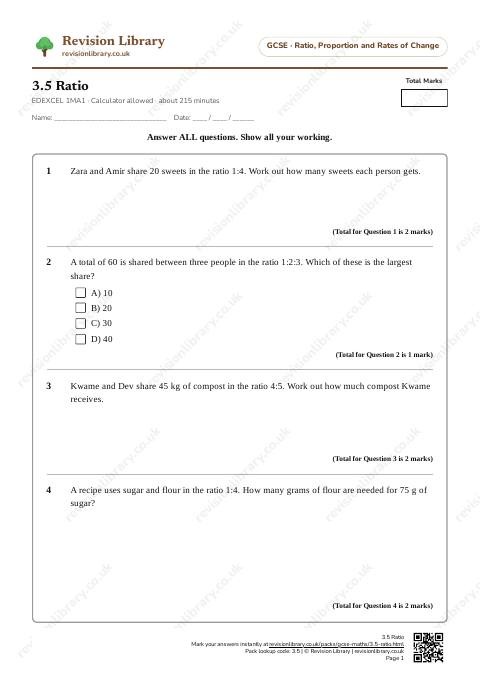
Revision Library
revisionlibrary.co.uk
GCSE · Ratio, Proportion and Rates of Change
3.5 Ratio
EDEXCEL 1MA1 · Calculator allowed · about 215 minutes
Zara and Amir share 20 sweets in the ratio 1:4. Work out how many sweets each person gets.
(Total for Question 1 is 2 marks)
2
A total of 60 is shared between three people in the ratio 1:2:3. Which of these is the largest share?
A) 10
B) 20
C) 30
D) 40
(Total for Question 2 is 1 mark)
3
Kwame and Dev share 45 kg of compost in the ratio 4:5. Work out how much compost Kwame receives.
(Total for Question 3 is 2 marks)
4
A recipe uses sugar and flour in the ratio 1:4. How many grams of flour are needed for 75 g of sugar?
(Total for Question 4 is 2 marks)
5
Share 28 sweets between A and B in the ratio 3:1. How many sweets does B get?
(Total for Question 5 is 2 marks)
6
A cleaning solution is made by mixing disinfectant and water in the ratio 1:9. Bilal has 2.5 litres of disinfectant and wants to use all of it, keeping the same ratio. Work out the total volume of solution he can make.
(Total for Question 6 is 3 marks)
7
A shop sells oats in two sizes. Small bag: 500 g for £1.20. Large bag: 1.4 kg for £3.15. Determine which bag is the better value for money.
(Total for Question 7 is 3 marks)
8
A football squad has 24 players. The ratio of forwards to midfielders to defenders is 3:5:4. Work out the percentage of the squad who are defenders.
(Total for Question 8 is 3 marks)
9
Given that 5:x = 15:24, work out the value of x.
(Total for Question 9 is 2 marks)
10
Ravi and Nia share £150 in the ratio 2:3. Work out how much more money Nia receives than Ravi.
(Total for Question 10 is 3 marks)
11
In a box of pens, the ratio of blue pens to black pens is 5:3. There are 12 more blue pens than black pens. Work out the total number of pens in the box.
(Total for Question 11 is 3 marks)
12
Grey paint is made by mixing blue paint and white paint in the ratio 3:2. Yusuf wants to make 40 litres of grey paint using this ratio. Work out how many litres of blue paint and how many litres of white paint he needs.
(Total for Question 12 is 3 marks)
13
The ratio of fiction to non-fiction in a box is 9:2. There are 10 non-fiction. How many fiction are there?
(Total for Question 13 is 2 marks)
14
Three friends share 312 stickers in the ratio 7:5:1. Work out the largest share.
(Total for Question 14 is 3 marks)
15
Ivan and Jade share £555 in the ratio 8:7. Work out how much each person receives.
(Total for Question 15 is 3 marks)
16
Ayesha and Ben share £360 in the ratio 4:5. Work out how much money Ben receives.
(Total for Question 16 is 3 marks)
17
A necklace is made using red, blue and green beads in the ratio 2:3:5. There are 60 beads in total.
(a)Work out the number of green beads.(3)
(b)Work out the number of red and blue beads combined.(2)
(Total for Question 17 is 5 marks)
18
The ratio of cats to dogs at a rescue centre is 3:7. There are 21 cats at the centre.
(a)Work out the number of dogs at the centre.(2)
(b)Work out the total number of animals at the centre.(1)
(Total for Question 18 is 3 marks)
19
A prize fund of £200 is shared between three charities in the ratio 2:3:5.
(a)Work out what fraction of the fund the charity with the largest share receives.(2)
(b)Work out how much money that charity receives.(2)
(Total for Question 19 is 4 marks)
20
Chloe, Mo and Nia are business partners. They share a profit of £960 in the ratio 2:3:7. Work out how much profit each partner receives.
(Total for Question 20 is 3 marks)
21
Aaliyah has a photograph that is 15 cm wide. She enlarges the photograph in the ratio 3:5. Work out the width of the enlarged photograph.
(Total for Question 21 is 3 marks)
22
The angles of a triangle are in the ratio 2:3:5. Work out the size of the largest angle.
(Total for Question 22 is 3 marks)
23
A class has boys and girls in the ratio 5:7. If there are 35 boys, how many pupils are there in total?
(Total for Question 23 is 3 marks)
24
Mix paint in the ratio red:blue = 2:5. How much red paint is needed for 35 litres of the mix?
(Total for Question 24 is 3 marks)
25
A map uses scale 1:50 000. A path measured on the map is 6 cm long. Work out the actual length of the path in metres.
(Total for Question 25 is 4 marks)
26
In a survey, the ratio of people who prefer tea to coffee is 5:4. The ratio of people who prefer coffee to hot chocolate is 3:2. Work out the ratio of people who prefer tea to coffee to hot chocolate, giving your answer in its simplest form.
(Total for Question 26 is 4 marks)
27
In a fruit basket, the ratio of apples to pears is 2:5. There are 35 pieces of fruit in total in the basket. 7 more apples are added to the basket. Work out the new ratio of apples to pears in the basket, giving your answer in its simplest form.
(Total for Question 27 is 4 marks)
28
The angles in a triangle are in the ratio 2:3:4. Show that none of the angles in the triangle is 90 degrees.
(Total for Question 28 is 3 marks)
29
Chloe and Dev share a sum of money in the ratio 3:4. Dev receives £24 more than Chloe. Work out the total amount of money shared.
(Total for Question 29 is 4 marks)
30
Write the ratio 6 : 15 in the form 1 : n.
(Total for Question 30 is 2 marks)
31
Amira and Ben share £96 in the ratio 5 : 3. Work out how much each person receives.
(Total for Question 31 is 3 marks)
32
The exchange rate is £1 : 1.28 dollars. Nadia changes £250 into dollars before a trip to New York. Work out how many dollars she receives.
(Total for Question 32 is 2 marks)
33
A community garden has 24 tulip bulbs and 18 daffodil bulbs. Write the fraction of the bulbs that are tulip bulbs. Give your answer in its simplest form.
(Total for Question 33 is 2 marks)
34
A bowl contains fruit in the ratio apples:pears:bananas = 4:2:3. There are 36 pieces of fruit in the bowl. How many apples are there?
(Total for Question 34 is 4 marks)
35
Ali and Zahra share money in the ratio 7:3. After Zahra receives £120, Ali has £280. Work out how much money they shared in total.
(Total for Question 35 is 4 marks)
36
Simplify the ratio 84 : 126.
(Total for Question 36 is 1 mark)
37
The cost of ribbon is directly proportional to its length. 3 metres of ribbon costs £5.40. Work out the cost of 8 metres of the same ribbon.
(Total for Question 37 is 3 marks)
38
An alloy is made from copper and tin in the ratio 7 : 3 by mass. A sample of the alloy has a mass of 450 g. Work out the mass of copper in the sample.
(Total for Question 38 is 3 marks)
39
A 750 ml bottle of squash costs £2.40. A 1.2 litre bottle of the same squash costs £3.60. By comparing the price per 100 ml, determine which bottle offers better value for money.
(Total for Question 39 is 4 marks)
40
On a school minibus, the ratio of adults to children is 2 : 5. There are 15 children on the minibus. Work out the total number of people on the minibus.
(Total for Question 40 is 3 marks)
41
A pancake recipe for 4 people uses 200 g of flour and 300 ml of milk. Freya wants to make pancakes for 10 people, using the same ratio of ingredients. Work out how much flour and how much milk she needs.
(Total for Question 41 is 3 marks)
42
A map has a scale of 1 : 25000. The distance between two villages on the map is 8.4 cm. Work out the real-life distance between the villages, giving your answer in kilometres.
(Total for Question 42 is 3 marks)
43
A paint mix uses white:grey in the ratio 5:2. A decorator needs 21 litres of grey. Work out how many litres of paint the decorator needs in total.
(a)Find the amount corresponding to one share.(2)
(b)Using your answer to part (a), find the total litres of paint required.(3)
(Total for Question 43 is 5 marks)
44
A carton contains orange and black sweets in the ratio 9:7. After 16 orange sweets are eaten, the ratio of orange to black becomes 5:4. How many black sweets were in the carton at the start?
(Total for Question 44 is 4 marks)
45
Sana is making cordial. The recipe uses lemon juice, water and sugar in the ratio 2 : 7 : 1. She needs to make 1.8 litres of cordial in total. Work out how much water (in litres) she should use. Give your answer to 2 decimal places.
(Total for Question 45 is 3 marks)
46
In a choir, the ratio of sopranos to altos is 4 : 5. The ratio of altos to tenors is 3 : 2. Find the ratio of sopranos : altos : tenors in its simplest form.
(Total for Question 46 is 3 marks)
47
A gardener mixes fertiliser and water in the ratio 1 : 24 to make feed for tomato plants. He has 6 litres of fertiliser.
(a)Work out the maximum volume of feed he can make using all 6 litres of fertiliser.(2)
(b)He decides to use only 250 ml of fertiliser at a time, mixed with water in the same ratio. Work out how many litres of water are needed for one 250 ml application.(2)
(Total for Question 47 is 4 marks)
48
Three friends share the prize money in the ratio 4 : 3 : k. The first two receive a total of £140 and the third receives £40 more than the second. Find k and the total prize money.
(Total for Question 48 is 4 marks)
49
A map uses a scale so that 1 cm represents 4 km. On the map two towns are 7.5 cm apart. Another town X is such that the ratio of real distances from the first town to the second and from the first town to X is 5 : 8. Work out the distance from the first town to town X in kilometres.
(Total for Question 49 is 4 marks)
50
Ten years ago, the ratio of Priya's age to her mother's age was 1 : 4. Priya is now 25 years old. Find her mother's current age.
(Total for Question 50 is 4 marks)
51
In triangle ABC, point D is on AC such that AD : DC = 2 : 3. Show that BD divides the triangle into two regions (triangles ABD and DBC) whose areas are in the ratio 2 : 3. (You may assume triangles with equal heights have areas proportional to their bases.)
(Total for Question 51 is 5 marks)
Mark scheme · 3.5 Ratio
Question 1
20 / 5 = 4 oe (one share found)M1
Zara = 4 and Amir = 16 caoA1
Answer: Zara = 4, Amir = 16
Question 2
C caoB1
Answer: C) 30
Question 3
45 / 9 = 5 oe (one share found)M1
20 kg caoA1
Answer: 20 kg
Question 4
Use unitary method: 75 g sugar corresponds to 75 x 4 = 300 g flour (method shown)M1
300 g caoA1
Answer: 300 g
Question 5
Find one share: 28 divided by (3+1) = 7 (method)M1
7 sweets caoA1
Answer: 7 sweets
Question 6
water = 9 x 2.5 = 22.5 oeM1
2.5 + 22.5 (dep on first M1), or total parts = 10 and 10 x 2.5M1
25 litres caoA1
Answer: 25 litres
Question 7
small bag unit price = 1.20 / 500 x 100 = £0.24 per 100 g oeM1
large bag unit price = 3.15 / 1400 x 100 = £0.225 per 100 g oeM1
correct conclusion: large bag is better value because 0.225 < £0.24 per 100 gC1
Answer: Large bag (£0.225 per 100 g vs £0.24 per 100 g)
Question 8
24 / 12 = 2 oe (one share found)M1
defenders = 4 x 2 = 8 oe, then 8/24 x 100 (dep)M1
awrt 33.3% (exact value 100/3%)A1
Answer: 33.3% (1 dp); exact value 100/3%
Question 9
sets up 5/15 = x/24 oe, or cross-multiplies 5 x 24 = 15xM1
x = 8 caoA1
Answer: x = 8
Question 10
150 / 5 = 30 oe (one share found)M1
Ravi = 60 and Nia = 90 both found (dep on first M1)M1
£30 caoA1
Answer: £30
Question 11
recognises the difference 5 - 3 = 2 parts represents 12 pens oeM1
1 part = 6, total parts = 5 + 3 = 8 oe (dep on first M1)M1
48 caoA1
Answer: 48 pens
Question 12
40 / 5 = 8 oe (one share found)M1
blue = 24 litres caoA1
white = 16 litres caoA1
Answer: blue = 24 litres, white = 16 litres
Question 13
finds the value of one part (5)M1
45A1
Answer: 45
Question 14
13 parts in total and 312/13 = 24M1
largest part 7 x 24M1
168A1
Answer: 168
Question 15
8 + 7 = 15 partsM1
555 / 15 = 37 per partM1
£296 and £259A1
Answer: Ivan £296 and Jade £259
Question 16
360 / 9 = 40 oe (one share found)M1
40 x 5 (dep on first M1)M1
£200 caoA1
Answer: £200
Question 17
(a) 60 / 10 = 6 oe (one share found)M1
(a) 6 x 5 (dep on first M1)M1
(a) 30 caoA1
(a) Answer: 30 green beads
(b) (2 + 3) x 6 oe, ft from part (a)M1
(b) 30 cao (ft)A1
(b) Answer: 30 beads
Question 18
(a) 21 / 3 = 7 oe (scale factor found)M1
(a) 49 caoA1
(a) Answer: 49 dogs
(b) 70 cao (ft from part (a))B1
(b) Answer: 70 animals
Question 19
(a) total parts = 2 + 3 + 5 = 10 oeM1
(a) 1/2 oe caoA1
(a) Answer: 1/2
(b) 200 / 10 = 20 oe, ft from part (a)M1
(b) £100 cao (ft)A1
(b) Answer: £100
Question 20
960 / 12 = 80 oe (one share found)M1
multiply each ratio part by 80 (dep on first M1)M1
Chloe = 160, Mo = 240, Nia = 560, all caoA1
Answer: Chloe = £160, Mo = £240, Nia = £560
Question 21
scale factor = 5/3 oeM1
15 x 5/3 (dep on first M1)M1
25 cm caoA1
Answer: 25 cm
Question 22
Method to find size per part: 180 divided by (2+3+5)=180/10=18 oeM1
Multiply 18 by 5 to get largest angle (method)M1
90 degrees caoA1
Answer: 90 degrees
Question 23
Find one share: 35 corresponds to 5 so one share = 35/5 = 7 (method)M1
Total shares = 5+7 =12 so total pupils = 12 x 7 = 84 (method)M1
84 pupils caoA1
Answer: 84 pupils
Question 24
One share: 35 divided by (2+5)=35/7=5 (method)M1
Red amount = 2 x 5 = 10 litres (method)M1
10 litres caoA1
Answer: 10 litres
Question 25
Convert map length to actual: 6 cm corresponds to 6 x 50 000 cm = 300 000 cm (method)M1
Convert cm to metres: 300 000 cm = 3000 m (method)M1
3000 m caoA1
final answer given with correct unitB1
Answer: 3000 m
Question 26
scale tea:coffee so coffee = 12, giving 15:12 oeM1
scale coffee:hot chocolate so coffee = 12, giving 12:8 oeM1
15:12:8 caoA1
ratio correctly labelled and ordered tea : coffee : hot chocolateC1
find total parts 2+7+1 = 10 and method to get amount per part: 1.8 / 10 or equivalentM1
multiply water parts 7 * (1.8/10) or 7/10 * 1.8M1
1.26 cao to 2 dpA1
Answer: 1.26 litres
Question 46
finds a common value for altos, e.g. LCM(5, 3) = 15M1
scales both ratios: sopranos:altos = 12:15 and altos:tenors = 15:10M1
12 : 15 : 10 (cao)A1
Answer: 12 : 15 : 10
Question 47
(a) total parts = 1 + 24 = 25, so 6 x 25 (oe)M1
(a) 150 litres (cao)A1
(a) Answer: 150 litres
(b) 250 x 24 (oe)M1
(b) 6 litres (cao, accept 6000 ml)A1
(b) Answer: 6 litres
Question 48
let the amounts be 4x, 3x and kx; use kx = 3x + 40M1
from kx = 3x + 40 get (k - 3)x = 40; also 4x + 3x = 140 so 7x = 140 hence x = 20M1
k - 3 = 40/x = 40/20 = 2 so k = 5A1
total = (4+3+5)x = 12 * 20 = £240 caoA1
Answer: k = 5, total prize money = £240
Question 49
convert map distance to real distance: 7.5 cm * 4 km/cm = 30 kmM1
use ratio 5:8 so scale factor for X distance = 8/5 of 30 km or set unit = 30/5 = 6 kmM1
compute distance = 6 * 8 = 48 kmM1
48 km caoA1
Answer: 48 km
Question 50
Priya's age 10 years ago = 25 - 10 = 15M1
uses the ratio to find her mother's age 10 years ago: 15 x 4 = 60M1
adds 10 years back on: 60 + 10M1
70 (cao)A1
Answer: 70 years old
Question 51
recognise that triangles ABD and DBC share vertex B and have bases AD, DC on the same straight line AC, so they share the same perpendicular height from B to ACM1
state that triangles with equal heights have areas proportional to their base lengthsM1
area(ABD) : area(DBC) = AD : DC = 2 : 3A1
verify with a worked example, e.g. coordinates A=(0,0), C=(5,0), B=(0,3), D=(2,0): area ABD = 3, area DBC = 4.5, ratio 3:4.5 = 2:3M1
conclude BD divides the triangle into two regions with areas in ratio 2 : 3 caoA1
Put this topic and others into one printable pack.
Open the Pack Builder
Worksheets are written for Revision Library and come with a full mark scheme; a few English packs quote an out-of-copyright text, and name it on the page. Exam board names and specification codes say which qualification a pack suits: we are not affiliated with, endorsed by or approved by any exam board, and no past-paper question is reproduced here. Rights queries: hello@revisionlibrary.co.uk