A percentage is a fraction out of 100, using the symbol %. Percentages are used to find part of an amount, describe increases and decreases, and compare proportions.
To find a percentage of an amount without a calculator, find 10% by dividing by 10, then scale that up or down to build the percentage you need - 5% is half of 10%, 30% is three lots of 10%, and so on.
With a calculator, convert the percentage to a decimal by dividing by 100, then multiply by the amount.
To increase or decrease an amount by a percentage, add or subtract the amount found from the original - or use a single multiplier, e.g. a 15% increase means multiplying by 1.15.
To find one amount as a percentage of another, divide the first amount by the second and multiply by 100.
For repeated percentage change over several time periods, such as compound interest, raise the multiplier to the power of the number of periods.
Worked example
A jacket costs 80 pounds before a 15% sale discount. Find the sale price.
Convert 15% to a decimal: 15 divided by 100 = 0.15.
Find 15% of 80: 0.15 x 80 = 12.
This means the discount is 12 pounds.
Subtract the discount from the original price: 80 - 12 = 68.
Alternatively, use a single multiplier: a 15% decrease means multiplying by (1 - 0.15) = 0.85, and 80 x 0.85 = 68.
The sale price is 68 pounds.
Revision Library
revisionlibrary.co.uk
GCSE · EDEXCEL
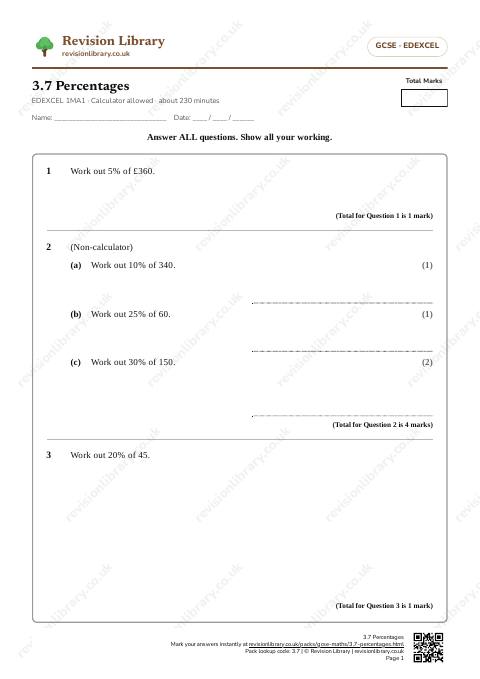
3.7 Percentages
EDEXCEL 1MA1 · Calculator allowed · about 230 minutes
(b)A bag has 90 sweets. 30% are taken out and shared. How many sweets remain in the bag?(1)
(Total for Question 4 is 2 marks)
5
Which is greater, 25% of 80 or 15% of 60? You must show your working.
(Total for Question 5 is 3 marks)
6
Express 2 out of 8 as a percentage.
(Total for Question 6 is 2 marks)
7
A shop reduces the price of a jacket from £500 by 25% in a sale. VAT at 20% is then added to the sale price. Work out the final price of the jacket.
(Total for Question 7 is 3 marks)
8
The price of a watch is £250. Decrease the price by 20%.
(Total for Question 8 is 2 marks)
9
Work out 60% of 360.
(Total for Question 9 is 2 marks)
10
Which is greater, 15% of 120 or 35% of 300? You must show your working.
(Total for Question 10 is 3 marks)
11
A shop reduces the price of a jacket from £60 by 30% in a sale. VAT at 20% is then added to the sale price. Work out the final price of the jacket.
(Total for Question 11 is 3 marks)
12
The price of a bike is £80. Increase the price by 4%.
(Total for Question 12 is 2 marks)
13
Express 20 out of 50 as a percentage.
(Total for Question 13 is 2 marks)
14
A shop reduces the price of a jacket from £240 by 40% in a sale. VAT at 20% is then added to the sale price. Work out the final price of the jacket.
(Total for Question 14 is 3 marks)
15
(Non-calculator) Work out 17.5% of 240.
(Total for Question 15 is 3 marks)
16
Work out 17.5% of £40.
(Total for Question 16 is 2 marks)
17
The price of a bike is £200. Increase the price by 15%.
(Total for Question 17 is 2 marks)
18
A shop reduces the price of a jacket from £200 by 30% in a sale. VAT at 20% is then added to the sale price. Work out the final price of the jacket.
(Total for Question 18 is 3 marks)
19
Which is greater, 30% of 40 or 15% of 160? You must show your working.
(Total for Question 19 is 3 marks)
20
Which is greater, 25% of 250 or 15% of 250? You must show your working.
(Total for Question 20 is 3 marks)
21
Work out 23% of £560.
(Total for Question 21 is 2 marks)
22
In a class of 25 students, 17 are right-handed. Work out the percentage of the class that is right-handed.
(Total for Question 22 is 2 marks)
23
(Non-calculator) A jacket costs £80. In a sale, the price is reduced by 15%.
(a)Work out the sale price of the jacket.(3)
(Total for Question 23 is 3 marks)
24
Work out 12% of £450.
(Total for Question 24 is 2 marks)
25
Work out 7% of 350. Give your answer as a decimal number.
(Total for Question 25 is 2 marks)
26
A jumper costs £40. It is reduced by 25% in a sale. Work out the sale price of the jumper.
(Total for Question 26 is 2 marks)
27
Increase 120 by 15%. Work out the new value.
(Total for Question 27 is 2 marks)
28
The population of a village is 1500. Over one year the population increases by 12%.
(a)Work out the population at the end of the year.(2)
(Total for Question 28 is 2 marks)
29
A car is worth £9000. Over one year its value decreases by 8%.
(a)Work out the value of the car at the end of the year.(2)
(Total for Question 29 is 2 marks)
30
A restaurant bill for food comes to £45. VAT is then added at 20%.
(a)Work out the total cost of the bill including VAT.(2)
(Total for Question 30 is 2 marks)
31
Increase 160 by 35%.
(Total for Question 31 is 2 marks)
32
Decrease 90 by 8%.
(Total for Question 32 is 2 marks)
33
A laptop has a price of £540 before VAT. VAT is charged at 20%. Work out the total price of the laptop including VAT.
(Total for Question 33 is 2 marks)
34
Kwame puts £1200 into a savings account that pays 2.5% simple interest per year. Work out the total interest he earns after 5 years.
(Total for Question 34 is 2 marks)
35
Yusuf has £200. He spends 40% of it on a bike. He then spends 25% of the remaining money on a helmet. Work out how much money Yusuf has left.
(Total for Question 35 is 3 marks)
36
A student scored 18 out of 24 on a test. Work out the percentage score correct to the nearest whole percent.
(Total for Question 36 is 2 marks)
37
A recipe requires 250 g of flour. A baker wants to increase all ingredient quantities by 12.5% to make a larger batch. Work out the new required mass of flour, giving your answer in grams.
(Total for Question 37 is 4 marks)
38
A shopkeeper buys a bicycle for £120. She sells it for £150.
(a)Work out her percentage profit.(3)
(Total for Question 38 is 3 marks)
39
Amelia and Noah each sit a test. Amelia scores 42 out of 60. Noah scores 55 out of 80.
(a)By working out each score as a percentage, determine who did better in the test. You must show your working.(3)
(Total for Question 39 is 3 marks)
40
Priya has £240. She spends 35% of it on a coat. She then spends 1/4 of what is left on a pair of shoes.
(a)Work out how much money Priya has left.(4)
(Total for Question 40 is 4 marks)
41
A theatre has 800 seats. For one show, 65% of the seats are sold in advance. On the night of the show, a further 120 seats are sold.
(a)Work out what percentage of the theatre's seats are sold in total.(3)
(Total for Question 41 is 3 marks)
42
A shop increases the price of a coat by 20%. In a later sale, it reduces the new price by 20%. A customer says: "The price is now back to what it started at, because a 20% increase and a 20% decrease cancel each other out."
(a)Using a starting price of £50, show that the customer is wrong and explain why.(3)
(Total for Question 42 is 3 marks)
43
A secondary school has 1200 students. 55% of the students are girls. Of the girls, 40% study French. Work out how many girls study French.
(Total for Question 43 is 3 marks)
44
A denim jacket is normally priced at £64. In a clearance sale it is reduced to £48. Work out the percentage decrease in the price.
(Total for Question 44 is 3 marks)
45
After a price increase of 20%, a mountain bike now costs £252. Work out the original price of the bike, before the increase.
(Total for Question 45 is 3 marks)
46
Daniel buys a second-hand table for £85. He restores it and sells it for £102. Work out his percentage profit.
(Total for Question 46 is 3 marks)
47
After a 20% increase the price of a radio is £372. Work out the original price of the radio.
(Total for Question 47 is 2 marks)
48
A jacket costs £120. It is reduced by 25% in a sale and then a further 10% is taken off the reduced price. Work out the final price of the jacket.
(Total for Question 48 is 3 marks)
49
A school fundraiser collected £840. The organisers decide to give 12% to charity, use 35% for equipment, and split the remainder equally between two sports teams. Work out how much each sports team receives. Show your working.
(Total for Question 49 is 4 marks)
50
In a sale, all normal prices are reduced by 20%. The sale price of a coat is £68.
(a)Work out the normal price of the coat before the sale.(3)
(Total for Question 50 is 3 marks)
51
Kwame invests £3000 in an account paying 5% compound interest per year.
(a)Work out the value of the investment at the end of 2 years.(3)
(Total for Question 51 is 3 marks)
52
Aisha invests £2500 in an account paying 3% compound interest per year. Work out the value of her investment at the end of 4 years. Give your answer to the nearest penny.
(Total for Question 52 is 3 marks)
53
Sophie buys a car for £18000. The car depreciates in value by 12% each year. Work out the value of the car after 3 years. Give your answer to the nearest pound.
(Total for Question 53 is 3 marks)
54
In a sale, a shop reduces every price by 15%. The sale price of a jumper is £39.10. Work out the original price of the jumper, before the sale.
(Total for Question 54 is 3 marks)
55
The population of a town increases by 8% each year. If the current population is 25 000, work out the population after 2 years. Give your answer to the nearest whole person.
(Total for Question 55 is 3 marks)
56
A bank offers 6% compound interest per year, compounded annually. Sara invests £2000 for 3 years. Work out the total interest earned after 3 years. Give your answer to the nearest pound.
(Total for Question 56 is 5 marks)
57
A price of £270 includes VAT at 20%. A shop removes the VAT to find the pre-VAT price, then applies a separate 10% loyalty-card discount to that pre-VAT price.
(a)Work out the price before VAT was added.(2)
(b)Work out the final price a loyalty-card customer pays, after the 10% discount is applied to the pre-VAT price.(2)
(Total for Question 57 is 4 marks)
58
A painting is currently worth £5000. Its value is expected to increase by 8% each year. Find the number of complete years it takes for the value of the painting to first be worth more than £7000.
(Total for Question 58 is 4 marks)
59
A laptop is on sale at 15% off the marked price. After the sale the shop increases the sale price by 10% to return nearer to the original price. If the final price is £810, find the original marked price. Give your answer to the nearest penny.
(Total for Question 59 is 5 marks)
60
A bacteria population starts at 800 and increases by 25% every hour.
(a)Work out the population after 6 hours. Give your answer to 3 significant figures.(3)
(b)Work out the overall percentage increase in the population over the 6 hours. Give your answer to 3 significant figures.(2)
(Total for Question 60 is 5 marks)
61
The price of an item is increased by x%. It is then decreased by x%. The final price is 4% less than the original price.
(Total for Question 61 is 4 marks)
Mark scheme · 3.7 Percentages
A correct answer earns full marks unless the question asks for working, a method, proof or explanation.
Question 1
£18 caoB1
Answer: £18
Question 2
(a) 34B1
(a) Answer: 34
(b) 15B1
(b) Answer: 15
(c) 10% of 150 = 15 seen, or 0.3 x 150 (oe method)M1
(c) 45A1
(c) Answer: 45
Question 3
9 caoB1
Answer: 9
Question 4
(a) 27 caoB1
(a) Answer: 27
(b) 63 caoB1
(b) Answer: 63
Question 5
20 foundM1
9 foundM1
25% of 80 is greaterA1
Answer: 25% of 80
Question 6
2 / 8 x 100M1
25%A1
Answer: 25%
Question 7
sale price £375.00M1
£375.00 x 1.2 or adds 20%M1
£450.00A1
Answer: £450.00
Question 8
250 x 0.8 or 20% of 250 foundM1
£200.00A1
Answer: £200.00
Question 9
60 / 100 x 360 or 10% methodM1
216A1
Answer: 216
Question 10
18 foundM1
105 foundM1
35% of 300 is greaterA1
Answer: 35% of 300
Question 11
sale price £42.00M1
£42.00 x 1.2 or adds 20%M1
£50.40A1
Answer: £50.40
Question 12
80 x 1.04 or 4% of 80 foundM1
£83.20A1
Answer: £83.20
Question 13
20 / 50 x 100M1
40%A1
Answer: 40%
Question 14
sale price £144.00M1
£144.00 x 1.2 or adds 20%M1
£172.80A1
Answer: £172.80
Question 15
10% of 240 = 24M1
5% = 12 and 2.5% = 6 (oe building blocks)M1
42A1
Answer: 42
Question 16
17.5 / 100 x 40 or 10% methodM1
£7.00A1
Answer: £7.00
Question 17
200 x 1.15 or 15% of 200 foundM1
£230.00A1
Answer: £230.00
Question 18
sale price £140.00M1
£140.00 x 1.2 or adds 20%M1
£168.00A1
Answer: £168.00
Question 19
12 foundM1
24 foundM1
15% of 160 is greaterA1
Answer: 15% of 160
Question 20
62.5 foundM1
37.5 foundM1
25% of 250 is greaterA1
Answer: 25% of 250
Question 21
0.23 x 560 (oe)M1
128.80 (pounds)A1
Answer: £128.80
Question 22
17/25 x 100 (oe)M1
68%A1
Answer: 68%
Question 23
(a) 15% of 80: 10% = 8 and 5% = 4 (oe), so reduction = 12M1
(a) 80 - 12 (oe)M1
(a) 68 (pounds)A1
(a) Answer: £68
Question 24
0.12 x 450 (oe)M1
54 (pounds)A1
Answer: £54
Question 25
use 0.07 x 350 or 7/100 x 350M1
24.5 caoA1
Answer: 24.5
Question 26
find 25% of 40 or show 40 x 0.25 or 40/4M1
£30 caoA1
Answer: £30
Question 27
find 15% of 120 or show 120 x 0.15M1
138 caoA1
Answer: 138
Question 28
(a) 1.12 x 1500 (oe: 12% of 1500 = 180)M1
(a) 1680A1
(a) Answer: 1680
Question 29
(a) 0.92 x 9000 (oe: 8% of 9000 = 720)M1
(a) 8280 (pounds)A1
(a) Answer: £8280
Question 30
(a) 1.2 x 45 (oe: 20% of 45 = 9)M1
(a) 54 (pounds)A1
(a) Answer: £54
Question 31
1.35 x 160 (oe: 35% of 160 = 56)M1
216A1
Answer: 216
Question 32
0.92 x 90 (oe: 8% of 90 = 7.2)M1
82.8A1
Answer: 82.8
Question 33
1.2 x 540 (oe: 20% of 540 = 108)M1
648 (pounds)A1
Answer: £648
Question 34
2.5% of 1200 = 30 (interest for one year)M1
150 (pounds), from 30 x 5A1
Answer: £150
Question 35
find 40% of 200 = 80 and subtract to find remaining 120, or show 200 x 0.6 = 120M1
find 25% of 120 = 30 and subtract to find remaining 90, or show 120 x 0.75 = 90M1
Put this topic and others into one printable pack.
Open the Pack Builder
Worksheets are written for Revision Library and come with a full mark scheme; a few English packs quote an out-of-copyright text, and name it on the page. Exam board names and specification codes say which qualification a pack suits: we are not affiliated with, endorsed by or approved by any exam board, and no past-paper question is reproduced here. Rights queries: hello@revisionlibrary.co.uk