Enlarging with a negative scale factor produces an image on the opposite side of the centre of enlargement to the object, rotated 180 degrees compared with the original shape, with the size of the image found using the magnitude of the scale factor, so a scale factor of -3 makes an image 3 times the size of the object. This Higher GCSE topic extends ordinary enlargement to negative scale factors.
Find the vector from the centre of enlargement to each vertex of the object (the difference in x and y coordinates).
Multiply that vector by the scale factor, including its negative sign.
Add the result to the coordinates of the centre of enlargement to find each image vertex.
Remember the image appears on the opposite side of the centre from the object, and upside down (rotated 180 degrees) compared with it.
Use the magnitude (ignore the sign) of the scale factor for any length, area or volume calculation.
To find an area scale factor, square the magnitude of the scale factor, since area scale factor is always positive.
Worked example
Triangle ABC has vertices A(4, 1), B(6, 1) and C(4, 3). It is enlarged by scale factor -2, centre (0, 0), to give triangle A'B'C'. Find the coordinates of A', B' and C'.
Find the vector from the centre (0, 0) to each vertex: A is (4, 1), B is (6, 1), C is (4, 3).
Multiply each vector by the scale factor -2: A becomes (-8, -2), B becomes (-12, -2), C becomes (-8, -6).
Since the centre is the origin, these are already the image coordinates.
A' = (-8, -2), B' = (-12, -2), C' = (-8, -6).
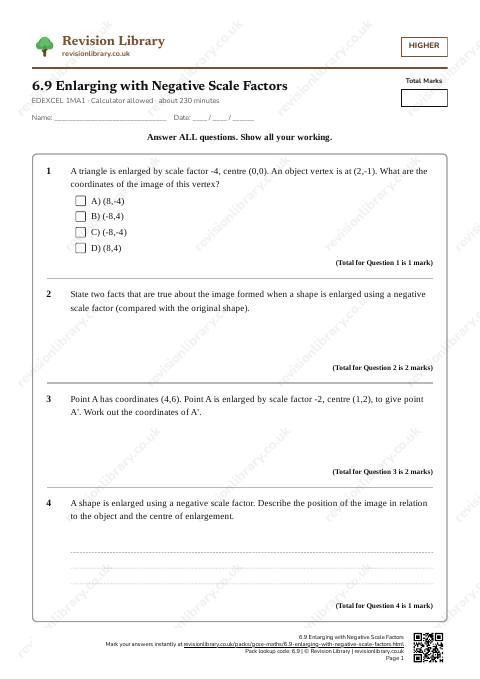
Revision Library
revisionlibrary.co.uk
HIGHER
6.9 Enlarging with Negative Scale Factors
EDEXCEL 1MA1 · Calculator allowed · about 230 minutes
A triangle is enlarged by scale factor -4, centre (0,0). An object vertex is at (2,-1). What are the coordinates of the image of this vertex?
A) (8,-4)
B) (-8,4)
C) (-8,-4)
D) (8,4)
(Total for Question 1 is 1 mark)
2
State two facts that are true about the image formed when a shape is enlarged using a negative scale factor (compared with the original shape).
(Total for Question 2 is 2 marks)
3
Point A has coordinates (4,6). Point A is enlarged by scale factor -2, centre (1,2), to give point A'. Work out the coordinates of A'.
(Total for Question 3 is 2 marks)
4
A shape is enlarged using a negative scale factor. Describe the position of the image in relation to the object and the centre of enlargement.
(Total for Question 4 is 1 mark)
5
A shape is enlarged by scale factor -4. State (i) the effect on the length of each side of the shape (ii) the effect on the orientation of the shape.
(Total for Question 5 is 2 marks)
6
A shape is enlarged by scale factor -3 to form an image. A side on the image has length 24 cm. Work out the length of the corresponding side on the original shape.
(Total for Question 6 is 2 marks)
7
Show that enlarging a shape by scale factor -1 about a centre C has exactly the same effect as rotating the shape by 180 degrees about the same centre C.
(Total for Question 7 is 3 marks)
8
A square WXYZ has vertices W(1,1), X(3,1), Y(3,3) and Z(1,3). The square is enlarged by scale factor -2, using the centre of the square, (2,2), as the centre of enlargement, to form square W'X'Y'Z'.
(a)Find the coordinates of W', X', Y' and Z'.(4)
(b)The area of square WXYZ is 4 cm². Use the scale factor of the enlargement to work out the area of square W'X'Y'Z'. Give a reason for your answer.(2)
(Total for Question 8 is 6 marks)
9
A shape is enlarged by scale factor -0.4. State two facts about the size and position of the image compared with the object.
(Total for Question 9 is 2 marks)
10
The point P is (4, 4). P is enlarged by scale factor -1/2 with centre (2, 2). Find the coordinates of the image of P.
(Total for Question 10 is 3 marks)
11
Triangle T has a side from A(-2, 4) to B(1, 4). Under a single enlargement, A maps to A'(0, -10) and B maps to B'(-3, -10). Describe fully the enlargement.
(Total for Question 11 is 3 marks)
12
Triangle ABC has vertices A(2, 1), B(5, 1) and C(2, 4). It is enlarged by scale factor -2 with centre (3, 3) to give triangle A'B'C'. Find the coordinates of A', B' and C'.
(Total for Question 12 is 4 marks)
13
The point P is (3, 5). P is enlarged by scale factor -3 with centre (0, 0). Write down the coordinates of the image of P.
(Total for Question 13 is 2 marks)
14
The point P is (3, 1). P is enlarged by scale factor -3 with centre (2, -2). Find the coordinates of the image of P.
(Total for Question 14 is 3 marks)
15
The point P(-1, 6) is mapped to P'(-1, -6) by an enlargement with scale factor -3. Find the coordinates of the centre of enlargement.
(Total for Question 15 is 3 marks)
16
Triangle ABC has vertices A(1, 1), B(2, 1) and C(1, 2). It is enlarged by scale factor -1 with centre (-3, -1) to give triangle A'B'C'. Find the coordinates of A', B' and C'.
(Total for Question 16 is 4 marks)
17
A shape has area 4 cm². It is enlarged by scale factor -3. Work out the area of the image.
(Total for Question 17 is 2 marks)
18
Triangle T has a side from A(0, 4) to B(2, 3). Under a single enlargement, A maps to A'(0, -20) and B maps to B'(-6, -17). Describe fully the enlargement.
(Total for Question 18 is 3 marks)
19
The point P is (0, 7). P is enlarged by scale factor -1/2 with centre (-4, -3). Find the coordinates of the image of P.
(Total for Question 19 is 3 marks)
20
The point P is (6, 10). P is enlarged by scale factor -1/2 with centre (-2, 2). Find the coordinates of the image of P.
(Total for Question 20 is 3 marks)
21
The point P(-7, 6) is mapped to P'(-1, 0) by an enlargement with scale factor -1. Find the coordinates of the centre of enlargement.
(Total for Question 21 is 3 marks)
22
The point P is (-2, 3). P is enlarged by scale factor -3 with centre (3, -2). Find the coordinates of the image of P.
(Total for Question 22 is 3 marks)
23
A shape has area 20 cm². It is enlarged by scale factor -2. Work out the area of the image.
(Total for Question 23 is 2 marks)
24
The point P is (13, 11). P is enlarged by scale factor -2/3 with centre (-2, -4). Find the coordinates of the image of P.
(Total for Question 24 is 3 marks)
25
The point P is (-6, 9). P is enlarged by scale factor -1/3 with centre (0, 0). Write down the coordinates of the image of P.
(Total for Question 25 is 2 marks)
26
Triangle PQR has vertices P(1,2), Q(3,2) and R(1,5). It is enlarged by scale factor -2, centre (0,0), to give triangle P'Q'R'. Find the coordinates of P', Q' and R'.
(Total for Question 26 is 3 marks)
27
The point P is (-4, -3). P is enlarged by scale factor -1 with centre (1, -2). Find the coordinates of the image of P.
(Total for Question 27 is 3 marks)
28
A shape has area 28 cm². It is enlarged by scale factor -5. Work out the area of the image.
(Total for Question 28 is 2 marks)
29
The point P is (0, -3). P is enlarged by scale factor -1 with centre (-2, -1). Find the coordinates of the image of P.
(Total for Question 29 is 3 marks)
30
The point P(-3, 2) is mapped to P'(6, -4) by an enlargement with scale factor -1/2. Find the coordinates of the centre of enlargement.
(Total for Question 30 is 3 marks)
31
The point P is (-2, 12). P is enlarged by scale factor -2/3 with centre (-2, 0). Find the coordinates of the image of P.
(Total for Question 31 is 3 marks)
32
A shape has perimeter 12 cm. It is enlarged by scale factor -4. Work out the perimeter of the image.
(Total for Question 32 is 2 marks)
33
The point P is (-10, 11). P is enlarged by scale factor -2/3 with centre (-1, -1). Find the coordinates of the image of P.
(Total for Question 33 is 3 marks)
34
Triangle T has a side from A(3, 2) to B(6, 1). Under a single enlargement, A maps to A'(-3, -7) and B maps to B'(-9, -5). Describe fully the enlargement.
(Total for Question 34 is 3 marks)
35
A shape has perimeter 8 cm. It is enlarged by scale factor -3. Work out the perimeter of the image.
(Total for Question 35 is 2 marks)
36
The point P(0, -5) is mapped to P'(8, 7) by an enlargement with scale factor -3. Find the coordinates of the centre of enlargement.
(Total for Question 36 is 3 marks)
37
Triangle ABC has vertices A(3,4), B(5,4) and C(3,6). Triangle ABC is enlarged by scale factor -3, centre (1,2), to give triangle A'B'C'. Find the coordinates of A', B' and C'.
(Total for Question 37 is 4 marks)
38
A shape has perimeter 14 cm. It is enlarged by scale factor -4. Work out the perimeter of the image.
(Total for Question 38 is 2 marks)
39
The point P(-1, 4) is mapped to P'(-10, -11) by an enlargement with scale factor -2. Find the coordinates of the centre of enlargement.
(Total for Question 39 is 3 marks)
40
Shape P has an area of 8 cm². Shape P is enlarged by scale factor -2 to form shape Q. Work out the area of shape Q.
(Total for Question 40 is 2 marks)
41
The point P has coordinates (2, 3). P is enlarged by scale factor -1, centre the origin O, to give the image P'. Find the coordinates of P'.
(Total for Question 41 is 2 marks)
42
The point Q has coordinates (4, -2). Q is enlarged by scale factor -2, centre the origin O, to give the image Q'. Find the coordinates of Q'.
(Total for Question 42 is 2 marks)
43
A shape has area 8 cm². The shape is enlarged by scale factor -2. Work out the area of the image.
(Total for Question 43 is 2 marks)
44
A rectangle ABCD has vertices A(-2,4), B(2,4), C(2,0) and D(-2,0). The rectangle is enlarged by scale factor -1/2, using centre (0,2), to form rectangle A'B'C'D'.
(a)Find the coordinates of A', B', C' and D'.(4)
(b)The area of rectangle ABCD is 16 cm². Use the scale factor to calculate the area of rectangle A'B'C'D'.(2)
(c)Find the ratio of the perimeter of ABCD to the perimeter of A'B'C'D', giving your answer in its simplest form.(2)
(Total for Question 44 is 8 marks)
45
Triangle ABC has vertices A(1,1), B(3,1) and C(1,2). It is enlarged to form triangle A'B'C' with vertices A'(5,-7), B'(-1,-7) and C'(5,-10). Find the scale factor of the enlargement and the coordinates of the centre of enlargement.
(Total for Question 45 is 4 marks)
46
Triangle ABC has vertices A(1, 1), B(4, 1) and C(1, 3). After an enlargement, the image has vertices A'(-2, -2), B'(-8, -2) and C'(-2, -6). Find (i) the scale factor of the enlargement (ii) the coordinates of the centre of enlargement.
(Total for Question 46 is 4 marks)
47
Point S has coordinates (2, 2) and maps to the image point S'(-2, -2) under an enlargement with scale factor -1. Find the coordinates of the centre of enlargement.
(Total for Question 47 is 2 marks)
48
Describe fully the single transformation that maps triangle XYZ, with vertices X(2, 1), Y(4, 1) and Z(2, 4), onto triangle X'Y'Z', with vertices X'(-4, -2), Y'(-8, -2) and Z'(-4, -8).
(Total for Question 48 is 3 marks)
49
An enlargement maps a line segment of length 6 cm to an image of length 15 cm. The image is inverted compared with the object. State (i) the scale factor of the enlargement, including its sign (ii) the area scale factor that this would give for a 2-dimensional shape.
(Total for Question 49 is 2 marks)
50
Triangle PQR has vertices P(0, 1), Q(3, 1) and R(0, 4). The area of triangle PQR is 4.5 cm². Triangle PQR is enlarged by scale factor -2, centre the origin O, to give triangle P'Q'R'.
(a)Find the coordinates of P', Q' and R'.(2)
(b)Find the area of triangle P'Q'R'.(2)
(Total for Question 50 is 4 marks)
51
A student called Aaliyah enlarges a triangle with vertices (2, 0), (4, 0) and (2, 3) by scale factor -2, centre the origin O. Aaliyah's image has vertices (4, 0), (8, 0) and (4, 6).
(a)Explain the error Aaliyah has made.(1)
(b)Write down the correct coordinates of the image vertices.(2)
(Total for Question 51 is 3 marks)
52
Triangle DEF has vertices D(2, 1), E(5, 1) and F(2, 3). The triangle is enlarged by scale factor -1/2, centre the origin O, to give triangle D'E'F'. Find the coordinates of D', E' and F'.
(Total for Question 52 is 3 marks)
53
An object has area 6 cm². After an enlargement with a negative scale factor, its image has area 54 cm². Find the scale factor of the enlargement.
(Total for Question 53 is 2 marks)
54
Triangle LMN has vertices L(2, 3), M(6, 3) and N(2, t), where t is a positive constant. The triangle is enlarged by scale factor -1/2, centre the origin O, to give triangle L'M'N'.
(a)Find the coordinates of L' and M'.(2)
(b)Given that N' has coordinates (-1, -4), find the value of t.(3)
(Total for Question 54 is 5 marks)
55
An object has area 12 cm². After an enlargement, the image has area 300 cm². The scale factor of the enlargement is known to be negative. Find the scale factor, showing your working.
(Total for Question 55 is 3 marks)
56
Declan is investigating how a pinhole camera works for a physics project. Light from an object passes through a small pinhole and forms an inverted image on a screen on the other side of the hole, with the object, the hole and the image point in a straight line. This means the image can be modelled as an enlargement of the object, with the pinhole as the centre of enlargement and a negative scale factor. In Declan's model, the screen is 15 cm from the pinhole, and a toy of height 40 cm stands upright 60 cm from the pinhole on the other side.
(a)Find the scale factor of the enlargement, giving your answer as a fraction.(2)
(b)Calculate the height of the image formed on the screen.(2)
(c)Declan then moves the toy so that it is 90 cm from the pinhole, keeping the screen 15 cm from the pinhole. Calculate the new height of the image formed on the screen.(3)
(Total for Question 56 is 7 marks)
57
Triangle ABC has vertices A(a, 2), B(a + 4, 2) and C(a, 5), where a is a constant. The triangle is enlarged by scale factor -1, centre the point (3, 4), to give triangle A'B'C'.
(a)Show that A' has coordinates (6 - a, 6).(3)
(b)Given that A' has coordinates (2, 6), find the value of a.(2)
(Total for Question 57 is 5 marks)
Mark scheme · 6.9 Enlarging with Negative Scale Factors
Question 1
BB1
Answer: B
Question 2
the image lies on the opposite side of the centre of enlargement to the object oeB1
the image is inverted / rotated 180 degrees relative to the object (upside down) oeB1
Answer: The image is on the opposite side of the centre of enlargement to the object, and it is inverted (rotated 180 degrees) compared with the object.
Question 3
vector from centre to A found or equivalent method, e.g. (3,4)M1
A'(-5,-6) caoA1
Answer: A'(-5,-6)
Question 4
image is on the opposite side of the centre of enlargement to the object (in line with the centre and the object) oeB1
Answer: The image lies on the opposite side of the centre of enlargement from the object, in line with the centre.
Question 5
each side is 4 times as long (the image is 4 times the size) oeB1
the image is rotated 180 degrees relative to the object (upside down and back-to-front) oeB1
Answer: (i) Each side becomes 4 times as long. (ii) The image is rotated 180 degrees compared with the object.
Question 6
24 / 3 with 3 identified as the magnitude of the scale factorM1
8 cm caoA1
Answer: 8 cm
Question 7
correct general image formula for enlargement with k = -1: P' = C + (-1)(P - C) = 2C - PM1
correct general image formula for a 180 degree rotation about C: P' = 2C - PM1
both expressions are identical, so the two transformations are the same csoA1
Answer: Both transformations map any point P to 2C - P, so an enlargement of scale factor -1 about C is identical to a rotation of 180 degrees about C.
Question 8
(a) W'(4,4)B1
(a) X'(0,4)B1
(a) Y'(0,0)B1
(a) Z'(4,0) caoB1
(a) Answer: W'(4,4), X'(0,4), Y'(0,0), Z'(4,0)
(b) area scale factor = (-2)2 = 4M1
(b) 16 cm² cao, with reason that area scale factor is the square of the length scale factorA1
(b) Answer: 16 cm2
Question 9
the image is smaller than the object, since the magnitude of the scale factor is less than 1 oeB1
the image is on the opposite side of the centre and inverted, since the scale factor is negative oeB1
Answer: The image is smaller than the object (since |scale factor| < 1), and it lies on the opposite side of the centre of enlargement, inverted compared with the object.
Question 10
vector from centre to P = (2, 2)M1
multiplies by -1/2 and adds the centreM1
(1, 1) caoA1
Answer: (1, 1)
Question 11
enlargementB1
scale factor -1B1
centre (-1, -3)B1
Answer: Enlargement, scale factor -1, centre (-1, -3)
Question 12
method for one vertex, e.g. (vertex - centre) x scale factor, then + centreM1
A'(5, 7)A1
B'(-1, 7)A1
C'(5, 1)A1
Answer: A'(5, 7), B'(-1, 7), C'(5, 1)
Question 13
multiplies both coordinates by -3M1
(-9, -15) caoA1
Answer: (-9, -15)
Question 14
vector from centre to P = (1, 3)M1
multiplies by -3 and adds the centreM1
(-1, -11) caoA1
Answer: (-1, -11)
Question 15
sets up an equation, e.g. centre + k x (P - centre) = P'M1
solves for one coordinate of the centreM1
(-1, 3) caoA1
Answer: (-1, 3)
Question 16
method for one vertex, e.g. (vertex - centre) x scale factor, then + centreM1
A'(-7, -3)A1
B'(-8, -3)A1
C'(-7, -4)A1
Answer: A'(-7, -3), B'(-8, -3), C'(-7, -4)
Question 17
area scale factor (-3)2 = 9 (the negative sign does not matter for size)M1
36 cm²A1
Answer: 36 cm2
Question 18
enlargementB1
scale factor -3B1
centre (0, -2)B1
Answer: Enlargement, scale factor -3, centre (0, -2)
Question 19
vector from centre to P = (4, 10)M1
multiplies by -1/2 and adds the centreM1
(-6, -8) caoA1
Answer: (-6, -8)
Question 20
vector from centre to P = (8, 8)M1
multiplies by -1/2 and adds the centreM1
(-6, -2) caoA1
Answer: (-6, -2)
Question 21
sets up an equation, e.g. centre + k x (P - centre) = P'M1
solves for one coordinate of the centreM1
(-4, 3) caoA1
Answer: (-4, 3)
Question 22
vector from centre to P = (-5, 5)M1
multiplies by -3 and adds the centreM1
(18, -17) caoA1
Answer: (18, -17)
Question 23
area scale factor (-2)2 = 4 (the negative sign does not matter for size)M1
80 cm²A1
Answer: 80 cm2
Question 24
vector from centre to P = (15, 15)M1
multiplies by -2/3 and adds the centreM1
(-12, -14) caoA1
Answer: (-12, -14)
Question 25
multiplies both coordinates by -1/3M1
(2, -3) caoA1
Answer: (2, -3)
Question 26
P'(-2,-4)B1
Q'(-6,-4)B1
R'(-2,-10) caoB1
Answer: P'(-2,-4), Q'(-6,-4), R'(-2,-10)
Question 27
vector from centre to P = (-5, -1)M1
multiplies by -1 and adds the centreM1
(6, -1) caoA1
Answer: (6, -1)
Question 28
area scale factor (-5)2 = 25 (the negative sign does not matter for size)M1
700 cm²A1
Answer: 700 cm2
Question 29
vector from centre to P = (2, -2)M1
multiplies by -1 and adds the centreM1
(-4, 1) caoA1
Answer: (-4, 1)
Question 30
sets up an equation, e.g. centre + k x (P - centre) = P'M1
solves for one coordinate of the centreM1
(3, -2) caoA1
Answer: (3, -2)
Question 31
vector from centre to P = (0, 12)M1
multiplies by -2/3 and adds the centreM1
(-2, -8) caoA1
Answer: (-2, -8)
Question 32
lengths are multiplied by 4 (size of scale factor)M1
48 cmA1
Answer: 48 cm
Question 33
vector from centre to P = (-9, 12)M1
multiplies by -2/3 and adds the centreM1
(5, -9) caoA1
Answer: (5, -9)
Question 34
enlargementB1
scale factor -2B1
centre (1, -1)B1
Answer: Enlargement, scale factor -2, centre (1, -1)
Question 35
lengths are multiplied by 3 (size of scale factor)M1
24 cmA1
Answer: 24 cm
Question 36
sets up an equation, e.g. centre + k x (P - centre) = P'M1
solves for one coordinate of the centreM1
(2, -2) caoA1
Answer: (2, -2)
Question 37
correct vector method used for at least one vertex, e.g. (A - centre) x -3, then + centreM1
A'(-5,-4)A1
B'(-11,-4)A1
C'(-5,-10) caoA1
Answer: A'(-5,-4), B'(-11,-4), C'(-5,-10)
Question 38
lengths are multiplied by 4 (size of scale factor)M1
56 cmA1
Answer: 56 cm
Question 39
sets up an equation, e.g. centre + k x (P - centre) = P'M1
solves for one coordinate of the centreM1
(-4, -1) caoA1
Answer: (-4, -1)
Question 40
area scale factor = (-2)2 = 4M1
32 cm² caoA1
Answer: 32 cm2
Question 41
P' = -1 * (2, 3) oe, or correct use of the enlargement formulaM1
(-2, -3) caoA1
Answer: (-2, -3)
Question 42
Q' = -2 * (4, -2) oeM1
(-8, 4) caoA1
Answer: (-8, 4)
Question 43
area scale factor = (-2)2 = 4M1
32 cm² caoA1
Answer: 32 cm2
Question 44
(a) A'(1,1)B1
(a) B'(-1,1)B1
(a) C'(-1,3)B1
(a) D'(1,3) caoB1
(a) Answer: A'(1,1), B'(-1,1), C'(-1,3), D'(1,3)
(b) area scale factor = (-1/2)2 = 1/4M1
(b) 4 cm² caoA1
(b) Answer: 4 cm2
(c) perimeter of ABCD = 16, perimeter of A'B'C'D' = 8 (or use scale factor magnitude 1/2 directly)M1
(c) 2 : 1 caoA1
(c) Answer: 2 : 1
Question 45
correct comparison of corresponding lengths, e.g. AB = 2, A'B' = 6, so ratio = 3M1
scale factor = -3 (negative because image is inverted / opposite orientation)A1
correct equation set up using one vertex and its image with k = -3 to find the centre (p,q)M1
centre = (2,-1) caoA1
Answer: Scale factor = -3; centre of enlargement = (2,-1)
Question 46
compares corresponding vectors, e.g. AB = (3,0) and A'B' = (-6,0)M1
scale factor = -2 caoA1
uses a correct method to find the centre, e.g. centre = (A' - kA)/(1-k)M1
centre = (0, 0) caoA1
Answer: scale factor = -2; centre of enlargement = (0, 0)
Question 47
recognises that the centre is the midpoint of S and S' when k = -1 oeM1
(0, 0) caoA1
Answer: (0, 0)
Question 48
enlargementB1
scale factor -2B1
centre (0, 0) oeB1
Answer: Enlargement, scale factor -2, centre (0, 0)
Question 49
k = -2.5 (or -5/2) caoB1
area scale factor = 6.25 (or 25/4) caoB1
Answer: k = -2.5; area scale factor = 6.25
Question 50
(a) multiplies each vertex by -2M1
(a) P'(0,-2), Q'(-6,-2) and R'(0,-8) all correct caoA1
(a) states Aaliyah has used scale factor +2 (ignored the negative sign), placing the image on the same side as the object instead of the opposite side oeB1
(a) Answer: Aaliyah used scale factor +2 instead of -2, so her image is on the same side of the centre as the object instead of the opposite side.
(b) multiplies each vertex by -2M1
(b) (-4,0), (-8,0) and (-4,-6) all correct caoA1
(b) Answer: (-4, 0), (-8, 0) and (-4, -6)
Question 52
correct method applied to at least one vertex, e.g. D' = -1/2 * (2, 1)M1
two of D'(-1,-0.5), E'(-2.5,-0.5), F'(-1,-1.5) correctA1
all three vertices correct caoA1
Answer: D' = (-1, -0.5); E' = (-2.5, -0.5); F' = (-1, -1.5)
Question 53
area scale factor = 54/6 = 9, so k2 = 9 oeM1
k = -3 cao (rejects +3)A1
Answer: -3
Question 54
(a) multiplies each vertex by -1/2M1
(a) L'(-1,-1.5) and M'(-3,-1.5) both correct caoA1
(a) Answer: L' = (-1, -1.5); M' = (-3, -1.5)
(b) sets up N' = -1/2 * (2, t) oeM1
(b) forms the equation -t/2 = -4 oeM1
(b) t = 8 caoA1
(b) Answer: t = 8
Question 55
area scale factor = 300/12 = 25M1
k2 = 25, so k = 5 or k = -5 oeM1
k = -5 cao (since the scale factor is negative, +5 is rejected)A1
Answer: -5
Question 56
(a) scale factor magnitude = 15/60 (= 1/4) oeM1
(a) k = -1/4 cao (negative since the image is inverted)A1
(a) Answer: -1/4
(b) multiplies 40 by 1/4 oeM1
(b) 10 cm caoA1
(b) Answer: 10 cm
(c) new scale factor magnitude = 15/90 (= 1/6) oeM1
(c) multiplies 40 by 1/6 oeM1
(c) 20/3 cm oe, awrt 6.67 cm caoA1
(c) Answer: 20/3 cm (awrt 6.67 cm)
Question 57
(a) finds the vector from the centre (3,4) to A: (a-3,-2) oeM1
Put this topic and others into one printable pack.
Open the Pack Builder
Worksheets are written for Revision Library and come with a full mark scheme; a few English packs quote an out-of-copyright text, and name it on the page. Exam board names and specification codes say which qualification a pack suits: we are not affiliated with, endorsed by or approved by any exam board, and no past-paper question is reproduced here. Rights queries: hello@revisionlibrary.co.uk