Revision Library
Choose a subject
Menu
Science
Need a new topic?
Missing a topic, found a bug, or want something added?

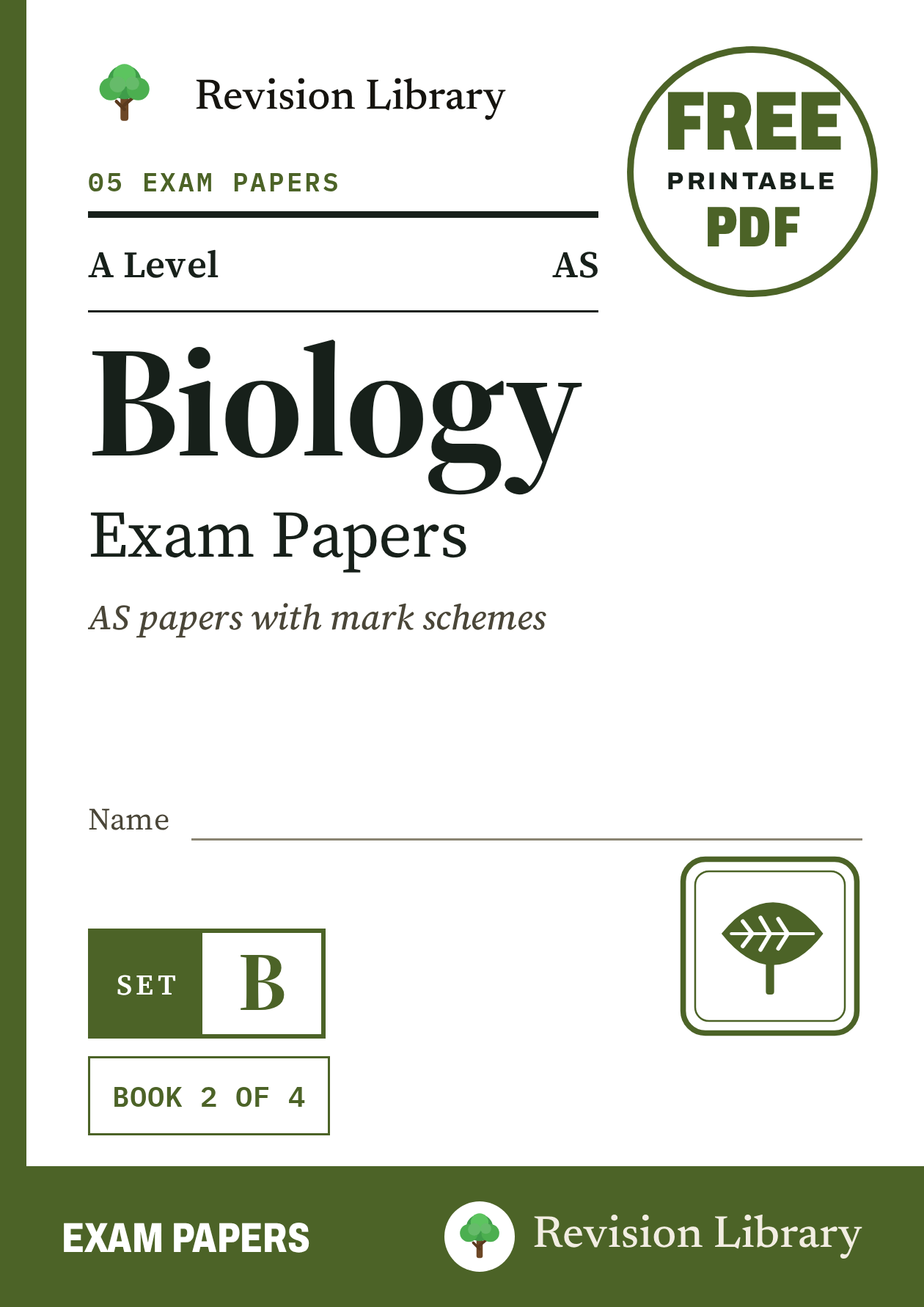
Book 2 of 4

A Level Biology Exam Papers Set B

AS Paper 4: Cells, Exchange and Genetics, AS Paper 5: Extended Topic Review and AS Paper 6: Full Course Review

Level
A Level · Edexcel · AQA 7402 · OCR H420
Series
A Level Biology Exam Papers, book 2 of 4
Suitable for
Years 12-13, AQA / Edexcel / OCR
FreePDF download · 2027 edition · 70 A4 pages
  • One file, prints straight to A4
  • No account, no password

3 papers, mark schemes at the back. This set is one of 558 free PDFs on the shelf.

Pages
70 A4 pages
Papers
3 papers
Questions
61 · 240 marks
Answers
From page 50

What is inside

3 papers · answers from p50

Each paper starts with a page showing its marks and a suggested time, followed by the questions. The mark schemes for all 3 papers are at the back, so you can sit each paper as a mock and mark it afterwards.

  1. 01AS Paper 4: Cells, Exchange and Genetics16 questions · 60 marksp3
  2. 02AS Paper 5: Extended Topic Review19 questions · 80 marksp15
  3. 03AS Paper 6: Full Course Review26 questions · 100 marksp30
  4. AnswersMark schemes for every paperp50

Each paper is drawn from one of our worksheet packs. Follow a paper title for the full pack on its own page, or browse every A Level Sciences pack. Every book on the shelf is a complete printable workbook of up to 120 A4 pages.

Explore this volume

A Level Biology Exam Papers Set B includes AS Paper 4: Cells, Exchange and Genetics (from page 3); AS Paper 5: Extended Topic Review (from page 15); AS Paper 6: Full Course Review (from page 30).

Worked question 2 - AS Paper 4: Cells, Exchange and Genetics

Capillaries are the smallest blood vessels and are the site of exchange between the blood and body tissues.

State two structural features of capillaries that adapt them for this exchange function.

Answer

Capillary walls are one endothelial cell thick, and capillaries form a dense, branched network. Also accept a narrow lumen or gaps/fenestrations permitting fluid and small-solute movement: any two distinct adaptations.

Mark scheme

B1for one valid structural adaptation: wall one endothelial cell thick; dense/branched network; narrow lumen; or gaps/fenestrations permitting fluid and small solute movement
B1for a second distinct valid structural adaptation from the list above (maximum 2 overall); do not require an explanation or two features for one mark

Question 16 - AS Paper 4: Cells, Exchange and Genetics

6 marks

In a large cohort study, coronary heart disease (CHD) develops in 180 out of 3000 smokers over ten years, and in 60 out of 3000 non-smokers over the same period.

Calculate the cumulative incidence (risk) of CHD in each group, as a percentage, and calculate the relative risk of CHD for smokers compared with non-smokers, using relative risk = incidence in exposed group / incidence in unexposed group.

Answer

Cumulative incidence in smokers = 180 / 3000 x 100 = 6 percent. In non-smokers = 60 / 3000 x 100 = 2 percent. Relative risk = 6 / 2 = 3: smokers were three times as likely to develop CHD over this study period.

Mark scheme

M1for incidence in smokers = (180 / 3000) x 100
A1for 6 percent
M1for incidence in non-smokers = (60 / 3000) x 100
A1for 2 percent
M1for relative risk = 6 / 2
A1for relative risk = 3, i.e. smokers in this study were three times as likely to develop CHD as non-smokers

Question 6 - AS Paper 4: Cells, Exchange and Genetics

2 marks

A gene consists of 1320 base pairs of DNA, all of which code for amino acids (ignore start and stop codons for this calculation).

Calculate the number of amino acids that would be coded for in the resulting polypeptide.

Answer

1320 / 3 = 440 amino acids

Mark scheme

M1for dividing the coding-strand length by three: 1320 / 3
A1for 440 amino acids

Question 8 - AS Paper 4: Cells, Exchange and Genetics

3 marks

A gene mutation can involve the substitution, insertion or deletion of one or more DNA bases.

Explain why the insertion or deletion of a single base usually has a much greater effect on the resulting protein than the substitution of a single base.

Answer

A single-base insertion or deletion changes the reading frame, regrouping downstream triplets and usually altering many subsequent amino acids or creating a premature stop. A substitution affects one codon, may change one amino acid or be synonymous, and leaves the downstream reading frame intact.

Mark scheme

B1for a single-base insertion/deletion shifts the reading frame because triplets are read from a fixed starting point
B1for regrouped downstream codons can change many amino acids and/or introduce a premature stop, often disrupting protein function
B1for a substitution leaves the reading frame intact and directly changes only one codon; it may be synonymous, missense or nonsense, so downstream residues can be lost at an early stop

Question 15 - AS Paper 5: Extended Topic Review

4 marks

A single base substitution mutation changes one triplet in the coding region of a gene from CTC to CTT. Both triplets code for the amino acid leucine.

Explain why this mutation would most likely have no effect on the structure or function of the protein produced, and name this type of mutation.

Answer

This is a silent (synonymous) substitution. The degenerate genetic code allows different triplets to specify leucine, leaving the primary structure unchanged and usually preserving folding and function.

Mark scheme

B1for the genetic code is degenerate: multiple triplets can specify the same amino acid
B1for this substitution leaves the polypeptide amino acid sequence (primary structure) unchanged
B1for unchanged primary structure would usually preserve folding, binding sites and protein function; do not require an absolute claim that all synonymous mutations are harmless
B1for silent or synonymous substitution

Question 6 - AS Paper 5: Extended Topic Review

2 marks

The polymerase chain reaction (PCR) is used to amplify a specific section of DNA, doubling the number of copies of the target sequence with each cycle.

Starting from a single copy of the target DNA sequence, calculate the number of copies present after 15 cycles of PCR.

Answer

1 x 2^15 = 32768 copies

Mark scheme

M1for 1 x 2^15
A1for 32768 copies

Question 18 - AS Paper 5: Extended Topic Review

6 marks

Fish use gills and mammals use lungs to exchange respiratory gases.

Compare how fish gills and mammalian lungs maintain an oxygen diffusion gradient through ventilation and blood flow. Explain the shared role of haemoglobin and how single and double circulation affect oxygen delivery from these exchange surfaces to respiring tissues.

Answer

Fish have one-way water flow opposite to blood flow over the gills, maintaining a gradient along the lamellae. Mammals use tidal ventilation to refresh alveolar air. Blood flow in both brings deoxygenated blood and removes oxygenated blood to maintain the gradient. Both carry oxygen reversibly bound to haemoglobin in red blood cells. Fish have single circulation: blood goes from gill capillaries to tissues after losing pressure. Mammals return blood from lungs to the heart in a double circulation, pumping it to tissues at higher pressure for rapid oxygen delivery.

Mark scheme

B1for one-way water flow over gills is opposite to blood flow, maintaining an oxygen gradient along the lamellae
B1for tidal ventilation refreshes alveolar air with oxygen-rich air
B1for blood flow in both systems brings deoxygenated blood and removes oxygenated blood, helping maintain the gradient
B1for both transport oxygen reversibly bound to haemoglobin in red blood cells from exchange surfaces to tissues
B1for fish have single circulation, with blood passing from gill capillaries to body tissues after pressure has fallen
B1for mammals have double circulation, returning blood from lungs to the heart to be pumped at higher pressure to tissues, supporting rapid oxygen delivery

Question 19 - AS Paper 6: Full Course Review

5 marks

An aphid can insert its stylet into a single phloem sieve tube element.

Describe how an aphid stylet can be used to collect a relatively pure sample of phloem sap for chemical analysis. State one possible chemical finding, and explain what continued sap exudation after removal of the aphid shows about pressure in the sieve tube.

Answer

Allow an aphid to feed, then carefully remove its body, leaving its stylet in a sieve tube. Collect the sap emerging through the retained stylet. This samples a single sieve tube with little contamination from other damaged cells. Chemical analysis can detect sucrose or amino acids. Continued exudation after the aphid is removed shows positive hydrostatic pressure in the sieve tube, without requiring pumping by the aphid; it does not by itself measure axial translocation speed.

Mark scheme

B1for allowing the aphid to insert its stylet and feed before carefully removing its body while leaving the stylet in the sieve tube
B1for collecting sap emerging through the retained stylet
B1for this samples a single sieve tube with little contamination from other damaged plant cells
B1for chemical analysis can detect sucrose (accept other valid phloem solutes such as amino acids)
B1for continued exudation without the aphid pumping shows positive hydrostatic pressure in the sieve tube; it does not by itself measure axial translocation speed

Question 12 - AS Paper 6: Full Course Review

2 marks

The polymerase chain reaction (PCR) is used to amplify a specific section of DNA, doubling the number of copies of the target sequence with each cycle.

Starting from a single copy of the target DNA sequence, calculate the number of copies present after 15 cycles of PCR.

Answer

1 x 2^15 = 32768 copies

Mark scheme

M1for 1 x 2^15
A1for 32768 copies

A Level Biology Exam Papers runs to 4 volumes

Book 2 of 4 · 263 pages in the set

Each set is a separate free PDF with its own mark schemes at the back.

Volume 1

64 pp · 49 Qs

AS Paper 1: Molecules, Cells and Exchange, AS Paper 2: Transport and Genetics, AS Paper 3: Molecules and Genetics and Plant Transport

Volume 2 · this book

70 pp · 61 Qs

AS Paper 4: Cells, Exchange and Genetics, AS Paper 5: Extended Topic Review and AS Paper 6: Full Course Review

Volume 3

60 pp · 50 Qs

A Level Paper 1: Molecules, Energy and Gene Expression, A Level Paper 2: Exchange, Transport and Ecosystems, A Level Paper 3: Molecules and Cells and Gene Expression

Volume 4

69 pp · 63 Qs

A Level Paper 4: Transport, Genetics and Ecosystems, A Level Paper 5: Transport, Energy and Response and A Level Paper 6: Full Specification Review

More A Level books

Want a different mix of topics?