Revision Library
Choose a subject
Menu
Science
Need a new topic?
Missing a topic, found a bug, or want something added?

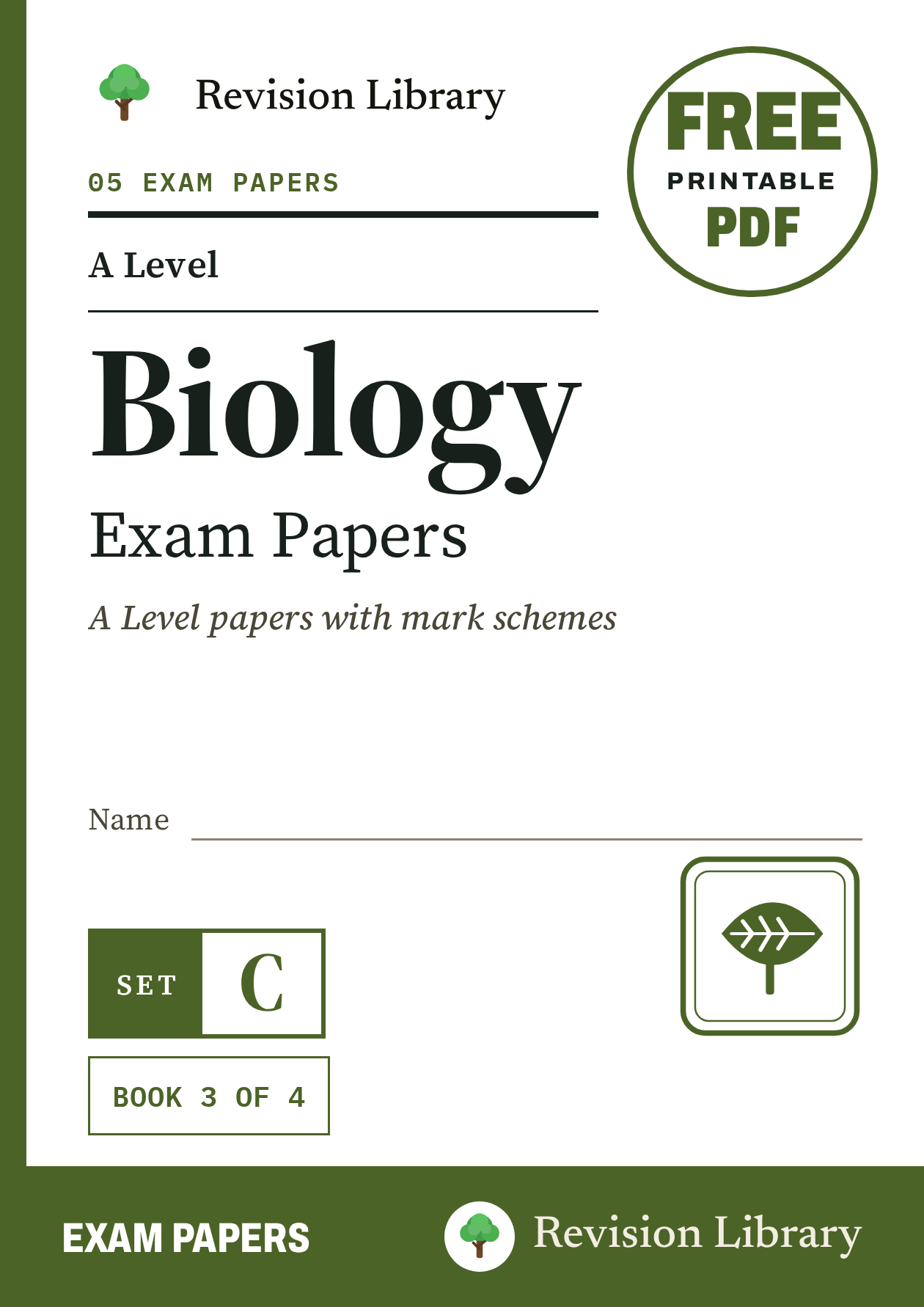
Book 3 of 4

A Level Biology Exam Papers Set C

A Level Paper 1: Molecules, Energy and Gene Expression, A Level Paper 2: Exchange, Transport and Ecosystems, A Level Paper 3: Molecules and Cells and Gene Expression

Level
A Level · Edexcel · AQA 7402 · OCR H420
Series
A Level Biology Exam Papers, book 3 of 4
Suitable for
Years 12-13, AQA / Edexcel / OCR
FreePDF download · 2027 edition · 60 A4 pages
  • One file, prints straight to A4
  • No account, no password

3 papers, mark schemes at the back. This set is one of 558 free PDFs on the shelf.

Pages
60 A4 pages
Papers
3 papers
Questions
50 · 200 marks
Answers
From page 44

What is inside

3 papers · answers from p44

Each paper starts with a page showing its marks and a suggested time, followed by the questions. The mark schemes for all 3 papers are at the back, so you can sit each paper as a mock and mark it afterwards.

  1. 01A Level Paper 1: Molecules, Energy and Gene Expression15 questions · 60 marksp3
  2. 02A Level Paper 2: Exchange, Transport and Ecosystems15 questions · 60 marksp15
  3. 03A Level Paper 3: Molecules, Cells and Gene Expression20 questions · 80 marksp27
  4. AnswersMark schemes for every paperp44

Each paper is drawn from one of our worksheet packs. Follow a paper title for the full pack on its own page, or browse every A Level Sciences pack. Every book on the shelf is a complete printable workbook of up to 120 A4 pages.

Explore this volume

A Level Biology Exam Papers Set C includes A Level Paper 1: Molecules, Energy and Gene Expression (from page 3); A Level Paper 2: Exchange, Transport and Ecosystems (from page 15); A Level Paper 3: Molecules, Cells and Gene Expression (from page 27).

Worked question 2 - A Level Paper 1: Molecules, Energy and Gene Expression

The light-dependent reactions of photosynthesis take place in the thylakoid membranes of the chloroplast.

State two products of the light-dependent reactions that are used in the light-independent reactions (the Calvin cycle).

Answer

ATP and reduced NADP (NADPH)

Mark scheme

B1for ATP
B1for reduced NADP; accept NADPH

Question 12 - A Level Paper 1: Molecules, Energy and Gene Expression

5 marks

Anaerobic respiration in yeast (alcoholic fermentation) and in mammalian muscle (lactate fermentation) both regenerate NAD from reduced NAD without using oxygen, allowing glycolysis to continue.

Compare the fate of pyruvate in alcoholic fermentation and in lactate fermentation, and explain why both processes are necessary for glycolysis to continue in the absence of oxygen.

Answer

Yeast decarboxylates pyruvate to ethanal, releasing CO2, then reduces ethanal to ethanol using reduced NAD. Muscle reduces pyruvate directly to lactate using reduced NAD, without CO2 release. Glycolysis needs NAD as an electron/hydrogen acceptor to continue producing its net ATP yield. Without oxygen the electron transport chain cannot reoxidise reduced NAD, so fermentation regenerates NAD instead.

Mark scheme

B1for yeast decarboxylates pyruvate to ethanal, releasing carbon dioxide
B1for ethanal is reduced to ethanol using reduced NAD, regenerating NAD
B1for muscle reduces pyruvate directly to lactate using reduced NAD, without releasing carbon dioxide
B1for NAD is required as an electron/hydrogen acceptor in glycolysis, allowing net ATP production
B1for without oxygen the electron transport chain cannot reoxidise reduced NAD, so fermentation provides an alternative route

Question 13 - A Level Paper 1: Molecules, Energy and Gene Expression

6 marks

A woodland is sampled using ten 1 m by 1 m quadrats placed randomly along a transect.

The percentage cover of bramble in each quadrat is: 20, 35, 10, 45, 15, 30, 25, 40, 20, 60.

Calculate the mean percentage cover of bramble, and calculate the standard deviation of this sample.

Use standard deviation = square root of (sum of (x minus mean)^2 divided by (n minus 1)).

Answer

Mean = 300 / 10 = 30 percent. Sum of squared deviations = 2100; sample standard deviation = sqrt(2100 / 9) = 15.275... percentage points, or 15.3 to 3 significant figures.

Mark scheme

M1for sum of values = 300, mean = 300 / 10
A1for mean = 30 percent
M1for calculating each deviation from the mean and squaring it, summing to 2100
M1for dividing the sum of squared deviations by (n - 1) = 9
M1for square rooting 2100 / 9
A1for sample standard deviation = 15.275... percentage points; accept 15.3, 15.28 or a more precise correctly rounded value

Question 3 - A Level Paper 1: Molecules, Energy and Gene Expression

3 marks

A student wants to test an unknown solution for the presence of lipids.

Describe the procedure for the emulsion test, and state the result that would indicate lipids are present.

Answer

Shake the sample with ethanol, then pour the mixture into water; a cloudy white emulsion indicates lipids are present

Mark scheme

B1for shaking/mixing the sample with ethanol to dissolve any lipid present
B1for adding water to the ethanolic extract or pouring the ethanolic extract into water
B1for a cloudy white/milky emulsion forms if lipids are present (the mixture stays clear if lipids are absent)

Question 12 - A Level Paper 2: Exchange, Transport and Ecosystems

5 marks

A student uses the Lincoln index (mark-release-recapture) to estimate a population of field mice on two separate occasions, one month apart.

First survey: 40 mice marked and released; second sample of 50 mice caught, 10 of which are marked. Second survey, one month later: 45 mice marked and released; second sample of 60 mice caught, 9 of which are marked.

Calculate the estimated population size on each occasion, and use these two estimates to describe how the population appears to have changed over the month.

Answer

Estimates are 200 and 300 mice, respectively, an apparent increase of 100 mice (50 percent). Sampling uncertainty means these estimates alone do not prove growth.

Mark scheme

M1for first estimate = 40 x 50 / 10
A1for 200 mice
M1for second estimate = 45 x 60 / 9
A1for 300 mice
B1for estimated increase of 100 mice or 50 percent, subject to sampling uncertainty

Question 6 - A Level Paper 2: Exchange, Transport and Ecosystems

4 marks

Sieve tube elements in phloem are living cells but lack a nucleus and most other organelles, and each is closely associated with a companion cell.

Explain the roles of sieve plates and companion cells in the structure and function of phloem.

Answer

Perforated sieve plates allow sap to flow between adjacent sieve tube elements. Companion-cell nuclei direct protein synthesis and metabolic support for the sieve tubes. Many plasmodesmata connect the two cell types and permit transfer of solutes and other materials. Companion-cell mitochondria generate ATP used for energy-dependent sucrose loading, including proton pumping coupled to sucrose cotransport.

Mark scheme

B1for pores in sieve plates connect adjacent sieve tube elements and allow sap to flow along the tube
B1for companion-cell nuclei direct protein synthesis/metabolic support for the associated sieve tube elements
B1for plasmodesmata connect companion cells to sieve tube elements, permitting transfer of solutes and other materials
B1for many companion-cell mitochondria generate ATP used in energy-dependent sucrose loading, e.g. proton pumping coupled to sucrose cotransport

Question 1 - A Level Paper 2: Exchange, Transport and Ecosystems

2 marks

State two features of an efficient gas exchange surface.

Answer

Large surface area (relative to volume) and a thin exchange layer (short diffusion pathway)

Mark scheme

B1for a large surface area relative to volume
B1for a thin layer/short diffusion distance (any two valid features accepted)

Question 4 - A Level Paper 3: Molecules, Cells and Gene Expression

3 marks

State the difference between a totipotent cell and a pluripotent cell, giving an example source of each.

Answer

Totipotent cells, such as a zygote, can form all embryonic and extraembryonic cell types. Pluripotent cells, such as blastocyst inner-cell-mass cells, can form all body cell types but not all extraembryonic tissues.

Mark scheme

B1for totipotent cells can form all embryonic and extraembryonic cell types, whereas pluripotent cells can form all body cell types but not all extraembryonic tissues
B1for a suitable totipotent source, e.g. a zygote or very early blastomere
B1for a suitable pluripotent source, e.g. inner cell mass of a blastocyst or induced pluripotent stem cells

Question 18 - A Level Paper 3: Molecules, Cells and Gene Expression

5 marks

A tumour cell divides uncontrollably because the normal regulation of the cell cycle has broken down.

Explain how checkpoints in the cell cycle normally prevent a cell with damaged DNA from dividing, and why a mutation in a checkpoint gene can lead to uncontrolled cell division.

Answer

Checkpoints monitor DNA integrity and halt the cycle for repair or trigger apoptosis if damage is found. Checkpoint proteins are encoded by genes. A mutation can make a checkpoint protein non-functional, so damage is not detected or fails to trigger arrest. Damaged cells then continue dividing, generating a growing abnormal population.

Mark scheme

B1for checkpoints (e.g. at G1, G2 or the spindle assembly checkpoint) monitor the cell for DNA damage or correct chromosome attachment before allowing progress to the next stage
B1for if damage is detected, the cycle is paused to allow repair, or the cell is directed towards apoptosis
B1for checkpoint proteins are themselves coded for by genes that can mutate
B1for a mutation can produce a non-functional checkpoint protein, so DNA damage is not detected or does not trigger cell-cycle arrest
B1for the cell continues to divide despite the damage, producing a growing population of genetically abnormal cells

A Level Biology Exam Papers runs to 4 volumes

Book 3 of 4 · 263 pages in the set

Each set is a separate free PDF with its own mark schemes at the back.

Volume 1

64 pp · 49 Qs

AS Paper 1: Molecules, Cells and Exchange, AS Paper 2: Transport and Genetics, AS Paper 3: Molecules and Genetics and Plant Transport

Volume 2

70 pp · 61 Qs

AS Paper 4: Cells, Exchange and Genetics, AS Paper 5: Extended Topic Review and AS Paper 6: Full Course Review

Volume 3 · this book

60 pp · 50 Qs

A Level Paper 1: Molecules, Energy and Gene Expression, A Level Paper 2: Exchange, Transport and Ecosystems, A Level Paper 3: Molecules and Cells and Gene Expression

Volume 4

69 pp · 63 Qs

A Level Paper 4: Transport, Genetics and Ecosystems, A Level Paper 5: Transport, Energy and Response and A Level Paper 6: Full Specification Review

More A Level books

Want a different mix of topics?