Revision Library
Choose a subject
Menu
Science
Need a new topic?
Missing a topic, found a bug, or want something added?

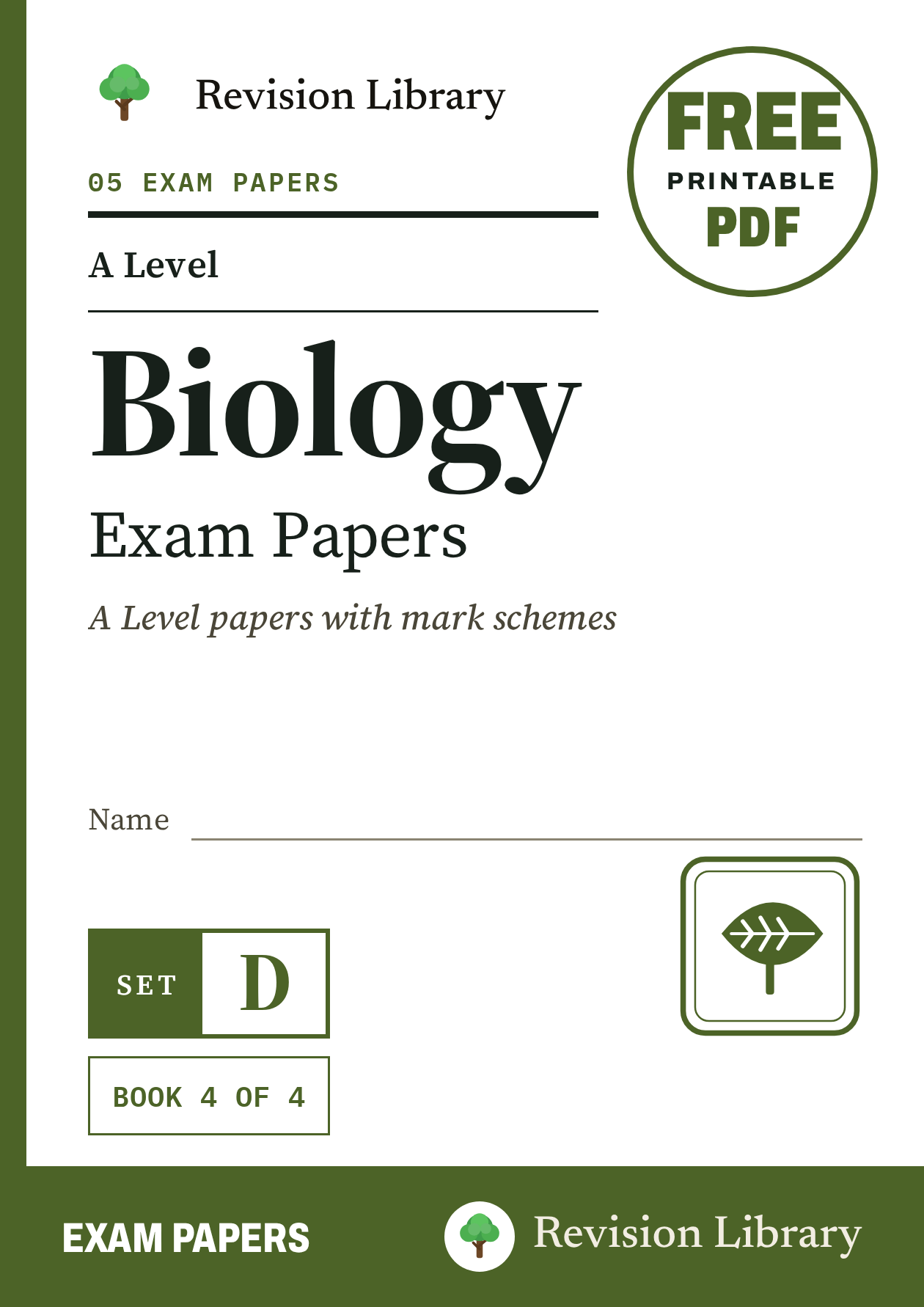
Book 4 of 4

A Level Biology Exam Papers Set D

A Level Paper 4: Transport, Genetics and Ecosystems, A Level Paper 5: Transport, Energy and Response and A Level Paper 6: Full Specification Review

Level
A Level · Edexcel · AQA 7402 · OCR H420
Series
A Level Biology Exam Papers, book 4 of 4
Suitable for
Years 12-13, AQA / Edexcel / OCR
FreePDF download · 2027 edition · 69 A4 pages
  • One file, prints straight to A4
  • No account, no password

3 papers, mark schemes at the back. This set is one of 558 free PDFs on the shelf.

Pages
69 A4 pages
Papers
3 papers
Questions
63 · 240 marks
Answers
From page 50

What is inside

3 papers · answers from p50

Each paper starts with a page showing its marks and a suggested time, followed by the questions. The mark schemes for all 3 papers are at the back, so you can sit each paper as a mock and mark it afterwards.

  1. 01A Level Paper 4: Transport, Genetics and Ecosystems16 questions · 60 marksp3
  2. 02A Level Paper 5: Transport, Energy and Response21 questions · 80 marksp14
  3. 03A Level Paper 6: Full Specification Review26 questions · 100 marksp29
  4. AnswersMark schemes for every paperp50

Each paper is drawn from one of our worksheet packs. Follow a paper title for the full pack on its own page, or browse every A Level Sciences pack. Every book on the shelf is a complete printable workbook of up to 120 A4 pages.

Explore this volume

A Level Biology Exam Papers Set D includes A Level Paper 4: Transport, Genetics and Ecosystems (from page 3); A Level Paper 5: Transport, Energy and Response (from page 14); A Level Paper 6: Full Specification Review (from page 29).

Worked question 7 - A Level Paper 4: Transport, Genetics and Ecosystems

Photophosphorylation in the light-dependent reactions can occur as cyclic or non-cyclic photophosphorylation.

Explain the difference between these two processes, in terms of the pathway taken by excited electrons and the products formed.

Answer

In non-cyclic flow electrons from water pass through PSII and PSI to NADP; this produces ATP, reduced NADP and oxygen from photolysis. In cyclic flow PSI electrons return through carriers to PSI, producing ATP only, with no net reduced NADP or oxygen.

Mark scheme

B1for in non-cyclic photophosphorylation, electrons excited from photosystem II pass along an electron transport chain to photosystem I, and are not returned to photosystem II
B1for non-cyclic photophosphorylation produces ATP, reduced NADP, and oxygen (from the photolysis of water)
B1for in cyclic photophosphorylation, electrons excited from photosystem I pass along an electron transport chain and return to photosystem I, rather than passing to NADP
B1for cyclic photophosphorylation produces only ATP, since photosystem II and water are not involved, so no reduced NADP or oxygen is produced

Question 16 - A Level Paper 4: Transport, Genetics and Ecosystems

6 marks

A person's blood pressure is measured as 120/80 mmHg (systolic/diastolic). Atherosclerosis causes a build-up of fatty plaques (atheroma) within the wall of an artery, narrowing its lumen.

Explain how atherosclerosis can lead to a heart attack (myocardial infarction), referring to the coronary arteries.

Answer

Restricted coronary blood flow reduces oxygen delivery to heart muscle. Rupture of a plaque or its overlying endothelium exposes material that activates platelets and clotting, forming a thrombus. This can occlude the coronary artery and cut off blood supply downstream. Oxygen shortage reduces aerobic respiration and ATP production; sustained inadequate ATP supply kills heart muscle cells, causing myocardial infarction.

Mark scheme

B1for reduced coronary blood flow reduces oxygen delivery to the myocardium
B1for the plaque/fibrous cap or overlying endothelium can rupture
B1for exposed underlying material triggers platelet activation and clotting, forming a thrombus
B1for the thrombus can completely occlude the coronary artery, cutting off blood supply to downstream muscle
B1for oxygen shortage reduces aerobic respiration and ATP production in affected muscle cells
B1for sustained inadequate ATP supply causes death of heart muscle cells, producing a myocardial infarction

Question 2 - A Level Paper 4: Transport, Genetics and Ecosystems

2 marks

Transfer RNA (tRNA) is a small, single-stranded RNA molecule that folds back on itself into a distinctive clover-leaf shape, held together by hydrogen bonds.

Describe the structure of a tRNA molecule, including the location of the anticodon and the amino acid binding site.

Answer

The anticodon is an exposed triplet in a loop and pairs with a complementary mRNA codon. The specific amino acid attaches to the 3' end of the acceptor stem.

Mark scheme

B1for the anticodon is a triplet of exposed bases in a loop
B1for the amino acid attachment site is at the 3' end of the acceptor stem

Question 6 - A Level Paper 4: Transport, Genetics and Ecosystems

2 marks

DNA polymerase can only add new nucleotides to an existing 3' end of a nucleotide strand; it cannot start a brand new strand from scratch.

Explain why a short RNA primer is needed to begin DNA replication at each origin of replication, and at the start of each Okazaki fragment.

Answer

DNA polymerase can only extend an existing strand, not start a new one, so primase first makes a short RNA primer with a free 3' end for DNA polymerase to extend from; a new primer is needed at the origin of replication and at the start of every Okazaki fragment

Mark scheme

B1for primase synthesises a short RNA primer complementary to the DNA template
B1for the primer supplies a free 3' hydroxyl end from which DNA polymerase extends; the same requirement applies to every new Okazaki fragment

Question 11 - A Level Paper 5: Transport, Energy and Response

4 marks

Photophosphorylation in the light-dependent reactions can occur as cyclic or non-cyclic photophosphorylation.

Explain the difference between these two processes, in terms of the pathway taken by excited electrons and the products formed.

Answer

In non-cyclic flow electrons from water pass through PSII and PSI to NADP; this produces ATP, reduced NADP and oxygen from photolysis. In cyclic flow PSI electrons return through carriers to PSI, producing ATP only, with no net reduced NADP or oxygen.

Mark scheme

B1for in non-cyclic photophosphorylation, electrons excited from photosystem II pass along an electron transport chain to photosystem I, and are not returned to photosystem II
B1for non-cyclic photophosphorylation produces ATP, reduced NADP, and oxygen (from the photolysis of water)
B1for in cyclic photophosphorylation, electrons excited from photosystem I pass along an electron transport chain and return to photosystem I, rather than passing to NADP
B1for cyclic photophosphorylation produces only ATP, since photosystem II and water are not involved, so no reduced NADP or oxygen is produced

Question 2 - A Level Paper 5: Transport, Energy and Response

2 marks

Define the term carrying capacity as it applies to a population.

Answer

The maximum population size that a given environment can sustain indefinitely with the resources available

Mark scheme

B1for the maximum population size (of a species)
B1for that a given environment can sustain indefinitely, given the resources available

Question 15 - A Level Paper 5: Transport, Energy and Response

5 marks

Nitrogen-fixing bacteria, nitrifying bacteria and denitrifying bacteria are all involved in the nitrogen cycle.

Describe the roles of nitrogen-fixing bacteria and nitrifying bacteria in making nitrogen available to plants.

Answer

Nitrogen-fixing bacteria convert atmospheric nitrogen gas into ammonium compounds; nitrifying bacteria then oxidise ammonium to nitrite and nitrite to nitrate (nitrification, requiring oxygen); nitrate can then be absorbed by plant roots and used to make amino acids and other nitrogen-containing molecules

Mark scheme

B1for nitrogen fixers convert N2 to ammonia/ammonium, making nitrogen usable by organisms
B1for nitrifying bacteria oxidise ammonium to nitrite
B1for other nitrifying bacteria oxidise nitrite to nitrate
B1for nitrification requires oxygen/aerobic conditions
B1for plant roots absorb nitrate or ammonium for synthesis of amino acids and other nitrogen compounds

Question 1 - A Level Paper 6: Full Specification Review

2 marks

Define the term carrying capacity as it applies to a population.

Answer

The maximum population size that a given environment can sustain indefinitely with the resources available

Mark scheme

B1for the maximum population size (of a species)
B1for that a given environment can sustain indefinitely, given the resources available

Question 26 - A Level Paper 6: Full Specification Review

6 marks

A large area of tropical rainforest is cleared for agriculture and then abandoned several years later, allowing secondary succession to begin.

Explain the process of secondary succession that would follow, from the initial colonisation to a climax community, referring to changes in species diversity and the abiotic environment.

Answer

Secondary succession starts from existing soil with fast-growing colonisers like grasses; as they alter the soil and light conditions, larger shrubs and trees establish and outcompete earlier species, diversity increases through the intermediate stages, and the process continues until a stable climax community (e.g. mature rainforest) is reached

Mark scheme

B1for because soil and some seeds/organisms are already present, secondary succession can begin at a later stage than primary succession, without needing pioneer species to first break down bare rock
B1for fast-growing plants such as grasses and small herbaceous plants colonise first, as they can grow quickly in the open, sunny conditions
B1for as these plants grow, they change the abiotic conditions, e.g. adding organic matter to the soil, and providing some shade
B1for these changed conditions allow larger species, such as shrubs and fast-growing trees, to establish and outcompete the earlier colonisers for light
B1for species diversity generally increases through the early-to-mid stages of succession, as more niches become available
B1for succession continues until a stable climax community is reached (e.g. mature rainforest), where the dominant species remain relatively stable, in equilibrium with the local abiotic conditions

A Level Biology Exam Papers runs to 4 volumes

Book 4 of 4 · 263 pages in the set

Each set is a separate free PDF with its own mark schemes at the back.

Volume 1

64 pp · 49 Qs

AS Paper 1: Molecules, Cells and Exchange, AS Paper 2: Transport and Genetics, AS Paper 3: Molecules and Genetics and Plant Transport

Volume 2

70 pp · 61 Qs

AS Paper 4: Cells, Exchange and Genetics, AS Paper 5: Extended Topic Review and AS Paper 6: Full Course Review

Volume 3

60 pp · 50 Qs

A Level Paper 1: Molecules, Energy and Gene Expression, A Level Paper 2: Exchange, Transport and Ecosystems, A Level Paper 3: Molecules and Cells and Gene Expression

Volume 4 · this book

69 pp · 63 Qs

A Level Paper 4: Transport, Genetics and Ecosystems, A Level Paper 5: Transport, Energy and Response and A Level Paper 6: Full Specification Review

More A Level books

Want a different mix of topics?