Revision Library
Choose a subject
Menu
Politics
Need a new topic?
Missing a topic, found a bug, or want something added?

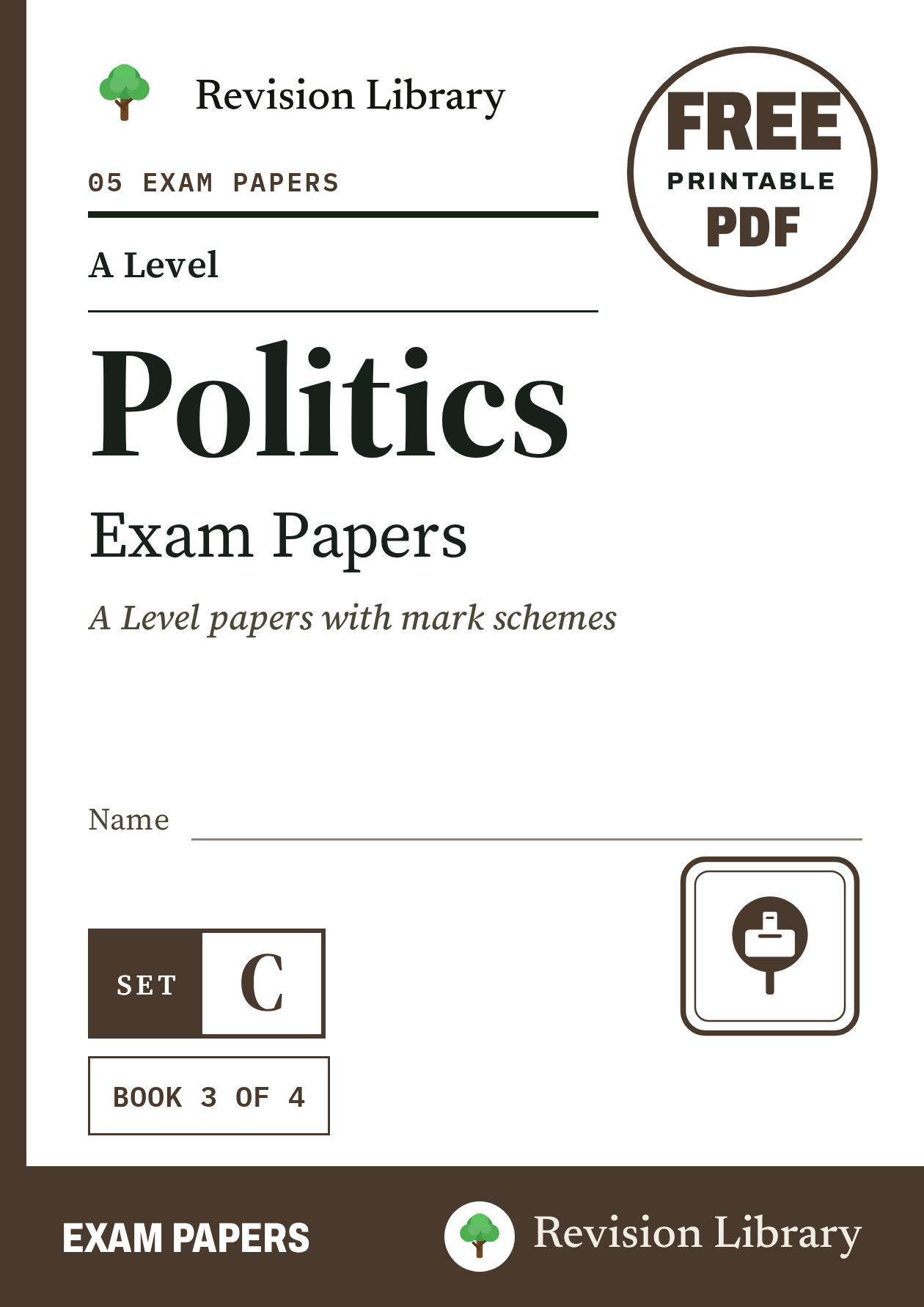
Book 3 of 4

A Level Politics Exam Papers Set C

A Level Paper 1: Politics and Liberalism, A Level Paper 2: Government Institutions and A Level Paper 3: Political Ideologies in Context

Level
A Level · Edexcel 9PL0
Series
A Level Politics Exam Papers, book 3 of 4
Suitable for
Years 12-13, Edexcel
FreePDF download · 2027 edition · 57 A4 pages
  • One file, prints straight to A4
  • No account, no password

3 papers in the Edexcel format, mark schemes at the back. This set is one of 558 free PDFs on the shelf.

Pages
57 A4 pages
Papers
3 papers
Questions
42 · 180 marks
Answers
From page 40

What is inside

3 papers · answers from p40

Each paper starts with a page showing its marks and a suggested time, followed by the questions. The mark schemes for all 3 papers are at the back, so you can sit each paper as a mock and mark it afterwards.

  1. 01A Level Paper 1: Politics and Liberalism15 questions · 60 marksp3
  2. 02A Level Paper 2: Government Institutions14 questions · 60 marksp14
  3. 03A Level Paper 3: Political Ideologies in Context13 questions · 60 marksp26
  4. AnswersMark schemes for every paperp40

Each paper is drawn from one of our worksheet packs. Follow a paper title for the full pack on its own page, or browse every A Level Politics pack. Every book on the shelf is a complete printable workbook of up to 120 A4 pages.

Explore this volume

A Level Politics Exam Papers Set C includes A Level Paper 1: Politics and Liberalism (from page 3); A Level Paper 2: Government Institutions (from page 14); A Level Paper 3: Political Ideologies in Context (from page 26).

Worked question 5 - A Level Paper 2: Government Institutions

Identify the three nations of the United Kingdom, other than England, that have their own devolved legislature or assembly.

Answer

Scotland, Wales and Northern Ireland

Mark scheme

1 mark for: Scotland
1 mark for: Wales
1 mark for: Northern Ireland

Question 1 - A Level Paper 2: Government Institutions

2 marks

State two grounds on which a court can find a public body's decision unlawful in judicial review.

Answer

Any two of: illegality (ultra vires); irrationality; procedural impropriety

Mark scheme

1 mark for: illegality, meaning the public body acted beyond the legal powers it was given (ultra vires)
1 mark for a second valid ground, such as irrationality, meaning the decision was so unreasonable that no reasonable decision-maker could have made it, or procedural impropriety, meaning a fair process was not followed

Question 4 - A Level Paper 2: Government Institutions

3 marks

Identify three functions that a codified constitution typically performs in political systems that have one.

Answer

Any three of: setting out and limiting the powers of government branches; entrenching citizens' rights against ordinary legislation; acting as higher law that other legislation must be consistent with; providing a single authoritative reference point

Mark scheme

1 mark for: setting out and limiting the powers of the different branches of government
1 mark for: entrenching citizens' rights so they cannot easily be removed by an ordinary law
1 mark for a third valid function, such as acting as a higher form of law that other legislation must be consistent with, or providing a single authoritative reference point for the rules of government

Question 2 - A Level Paper 2: Government Institutions

2 marks

State two features of the doctrine of collective Cabinet responsibility.

Answer

Any two of: ministers must publicly support Cabinet decisions or resign; Cabinet discussions are kept confidential; a dissenting minister is expected to leave government

Mark scheme

1 mark for: ministers must publicly support all Cabinet decisions or resign
1 mark for a second valid feature, such as Cabinet discussions being kept confidential, or a minister who cannot accept a decision being expected to leave government

Question 4 - A Level Paper 1: Politics and Liberalism

2 marks

State two core values of liberalism.

Answer

Any two of: individualism; liberty; rationalism; toleration; consent; equality of opportunity

Mark scheme

1 mark for: individualism
1 mark for a second valid value, such as liberty/freedom, rationalism, toleration, or consent

Question 13 - A Level Paper 1: Politics and Liberalism

6 marks

Explain three ways in which liberal ideas underpin the international protection of human rights.

Answer

Three developed points, such as: the idea of universal natural or human rights underpinning documents such as the Universal Declaration of Human Rights; liberal support for holding states accountable beyond their own domestic law, as through the European Court of Human Rights; liberal toleration underpinning international protection for minority and dissenting views

Mark scheme

1 mark for identifying a first way, such as the liberal idea of natural or human rights belonging to individuals simply because they are human
1 mark for developing this, such as explaining that this underpins international documents such as the Universal Declaration of Human Rights, which sets out rights intended to apply to everyone regardless of which state they live in
1 mark for identifying a second way, such as liberal support for holding states accountable to a standard beyond their own domestic law
1 mark for developing this, such as explaining that international courts, such as the European Court of Human Rights, allow an individual to challenge their own state if it breaches rights that liberal thought regards as universal
1 mark for identifying a third way, such as liberal toleration underpinning protection for minority and dissenting views internationally
1 mark for developing this, such as explaining that human rights frameworks typically protect freedoms such as expression and belief that liberals see as central to individual autonomy, even where a state's majority disapproves of how they are used

Question 10 - A Level Paper 1: Politics and Liberalism

5 marks

Critics of some political arrangements refer to a 'democratic deficit'.

Explain what is meant by a democratic deficit, and explain one way in which the term has been applied to an unelected UK institution.

Answer

A democratic deficit describes a shortfall in the accountability or legitimacy of a decision-making body; it has been applied to the House of Lords, whose appointed, unelected peers cannot be removed by voters, which is one reason the chamber generally defers to the elected Commons

Mark scheme

1 mark for explaining the core idea, such as that a democratic deficit describes a shortfall in the accountability or legitimacy of a decision-making body
1 mark for developing this, such as noting that the term is often used where a body exercises significant power without being directly elected or answerable to voters
1 mark for identifying an example, such as the House of Lords
1 mark for developing this, such as explaining that peers are appointed rather than elected, so cannot be removed by voters at a general election
1 mark for a relevant supporting point, such as noting that the Lords' lack of a direct mandate is one reason it generally defers to the elected Commons on most matters

Question 2 - A Level Paper 3: Political Ideologies in Context

3 marks

Identify three constitutional or institutional arrangements that liberals typically favour to limit the power of government.

Answer

Any three of: a limiting constitution; separation of powers; an entrenched bill of rights; regular elections

Mark scheme

1 mark for: a constitution that sets out and limits the powers of government
1 mark for: a separation of powers between different branches of government
1 mark for a third valid arrangement, such as an entrenched bill of rights, or regular elections to hold government accountable

Question 9 - A Level Paper 3: Political Ideologies in Context

5 marks

Conservatives disagree about how much authority the state should exercise over individuals' lives.

Distinguish between the neoliberal and neoconservative strands of the New Right, and explain one way this creates tension within New Right thinking.

Answer

Neoliberalism favours a minimal economic state and the free market; neoconservatism favours strong state authority over social order and morality. This creates tension because a smaller economic state sits alongside a stronger authoritative one, seen in practice in policies combining tax cuts with tougher law-and-order measures

Mark scheme

1 mark for explaining neoliberalism, such as its support for a free market and a minimal economic role for the state
1 mark for explaining neoconservatism, such as its support for strong state authority, traditional morality and social order
1 mark for identifying the tension, such as neoliberalism wanting the state to withdraw from the economy while neoconservatism wants a strong, authoritative state in social matters
1 mark for developing this, such as explaining that a party can find it difficult to argue for a smaller state economically while also arguing for stronger state authority over law and order or morality
1 mark for a relevant supporting example, such as citing tax cuts alongside tougher sentencing policy as an example of the two strands combined in practice

A Level Politics Exam Papers runs to 4 volumes

Book 3 of 4 · 261 pages in the set

Each set is a separate free PDF with its own mark schemes at the back.

Volume 1

55 pp · 41 Qs

AS Paper 1: Democracy and Elections, AS Paper 2: The Constitution and Government, AS Paper 3: Parties and Voting and Parliament

Volume 2

72 pp · 61 Qs

AS Paper 4: Government in Practice, AS Paper 5: Politics and Government and AS Paper 6: Elections and Institutions

Volume 3 · this book

57 pp · 42 Qs

A Level Paper 1: Politics and Liberalism, A Level Paper 2: Government Institutions and A Level Paper 3: Political Ideologies in Context

Volume 4

77 pp · 61 Qs

A Level Paper 4: Elections and Representation, A Level Paper 5: Politics and Government Core and A Level Paper 6: Government and Ideologies

More A Level books

A Level Politics Topic Workbook 1

85 pp · 100 Qs

Direct versus Representative Democracy and Debates on Reform, Political Parties, Rights and Civil Liberties in the UK: Protection and Tensions and 13 more

Want a different mix of topics?

Sitting an exam soon? Build a A Level Politics mock paper or print a ready-made one.