Revision Library
Choose a subject
Menu
History
Need a new topic?
Missing a topic, found a bug, or want something added?

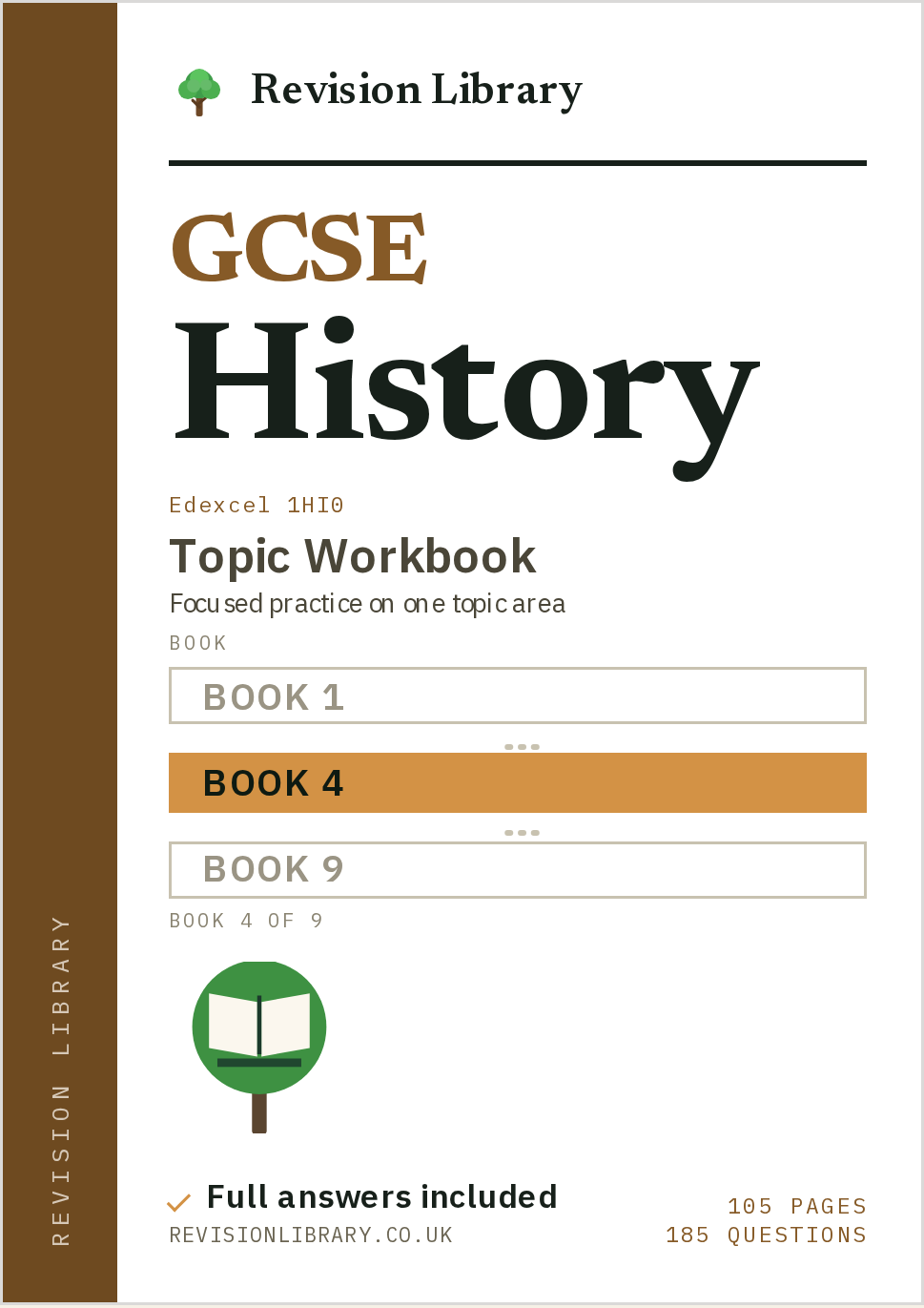
GCSE History Topic Workbooks · Book 4 of 9

GCSE History Topic Workbook 4

Superpower Relations and the Cold War, 1941-91: Growing Rivalry and the Berlin Blockade, 1945-58, Superpower Relations and the Cold War, 1941-91: The Berlin Crisis and the Building of the Berlin Wall, 1958-61, Superpower Relations and the Cold War, 1941-91: The Cuban Missile Crisis, 1962 and 10 more

Level
GCSE · Edexcel 1HI0
Series
GCSE History Topic Workbooks, book 4 of 9
Suitable for
Years 10-11, Edexcel

History is examined through a small number of question styles that reward structure as much as knowledge. Each volume works through one period in order and keeps the mark scheme for every exam-style question, so the difference between a described answer and an explained one is visible.

FreePDF download · 2027 edition · 105 A4 pages
  • One file, prints straight to A4
  • No account, no password

Workbooks like this one, with 13 topics, 185 questions and mark schemes at the back, are usually printed and sold by publishers. This one is one of 558 free PDFs on the shelf.

Pages
105 A4 pages
Chapters
13 worksheet chapters
Questions
185 · 651 marks
Answers
From page 76
Working time
About 12h 35m

What is inside

13 chapters · answers from p76

Each chapter starts with a page showing its marks and a suggested time, followed by the questions. The mark schemes for all 13 chapters are at the back, so the book works for homework, a timed test or revision.

  1. 01Superpower Relations and the Cold War, 1941-91: Growing Rivalry and the Berlin Blockade, 1945-5812 questions · 46 marks · about 55 min Topic guide: Superpower Relations and the Cold War, 1941-91: Growing Rivalry and the Berlin Blockade, 1945-58p3
  2. 02Superpower Relations and the Cold War, 1941-91: The Berlin Crisis and the Building of the Berlin Wall, 1958-6112 questions · 48 marks · about 55 min Topic guide: Superpower Relations and the Cold War, 1941-91: The Berlin Crisis and the Building of the Berlin Wall, 1958-61p8
  3. 03Superpower Relations and the Cold War, 1941-91: The Cuban Missile Crisis, 196212 questions · 47 marks · about 55 min Topic guide: Superpower Relations and the Cold War, 1941-91: The Cuban Missile Crisis, 1962p13
  4. 04Superpower Relations and the Cold War, 1941-91: Czechoslovakia and the Prague Spring, 196811 questions · 47 marks · about 55 min Topic guide: Superpower Relations and the Cold War, 1941-91: Czechoslovakia and the Prague Spring, 1968p18
  5. 05Superpower Relations and the Cold War, 1941-91: Detente, Afghanistan and the End of the Cold War, 1970-9113 questions · 48 marks · about 55 min Topic guide: Superpower Relations and the Cold War, 1941-91: Detente, Afghanistan and the End of the Cold War, 1970-91p23
  6. 06Detente and Arms Control: SALT I and the Helsinki Agreement, 1969-758 questions · 43 marks · about 50 min Topic guide: Detente and Arms Control: SALT I and the Helsinki Agreement, 1969-75p28
  7. 07The Collapse of Detente: SALT II and the Invasion of Afghanistan, 197917 questions · 48 marks · about 55 min Topic guide: The Collapse of Detente: SALT II and the Invasion of Afghanistan, 1979p33
  8. 08Effects of the Soviet Invasion of Afghanistan on Superpower Relations15 questions · 48 marks · about 55 min Topic guide: Effects of the Soviet Invasion of Afghanistan on Superpower Relationsp39
  9. 09Gorbachev's New Thinking: Glasnost, Perestroika and Reform in the USSR17 questions · 51 marks · about 60 min Topic guide: Gorbachev's New Thinking: Glasnost, Perestroika and Reform in the USSRp45
  10. 10The Reagan-Gorbachev Summits and the INF Treaty, 1985-8715 questions · 47 marks · about 55 min Topic guide: The Reagan-Gorbachev Summits and the INF Treaty, 1985-87p51
  11. 11The Fall of the Berlin Wall and the End of the Cold War, 1989-9115 questions · 46 marks · about 55 min Topic guide: The Fall of the Berlin Wall and the End of the Cold War, 1989-91p56
  12. 12Weimar and Nazi Germany, 1929-1934: The Nazi Rise to Power and the Creation of the Dictatorship19 questions · 66 marks · about 75 min Topic guide: Weimar and Nazi Germany, 1929-1934: The Nazi Rise to Power and the Creation of the Dictatorshipp61
  13. 13Weimar and Nazi Germany, 1918-1923: The Origins of the Republic and Early Crises19 questions · 66 marks · about 75 min Topic guide: Weimar and Nazi Germany, 1918-1923: The Origins of the Republic and Early Crisesp68
  14. AnswersMark schemes for every chapterp76

Each chapter is drawn from one of our worksheet packs. Follow a chapter title for the full pack on its own page, or browse every GCSE History pack. Every book on the shelf is a complete printable workbook of up to 120 A4 pages.

Explore this volume

GCSE History Topic Workbook 4 includes Superpower Relations and the Cold War, 1941-91: Growing Rivalry and the Berlin Blockade, 1945-58 (from page 3); Superpower Relations and the Cold War, 1941-91: The Berlin Crisis and the Building of the Berlin Wall, 1958-61 (from page 8); Superpower Relations and the Cold War, 1941-91: The Cuban Missile Crisis, 1962 (from page 13); Superpower Relations and the Cold War, 1941-91: Czechoslovakia and the Prague Spring, 1968 (from page 18); Superpower Relations and the Cold War, 1941-91: Detente, Afghanistan and the End of the Cold War, 1970-91 (from page 23); Detente and Arms Control: SALT I and the Helsinki Agreement, 1969-75 (from page 28); The Collapse of Detente: SALT II and the Invasion of Afghanistan, 1979 (from page 33); Effects of the Soviet Invasion of Afghanistan on Superpower Relations (from page 39); Gorbachev's New Thinking: Glasnost, Perestroika and Reform in the USSR (from page 45); The Reagan-Gorbachev Summits and the INF Treaty, 1985-87 (from page 51); The Fall of the Berlin Wall and the End of the Cold War, 1989-91 (from page 56); Weimar and Nazi Germany, 1929-1934: The Nazi Rise to Power and the Creation of the Dictatorship (from page 61); Weimar and Nazi Germany, 1918-1923: The Origins of the Republic and Early Crises (from page 68).

Worked question 19 - Weimar and Nazi Germany, 1918-1923: The Origins of the Republic and Early Crises

Open the included worksheet

Source A, and Interpretations 1 and 2

Source A was written for Revision Library. It is an original text representative of a personal account of daily life in Germany during the hyperinflation crisis of autumn 1923. It is not a reproduction, translation or paraphrase of any surviving diary, letter or newspaper report, and no genuine individual's words are reproduced. Interpretation 1 and Interpretation 2 were also written for Revision Library, in the style of history textbook extracts discussing why the Weimar Republic survived the crises of 1919 to 1923; they are not the work of any real, named historian.

SOURCE A: a personal account written for Revision Library, representative of the experience of an ordinary German family during the hyperinflation crisis of autumn 1923.

By October my husband was being paid twice a day so that we could spend the money before its value fell again. We rushed to the shops in our lunch break, because bread that cost 2,000 marks in the morning could cost 4,000 marks by the afternoon. Neighbours who had saved carefully all their lives watched their savings become worthless in a matter of weeks, while others who owed money on their houses found their debts melted away to almost nothing. Some families burned banknotes for fuel rather than buy firewood, since the notes themselves were cheaper than wood. We began trading eggs and vegetables directly with the baker rather than trust money at all.

INTERPRETATION 1: from a history textbook written for Revision Library, discussing why the Weimar Republic survived the crises of 1919 to 1923.

The Republic survived chiefly because, at the critical moments, the key institutions of the German state chose to defend it rather than abandon it. When the Kapp Putsch attempted to seize power in March 1920, the regular army did not actively support the coup, and Berlin's workers brought the city to a standstill with a general strike that made the putsch impossible to sustain. A similar pattern held in 1923: neither the Spartacist rising of the far left in 1919 nor Hitler's Munich Putsch of November 1923 could win over the army or the civil service, without whose cooperation no seizure of power could succeed.

INTERPRETATION 2: from a history textbook written for Revision Library, discussing why the Weimar Republic survived the crises of 1919 to 1923.

Loyalty from institutions explains why individual coups failed, but it does not explain why the Republic did not simply collapse under the weight of economic disaster in 1923. What mattered most was the speed and decisiveness of the government's response once Gustav Stresemann became Chancellor in August 1923: calling off passive resistance in the Ruhr in September, then replacing the worthless mark with the new Rentenmark in November, brought the hyperinflation to a rapid end. Without this economic stabilisation, continued economic collapse would eventually have destroyed public confidence in the Republic altogether, whatever the institutions chose to do.

State what the Freikorps were and how the government used them against the Spartacist Uprising.

Answer and mark scheme

Question 19

CreditAnswer or working
B1the Freikorps were bands of armed ex-soldiers and volunteers, not part of the regular army
B1the Ebert government used them to crush the Spartacist Uprising by force in January 1919
  • Answer: The Freikorps were armed ex-soldier volunteer units, used by the Ebert government to violently suppress the Spartacist Uprising in January 1919.


Question 10 - Weimar and Nazi Germany, 1918-1923: The Origins of the Republic and Early Crises

Open the included worksheet

Source A, and Interpretations 1 and 2

Source A was written for Revision Library. It is an original text representative of a personal account of daily life in Germany during the hyperinflation crisis of autumn 1923. It is not a reproduction, translation or paraphrase of any surviving diary, letter or newspaper report, and no genuine individual's words are reproduced. Interpretation 1 and Interpretation 2 were also written for Revision Library, in the style of history textbook extracts discussing why the Weimar Republic survived the crises of 1919 to 1923; they are not the work of any real, named historian.

SOURCE A: a personal account written for Revision Library, representative of the experience of an ordinary German family during the hyperinflation crisis of autumn 1923.

By October my husband was being paid twice a day so that we could spend the money before its value fell again. We rushed to the shops in our lunch break, because bread that cost 2,000 marks in the morning could cost 4,000 marks by the afternoon. Neighbours who had saved carefully all their lives watched their savings become worthless in a matter of weeks, while others who owed money on their houses found their debts melted away to almost nothing. Some families burned banknotes for fuel rather than buy firewood, since the notes themselves were cheaper than wood. We began trading eggs and vegetables directly with the baker rather than trust money at all.

INTERPRETATION 1: from a history textbook written for Revision Library, discussing why the Weimar Republic survived the crises of 1919 to 1923.

The Republic survived chiefly because, at the critical moments, the key institutions of the German state chose to defend it rather than abandon it. When the Kapp Putsch attempted to seize power in March 1920, the regular army did not actively support the coup, and Berlin's workers brought the city to a standstill with a general strike that made the putsch impossible to sustain. A similar pattern held in 1923: neither the Spartacist rising of the far left in 1919 nor Hitler's Munich Putsch of November 1923 could win over the army or the civil service, without whose cooperation no seizure of power could succeed.

INTERPRETATION 2: from a history textbook written for Revision Library, discussing why the Weimar Republic survived the crises of 1919 to 1923.

Loyalty from institutions explains why individual coups failed, but it does not explain why the Republic did not simply collapse under the weight of economic disaster in 1923. What mattered most was the speed and decisiveness of the government's response once Gustav Stresemann became Chancellor in August 1923: calling off passive resistance in the Ruhr in September, then replacing the worthless mark with the new Rentenmark in November, brought the hyperinflation to a rapid end. Without this economic stabilisation, continued economic collapse would eventually have destroyed public confidence in the Republic altogether, whatever the institutions chose to do.

Suggest two reasons why the authors of Interpretation 1 and Interpretation 2 might have different views about why the Weimar Republic survived its early crises.

Answer and mark scheme

Question 10

CreditAnswer or working
B2the authors may focus on different kinds of evidence: Interpretation 1 draws on political and military events (the putsches, the army's response), while Interpretation 2 draws on economic evidence (the currency, government financial policy)
B2the authors may hold different views about what makes a state's survival most fundamental, e.g. one emphasising political and institutional loyalty and the other emphasising economic stability, leading them to weigh the same period differently
  • Answer: They may draw on different types of evidence (political/military events vs economic policy) and hold different general views about what most fundamentally keeps a state stable.

Question 14 - Weimar and Nazi Germany, 1918-1923: The Origins of the Republic and Early Crises

Open the included worksheet

Source A, and Interpretations 1 and 2

Source A was written for Revision Library. It is an original text representative of a personal account of daily life in Germany during the hyperinflation crisis of autumn 1923. It is not a reproduction, translation or paraphrase of any surviving diary, letter or newspaper report, and no genuine individual's words are reproduced. Interpretation 1 and Interpretation 2 were also written for Revision Library, in the style of history textbook extracts discussing why the Weimar Republic survived the crises of 1919 to 1923; they are not the work of any real, named historian.

SOURCE A: a personal account written for Revision Library, representative of the experience of an ordinary German family during the hyperinflation crisis of autumn 1923.

By October my husband was being paid twice a day so that we could spend the money before its value fell again. We rushed to the shops in our lunch break, because bread that cost 2,000 marks in the morning could cost 4,000 marks by the afternoon. Neighbours who had saved carefully all their lives watched their savings become worthless in a matter of weeks, while others who owed money on their houses found their debts melted away to almost nothing. Some families burned banknotes for fuel rather than buy firewood, since the notes themselves were cheaper than wood. We began trading eggs and vegetables directly with the baker rather than trust money at all.

INTERPRETATION 1: from a history textbook written for Revision Library, discussing why the Weimar Republic survived the crises of 1919 to 1923.

The Republic survived chiefly because, at the critical moments, the key institutions of the German state chose to defend it rather than abandon it. When the Kapp Putsch attempted to seize power in March 1920, the regular army did not actively support the coup, and Berlin's workers brought the city to a standstill with a general strike that made the putsch impossible to sustain. A similar pattern held in 1923: neither the Spartacist rising of the far left in 1919 nor Hitler's Munich Putsch of November 1923 could win over the army or the civil service, without whose cooperation no seizure of power could succeed.

INTERPRETATION 2: from a history textbook written for Revision Library, discussing why the Weimar Republic survived the crises of 1919 to 1923.

Loyalty from institutions explains why individual coups failed, but it does not explain why the Republic did not simply collapse under the weight of economic disaster in 1923. What mattered most was the speed and decisiveness of the government's response once Gustav Stresemann became Chancellor in August 1923: calling off passive resistance in the Ruhr in September, then replacing the worthless mark with the new Rentenmark in November, brought the hyperinflation to a rapid end. Without this economic stabilisation, continued economic collapse would eventually have destroyed public confidence in the Republic altogether, whatever the institutions chose to do.

State one strength and one weakness of the Weimar Constitution.

Answer and mark scheme

Question 14

CreditAnswer or working
B1a strength, e.g. proportional representation gave every party a fair share of seats and universal suffrage extended the vote to all men and women aged 20 and over
B1a weakness, e.g. proportional representation made coalition governments likely, causing political instability, or Article 48 let the President rule by emergency decree, bypassing the Reichstag
  • Answer: Strength: proportional representation and universal suffrage made the system fair and democratic. Weakness: proportional representation caused unstable coalitions, and Article 48 could be used to bypass the Reichstag.

Question 19 - Weimar and Nazi Germany, 1929-1934: The Nazi Rise to Power and the Creation of the Dictatorship

Open the included worksheet

Source A, and Interpretations 1 and 2

Source A was written for Revision Library. It is an original text representative of the style, tone and typical themes of Nazi Party election leaflets during the July and November 1932 Reichstag election campaigns. It is not a reproduction, translation or close paraphrase of any surviving Nazi document, and no genuine slogan or quotation is reproduced. Interpretation 1 and Interpretation 2 were also written for Revision Library, in the style of history textbook extracts discussing why the Nazis were able to establish a dictatorship so quickly after January 1933; they are not the work of any real, named historian.

SOURCE A: an election leaflet written for Revision Library, representative of Nazi Party campaign material distributed during the 1932 Reichstag election campaigns.

Fellow German! Six million of your countrymen stand without work while the parties of the failed republic argue among themselves. Fourteen years of broken promises, foreign debt and a treaty that strangles our industry have brought Germany to its knees. Only a strong national government, united behind one leader, can restore order on our streets, put our people back to work, and win back the respect Germany deserves among nations. A vote for the National Socialist movement is a vote against division, against weakness, and against the men who have governed and failed. Join the millions who have already chosen a new path. Vote National Socialist on election day.

INTERPRETATION 1: from a history textbook written for Revision Library, discussing why the Nazis were able to establish a dictatorship so quickly after January 1933.

The speed of the Nazi takeover between January 1933 and August 1934 is best explained by Hitler's skilful use of legal and constitutional methods. The Reichstag Fire Decree and the Enabling Act each gave Hitler's government the appearance of acting within the law, making it far harder for opponents, at home or abroad, to resist or organise against what was happening. By the time many Germans recognised the true scale of the change, the legal framework of the dictatorship was already in place.

INTERPRETATION 2: from a history textbook written for Revision Library, discussing why the Nazis were able to establish a dictatorship so quickly after January 1933.

Legal changes alone cannot explain how completely Hitler secured power by August 1934. What mattered more was his removal of every group capable of physically resisting him. Destroying the leadership of the SA in the Night of the Long Knives reassured the army, whose support was essential, and Hindenburg's death then removed the last figure with the constitutional authority to challenge Hitler. Without securing the loyalty of the army in particular, the legal changes of 1933 could still have been reversed.

State what the Enabling Act allowed Hitler's government to do.

Answer and mark scheme

Question 19

CreditAnswer or working
B1it allowed Hitler's government to make laws without the approval of the Reichstag
B1for a period of four years, effectively ending parliamentary democracy in Germany
  • Answer: It let Hitler's government make laws without Reichstag approval for four years, ending parliamentary democracy.

Question 9 - Weimar and Nazi Germany, 1929-1934: The Nazi Rise to Power and the Creation of the Dictatorship

Open the included worksheet

Source A, and Interpretations 1 and 2

Source A was written for Revision Library. It is an original text representative of the style, tone and typical themes of Nazi Party election leaflets during the July and November 1932 Reichstag election campaigns. It is not a reproduction, translation or close paraphrase of any surviving Nazi document, and no genuine slogan or quotation is reproduced. Interpretation 1 and Interpretation 2 were also written for Revision Library, in the style of history textbook extracts discussing why the Nazis were able to establish a dictatorship so quickly after January 1933; they are not the work of any real, named historian.

SOURCE A: an election leaflet written for Revision Library, representative of Nazi Party campaign material distributed during the 1932 Reichstag election campaigns.

Fellow German! Six million of your countrymen stand without work while the parties of the failed republic argue among themselves. Fourteen years of broken promises, foreign debt and a treaty that strangles our industry have brought Germany to its knees. Only a strong national government, united behind one leader, can restore order on our streets, put our people back to work, and win back the respect Germany deserves among nations. A vote for the National Socialist movement is a vote against division, against weakness, and against the men who have governed and failed. Join the millions who have already chosen a new path. Vote National Socialist on election day.

INTERPRETATION 1: from a history textbook written for Revision Library, discussing why the Nazis were able to establish a dictatorship so quickly after January 1933.

The speed of the Nazi takeover between January 1933 and August 1934 is best explained by Hitler's skilful use of legal and constitutional methods. The Reichstag Fire Decree and the Enabling Act each gave Hitler's government the appearance of acting within the law, making it far harder for opponents, at home or abroad, to resist or organise against what was happening. By the time many Germans recognised the true scale of the change, the legal framework of the dictatorship was already in place.

INTERPRETATION 2: from a history textbook written for Revision Library, discussing why the Nazis were able to establish a dictatorship so quickly after January 1933.

Legal changes alone cannot explain how completely Hitler secured power by August 1934. What mattered more was his removal of every group capable of physically resisting him. Destroying the leadership of the SA in the Night of the Long Knives reassured the army, whose support was essential, and Hindenburg's death then removed the last figure with the constitutional authority to challenge Hitler. Without securing the loyalty of the army in particular, the legal changes of 1933 could still have been reversed.

What is the main difference between Interpretation 1 and Interpretation 2 about why the Nazis were able to establish a dictatorship so quickly after January 1933? Explain your answer, using details from both interpretations.

Answer and mark scheme

Question 9

CreditAnswer or working
B2Interpretation 1 argues the main reason was Hitler's use of legal, constitutional-seeming methods, such as the Reichstag Fire Decree and the Enabling Act, which prevented effective resistance
B2Interpretation 2 argues the main reason was the removal of physical threats to Hitler's power, such as destroying the SA leadership and securing the army's loyalty, then Hindenburg's death, without which the legal changes could have been reversed
  • Answer: Interpretation 1 sees legal/constitutional methods (the Fire Decree, Enabling Act) as decisive; Interpretation 2 sees the removal of physical threats (the SA, then securing army loyalty) as decisive.

GCSE History Topic Workbooks runs to 9 volumes

Book 4 of 9 · 865 pages in the set

Each book is a separate free PDF.

Volume 1

101 pp · 158 Qs

Medicine in Britain, c1250-c1500: Ideas About the Cause and Treatment of Disease, Medicine in Britain, c1700-c1900: Vaccination, Germ Theory and Public Health, Medicine in Britain, c1500-c1700: The Medical Renaissance and Ideas About the Cause of Disease and 11 more

Volume 2

100 pp · 161 Qs

The Role of Religion in Shaping Medical Ideas and Practice, c1250-1700, The Role of Science, Technology and Communication in Medical Change, The Western Front, 1914-16: Trench Warfare, Wounds and the Chain of Evacuation and 8 more

Volume 3

98 pp · 200 Qs

Early Elizabethan England, 1569-1587: Mary, Queen of Scots and the Revolt of the Northern Earls, Early Elizabethan England, 1558-1559: Elizabeth's Succession and Character, Elizabethan Government in 1558: Court, Privy Council and the Problems Elizabeth Inherited and 10 more

Volume 4 · this book

105 pp · 185 Qs

Superpower Relations and the Cold War, 1941-91: Growing Rivalry and the Berlin Blockade, 1945-58, Superpower Relations and the Cold War, 1941-91: The Berlin Crisis and the Building of the Berlin Wall, 1958-61, Superpower Relations and the Cold War, 1941-91: The Cuban Missile Crisis, 1962 and 10 more

Volume 5

103 pp · 157 Qs

Weimar and Nazi Germany, 1924-1929: The Recovery of the Republic, Nazi Germany, 1933-1939: The Police State, Nazi Germany, 1933-1939: Propaganda, Censorship and the Churches and 8 more

Volume 6

97 pp · 167 Qs

Reasons for Limited Nazi Support, 1924-1928, The American West, c1835-c1895: The Plains Indians' Way of Life, The American West, c1835-c1895: Migration and Early Settlement and 10 more

Volume 7

89 pp · 166 Qs

Anglo-Saxon and Norman England, 1060-66: Anglo-Saxon Government, Economy and Society, Anglo-Saxon and Norman England, 1060-66: The Last Years of Edward the Confessor and the Succession Crisis, Anglo-Saxon and Norman England, 1066: The Rival Claimants, Gate Fulford and Stamford Bridge and 1 more

Volume 8

87 pp · 107 Qs

Anglo-Saxon and Norman England, 1066-87: Establishing Control: the Earls, the Marcher Earldoms and Castles, Anglo-Saxon and Norman England, 1068-71: Anglo-Saxon Resistance, Anglo-Saxon and Norman England, 1069-87: The Harrying of the North and Changes in Landownership and 1 more

Volume 9

85 pp · 106 Qs

Anglo-Saxon and Norman England, 1066-88: The Feudal System and the Church, Anglo-Saxon and Norman England, 1066-88: Norman Government: Sheriffs, the Forest and Domesday, Anglo-Saxon and Norman England, 1066-88: The Norman Aristocracy and Bishop Odo and 1 more

More GCSE books

GCSE History 10-Minute Tests 1

97 pp · 129 Qs

Medicine in Britain, c1250-c1500: Ideas About the Cause and Treatment of Disease, Medicine in Britain, c1700-c1900: Vaccination, Germ Theory and Public Health, Medicine in Britain, c1500-c1700: The Medical Renaissance and Ideas About the Cause of Disease and 23 more

Want a different mix of topics?

Sitting an exam soon? Build a GCSE History mock paper or print a ready-made one.