Revision Library
Choose a subject
Menu
Sociology

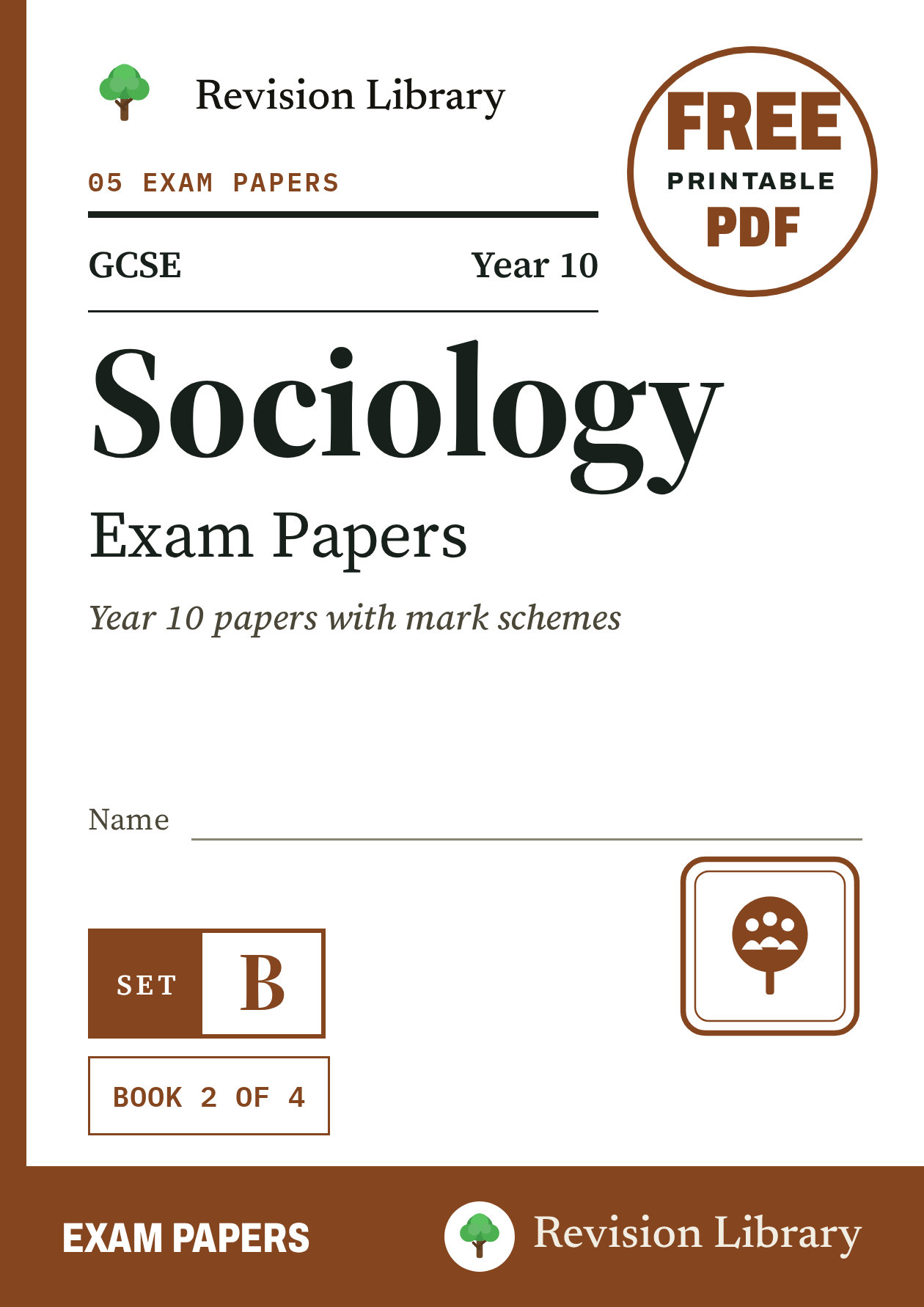
Book 2 of 4

GCSE Sociology Exam Papers Set B

Year 10 Paper 4: Family and School Foundations, Year 10 Paper 5: Education in Depth and Year 10 Paper 6: Full Year Review

Level
GCSE · AQA 8192
Series
GCSE Sociology Exam Papers, book 2 of 4
Suitable for
Years 10-11, AQA

Sociology questions ask for named theories and studies applied to a specific claim, and an answer that explains without naming loses marks it has already earned in substance. Each volume takes a group of themes and keeps the full marking lines so the naming and the explaining can be checked apart.

FreePDF download · 2027 edition · 75 A4 pages
  • One file, prints straight to A4
  • No account, no password

3 papers in the AQA format, mark schemes at the back. This set is one of 558 free PDFs on the shelf.

Pages
75 A4 pages
Papers
3 papers
Questions
55 · 240 marks
Answers
From page 52

What is inside

3 papers · answers from p52

Each paper starts with a page showing its marks and a suggested time, followed by the questions. The mark schemes for all 3 papers are at the back, so you can sit each paper as a mock and mark it afterwards.

  1. 01Year 10 Paper 4: Family and School Foundations13 questions · 60 marksp3
  2. 02Year 10 Paper 5: Education in Depth18 questions · 80 marksp16
  3. 03Year 10 Paper 6: Full Year Review24 questions · 100 marksp32
  4. AnswersMark schemes for every paperp52

Each paper is drawn from one of our worksheet packs. Follow a paper title for the full pack on its own page, or browse every GCSE Sociology pack. Every book on the shelf is a complete printable workbook of up to 120 A4 pages.

Explore this volume

GCSE Sociology Exam Papers Set B includes Year 10 Paper 4: Family and School Foundations (from page 3); Year 10 Paper 5: Education in Depth (from page 16); Year 10 Paper 6: Full Year Review (from page 32).

Worked question 6 - Year 10 Paper 4: Family and School Foundations

Public health measures and medical treatment can prevent deaths or help people survive serious illness.

Explain two reasons, other than diet, why the risk of dying prematurely in the UK has fallen over the last century.

Answer

Improved sanitation and clean water reduce exposure to infectious disease. Improved prevention or treatment also reduces the risk of dying from serious illness. Reduced smoking is another valid non-diet explanation. These affect survival risks; crude death rates can rise as a population ages.

Mark scheme

B1for a non-diet reason, such as improved medical prevention or treatment
B1for explaining how it prevents illness or improves survival
B1for a distinct second non-diet reason, such as sanitation or reduced smoking
B1for explaining how it reduces exposure to disease or other causes of premature death
B1for a further linked example or development of either explanation; distinguish premature mortality risk from the crude death rate

Question 8 - Year 10 Paper 4: Family and School Foundations

5 marks

Income, housing and employment opportunities can shape family arrangements, although family life varies within every social class.

Explain two ways in which family diversity in the UK can differ between social classes.

Answer

Limited housing resources can encourage adult children to remain in the parental household, whereas greater resources can facilitate separate households. Separately, employment mobility can move some families further from extended kin, changing the availability of everyday family care. Accept other distinct, explained class-related patterns; avoid universal assumptions.

Mark scheme

B1for a first class-related difference, such as resources affecting whether adult children establish separate households
B1for explaining how housing affordability or earnings shape that arrangement
B1for a distinct second difference, such as occupational mobility affecting proximity to extended kin
B1for explaining how living near or far from kin changes everyday support or family organisation
B1for further exemplification or development of either difference, without presenting class tendencies as universal

Question 11 - Year 10 Paper 4: Family and School Foundations

6 marks

Sure Start Children's Centres were set up in disadvantaged areas of England to offer free or low-cost childcare, early learning and family support before children start school.

Explain two ways in which early years programmes such as Sure Start aim to reduce educational inequality before children start school.

Answer

e.g. Sure Start provides free or low-cost early learning and childcare in disadvantaged areas, giving children from poorer families similar early learning opportunities to better-off children before school starts, and it offers parenting and health support, such as help with speech and language development, aiming to make sure children arrive at school more ready to learn

Mark scheme

B1for identifying a first way, such as providing free or low-cost early learning and childcare for disadvantaged families
B1for development of the first way
B1for a linked example or further explanation of the first way
B1for identifying a second way, such as offering parenting and health support, for example with speech and language development
B1for development of the second way
B1for a linked example or further explanation of the second way

Question 13 - Year 10 Paper 4: Family and School Foundations

6 marks

The New Right perspective argues that giving parents more choice of school through marketisation raises standards, while critics argue it increases inequality between schools.

Explain two ways in which marketisation policies may increase inequality between schools.

Answer

e.g. middle-class parents are often better able to research schools and secure places at popular schools, and cream-skimming leaves less popular schools with fewer resources and lower results

Mark scheme

B1for identifying a first way marketisation increases inequality, such as middle-class parents being better able to use parental choice
B1for development of the first way
B1for a linked example or further explanation of the first way
B1for identifying a second way marketisation increases inequality, such as popular schools 'cream-skimming' higher-achieving pupils
B1for development of the second way
B1for a linked example or further explanation of the second way

Question 12 - Year 10 Paper 5: Education in Depth

5 marks

Sociologists argue that childhood is a 'social construction', meaning what counts as childhood is defined differently in different societies rather than being fixed by nature.

Explain two ways in which the experience of childhood can differ between the UK and some poorer countries.

Answer

Poverty can require some children to spend more time working or helping a household and less time in education than many UK children. Separately, access to healthcare, safe housing or leisure resources can differ, affecting protection and wellbeing. These are possible differences, with variation within both the UK and poorer countries; no universal claim that children elsewhere work or lack schooling is required.

Mark scheme

B1for one cross-societal difference, such as participation in education compared with substantial work responsibilities
B1for explaining how resources and expectations can shape time spent at school or supporting a household
B1for a distinct second difference, such as access to healthcare, safe housing or leisure
B1for explaining how this changes protection, wellbeing or dependency
B1for a further example or development of either contrast, allowing variation within societies and avoiding blanket claims about work being illegal

Question 16 - Year 10 Paper 5: Education in Depth

6 marks

Sociologists point out that the family is not always a source of harmony; research on domestic abuse shows that some family members experience conflict or harm within the home rather than only support.

Explain two ways in which sociologists argue the family can be a source of conflict as well as support for some of its members.

Answer

e.g. feminist research on domestic abuse shows that some family members, often women and children, experience conflict and harm within the home rather than only support, and even in families without abuse, disagreements between generations or siblings, for example over money or caring responsibilities, can create ongoing tension rather than harmony

Mark scheme

B1for identifying a first way, such as domestic abuse occurring within some families, showing family life is not always positive
B1for development of the first way
B1for a linked example or further explanation of the first way
B1for identifying a second way, such as disagreements between generations or siblings over money or care creating ongoing tension
B1for development of the second way
B1for a linked example or further explanation of the second way

Question 9 - Year 10 Paper 5: Education in Depth

5 marks

Sociologists argue that the UK has become more 'child-centred' over time, meaning children are given more attention, resources and protection than in the past.

Explain two ways in which UK society has become more child-centred since the Victorian era.

Answer

e.g. because families are smaller than in the Victorian era, parents can now invest more time, money and attention in each individual child, and laws and services such as child protection agencies and compulsory schooling now focus much more on safeguarding children's welfare than they did in the past

Mark scheme

B1for identifying a first way, such as parents investing more money and attention in each child now families are smaller
B1for a linked development of the first way
B1for identifying a second way, such as laws and services increasingly focusing on protecting children's welfare
B1for a linked development of the second way
B1for further exemplification or development that completes either explanation

GCSE Sociology Exam Papers runs to 4 volumes

Book 2 of 4 · 277 pages in the set

Each set is a separate free PDF with its own mark schemes at the back.

Volume 1

64 pp · 47 Qs

Year 10 Paper 1: Studying Family Life, Year 10 Paper 2: Family Change and Year 10 Paper 3: Education and Family Ties

Volume 2 · this book

75 pp · 55 Qs

Year 10 Paper 4: Family and School Foundations, Year 10 Paper 5: Education in Depth and Year 10 Paper 6: Full Year Review

Volume 3

62 pp · 47 Qs

Year 11 Paper 1: Crime and Deviance, Year 11 Paper 2: Social Stratification, Year 11 Paper 3: Crime and Stratification and Family

Volume 4

76 pp · 56 Qs

Year 11 Paper 4: Crime, Class and Education, Year 11 Paper 5: Crime and Stratification in Depth and Year 11 Paper 6: Full Course Mock

More GCSE books

GCSE Sociology Topic Workbook 1

113 pp · 175 Qs

Culture, Norms, Values and Socialisation, Sociological Perspectives: Functionalism, Marxism, Feminism and Interactionism, Feminist Perspectives in Sociology and 10 more

Want a different mix of topics?

Sitting an exam soon? Build a GCSE Sociology mock paper or print a ready-made one.