Revision Library
Choose a subject
Menu
Sociology

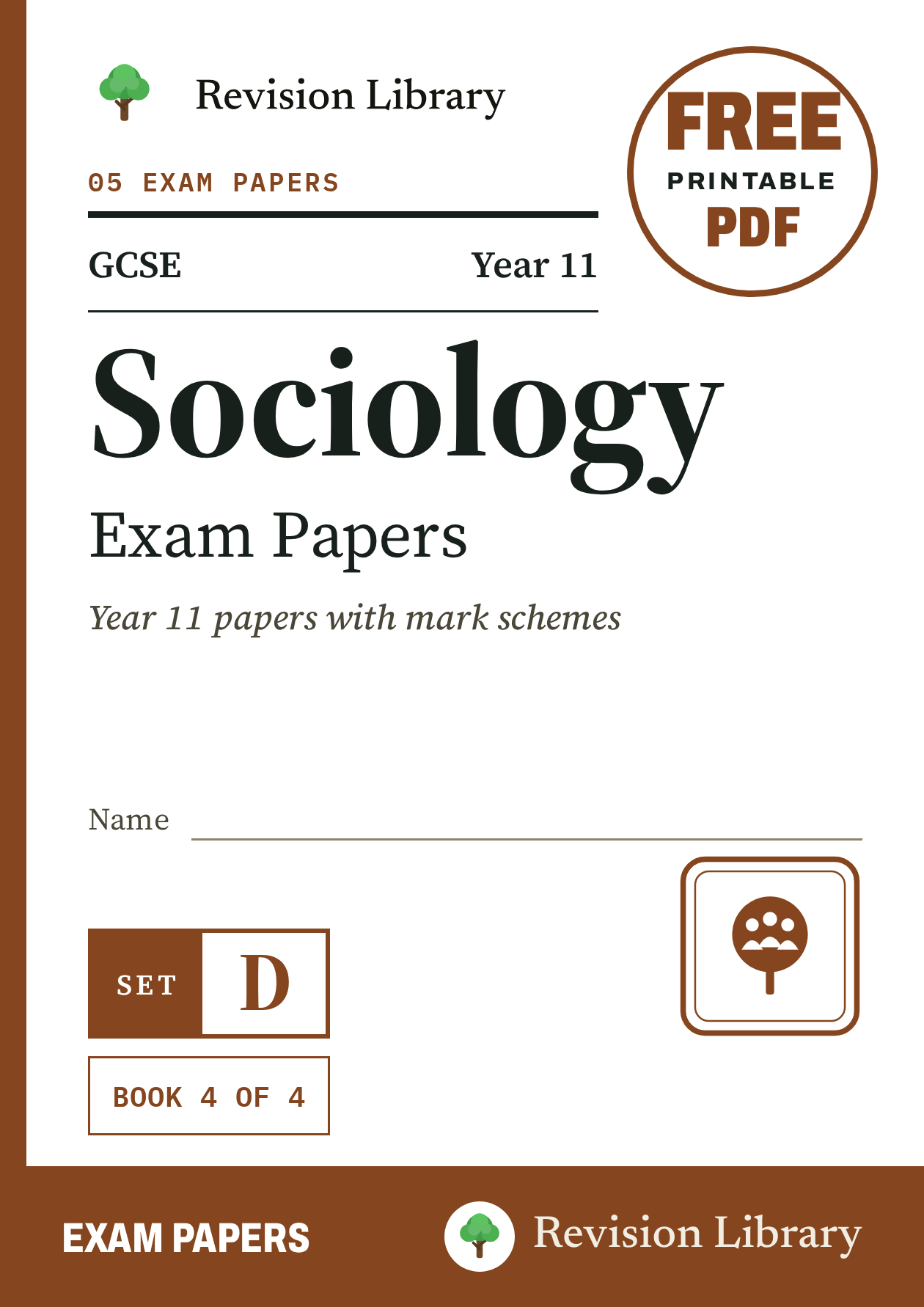
Book 4 of 4

GCSE Sociology Exam Papers Set D

Year 11 Paper 4: Crime, Class and Education, Year 11 Paper 5: Crime and Stratification in Depth and Year 11 Paper 6: Full Course Mock

Level
GCSE · AQA 8192
Series
GCSE Sociology Exam Papers, book 4 of 4
Suitable for
Years 10-11, AQA

Sociology questions ask for named theories and studies applied to a specific claim, and an answer that explains without naming loses marks it has already earned in substance. Each volume takes a group of themes and keeps the full marking lines so the naming and the explaining can be checked apart.

FreePDF download · 2027 edition · 76 A4 pages
  • One file, prints straight to A4
  • No account, no password

3 papers in the AQA format, mark schemes at the back. This set is one of 558 free PDFs on the shelf.

Pages
76 A4 pages
Papers
3 papers
Questions
56 · 240 marks
Answers
From page 52

What is inside

3 papers · answers from p52

Each paper starts with a page showing its marks and a suggested time, followed by the questions. The mark schemes for all 3 papers are at the back, so you can sit each paper as a mock and mark it afterwards.

  1. 01Year 11 Paper 4: Crime, Class and Education14 questions · 60 marksp3
  2. 02Year 11 Paper 5: Crime and Stratification in Depth19 questions · 80 marksp15
  3. 03Year 11 Paper 6: Full Course Mock23 questions · 100 marksp31
  4. AnswersMark schemes for every paperp52

Each paper is drawn from one of our worksheet packs. Follow a paper title for the full pack on its own page, or browse every GCSE Sociology pack. Every book on the shelf is a complete printable workbook of up to 120 A4 pages.

Explore this volume

GCSE Sociology Exam Papers Set D includes Year 11 Paper 4: Crime, Class and Education (from page 3); Year 11 Paper 5: Crime and Stratification in Depth (from page 15); Year 11 Paper 6: Full Course Mock (from page 31).

Worked question 3 - Year 11 Paper 4: Crime, Class and Education

Some pupils in UK schools speak English as an additional language (EAL) rather than as their first language.

Explain one reason why pupils who speak English as an additional language may find some GCSE subjects harder to access.

Answer

e.g. pupils who speak English as an additional language may need extra time to build up the subject-specific academic vocabulary used in exam questions, which can make some subjects harder to access at first even if the pupil understands the underlying ideas

Mark scheme

B1for identifying a valid reason, such as needing extra time to become fluent in subject-specific academic vocabulary
B1for a linked development of that reason
B1for a further linked development or example that completes the explanation

Question 5 - Year 11 Paper 4: Crime, Class and Education

3 marks

Faith schools are state-funded schools in England that have a religious character, often linked to a particular Christian denomination, or to another faith such as Islam or Judaism.

Explain one reason why some parents in the UK choose to send their child to a faith school.

Answer

e.g. some parents want their child's schooling to reflect the family's own religious beliefs and values, so they choose a faith school that shares and reinforces those beliefs

Mark scheme

B1for identifying a valid reason, such as wanting their child's education to reflect the family's religious beliefs and values
B1for a linked development of that reason
B1for a further linked development or example that completes the explanation

Question 4 - Year 11 Paper 4: Crime, Class and Education

3 marks

Sociologist Howard Becker argued that teachers often have an image of the 'ideal pupil', who is well behaved, hard working and speaks in a way the teacher approves of.

Explain one way in which a pupil's closeness to the teacher's 'ideal pupil' image can affect how they are treated in class.

Answer

e.g. pupils who match the teacher's idea of an 'ideal pupil' may receive more praise, attention and the benefit of the doubt than pupils who do not fit that image, giving them an advantage in class

Mark scheme

B1for identifying a valid way, such as pupils closer to the ideal pupil image receiving more praise and attention from the teacher
B1for a linked development of that way
B1for a further linked development or example that completes the explanation

Question 11 - Year 11 Paper 4: Crime, Class and Education

6 marks

Right realist criminologists argue crime is mainly a rational choice that can be deterred through policing and punishment, while left realist criminologists argue crime is driven mainly by inequality and social exclusion.

Explain two ways in which the left realist explanation of crime differs from the right realist explanation.

Answer

Example answer: Left realists emphasise relative deprivation and exclusion. Comparisons with others can generate resentment and pressure towards crime. Right realists emphasise choices shaped by rewards and risks. Left realists favour reducing exclusion and improving relationships with communities. These address social pressures and marginalisation. Right realists emphasise opportunity reduction and deterrence to alter individual calculations. Accept other valid answers: Relative deprivation versus rational calculation; marginalisation/subculture versus weak controls; contrasting prevention follows causal differences.

Mark scheme

B1for identify a paired contrast between left realist social pressures and right realist calculations of risk and reward.
B1for develop the left realist mechanism, for example relative deprivation.
B1for develop the corresponding right realist explanation or give a linked comparison.
B1for identify a second contrast, such as marginalisation and subcultures versus weak controls, or the prevention implications of the accounts.
B1for develop the left realist side of the second contrast.
B1for develop the right realist side of the second contrast. Accept equivalent paired comparisons, not opposing halves counted twice.

Question 7 - Year 11 Paper 5: Crime and Stratification in Depth

3 marks

Some pupils in UK schools speak English as an additional language (EAL) rather than as their first language.

Explain one reason why pupils who speak English as an additional language may find some GCSE subjects harder to access.

Answer

e.g. pupils who speak English as an additional language may need extra time to build up the subject-specific academic vocabulary used in exam questions, which can make some subjects harder to access at first even if the pupil understands the underlying ideas

Mark scheme

B1for identifying a valid reason, such as needing extra time to become fluent in subject-specific academic vocabulary
B1for a linked development of that reason
B1for a further linked development or example that completes the explanation

Question 4 - Year 11 Paper 5: Crime and Stratification in Depth

3 marks

Fraud can be concealed within apparently legitimate business activity, making it difficult for victims or investigators to recognise.

Explain one reason why white-collar offending can be difficult to detect or punish.

Answer

Example answer: Complex accounting can conceal fraud. Victims may not recognise the loss as a crime or report it. Fewer reports and specialist evidence requirements can reduce detection and prosecution. Accept other valid answers: Victims unaware of offending, complex evidence, specialist investigation costs or powerful offenders resisting scrutiny.

Mark scheme

B1for identifying a valid reason, such as the crime being hidden within complex financial or business systems
B1for a linked development of that reason
B1for a further linked development or example that completes the explanation

Question 18 - Year 11 Paper 5: Crime and Stratification in Depth

6 marks

Family networks can provide access to work experience, advice and contacts that affect children's later occupational opportunities.

Explain two ways in which access to social networks and contacts can help pass on class advantage between generations.

Answer

Example answer: Contacts can arrange work experience or introductions. This provides experience valued by recruiters. Children may then gain access to professional careers. Networks share information about opportunities and selection expectations. Advice can strengthen applications and interviews. This helps transmit advantage across generations. Accept other valid answers: Introductions, references, information, mentoring or access to placements; two independently explained routes, not one repeated chain.

Mark scheme

B1for identify a first network route, such as access to placements or introductions.
B1for develop how contacts make this possible.
B1for explain the benefit for later occupational chances.
B1for identify a second distinct route, such as sharing application information or mentoring.
B1for develop the informational advantage.
B1for explain its contribution to intergenerational class advantage. Accept other distinct routes; one placement chain is not automatically two ways.

Question 8 - Year 11 Paper 6: Full Course Mock

3 marks

Police-recorded crime statistics include incidents recorded by the police, but not every crime is reported or recorded.

Explain one reason why police-recorded crime statistics may underestimate the true amount of crime.

Answer

Example answer: A victim may fear retaliation. They may therefore not report an offence. It is then absent from police-recorded statistics even though it occurred. Accept other valid answers: Fear, embarrassment, unrecognised victimisation, low confidence in police or non-recording of a reported incident.

Mark scheme

B1for identifying a valid reason, such as some victims not reporting a crime to the police
B1for a linked development of that reason
B1for a further linked development or example that completes the explanation

Question 5 - Year 11 Paper 6: Full Course Mock

3 marks

Resources and opportunities can vary by social class and influence access to education and employment.

Explain one reason why social class can affect a person's life chances.

Answer

Example answer: Low family income can limit access to educational resources. A child may have less quiet space or fewer learning materials. This can reduce qualifications and subsequent occupational opportunities, without determining every child's outcome. Accept other valid answers: Material resources, cultural capital, networks, discrimination, housing or health, each linked to a particular opportunity.

Mark scheme

B1for identifying a valid reason, such as wealthier families being able to afford tutoring or educational resources
B1for a linked development of that reason
B1for a further linked development or example that completes the explanation

GCSE Sociology Exam Papers runs to 4 volumes

Book 4 of 4 · 277 pages in the set

Each set is a separate free PDF with its own mark schemes at the back.

Volume 1

64 pp · 47 Qs

Year 10 Paper 1: Studying Family Life, Year 10 Paper 2: Family Change and Year 10 Paper 3: Education and Family Ties

Volume 2

75 pp · 55 Qs

Year 10 Paper 4: Family and School Foundations, Year 10 Paper 5: Education in Depth and Year 10 Paper 6: Full Year Review

Volume 3

62 pp · 47 Qs

Year 11 Paper 1: Crime and Deviance, Year 11 Paper 2: Social Stratification, Year 11 Paper 3: Crime and Stratification and Family

Volume 4 · this book

76 pp · 56 Qs

Year 11 Paper 4: Crime, Class and Education, Year 11 Paper 5: Crime and Stratification in Depth and Year 11 Paper 6: Full Course Mock

More GCSE books

GCSE Sociology Topic Workbook 1

113 pp · 175 Qs

Culture, Norms, Values and Socialisation, Sociological Perspectives: Functionalism, Marxism, Feminism and Interactionism, Feminist Perspectives in Sociology and 10 more

Want a different mix of topics?

Sitting an exam soon? Build a GCSE Sociology mock paper or print a ready-made one.