Averages summarise a set of data with a single typical value: the mean (total divided by how many values there are), the median (the middle value when data is ordered), and the mode (the most frequently occurring value). The range measures how spread out the data is, the largest value minus the smallest value.
To find the mean, add up all the values and divide by how many values there are.
To find the median, put the values in order from smallest to largest, then pick the middle value, or the mean of the two middle values if there is an even number of values.
To find the mode, identify the value that appears most often; there can be more than one mode, or none at all.
To find the range, subtract the smallest value from the largest value.
When comparing two data sets, compare an average - usually the mean or median - alongside the range, to describe both typical size and consistency.
Worked example
Find the mean, median, mode and range of the data set: 4, 7, 4, 9, 6, 4, 8.
Mean: add the values, 4+7+4+9+6+4+8 = 42, then divide by 7 (how many values): 42 divided by 7 = 6.
Median: order the values, 4, 4, 4, 6, 7, 8, 9. With 7 values, the middle (4th) value is 6.
Mode: 4 appears three times, more than any other value, so the mode is 4.
Range: largest value (9) minus smallest value (4) = 5.
Revision Library
revisionlibrary.co.uk
GCSE · Statistics
2.14 Averages
EDEXCEL 1MA1 · Calculator allowed · about 265 minutes
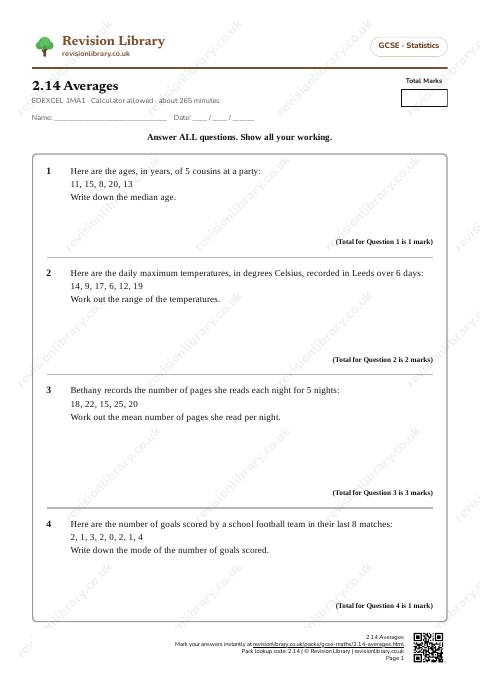
Here are the ages, in years, of 5 cousins at a party: 11, 15, 8, 20, 13 Write down the median age.
(Total for Question 1 is 1 mark)
2
Here are the daily maximum temperatures, in degrees Celsius, recorded in Leeds over 6 days: 14, 9, 17, 6, 12, 19 Work out the range of the temperatures.
(Total for Question 2 is 2 marks)
3
Bethany records the number of pages she reads each night for 5 nights: 18, 22, 15, 25, 20 Work out the mean number of pages she read per night.
(Total for Question 3 is 3 marks)
4
Here are the number of goals scored by a school football team in their last 8 matches: 2, 1, 3, 2, 0, 2, 1, 4 Write down the mode of the number of goals scored.
(Total for Question 4 is 1 mark)
5
Here are the times, in minutes, taken by 7 students to travel to school: 12, 18, 9, 25, 14, 20, 11 Write down the median travel time.
(Total for Question 5 is 1 mark)
6
Here are the numbers of books read last month by 5 friends: 3, 7, 2, 9, 5 Put a ring around the range of this list of numbers.
A) 5
B) 6
C) 7
D) 9
(Total for Question 6 is 1 mark)
7
A cricketer scored these numbers of runs in 6 innings: 34, 28, 45, 31, 26, 40 Work out the mean number of runs per innings.
(Total for Question 7 is 3 marks)
8
Here are the midday temperatures, in degrees Celsius, recorded in Aberdeen on six days in January: -3, 5, -1, 8, 0, -6
(a)Write these temperatures in order from lowest to highest.(1)
(b)Work out the range of the temperatures.(2)
(c)Calculate the mean temperature.(2)
(Total for Question 8 is 5 marks)
9
Priya and Sam each play a video game 5 times. Their scores are shown below. Priya: 12, 18, 9, 15, 21 Sam: 14, 16, 15, 17, 13
(a)Work out the mean score for Priya and the mean score for Sam.(3)
(b)Work out the range of each person's scores.(2)
(c)Ahmed says, 'Priya and Sam played equally well because they have the same mean score.' Comment on whether Ahmed is correct, using the range to support your answer.(2)
(Total for Question 9 is 7 marks)
10
For each statement, write down whether it is True or False.
(a)The range of a set of data can never be negative.(1)
(b)The mean of a set of data is always equal to one of the values in the data set.(1)
(c)To find the median of 10 numbers placed in order, you find the mean of the 5th and 6th values.(1)
(Total for Question 10 is 3 marks)
11
Here are the numbers of text messages sent by 8 students in one day: 12, 15, 12, 18, 20, 15, 12, 16
(a)Write down the mode of the number of messages sent.(1)
(b)Find the median number of messages sent.(2)
(c)Work out the range of the number of messages sent.(1)
(d)Calculate the mean number of messages sent.(2)
(Total for Question 11 is 6 marks)
12
The table shows the number of bags carried by shoppers leaving a supermarket, recorded during a survey.
Number of bags
1
2
3
4
Frequency
6
9
7
3
(a)Work out how many shoppers took part in the survey.(1)
(b)Write down the mode of the number of bags carried.(1)
(c)Work out the number of shoppers who carried more than 2 bags.(2)
(Total for Question 12 is 4 marks)
13
The table shows the number of goals scored by a football team in each of its matches last season.
Goals scored
0
1
2
3
4
Frequency
4
7
8
4
2
(a)Show that the team played 25 matches last season.(1)
(b)Calculate the mean number of goals scored per match.(3)
(Total for Question 13 is 4 marks)
14
A survey asked 20 students to name their favourite school subject. The results are shown in the table.
Subject
Maths
English
Science
Art
Frequency
6
4
7
3
(a)Write down the modal subject.(1)
(b)Explain why it is not possible to calculate the mean or the median favourite subject.(2)
(Total for Question 14 is 3 marks)
15
Here are the scores, relative to par, of 6 golfers after the first round of a tournament: -3, 2, -1, 0, -5, 4
(a)Work out the range of the scores.(2)
(b)Calculate the mean score.(3)
(Total for Question 15 is 5 marks)
16
For each statement, write down whether it is True or False.
(a)If you add 4 to every value in a data set, the mean also increases by 4.(1)
(b)If you add 4 to every value in a data set, the range stays the same.(1)
(c)If a data set has an even number of values, the median is always one of the values in the data set.(1)
(Total for Question 16 is 3 marks)
17
The table shows the number of siblings reported by the students in a Year 8 class.
Number of siblings
0
1
2
3
Frequency
5
10
6
4
(a)Work out how many students were surveyed.(1)
(b)Write down the modal number of siblings.(1)
(c)Work out the number of students with at least 2 siblings.(2)
(d)Calculate the mean number of siblings.(3)
(Total for Question 17 is 7 marks)
18
The bar chart shows the number of goals scored by a hockey team in each of its matches this season.
(a)Write down the number of matches in which the team scored 2 goals.(1)
(b)Work out the total number of matches played this season.(1)
(c)Calculate the mean number of goals scored per match.(3)
(Total for Question 18 is 5 marks)
19
Amir recorded the number of press-ups he did on 5 days: 18, 22, 25, 20, 15 Show that the mean number of press-ups per day is 20.
(Total for Question 19 is 2 marks)
20
The mean of five numbers is 9. Four of the numbers are 6, 8, 11 and 7. Work out the fifth number.
(Total for Question 20 is 3 marks)
21
The stem-and-leaf diagram below shows the times, in minutes, taken by 15 runners to complete a fun run.
(a)Write down the number of runners who took less than 30 minutes.(1)
(b)Find the median time taken.(2)
(c)Work out the range of the times.(2)
(Total for Question 21 is 5 marks)
22
Class 10A (28 students) and Class 10B (25 students) sat the same maths test, out of 20 marks. Class 10A: mean score = 14, range = 12 Class 10B: mean score = 14, range = 6
(a)Both classes have the same mean score. State what this tells you about the average performance of the two classes.(1)
(b)Use the ranges to explain why the performance within the two classes was different.(2)
(Total for Question 22 is 3 marks)
23
Class 10A (28 students) and Class 10B (25 students) sat the same maths test, out of 20 marks. Class 10A: mean score = 14 Class 10B: mean score = 14
(a)Work out the total marks scored by all the students in Class 10A.(2)
(b)Work out the total marks scored by all the students in Class 10B.(2)
(c)Calculate the combined mean score of all 53 students in Class 10A and Class 10B together.(3)
(Total for Question 23 is 7 marks)
24
Grace recorded the number of steps she walked, in thousands, on 4 days. The mean number of steps per day was 8. On the 5th day she walked 13 thousand steps. Work out her new mean number of steps per day over the 5 days.
(Total for Question 24 is 3 marks)
25
At a weekend running club, the combined mean finishing time for all 10 runners is 42 minutes. Of these 10 runners, 6 are in the beginners' group, with a mean finishing time of 38 minutes. The rest are in the advanced group. Work out the mean finishing time of the runners in the advanced group.
(Total for Question 25 is 4 marks)
26
Here are the delivery times, in minutes, for 13 parcels delivered by a courier in one day: 22, 35, 18, 40, 27, 31, 45, 29, 33, 38, 24, 50, 19
(a)Find the median delivery time.(2)
(b)Work out the range of the delivery times.(2)
(c)The courier says, 'Most parcels take about half an hour to deliver.' Use the median to comment on whether this claim is reasonable.(2)
(Total for Question 26 is 6 marks)
27
Rhys recorded his journey times, in minutes, to work on 7 days: 21, 22, 23, 24, 25, 26, 95 (Day 7 included a cancelled train.)
(a)Calculate the mean of all 7 journey times.(3)
(b)Calculate the mean of the first 6 journey times only (excluding day 7).(2)
(c)Use your answers to parts (a) and (b) to explain why the mean of all 7 days is not a fair representation of Rhys's typical journey time.(2)
(Total for Question 27 is 7 marks)
28
Here are the shoe sizes of 10 dancers in a class: 4, 5, 4, 6, 7, 4, 8, 5, 4, 6 Write down the mode of the shoe sizes.
(Total for Question 28 is 1 mark)
29
Here is the rainfall, in mm, recorded over 6 days: 0, 3, 12, 0, 7, 15 Work out the range of the rainfall.
(Total for Question 29 is 1 mark)
30
Here are the number of goals scored by a school football team in their last 9 matches: 2, 1, 0, 3, 1, 2, 1, 4, 1 Write down the mode of the number of goals scored.
(Total for Question 30 is 1 mark)
31
Here are the times, in minutes, taken by 8 runners to complete a park run: 32, 45, 28, 39, 41, 35, 30, 44 Find the median time.
(Total for Question 31 is 2 marks)
32
Here are the heights, in cm, of 7 sunflowers grown by a gardening club: 112, 98, 130, 105, 121, 99, 115 Work out the range of the heights.
(Total for Question 32 is 1 mark)
33
The table shows the favourite school lunch of 38 pupils. Lunch: Sandwiches, Pasta, Pizza, Salad Frequency: 7, 12, 15, 4 Write down the modal favourite lunch.
(Total for Question 33 is 1 mark)
34
For each statement, write down whether it is True or False.
(a)The range of a data set depends only on the highest and lowest values, not on how many times each value occurs.(1)
(b)It is impossible for the mean of a data set to equal a value that is not one of the data values.(1)
(c)For a data set with an even number of values, the median is the mean of the two middle values when the data is placed in order.(1)
(Total for Question 34 is 3 marks)
35
Here are the points scored by a netball team in their last 5 matches: 34, 28, 41, 25, 37 Work out the mean number of points scored.
(Total for Question 35 is 2 marks)
36
Here are the numbers of minutes 6 students spent on homework one evening: 35, 42, 28, 50, 33, 45 Work out the mean number of minutes. Give your answer correct to 1 decimal place.
(Total for Question 36 is 2 marks)
37
Two hockey teams recorded the number of goals they scored in their last 6 matches. Team Red: 2, 1, 3, 0, 4, 2 Team Blue: 1, 2, 2, 3, 1, 3
(a)Work out the mean number of goals for Team Red and the mean number of goals for Team Blue.(2)
(b)Work out the range of goals for Team Red and the range of goals for Team Blue.(2)
(c)Both teams have the same mean. Use the ranges to state which team's goal-scoring was more consistent, giving a reason.(1)
(Total for Question 37 is 5 marks)
38
A cricket player scored the following runs in 5 innings: 24, 51, 33, 18, 39 Work out the mean number of runs scored.
(Total for Question 38 is 2 marks)
39
Here is the pocket money, in pounds, received by 6 students in one week: 5, 8, 12, 6, 10, 15 Work out the mean amount of pocket money. Give your answer correct to 2 decimal places.
(Total for Question 39 is 2 marks)
40
The mean temperature over 5 days in February was -2 degrees Celsius. The temperatures on four of the days were -5, 1, -4 and 2 degrees Celsius. Work out the temperature on the fifth day.
(Total for Question 40 is 3 marks)
41
The mean of the four numbers x, x + 5, x + 7 and 15 is 12. Work out the value of x.
(Total for Question 41 is 3 marks)
42
8 runners in Group X have a mean finishing time of 42 seconds. 12 runners in Group Y have a mean finishing time of 46 seconds. Work out the mean finishing time for all 20 runners combined.
(Total for Question 42 is 3 marks)
43
The table shows the number of siblings for each pupil in a class of 25. Number of siblings: 0, 1, 2, 3, 4 Frequency: 6, 10, 5, 3, 1 Work out the mean number of siblings.
(Total for Question 43 is 3 marks)
44
A student, Erin, is finding the range of these temperatures, in degrees Celsius, recorded over a week: 3, -5, 8, -2, 6, -1, 4 Erin writes: 'The range is 8 - (-1) = 9.'
(a)Identify the error in Erin's method.(1)
(b)Work out the correct range.(2)
(Total for Question 44 is 3 marks)
45
The mean of 6 numbers is 15. A seventh number is added to the list, and the mean of all 7 numbers becomes 16. Work out the seventh number.
(Total for Question 45 is 3 marks)
46
A list of 6 numbers, placed in order, is: 4, 9, x, x + 3, 15, 20 The median of the list is 11. Work out the value of x.
(Total for Question 46 is 3 marks)
47
The range of five numbers is 17. The greatest of the five numbers is 3g. The least of the five numbers is g - 1. Work out the value of g.
(Total for Question 47 is 3 marks)
48
A delivery company is deciding which of two drivers, Driver A or Driver B, to keep on for weekend shifts, based on their delivery times, in minutes, over their last 6 shifts. Driver A: 18, 20, 19, 45, 21, 19 Driver B: 24, 23, 25, 22, 26, 24
(a)Calculate the mean delivery time for Driver A and the mean delivery time for Driver B. Give your answers correct to 2 decimal places where necessary.(3)
(b)Work out the range of delivery times for each driver, and use your answers to recommend which driver the company should keep on for weekend shifts. Give a reason.(3)
(Total for Question 48 is 6 marks)
49
A list of 7 numbers, placed in order, is: 3, 8, 11, 2x - 1, 19, 24, 30 The median of the list is 15. Work out the value of x.
(Total for Question 49 is 3 marks)
50
10 students in Class A have a mean test score of 60. 15 students in Class B have a mean score of 70. 25 students in Class C have a mean score of 78. Work out the mean score for all 50 students combined.
(Total for Question 50 is 4 marks)
51
The table shows the distance, in km, travelled to school by 40 pupils. Distance (km): 0 < d ≤ 2, 2 < d ≤ 4, 4 < d ≤ 6, 6 < d ≤ 8, 8 < d ≤ 10 Frequency: 12, 14, 8, 4, 2 Work out an estimate for the mean distance travelled.
(Total for Question 51 is 4 marks)
52
The table shows the number of pets owned by the people in a survey. Number of pets: 0, 1, 2, 3 Frequency: 4, 8, x, 6 The mean number of pets owned is 1.5. Work out the value of x.
(Total for Question 52 is 3 marks)
53
Three consecutive integers can be written as n - 1, n and n + 1. Show that the mean of any three consecutive integers is always equal to their median.
(Total for Question 53 is 3 marks)
54
Four numbers are b, b + 7, 2b - 3, and 24. The mean of the four numbers is 16.
(a)Work out the value of b.(3)
(b)Hence work out the range of the four numbers.(2)
(Total for Question 54 is 5 marks)
55
The mean of n numbers is 18. A new number, 42, is added to the list, and the mean of the n + 1 numbers becomes 20. Work out the value of n.
(Total for Question 55 is 4 marks)
56
Six positive integers have a mean of 7, a median of 6.5, a mode of 5, and a range of 9. Find a set of six numbers that satisfies all four conditions.
(Total for Question 56 is 4 marks)
57
A sports club has junior and senior members. The mean age of the junior members is 12 years and the mean age of the senior members is 34 years. The mean age of all the members combined is 20 years. There are 18 more junior members than senior members. Work out the total number of members in the club.
(Total for Question 57 is 5 marks)
58
In a class, 3/5 of the students are girls and the rest are boys. The mean score of the girls is 68. The mean score of the whole class is 71. Work out the mean score of the boys.
(Total for Question 58 is 5 marks)
Mark scheme · 2.14 Averages
A correct answer earns full marks unless the question asks for working, a method, proof or explanation.
Question 1
13 caoB1
Answer: 13
Question 2
19 and 6 identified as the highest and lowest values, oe (19 - 6)M1
13 caoA1
Answer: 13°C
Question 3
18 + 22 + 15 + 25 + 20 (= 100), oeM1
100 / 5M1
20 caoA1
Answer: 20 pages
Question 4
2 caoB1
Answer: 2
Question 5
14 caoB1
Answer: 14 minutes
Question 6
C (7) caoB1
Answer: C) 7
Question 7
34 + 28 + 45 + 31 + 26 + 40 (= 204), oeM1
204 / 6M1
34 caoA1
Answer: 34 runs
Question 8
(a) -6, -3, -1, 0, 5, 8, caoB1
(a) Answer: -6, -3, -1, 0, 5, 8
(b) 8 - (-6), oeM1
(b) 14 caoA1
(b) Answer: 14°C
(c) -3 + 5 - 1 + 8 + 0 - 6 (= 3), oe, / 6M1
(c) 0.5 caoA1
(c) Answer: 0.5°C
Question 9
(a) Priya: 12+18+9+15+21 (= 75), oeM1
(a) Sam: 14+16+15+17+13 (= 75), oeM1
(a) both means = 15 caoA1
(a) Answer: Priya: 15, Sam: 15
(b) 21 - 9 and 17 - 13, oe (at least one correct range identified)M1
(b) Priya = 12 and Sam = 4, both caoA1
(b) Answer: Priya: 12, Sam: 4
(c) states that Ahmed is not (fully) correct / disagrees with AhmedB1
(c) correct reason referring to the range, e.g. Sam's range (4) is smaller than Priya's range (12), so Sam's scores were more consistent, oeB1
(c) Answer: Ahmed is not correct. Although the means are equal, Sam's range (4) is much smaller than Priya's range (12), so Sam's scores were more consistent than Priya's.
(c) 7 + 3, oe (frequencies for 3 bags and 4 bags identified)M1
(c) 10 caoA1
(c) Answer: 10
Question 13
(a) 4 + 7 + 8 + 4 + 2 = 25, cso (answer of 25 is given, so working must be shown)B1
(a) Answer: 25 (shown)
(b) fx products found: 0, 7, 16, 12, 8, oe (at least 3 correct)M1
(b) (0 + 7 + 16 + 12 + 8) / 25M1
(b) 1.72 caoA1
(b) Answer: 1.72 goals
Question 14
(a) Science caoB1
(a) Answer: Science
(b) mean: subject names are not numbers, so they cannot be added and divided, oeB1
(b) median: the subjects have no numerical order, so they cannot be placed in order from lowest to highest, oeB1
(b) Answer: The mean cannot be calculated because the data (subject names) are not numbers, so they cannot be added and divided. The median cannot be found because the subjects cannot be placed in numerical order.
Question 15
(a) 4 and -5 identified as the highest and lowest values, oe (4 - (-5))M1
(a) 9 caoA1
(a) Answer: 9
(b) -3 + 2 - 1 + 0 - 5 + 4 (= -3), oeM1
(b) -3 / 6M1
(b) -0.5 caoA1
(b) Answer: -0.5
Question 16
(a) True caoB1
(a) Answer: True
(b) True caoB1
(b) Answer: True
(c) False caoB1
(c) Answer: False
Question 17
(a) 25 cao (5 + 10 + 6 + 4)B1
(a) Answer: 25
(b) 1 caoB1
(b) Answer: 1
(c) 6 + 4, oe (frequencies for 2 siblings and 3 siblings identified)M1
(c) 10 caoA1
(c) Answer: 10
(d) fx products found: 0, 10, 12, 12, oe (at least 3 correct)M1
(d) (0 + 10 + 12 + 12) / 25M1
(d) 1.36 caoA1
(d) Answer: 1.36 siblings
Question 18
(a) 5 caoB1
(a) Answer: 5
(b) 15 cao (3 + 4 + 5 + 2 + 1)B1
(b) Answer: 15
(c) fx products found: 0, 4, 10, 6, 4, oe (at least 3 correct)M1
(c) (0 + 4 + 10 + 6 + 4) / 15M1
(c) 1.6 caoA1
(c) Answer: 1.6 goals
Question 19
18 + 22 + 25 + 20 + 15 (= 100), oeM1
100 / 5 = 20 cso (answer of 20 is given, so working must be shown)A1
Answer: 20 (shown)
Question 20
9 x 5 (= 45), oeM1
45 - (6 + 8 + 11 + 7), oe (45 - 32)M1
13 caoA1
Answer: 13
Question 21
(a) 3 caoB1
(a) Answer: 3
(b) identifies the 8th value out of 15 ordered valuesM1
(b) 36 caoA1
(b) Answer: 36 minutes
(c) 53 - 25, oeM1
(c) 28 (minutes) caoA1
(c) Answer: 28 minutes
Question 22
(a) on average, the two classes performed equally well / the same, oeB1
(a) Answer: On average, the two classes performed equally well.
(b) Class 10A's scores were more spread out / varied, since its range (12) is greater than Class 10B's range (6)B1
(b) Class 10B's scores were more consistent / closer together, since its range (6) is smallerB1
(b) Answer: Class 10A's scores were more spread out (range 12) while Class 10B's scores were more consistent (range 6), so the students in 10B performed more similarly to each other.
Question 23
(a) 14 x 28, oeM1
(a) 392 caoA1
(a) Answer: 392
(b) 14 x 25, oeM1
(b) 350 caoA1
(b) Answer: 350
(c) 392 + 350 (= 742), ft their (a) and (b)M1
(c) 742 / 53, ft (28 + 25 students)M1
(c) 14 caoA1
(c) Answer: 14
Question 24
8 x 4 (= 32), oeM1
32 + 13 (= 45), oe, / 5M1
9 caoA1
Answer: 9 thousand steps
Question 25
10 x 42 (= 420), oeM1
6 x 38 (= 228), oeM1
(420 - 228) / (10 - 6), oe (192 / 4)M1
48 caoA1
Answer: 48 minutes
Question 26
(a) times placed in order: 18, 19, 22, 24, 27, 29, 31, 33, 35, 38, 40, 45, 50, oeM1
(a) 31 caoA1
(a) Answer: 31 minutes
(b) 50 - 18, oeM1
(b) 32 caoA1
(b) Answer: 32 minutes
(c) compares the median (31 minutes) with half an hour (30 minutes)B1
(c) valid comment, e.g. the median is very close to 30 minutes, so the claim is reasonable, oeB1
(c) Answer: The median (31 minutes) is very close to half an hour (30 minutes), so the courier's claim is reasonable.
(c) compares the two means, e.g. the mean of all 7 days (33.7) is much higher than the mean of the usual 6 days (23.5), ft their (a) and (b)B1
(c) correct reason, e.g. the single unusually high value (95, caused by a cancelled train) pulls the overall mean up, so it does not represent a typical day, oeB1
(c) Answer: The mean of all 7 days (33.7) is much higher than the mean of the usual 6 days (23.5), because the single outlier of 95 minutes (caused by a cancelled train) pulls the overall mean up, so it does not fairly represent Rhys's typical journey time.
identifies that the median of 6 ordered values is the mean of the 3rd and 4th values: (x + (x + 3)) / 2 = 11M1
2x + 3 = 22 (oe)M1
x = 9.5 caoA1
Answer: x = 9.5
Question 47
3g - (g - 1) (oe: = 2g + 1)M1
2g + 1 = 17, leading to 2g = 16M1
g = 8 caoA1
Answer: g = 8
Question 48
(a) 18+20+19+45+21+19 (= 142) and 24+23+25+22+26+24 (= 144) both foundM1
(a) Driver A mean = 23.67 (minutes), awrt 2dpA1
(a) Driver B mean = 24 (minutes) caoA1
(a) Answer: Driver A mean = 23.67 minutes, Driver B mean = 24 minutes
(b) Driver A range = 27 (from 45 - 18)B1
(b) Driver B range = 4 (from 26 - 22)B1
(b) Driver B recommended (ft from correct ranges), because Driver B's much smaller range shows far more consistent delivery times, even though Driver B's mean is only slightly higher than Driver A'sB1
(b) Answer: Driver A range = 27 minutes, Driver B range = 4 minutes; Driver B is recommended for consistency
Question 49
identifies that for 7 ordered values the median is the 4th value: 2x - 1 = 15M1
2x = 16 (oe)M1
x = 8 caoA1
Answer: x = 8
Question 50
10 x 60 (= 600) foundM1
15 x 70 (= 1050) and 25 x 78 (= 1950) both foundM1
(600 + 1050 + 1950) / 50 (oe) set upM1
72 caoA1
Answer: 72
Question 51
correct midpoints used: 1, 3, 5, 7, 9M1
sum of (midpoint x frequency) = 140 foundM1
divides by total frequency = 40M1
3.5 (km) caoA1
Answer: 3.5 km
Question 52
total pets = (0x4) + (1x8) + (2 x x) + (3x6) (= 26 + 2x) set upM1
(26 + 2x) / (18 + x) = 1.5 (oe), leading to 26 + 2x = 27 + 1.5x, i.e. 0.5x = 1M1
x = 2 caoA1
Answer: x = 2
Question 53
sum = (n - 1) + n + (n + 1) (= 3n) correctly foundM1
mean = 3n / 3 = nA1
states that n is the median (middle value) of n - 1, n, n + 1, so the mean equals the median, csoA1
Answer: Mean = n = median (shown)
Question 54
(a) b + (b + 7) + (2b - 3) + 24 = 4 x 16 (oe), leading to 4b + 28 = 64M1
(a) 4b = 36 (oe)M1
(a) b = 9 caoA1
(a) Answer: b = 9
(b) identifies the four values as 9, 16, 15, 24 (ft from their b) and identifies the highest (24) and lowest (9)M1
(b) 15 cao (ft from their b)A1
(b) Answer: 15
Question 55
total of the original n numbers = 18nM1
sets up (18n + 42) / (n + 1) = 20 (oe), or 18n + 42 = 20(n + 1)M1
correctly solves to 22 = 2n (oe)M1
n = 11 caoA1
Answer: n = 11
Question 56
uses the mean to find the total of the six numbers: 6 x 7 = 42M1
uses the median condition correctly, e.g. the 3rd and 4th ordered values sum to 13 (since their mean is 6.5)M1
places two values equal to 5 (for the mode) consistent with the ordering, and uses the range condition to fix the highest and lowest values 9 apartM1
a fully correct set of six positive integers satisfying all four conditions, e.g. 3, 5, 5, 8, 9, 12 (accept any other valid set)A1
Answer: 3, 5, 5, 8, 9, 12 (one valid answer; other correct sets may exist)
Question 57
lets the number of seniors be s, so the number of juniors is s + 18M1
total age = 12(s + 18) + 34s (oe), correctly expanded to 46s + 216M1
sets up (46s + 216) / (2s + 18) = 20 (oe)M1
correctly solves to 46s + 216 = 40s + 360, leading to 6s = 144, s = 24M1
66 (total members) cao, from 2 x 24 + 18A1
Answer: 66 members
Question 58
recognises girls = 3/5 of the class and boys = 2/5 of the class (oe, e.g. ratio girls:boys = 3:2)M1
lets the total number of students be n, so total class score = 71nM1
total score of girls = 68 x (3/5)n (= 40.8n) foundM1
total score of boys = 71n - 40.8n (= 30.2n), dep on previous M1M1
Put this topic and others into one printable pack.
Open the Pack Builder
Worksheets are written for Revision Library and come with a full mark scheme; a few English packs quote an out-of-copyright text, and name it on the page. Exam board names and specification codes say which qualification a pack suits: we are not affiliated with, endorsed by or approved by any exam board, and no past-paper question is reproduced here. Rights queries: hello@revisionlibrary.co.uk