Revision Library
Choose a subject
Menu

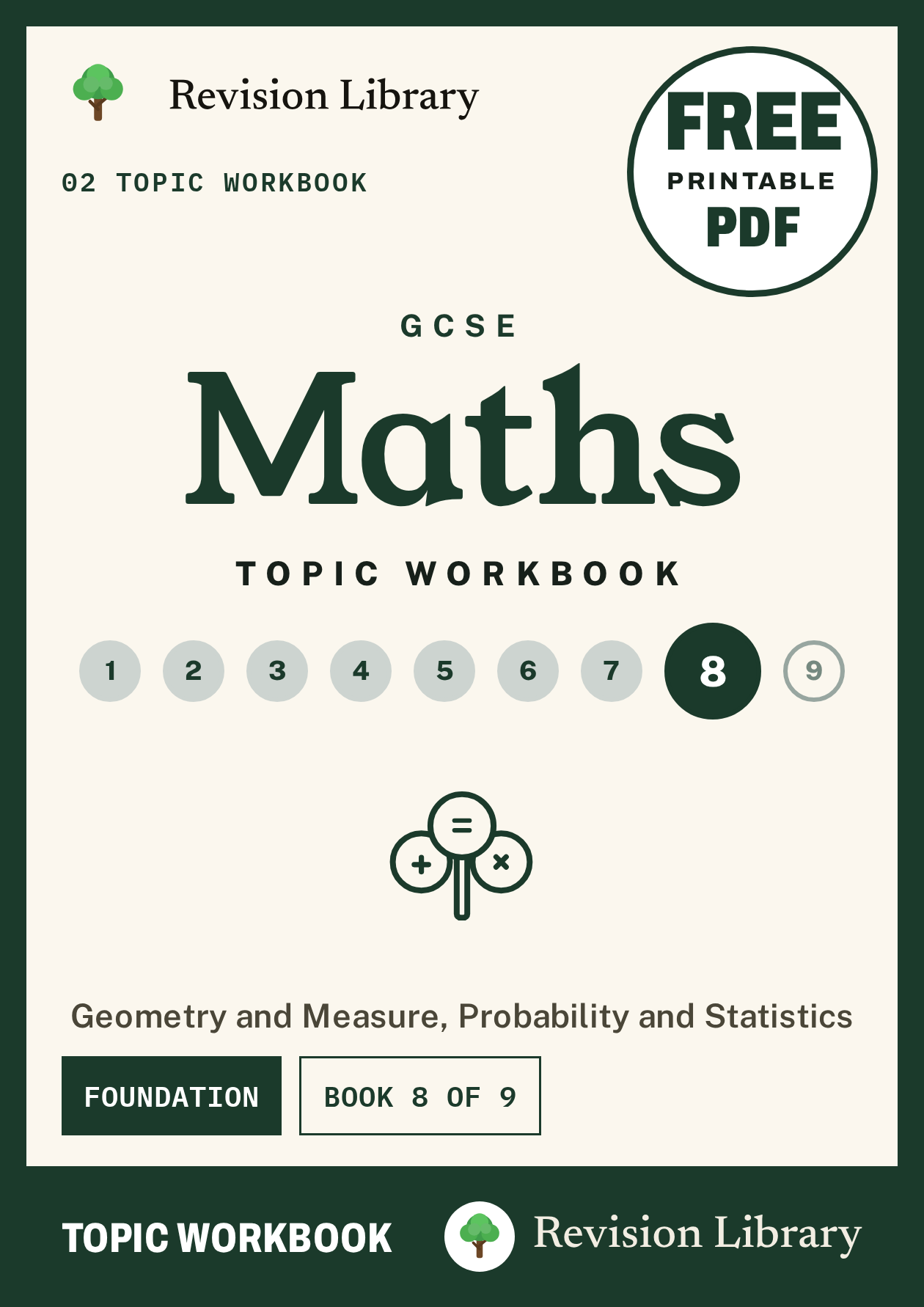
GCSE Maths Foundation Topic Workbooks · Book 8 of 9

GCSE Maths Foundation Topic Workbook 8

Vectors, Systematic Listing, Probability (Foundation) and 6 more

Level
GCSE Foundation · Edexcel 1MA1 · AQA 8300 · OCR J560
Series
GCSE Maths Foundation Topic Workbooks, book 8 of 9
Suitable for
Years 10-11, AQA / Edexcel / OCR

Foundation tier rewards accuracy on the topics that come up every year far more than it rewards breadth. Each volume takes a run of related topics in curriculum order and gives you the fluency practice first, then the exam-style questions on the same material, so a weak topic gets rebuilt rather than revised around.

FreePDF download · 2027 edition · 112 A4 pages
  • One file, prints straight to A4
  • No account, no password

Workbooks like this one, with 9 topics, 126 questions and mark schemes at the back, are usually printed and sold by publishers. This one is one of 558 free PDFs on the shelf.

Pages
112 A4 pages
Chapters
9 worksheet chapters
Questions
126 · 496 marks
Answers
From page 98
Working time
About 10h 25m

What is inside

9 chapters · answers from p98

Each chapter starts with a page showing its marks and a suggested time, followed by the questions. The mark schemes for all 9 chapters are at the back, so the book works for homework, a timed test or revision.

  1. 01Vectors16 questions · 48 marks · about 60 min Topic guide: Vectorsp3
  2. 02Systematic Listing15 questions · 42 marks · about 55 min Topic guide: Systematic Listingp13
  3. 03Probability (Foundation)14 questions · 40 marks · about 50 min Topic guide: Probability (Foundation)p19
  4. 04Averages10 questions · 46 marks · about 60 min Topic guide: Averagesp26
  5. 05Probability (Higher)16 questions · 69 marks · about 85 min Topic guide: Probability (Higher)p32
  6. 06Probability Trees12 questions · 73 marks · about 90 min Topic guide: Probability Treesp43
  7. 07Venn Diagrams13 questions · 67 marks · about 85 min Topic guide: Venn Diagramsp54
  8. 08Pictograms14 questions · 64 marks · about 80 min Topic guide: Pictogramsp67
  9. 09Frequency Polygons16 questions · 47 marks · about 60 min Topic guide: Frequency Polygonsp82
  10. AnswersMark schemes for every chapterp98

Each chapter is drawn from one of our worksheet packs. Follow a chapter title for the full pack on its own page, or browse every GCSE Maths pack. Every book on the shelf is a complete printable workbook of up to 120 A4 pages.

Explore this volume

GCSE Maths Foundation Topic Workbook 8 includes Vectors (from page 3); Systematic Listing (from page 13); Probability (Foundation) (from page 19); Averages (from page 26); Probability (Higher) (from page 32); Probability Trees (from page 43); Venn Diagrams (from page 54); Pictograms (from page 67); Frequency Polygons (from page 82).

Worked question 12 - Probability Trees

Open the included worksheet

A factory makes phone screens. 3% of the screens produced are faulty. Every screen is tested. If a screen is faulty, the test correctly shows it as faulty 90% of the time. If a screen is not faulty, the test incorrectly shows it as faulty 5% of the time.
0.03 0.97 Faulty Not faulty Test faulty Test not faulty Test faulty Test not faulty (Diagram NOT to scale)
(a)Complete the probability tree diagram for a randomly chosen screen.(3)
(b)Calculate the probability that a randomly selected screen is shown as faulty by the test.(3)
(c)A screen is tested and shown as faulty. Find the probability that it is actually faulty.(3)

Answer and mark scheme

Question 12

CreditAnswer or working
B1(a) 0.9 and 0.1 on the branches after Faulty
B1(a) 0.05 and 0.95 on the branches after Not faulty
B1(a) 0.03 and 0.97 correctly retained on the first-stage branches
M1(b) 0.03 x 0.9 (= 0.027, one correct route)
M1(b) 0.03 x 0.9 + 0.97 x 0.05 (both routes added)
A1(b) 0.0755 cao
M1(c) identifies P(faulty and shown faulty) = 0.027
M1(c) 0.027 / 0.0755 (divides by P(shown faulty) from part (b))
A1(c) awrt 0.358 (or 35.8%)
  • (a) Answer: First stage: Faulty 0.03, Not faulty 0.97. After Faulty: Test faulty 0.9, Test not faulty 0.1. After Not faulty: Test faulty 0.05, Test not faulty 0.95
  • (b) Answer: 0.0755
  • (c) Answer: awrt 0.358

Question 9 - Probability Trees

Open the included worksheet

In a factory, machines A and B operate independently of each other on any given day. The probability that machine A breaks down on a given day is 0.1. The probability that machine B breaks down on a given day is 0.05.
Machine A Machine B Breaks down Does not break down Breaks down Does not break down Breaks down Does not break down (Not to scale)
(a)Complete the probability tree diagram for a single day, showing both machines.(2)
(b)Find the probability that neither machine breaks down on a given day.(2)
(c)Find the probability that exactly one of the two machines breaks down on a given day.(3)

Answer and mark scheme

Question 9

CreditAnswer or working
B1(a) 0.9 and 0.1 on the machine A branches
B1(a) 0.95 and 0.05 on the machine B branches
M1(b) 0.9 x 0.95
A1(b) 0.855 cao
M1(c) 0.1 x 0.95 (or 0.9 x 0.05) for one correct route
M1(c) 0.1 x 0.95 + 0.9 x 0.05 (both routes added)
A1(c) 0.14 cao
  • (a) Answer: A: Breaks down 0.1, Does not break down 0.9. B: Breaks down 0.05, Does not break down 0.95
  • (b) Answer: 0.855
  • (c) Answer: 0.14

Question 11 - Probability Trees

Open the included worksheet

A bag contains 3 red counters and n blue counters only, where n > 0. Two counters are taken from the bag at random, one after another, without replacement.
(a)Show that the probability that both counters are red is 6 / ((n+3)(n+2)).(3)
(b)Given that the probability that both counters are red is 1/5, show that n2 + 5n - 24 = 0.(2)
(c)Hence find the number of blue counters in the bag.(3)

Answer and mark scheme

Question 11

CreditAnswer or working
M1(a) P(first red) = 3/(n+3)
M1(a) P(second red | first red) = 2/(n+2)
A1(a) cso: 3/(n+3) x 2/(n+2) = 6/((n+3)(n+2))
M1(b) 5 x 6 = (n+3)(n+2), i.e. (n+3)(n+2) = 30
A1(b) cso: expands to n2 + 5n + 6 = 30, giving n2 + 5n - 24 = 0
M1(c) factorises: (n+8)(n-3) = 0
M1(c) n = 3 selected, rejecting n = -8 since n > 0
A1(c) n = 3 cao
  • (a) Answer: 6 / ((n+3)(n+2)) shown
  • (b) Answer: n2 + 5n - 24 = 0 shown
  • (c) Answer: 3 blue counters

Question 15 - Vectors

Open the included worksheet

O is the origin. The position vectors of A and B are a and b. Q lies on the line AB extended beyond B such that AQ = (5/3)AB. Find the position vector of Q, OQ, in terms of a and b, giving your answer in its simplest form.
Diagram NOT accurately drawn
O A B Q a b

Answer and mark scheme

Question 15

CreditAnswer or working
M1AB = b - a
M1OQ = a + (5/3)(b - a), correct method
A1(5b - 2a)/3 oe, e.g. -(2/3)a + (5/3)b
  • Answer: OQ = (5b - 2a)/3

Question 14 - Vectors

Open the included worksheet

In triangle OAB, OA = a and OB = b. E is the point on OA extended beyond A such that OE = (3/2)a. F is the point on OB extended beyond B such that OF = (3/2)b.
Diagram NOT accurately drawn
O A E B F a b
(a)Find EF in terms of a and b.(2)
(b)Show that EF is parallel to AB, and find the ratio EF : AB.(3)

Answer and mark scheme

Question 14

CreditAnswer or working
M1(a) EF = OF - OE = (3/2)b - (3/2)a
A1(a) (3/2)(b - a) oe
M1(b) states AB = b - a
M1(b) EF = (3/2)AB (ft from part a)
A1(b) cso: EF is a scalar multiple of AB so they are parallel; ratio EF : AB = 3 : 2
  • (a) Answer: EF = (3/2)(b - a)
  • (b) Answer: EF is parallel to AB; EF : AB = 3 : 2

Question 6 - Pictograms

Open the included worksheet

A library app pictogram shows the number of e-books downloaded each day for five days, but the key is missing. Mon: 2 symbols. Tue: 4 symbols. Wed: 3 symbols. Thu: 1 symbol. Fri: 2 symbols. The total number of downloads over the five days was 180.
E-book downloads (Monday to Friday) Monday Tuesday Wednesday Thursday Friday Key: = ? downloads (key hidden) Total downloads (Monday to Friday) = 180
(a)Work out the number of downloads represented by 1 symbol.(2)
(b)Work out the number of downloads on Wednesday.(2)
(c)Work out the number of downloads on Thursday.(1)

Answer and mark scheme

Question 6

CreditAnswer or working
M1(a) 180 / (2+4+3+1+2), i.e. 180 / 12, oe
A1(a) 15 cao
M1(b) 3 x their key from (a)
A1(b) 45 cao (ft their key)
B1(c) 15 cao (ft their key)
  • (a) Answer: 1 symbol = 15 downloads
  • (b) Answer: 45
  • (c) Answer: 15

Question 3 - Pictograms

Open the included worksheet

A table shows how pupils travel to school. A pictogram is to be drawn using the key: 1 symbol = 3 pupils.
Method of travel Number of pupils Walk 24 Cycle 9 Bus 15 Car 6 Pictogram key to be used: 1 symbol = 3 pupils
(a)Write down how many symbols should be used to represent Cycle.(1)
(b)Write down how many symbols should be used to represent Car.(1)
(c)A pupil says: 'Since 24 pupils walk to school, I need to draw exactly 24 symbols for Walk.' Explain why the pupil is wrong.(1)

Answer and mark scheme

Question 3

CreditAnswer or working
B1(a) 3 (symbols) cao
B1(b) 2 (symbols) cao
B1(c) correct explanation that each symbol represents 3 pupils (the key), not 1 pupil, so only 8 symbols are needed (24 / 3 = 8), oe
  • (a) Answer: 3 symbols
  • (b) Answer: 2 symbols
  • (c) Answer: Each symbol represents 3 pupils, not 1, so only 8 symbols are needed (24 / 3 = 8), not 24 symbols.

GCSE Maths Foundation Topic Workbooks runs to 9 volumes

Book 8 of 9 · 1,011 pages in the set

Each book is a separate free PDF.

Volume 1

114 pp · 256 Qs

Addition and Subtraction, Multiplication and Division, Writing, Simplifying and Ordering Fractions and 12 more

Volume 2

113 pp · 208 Qs

Estimating, Percentage Change, Indices and 10 more

Volume 3

109 pp · 154 Qs

Inequalities, Forming and Solving Equations, Sequences (Nth Term) and 6 more

Volume 4

107 pp · 174 Qs

Simultaneous Equations, Solving Simultaneous Equations Graphically, Gradient of a Line and 9 more

Volume 5

112 pp · 151 Qs

Compound Interest and Depreciation, Real Life and Distance Time Graphs, Writing a Ratio as a Fraction or Linear Function and 7 more

Volume 6

116 pp · 133 Qs

Area and Circumference of Circles, Transformations, Area of Compound Shapes and 6 more

Volume 7

116 pp · 119 Qs

Loci and Construction, Bearings, Plans and Elevations and 5 more

Volume 8 · this book

112 pp · 126 Qs

Vectors, Systematic Listing, Probability (Foundation) and 6 more

Volume 9

112 pp · 108 Qs

Bar Charts, Stem and Leaf, Pie Charts and 4 more

More GCSE Foundation books

Want a different mix of topics?

Sitting an exam soon? Build a GCSE Maths mock paper or print a ready-made one.