Systematic listing is a strategy for finding every possible outcome or combination in a situation without missing any or repeating any, by working through the options in a fixed, logical order, underpinning counting and probability questions that need the total number of equally likely outcomes. GCSE Foundation questions ask for outcomes to be listed directly, or counted using multiplication.
Identify the separate choices involved, such as drink and snack, or bread and filling, and how many options each choice has.
Fix the first choice and list every option for the second choice with it, before moving on to the next value of the first choice.
Work through the first choice systematically, in a fixed order such as alphabetically or numerically, so nothing is skipped or repeated.
Count the total number of items in the completed list, or use the product rule (multiply the number of options for each choice together) when a full list is not required.
Check for repeats or omissions by comparing the list length with the product of the numbers of options.
Worked example
A cafe sells 3 types of soup (tomato, leek, carrot) and 2 types of bread roll (white, brown). A customer chooses one soup and one roll. List all the different soup-and-roll combinations.
Fix tomato soup first and pair it with each roll: tomato+white, tomato+brown.
Fix leek soup next and pair it with each roll: leek+white, leek+brown.
Fix carrot soup last and pair it with each roll: carrot+white, carrot+brown.
Count the combinations listed: there are 6 in total.
Final answer: tomato+white, tomato+brown, leek+white, leek+brown, carrot+white, carrot+brown.
Revision Library
revisionlibrary.co.uk
GCSE · Probability - Systematic listing strategies
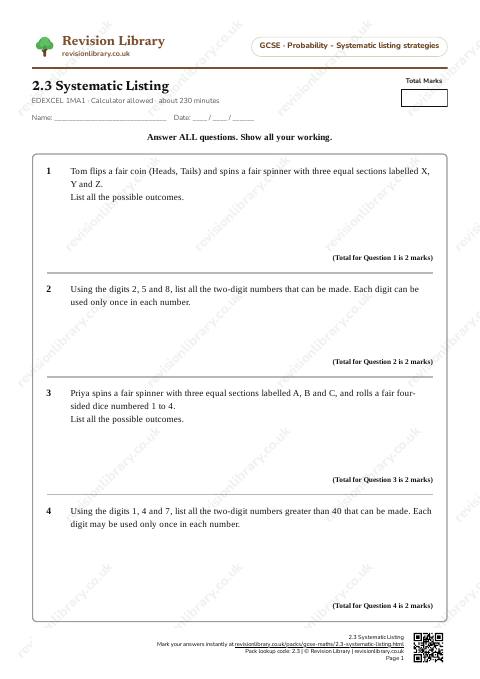
2.3 Systematic Listing
EDEXCEL 1MA1 · Calculator allowed · about 230 minutes
Tom flips a fair coin (Heads, Tails) and spins a fair spinner with three equal sections labelled X, Y and Z. List all the possible outcomes.
(Total for Question 1 is 2 marks)
2
Using the digits 2, 5 and 8, list all the two-digit numbers that can be made. Each digit can be used only once in each number.
(Total for Question 2 is 2 marks)
3
Priya spins a fair spinner with three equal sections labelled A, B and C, and rolls a fair four-sided dice numbered 1 to 4. List all the possible outcomes.
(Total for Question 3 is 2 marks)
4
Using the digits 1, 4 and 7, list all the two-digit numbers greater than 40 that can be made. Each digit may be used only once in each number.
(Total for Question 4 is 2 marks)
5
Erin lists the possible starter-and-main combinations at a cafe, where a customer chooses 1 of 2 starters (soup, salad) and 1 of 3 mains (pasta, curry, fish), as: soup+pasta, soup+curry, salad+pasta, salad+fish. Give one reason why Erin's list is not a correct systematic list of all the possible combinations.
(Total for Question 5 is 1 mark)
6
A shop sells shirts in red or blue and trousers in black or grey. List all possible outfits that consist of one shirt and one pair of trousers.
(Total for Question 6 is 2 marks)
7
How many different 2-letter arrangements are there using the letters A, B and C if no letter is used more than once?
(Total for Question 7 is 1 mark)
8
A cafe lunch deal lets you choose one sandwich from 4 types (cheese, ham, tuna, egg) and one drink from 3 types (water, juice, tea). Work out how many different lunch deals are possible.
(Total for Question 8 is 1 mark)
9
A sandwich shop makes rolls using one type of bread (white or brown) and one filling (cheese, ham or tuna).
(a)List all the different rolls that could be made.(2)
(b)Write down the total number of different rolls possible.(1)
(Total for Question 9 is 3 marks)
10
Two fair spinners, each with sections numbered 1, 2, 3 and 4, are spun. The two numbers are added together to give a total.
(a)Complete the sample space diagram to show all 16 possible totals.(2)
(b)Use your diagram to find the probability that the total is 5.(2)
(Total for Question 10 is 4 marks)
11
A locker code uses 2 different digits chosen from 1, 2, 3 and 4. No digit is repeated in a code.
(a)List all the possible codes.(2)
(b)Write down the total number of different codes possible.(1)
(Total for Question 11 is 3 marks)
12
A cafe sells sandwiches with a choice of 2 types of bread (white, brown) and 4 types of filling (cheese, ham, egg, tuna). A table showing some of the possible combinations has been started below, but is not yet complete.
(a)Complete the table to show all 8 possible bread-and-filling combinations.(2)
(b)Write down the total number of different sandwiches possible.(1)
(Total for Question 12 is 3 marks)
13
A charity bake sale sells cupcakes in 2 flavours (vanilla, chocolate) and 2 icing colours (pink, white).
(a)List all the different flavour-and-icing combinations that could be made.(2)
(b)Write down the total number of different cupcakes possible.(1)
(Total for Question 13 is 3 marks)
14
Two fair spinners are spun together. Spinner P has three equal sections numbered 1, 2 and 3. Spinner Q has three equal sections numbered 2, 4 and 6. The two numbers shown are multiplied together to give a score.
(a)Complete the sample space diagram to show all 9 possible scores.(2)
(b)Use your diagram to find the probability that the score is greater than 10.(2)
(Total for Question 14 is 4 marks)
15
A padlock uses a 2-letter code chosen from the letters V, W, X, Y and Z. No letter is repeated in a code.
(a)List all the possible codes.(2)
(b)Write down the total number of different codes possible.(1)
(Total for Question 15 is 3 marks)
16
A phone case shop sells cases in 4 colours (black, white, red, blue) and 2 finishes (matte, glossy). A customer buys one case.
(a)List all the different colour-and-finish combinations possible.(2)
(b)Nadia says you do not need to list every combination to find the total number possible. Use multiplication to work out the total number of combinations.(2)
(Total for Question 16 is 4 marks)
17
A cafe sells jacket potatoes with a choice of 3 fillings (cheese, beans, tuna) and 2 sizes (regular, large). A table showing some of the possible combinations has been started below, but is not yet complete.
(a)Complete the table to show all 6 possible size-and-filling combinations.(2)
(b)Write down the total number of different jacket potatoes possible.(1)
(Total for Question 17 is 3 marks)
18
List all the 2-letter arrangements from the letters A, B and C if no letter is used more than once.
(Total for Question 18 is 2 marks)
19
A fair coin is flipped and then a spinner showing the numbers 1, 2, 3 and 4 is spun. Work out the number of possible outcomes in which the spinner shows an even number.
(Total for Question 19 is 2 marks)
20
A vending machine sells a hot drink: first you choose Tea or Coffee, then you choose Whole milk, Semi-skimmed milk or None. Part of the tree diagram is shown: the Tea branch splits into three further branches (Whole, Semi-skimmed, None), but the branches after Coffee are missing.
(a)Copy and complete the tree diagram by adding the three missing branches after Coffee, labelled correctly.(1)
(b)Use the completed tree diagram to work out the total number of different drink orders possible.(1)
(Total for Question 20 is 2 marks)
21
Four charity bake-sale items, a flapjack, a brownie, a cookie and a muffin, are to be arranged in a row on a shelf. Work out how many different arrangements are possible.
(Total for Question 21 is 2 marks)
22
A school ID badge shows one shape chosen from circle, square, triangle and star, together with one colour chosen from red, green and blue. Work out how many different badges can be made in which the shape is not a star.
(Total for Question 22 is 2 marks)
23
Aisha, Ben and Chidi stand in a line to have their photograph taken. List all the different possible orders in which the three friends can stand, and write down the total number of arrangements.
(Total for Question 23 is 3 marks)
24
A dessert cart sells ice cream in 4 flavours and 3 toppings. A customer chooses one flavour and one topping. Without listing them, work out the total number of different one-scoop, one-topping ice creams possible.
(Total for Question 24 is 2 marks)
25
A restaurant's set menu offers a choice of 3 starters, 4 main courses and 2 desserts. A customer chooses one of each course. Work out the total number of different three-course meals possible.
(Total for Question 25 is 2 marks)
26
A fencing company offers fence panels in 3 styles (lattice, picket, plain) and paint in 2 colours (green, brown). A customer chooses one style and one colour.
(a)List, or draw a table to show, all the different style-and-colour combinations possible.(2)
(b)A combination is chosen at random from all the possibilities in part (a). Find the probability that it is the picket style painted brown.(2)
(Total for Question 26 is 4 marks)
27
A padlock code is made from 3 digits. Each digit is chosen from 0 to 9 and digits may be repeated. Work out the total number of different codes possible.
(Total for Question 27 is 2 marks)
28
A cafe offers 5 different toppings. A customer chooses 2 different ones. The order does not matter. How many different choices are there?
(Total for Question 28 is 3 marks)
29
A shop sells 4 different tops, 3 different pairs of trousers and 3 pairs of shoes. An outfit has one top, one pair of trousers and one pair of shoes. How many different outfits are possible?
(Total for Question 29 is 2 marks)
30
Coins of the following values are available: 1p, 5p, 10p. Any coin can be used as many times as you like. Work out the number of different ways to make exactly 16p.
(Total for Question 30 is 3 marks)
31
Here are 3 digit cards: 4, 6, 9. Use the cards to make 3-digit numbers. Each digit can be used once only. How many different 3-digit numbers can be made?
(Total for Question 31 is 2 marks)
32
A cafe offers 5 different flavours of ice cream. A customer chooses 2 different ones. The order does not matter. How many different choices are there?
(Total for Question 32 is 3 marks)
33
Coins of the following values are available: 1p, 5p, 10p, 20p. Any coin can be used as many times as you like. Work out the number of different ways to make exactly 24p.
(Total for Question 33 is 3 marks)
34
Here are 3 digit cards: 3, 6, 7. Use the cards to make 3-digit numbers. Digits may be used more than once. How many different 3-digit numbers can be made?
(Total for Question 34 is 2 marks)
35
A shop sells 4 different tops, 2 different pairs of trousers. An outfit has one top, one pair of trousers. How many different outfits are possible?
(Total for Question 35 is 2 marks)
36
A cafe offers 6 different toppings. A customer chooses 2 different ones. The order does not matter. How many different choices are there?
(Total for Question 36 is 3 marks)
37
A shop sells 5 different tops, 4 different pairs of trousers. An outfit has one top, one pair of trousers. How many different outfits are possible?
(Total for Question 37 is 2 marks)
38
Here are 3 digit cards: 6, 7, 8. Use the cards to make 2-digit numbers. Digits may be used more than once. How many different 2-digit numbers can be made?
(Total for Question 38 is 2 marks)
39
A cafe offers 7 different colours of paint. A customer chooses 3 different ones. The order does not matter. How many different choices are there?
(Total for Question 39 is 3 marks)
40
Here are 3 digit cards: 3, 6, 9. Use the cards to make 2-digit numbers. Each digit can be used once only. How many different 2-digit numbers can be made?
(Total for Question 40 is 2 marks)
41
A shop sells 4 different tops, 5 different pairs of trousers and 3 pairs of shoes. An outfit has one top, one pair of trousers and one pair of shoes. How many different outfits are possible?
(Total for Question 41 is 2 marks)
42
A cafe offers 5 different fruits. A customer chooses 2 different ones. The order does not matter. How many different choices are there?
(Total for Question 42 is 3 marks)
43
Here are 3 digit cards: 2, 6, 8. Use the cards to make 3-digit numbers. Digits may be used more than once. How many different 3-digit numbers can be made?
(Total for Question 43 is 2 marks)
44
A furniture shop sells armchairs in 5 different fabrics and 3 different colours. A customer chooses one fabric and one colour. Without listing them, work out the total number of different armchairs possible.
(Total for Question 44 is 2 marks)
45
A voucher code uses 3 characters, each chosen from the letters A, B and C. A letter may be used more than once in a code. Work out the total number of different voucher codes possible.
(Total for Question 45 is 2 marks)
46
A garden centre sells plant pots in 4 sizes (small, medium, large, extra-large) and 3 colours (terracotta, grey, white).
(a)List all the different size-and-colour combinations possible.(2)
(b)A pot is chosen at random from all the possibilities in part (a). Find the probability that it is a large, grey pot.(2)
(Total for Question 46 is 4 marks)
47
A box contains 4 counters, numbered 1, 2, 3 and 4. Two counters are drawn from the box one after another, without replacement, and the two numbers are added together to give a total.
(a)List all the possible pairs of counters that could be drawn, showing which counter is drawn first each time.(2)
(b)Use your list to find the probability that the total of the two counters drawn is 5.(2)
(Total for Question 47 is 4 marks)
48
A sticker book lets a child choose 1 of 6 animal stickers and 1 of 4 sticker borders. Work out the total number of different animal-and-border stickers possible.
(Total for Question 48 is 2 marks)
49
From five people, a president and a secretary are to be chosen. How many different ways can this be done?
(Total for Question 49 is 2 marks)
50
Olivia chooses two different fruits from apple, banana, cherry and date to make a smoothie. Order does not matter. How many choices are there?
(Total for Question 50 is 2 marks)
51
List all ordered pairs of numbers shown on two six-sided dice that add to 7.
(Total for Question 51 is 3 marks)
52
A padlock code is made from 3 digits, each chosen from 0 to 9. Digits may be repeated. Work out how many different codes are possible.
(Total for Question 52 is 2 marks)
53
Nadia wants to make exactly 30p using only 20p, 10p and 5p coins. She may use more than one of each coin, or none of some of them. List all the different ways she could make exactly 30p, showing the number of each coin used each time.
(Total for Question 53 is 3 marks)
54
A computer password is 3 letters long, using 3 different letters chosen from the 5 letters A, B, C, D and E. The order of the letters matters and no letter is repeated. Without listing them, work out the total number of different passwords possible.
(Total for Question 54 is 2 marks)
55
A meal deal lets a customer choose 1 of 3 breads, 1 of 4 fillings and 1 of 2 sauces. The chilli sauce cannot be chosen together with the tuna filling. Work out the total number of different meal deals possible.
(Total for Question 55 is 3 marks)
56
Yusuf wants to make exactly 45p using only 20p, 10p and 5p coins. He may use more than one of each coin, or none of some of them. List all the different ways he could make exactly 45p, showing the number of each coin used each time.
(Total for Question 56 is 3 marks)
57
A gate code is 4 digits long, using 4 different digits chosen from 1, 2, 3, 4, 5 and 6. The order of the digits matters and no digit is repeated. Without listing them, work out the total number of different gate codes possible.
(Total for Question 57 is 2 marks)
58
A password consists of two different letters chosen from {A, B, C} followed by one digit chosen from {1, 2, 3, 4}. Work out how many passwords are possible.
(Total for Question 58 is 3 marks)
59
Priya chooses two scoops of ice cream from 5 flavours.
(a)If the order of scoops matters (first scoop then second) and the same flavour can be chosen twice, how many ordered pairs of scoops are possible?(2)
(b)If the order of scoops does not matter but the same flavour can be chosen twice (so scoops like strawberry + vanilla and vanilla + strawberry are the same), how many different unordered selections are possible?(2)
(Total for Question 59 is 4 marks)
60
How many different 3-digit codes are possible using the digits 1 to 5 if no digit is repeated within a code?
(Total for Question 60 is 3 marks)
61
How many 4-character codes can be made if each character is chosen from the set {A, B, C, D} and repetition of characters is allowed?
(Total for Question 61 is 2 marks)
62
Using the digits 3, 4, 5 and 7, each digit used at most once within a number, list all the two-digit numbers greater than 40 that can be formed, then state how many there are.
(Total for Question 62 is 2 marks)
63
A sandwich shop lets customers choose 2 fillings for a sandwich from cheese, ham, tuna and egg. The same filling may be chosen twice (a double portion), and the order in which the fillings are chosen does not matter. Work out how many different sandwiches are possible.
(Total for Question 63 is 2 marks)
64
In a school choir competition, gold, silver and bronze medals are awarded in order to 3 of the 8 semi-finalists. Work out how many different ways the three medals could be awarded.
(Total for Question 64 is 2 marks)
65
Ali must select a committee of 3 people from 6 people. How many different committees are possible? (Order of selection does not matter.)
(Total for Question 65 is 2 marks)
66
A cafe lunch deal lets a customer choose one main course from soup, sandwich, salad and jacket potato, and one drink from juice, tea, coffee, water and hot chocolate.
(a)Work out the total number of different lunch deals possible.(1)
(b)Kwame will not choose soup, and will not choose hot chocolate. Work out how many different lunch deals Kwame could choose.(2)
(c)The cafe advertises 'over 15 different lunch deals available'. Using your answer to part (a), determine whether this claim is correct. Give a reason.(1)
(Total for Question 66 is 4 marks)
67
A quiz team of 4 people is to be chosen from a group of 5 women and 3 men, so that the team contains exactly 2 women and 2 men. Work out how many different teams are possible.
(Total for Question 67 is 4 marks)
Mark scheme · 2.3 Systematic Listing
A correct answer earns full marks unless the question asks for working, a method, proof or explanation.
Question 1
systematic list or table shown, at least 4 correct outcomesB1
all 6 outcomes listed with no repeats or omissionsB1
Answer: HX, HY, HZ, TX, TY, TZ (6 outcomes)
Question 2
systematic list shown, at least 4 correct numbersB1
all 6 numbers correct with no repeats or omissions: 25, 28, 52, 58, 82, 85B1
Answer: 25, 28, 52, 58, 82, 85 (6 numbers)
Question 3
systematic list or table shown, at least 8 correct outcomesB1
all 12 outcomes listed with no repeats or omissionsB1
Put this topic and others into one printable pack.
Open the Pack Builder
Worksheets are written for Revision Library and come with a full mark scheme; a few English packs quote an out-of-copyright text, and name it on the page. Exam board names and specification codes say which qualification a pack suits: we are not affiliated with, endorsed by or approved by any exam board, and no past-paper question is reproduced here. Rights queries: hello@revisionlibrary.co.uk