Writing and simplifying a ratio means comparing two or more quantities and reducing them to the smallest whole numbers that keep the same proportion, similar to simplifying a fraction. It is a foundation skill for GCSE ratio and proportion questions, including sharing amounts, recipes and scale drawings.
Write the ratio in the order stated in the question, using a colon between the parts.
If the quantities are in different units, convert them to the same unit before writing the ratio.
Find the highest common factor (HCF) of all parts of the ratio.
Divide every part of the ratio by the HCF to simplify it fully.
To write a ratio in the form 1:n or n:1, divide both parts by whichever part needs to become 1.
Check your simplified ratio cannot be divided any further, since the parts should have no common factor other than 1.
Worked example
Write the ratio 900 ml : 2.4 litres in its simplest form.
Convert 2.4 litres to millilitres: 2.4 x 1000 = 2400 ml.
Write the ratio using matching units: 900 : 2400.
Find the highest common factor of 900 and 2400, which is 300.
Divide both parts by 300: 900/300 = 3 and 2400/300 = 8.
State the final answer: the simplified ratio is 3 : 8.
Revision Library
revisionlibrary.co.uk
GCSE · Ratio, Proportion and Rates of Change
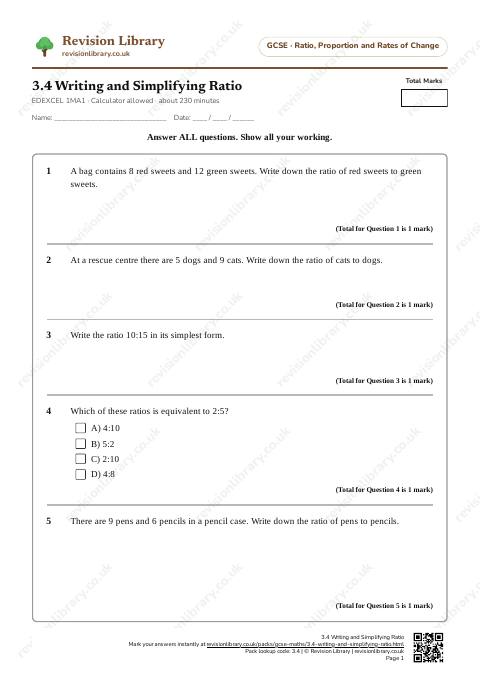
3.4 Writing and Simplifying Ratio
EDEXCEL 1MA1 · Calculator allowed · about 230 minutes
A bag contains 8 red sweets and 12 green sweets. Write down the ratio of red sweets to green sweets.
(Total for Question 1 is 1 mark)
2
At a rescue centre there are 5 dogs and 9 cats. Write down the ratio of cats to dogs.
(Total for Question 2 is 1 mark)
3
Write the ratio 10:15 in its simplest form.
(Total for Question 3 is 1 mark)
4
Which of these ratios is equivalent to 2:5?
A) 4:10
B) 5:2
C) 2:10
D) 4:8
(Total for Question 4 is 1 mark)
5
There are 9 pens and 6 pencils in a pencil case. Write down the ratio of pens to pencils.
(Total for Question 5 is 1 mark)
6
In a car park there are 14 cars and 4 motorbikes. Write down the ratio of motorbikes to cars.
(Total for Question 6 is 1 mark)
7
Share £63 in the ratio 1:2. Work out how much the smaller share is.
(Total for Question 7 is 2 marks)
8
Simplify the ratio 45:60.
(Total for Question 8 is 1 mark)
9
Priya and Noah share 35 stickers in the ratio 3:4. How many stickers does Priya receive?
(Total for Question 9 is 2 marks)
10
Write the ratio 9:36 in the form 1:n.
(Total for Question 10 is 2 marks)
11
Write the ratio 18:8 in the form n:1.
(Total for Question 11 is 2 marks)
12
In Ms Okafor's class there are 30 students. 12 of them are boys. Write the ratio of boys to girls in its simplest form.
(Total for Question 12 is 3 marks)
13
Aisha is baking a cake. Her recipe uses flour, sugar and butter with masses 300 g flour, 150 g sugar and 100 g butter.
(a)Write the ratio flour : sugar : butter in its simplest form.(2)
(b)Aisha decides to make a bigger cake using 900 g of flour, keeping the same ratio. Work out the mass of sugar and the mass of butter she needs.(3)
(Total for Question 13 is 5 marks)
14
In a garden the ratio of flowers to shrubs is 3:7. Write down what fraction of the plants are flowers.
(Total for Question 14 is 2 marks)
15
A rectangular garden bed has length 24 m and width 18 m. Write the ratio of length to width in its simplest form.
(Total for Question 15 is 2 marks)
16
Chidi, Priya and Tom invest £120, £180 and £300 respectively in a business. Write the ratio of their investments, Chidi : Priya : Tom, in its simplest form.
(Total for Question 16 is 3 marks)
17
In a choir there are 15 girls and 18 boys. Write the ratio of girls to all the members in its simplest form.
(Total for Question 17 is 2 marks)
18
Write the ratio 2:81 in the form 1:n.
(Total for Question 18 is 2 marks)
19
Write the ratio 185 minutes to 2.25 hours in its simplest form.
(Total for Question 19 is 3 marks)
20
In a school council there are 27 girls and 23 boys. Write the ratio of girls to all the members in its simplest form.
(Total for Question 20 is 2 marks)
21
Write the ratio 101:4 in the form n:1.
(Total for Question 21 is 2 marks)
22
Write the ratio 9:36:27 in its simplest form.
(Total for Question 22 is 2 marks)
23
Write the ratio 30:6:24 in its simplest form.
(Total for Question 23 is 2 marks)
24
Write the ratio 25:30:40 in its simplest form.
(Total for Question 24 is 2 marks)
25
Write the ratio 1150 g to 3.5 kg in its simplest form.
(Total for Question 25 is 3 marks)
26
Write the ratio 36:36:27 in its simplest form.
(Total for Question 26 is 2 marks)
27
In a school council there are 19 girls and 19 boys. Write the ratio of boys to girls in its simplest form.
(Total for Question 27 is 2 marks)
28
Write the ratio 70:25 in the form n:1.
(Total for Question 28 is 2 marks)
29
Write the ratio 24:3:3 in its simplest form.
(Total for Question 29 is 2 marks)
30
Write the ratio 145 cm to 12.25 m in its simplest form.
(Total for Question 30 is 3 marks)
31
Simplify the ratio 24:36.
(Total for Question 31 is 2 marks)
32
Simplify the ratio 6:9:15 fully.
(Total for Question 32 is 2 marks)
33
Simplify the ratio 40 minutes : 2 hours, giving your answer in its simplest form.
(Total for Question 33 is 3 marks)
34
Simplify the ratio 750 g : 3 kg, giving your answer in its simplest form.
(Total for Question 34 is 3 marks)
35
Nadia has 45p and her sister has £2.25. Simplify the ratio of Nadia's money to her sister's money.
(Total for Question 35 is 3 marks)
36
Write the ratio 16:24 in its simplest form.
(Total for Question 36 is 1 mark)
37
Which of these ratios is equivalent to 3:4?
A) 6:8
B) 4:3
C) 3:8
D) 9:16
(Total for Question 37 is 1 mark)
38
Simplify the ratio 35:14.
(Total for Question 38 is 1 mark)
39
Simplify the ratio 45:60.
(Total for Question 39 is 1 mark)
40
Share £48 in the ratio 5:3.
(a)Find the larger share.(2)
(b)Find the difference between the two shares.(2)
(Total for Question 40 is 4 marks)
41
Red paint and blue paint are mixed in the ratio 3:5. A painter needs 32 litres of the mix. Work out how many litres of red paint and how many litres of blue paint are needed.
(Total for Question 41 is 4 marks)
42
A cake recipe uses flour : sugar : butter = 4 : 3 : 1. The recipe makes 16 cups of mixture in total. Work out how many cups of sugar are needed.
(Total for Question 42 is 3 marks)
43
Simplify the ratio 0.5 : 1.25, giving your answer as a ratio of whole numbers in its simplest form.
(Total for Question 43 is 2 marks)
44
Simplify the ratio 3/4 : 1/2, giving your answer as a ratio of whole numbers in its simplest form.
(Total for Question 44 is 2 marks)
45
Leon mixes paint using 2 litres of white paint, 500 ml of blue paint and 1.5 litres of red paint. Write the ratio white : blue : red in its simplest form.
(Total for Question 45 is 3 marks)
46
Freya is drawing a scale plan of her bedroom.
(a)On the plan, one wall is drawn 8 cm long. The real wall is 20 m long. Find the scale of the drawing, giving your answer in the form 1 : n.(3)
(b)A different wall is drawn 11.4 cm long on the plan. Work out the real length of this wall, giving your answer in metres.(2)
(Total for Question 46 is 5 marks)
47
Simplify the ratio 900 m : 2 km, giving your answer in its simplest form.
(Total for Question 47 is 2 marks)
48
Simplify the ratio 2 hours : 50 minutes, giving your answer in its simplest form.
(Total for Question 48 is 2 marks)
49
Write the ratio 15:45 in the form 1:n.
(Total for Question 49 is 2 marks)
50
A fruit drink is made from concentrate and water in the ratio 1:4. Write down what fraction of the drink is concentrate.
(Total for Question 50 is 1 mark)
51
A fruit bowl contains 8 apples, 6 bananas and 10 oranges. Write the ratio apples : bananas : oranges in its simplest form.
(Total for Question 51 is 2 marks)
52
Simplify the ratio 20:24:32 fully.
(Total for Question 52 is 2 marks)
53
Simplify the ratio 21:28:49 fully.
(Total for Question 53 is 2 marks)
54
Simplify the ratio 60 cm : 1.5 m, giving your answer in its simplest form.
(Total for Question 54 is 2 marks)
55
The numbers of cats, dogs and rabbits at a pet fair are in the ratio 2 : 3 : 5. There are 40 animals in total.
(a)Work out the number of dogs and the number of rabbits.(3)
(b)Work out the number of cats.(1)
(c)Work out the ratio dogs : (cats + rabbits) in its simplest form.(2)
(Total for Question 55 is 6 marks)
56
Write the ratio 45:18 in the form n:1.
(Total for Question 56 is 2 marks)
57
Write the ratio 5:9 in the form 1:n.
(Total for Question 57 is 2 marks)
58
In a choir the ratio of sopranos to altos is 7:5. Write down what fraction of the choir are altos.
(Total for Question 58 is 2 marks)
59
Ravi has £3.60 and his sister has 90p. Write the ratio of Ravi's money to his sister's money in its simplest form.
(Total for Question 59 is 3 marks)
60
A cafe sells squash. In Batch A the squash is diluted with water in the ratio 2:9. A jug from Batch B contains 150 ml of squash and 600 ml of water. Determine, showing your working, whether the jug from Batch B has been diluted in the same ratio as Batch A.
(Total for Question 60 is 3 marks)
61
A recipe uses flour and sugar in the ratio 5:2. Anna wants to make a batch using 800 g of flour. Work out how much sugar she must use.
(Total for Question 61 is 3 marks)
62
Simplify fully: (3x + 6) : (5x + 10).
(Total for Question 62 is 3 marks)
63
A map is drawn using a scale where 4 cm represents 3 km. Write this scale as a ratio in the form 1:n.
(Total for Question 63 is 4 marks)
64
The lengths of three rods are in the ratio 3:4:7. The longest rod is 1.75 m. Work out the lengths of the other two rods. Give your answers in metres.
(Total for Question 64 is 4 marks)
65
A box contains red, green and blue counters in the ratio 2:3:5. There are 10 counters in total. Two counters are taken at random without replacement. Calculate the probability that both counters are blue. Give your answer as a fraction in simplest form.
(Total for Question 65 is 4 marks)
66
At a school, the ratio of Year 10 students to Year 11 students is 4:5. The ratio of Year 11 students to Year 12 students is 3:2. Find the ratio Year 10 : Year 11 : Year 12 in its simplest form.
(Total for Question 66 is 4 marks)
67
A coffee roastery blends Colombian and Kenyan beans. In Batch A the beans are blended in the ratio 7:3 (Colombian : Kenyan). Batch B is made using 630 g of Colombian beans and 260 g of Kenyan beans. Determine, showing your working, whether Batch B has been blended in the same ratio as Batch A.
(Total for Question 67 is 5 marks)
68
Simplify fully: (2x2 - 8) : (x2 + x - 6).
(Total for Question 68 is 4 marks)
69
The ratio a:b is equivalent to 5:8. The ratio b:c is equivalent to 6:11. Given that a, b and c are positive integers and that c - a = 58, find the ratio a : b : c in its simplest form and find the value of b.
(Total for Question 69 is 5 marks)
Mark scheme · 3.4 Writing and Simplifying Ratio
Question 1
8:12 oe (simplifying is not required)B1
Answer: 8:12
Question 2
9:5 oe (order must be cats then dogs)B1
Answer: 9:5
Question 3
2:3 caoB1
Answer: 2:3
Question 4
A caoB1
Answer: A) 4:10
Question 5
9:6 oe (simplifying is not required)B1
Answer: 9:6
Question 6
4:14 oe (order must be motorbikes then cars; simplifying is not required)B1
Answer: 4:14
Question 7
divide 63 by 3 to find one part (63/3 = 21) or equivalent methodM1
£21 caoA1
Answer: £21
Question 8
3:4 caoB1
Answer: 3:4
Question 9
find one part: 35/7 = 5 or equivalentM1
15 caoA1
Answer: 15
Question 10
divide both parts by 9 oeM1
1:4 caoA1
Answer: 1:4
Question 11
divide both parts by 8 oeM1
2.25:1 oe (accept 9/4 : 1)A1
Answer: 2.25:1
Question 12
girls = 30 - 12 = 18 oeM1
form the ratio 12:18M1
2:3 caoA1
Answer: 2:3
Question 13
(a) divide all three masses by a common factor (e.g. 50) oeM1
(a) 6:3:2 caoA1
(a) Answer: 6:3:2
(b) find the scale factor, 900 / 300 = 3 oeM1
(b) multiply the sugar and butter masses by 3 (or use ratio part = 150 g)M1
(b) sugar = 450 g and butter = 300 g caoA1
(b) Answer: sugar = 450 g, butter = 300 g
Question 14
total parts = 3 + 7 = 10 oeM1
3/10 oeA1
Answer: 3/10
Question 15
identify a common factor of 24 and 18 (e.g. 6) oeM1
4:3 caoA1
Answer: 4:3
Question 16
identify a common factor of 120, 180 and 300 (e.g. 60) oeM1
divide all three amounts by the common factorM1
2:3:5 caoA1
Answer: 2:3:5
Question 17
15:33 identifiedM1
5:11 caoA1
Answer: 5:11
Question 18
divides by 2M1
1:40.5 caoA1
Answer: 1:40.5
Question 19
converts to the same unitsM1
185:135M1
37:27 caoA1
Answer: 37:27
Question 20
27:50 identifiedM1
27:50 caoA1
Answer: 27:50
Question 21
divides by 4M1
25.25:1 caoA1
Answer: 25.25:1
Question 22
divides all three terms by a common factor (9)M1
1:4:3A1
Answer: 1:4:3
Question 23
divides all three terms by a common factor (6)M1
5:1:4A1
Answer: 5:1:4
Question 24
divides all three terms by a common factor (5)M1
5:6:8A1
Answer: 5:6:8
Question 25
converts to the same unitsM1
1150:3500M1
23:70 caoA1
Answer: 23:70
Question 26
divides all three terms by a common factor (9)M1
4:4:3A1
Answer: 4:4:3
Question 27
19:19 identifiedM1
1:1 caoA1
Answer: 1:1
Question 28
divides by 25M1
2.8:1 caoA1
Answer: 2.8:1
Question 29
divides all three terms by a common factor (3)M1
8:1:1A1
Answer: 8:1:1
Question 30
converts to the same unitsM1
145:1225M1
29:245 caoA1
Answer: 29:245
Question 31
identify a common factor of 24 and 36 (e.g. divide by 12) oeM1
2:3 caoA1
Answer: 2:3
Question 32
divide all three parts by a common factor (e.g. 3) oeM1
2:3:5 caoA1
Answer: 2:3:5
Question 33
convert 2 hours to 120 minutes oeM1
form the ratio 40:120 (or equivalent) and begin to simplifyM1
1:3 caoA1
Answer: 1:3
Question 34
convert 3 kg to 3000 g oeM1
form the ratio 750:3000 and begin to simplifyM1
1:4 caoA1
Answer: 1:4
Question 35
convert £2.25 to 225p oeM1
form the ratio 45:225 and begin to simplifyM1
1:5 caoA1
Answer: 1:5
Question 36
2:3 caoB1
Answer: 2:3
Question 37
A caoB1
Answer: A) 6:8
Question 38
5:2 caoB1
Answer: 5:2
Question 39
3:4 caoB1
Answer: 3:4
Question 40
(a) find one part: 48/8 = 6 or equivalentM1
(a) £30 caoA1
(a) Answer: £30
(b) find smaller share 3 x 6 = 18 or equivalentM1
(b) £12 caoA1
(b) Answer: £12
Question 41
find one part: 32/(3+5) = 32/8 = 4 or equivalentM1
red = 3 x 4 = 12 litres caoA1
use same one part for blueM1
blue = 5 x 4 = 20 litres caoA1
Answer: red 12 litres, blue 20 litres
Question 42
find total parts 4+3+1 = 8 and divide 16 by 8 to find one part = 2 (or equivalent)M1
3 parts x 2 = 6 caoA1
state units: 6 cups (accept 6 with units implied) oeB1
Answer: 6 cups
Question 43
multiply both parts by a suitable number (e.g. x4 or x100) to remove the decimals oeM1
2:5 caoA1
Answer: 2:5
Question 44
multiply both parts by a common denominator (e.g. x4) oeM1
3:2 caoA1
Answer: 3:2
Question 45
convert all amounts to the same unit, e.g. 2000 ml, 500 ml, 1500 ml oeM1
form the ratio 2000:500:1500 and begin to simplifyM1
4:1:3 caoA1
Answer: 4:1:3
Question 46
(a) convert 20 m to 2000 cm oeM1
(a) form the ratio 8:2000 and simplify (e.g. divide by 8)M1
(a) n = 250, i.e. 1:250 caoA1
(a) Answer: 1:250
(b) 11.4 x 250 (= 2850) oe, ft from part (a)M1
(b) 28.5 m caoA1
(b) Answer: 28.5 m
Question 47
convert 2 km to 2000 m oeM1
9:20 caoA1
Answer: 9:20
Question 48
convert 2 hours to 120 minutes oeM1
12:5 caoA1
Answer: 12:5
Question 49
divide both parts by 15 oeM1
1:3 caoA1
Answer: 1:3
Question 50
1/5 oeB1
Answer: 1/5
Question 51
identify a common factor of 8, 6 and 10 (e.g. 2) oeM1
4:3:5 caoA1
Answer: 4:3:5
Question 52
identify a common factor of 20, 24 and 32 (e.g. divide by 4) oeM1
5:6:8 caoA1
Answer: 5:6:8
Question 53
identify a common factor of 21, 28 and 49 (e.g. divide by 7) oeM1
3:4:7 caoA1
Answer: 3:4:7
Question 54
convert 1.5 m to 150 cm oeM1
2:5 caoA1
Answer: 2:5
Question 55
(a) find total parts 2+3+5 = 10 and one part = 40/10 = 4 (or equivalent)M1
(a) dogs = 3 x 4 = 12 caoA1
(a) rabbits = 5 x 4 = 20 caoA1
(a) Answer: dogs 12, rabbits 20
(b) cats = 2 x 4 = 8 caoB1
(b) Answer: 8
(c) form ratio 12 : (8 + 20) = 12 : 28 or equivalentM1
(c) 3:7 caoA1
(c) Answer: 3:7
Question 56
divide both parts by 18 oeM1
2.5:1 oe (accept 5/2 : 1)A1
Answer: 2.5:1
Question 57
divide both parts by 5 oeM1
1:1.8 oe (accept 1 : 9/5)A1
Answer: 1:1.8
Question 58
total parts = 7+5=12 oeM1
5/12 oeA1
Answer: 5/12
Question 59
convert £3.60 to 360p oeM1
form the ratio 360:90 and begin to simplifyM1
4:1 caoA1
Answer: 4:1
Question 60
scale Batch A's ratio so the squash matches 150 ml, e.g. 2:9 x 75 = 150:675 oeM1
compare 675 ml (water needed for Batch A's ratio) with Batch B's actual 600 ml of waterM1
correct conclusion with valid reason, e.g. 'No - Batch B is not diluted in the same ratio; it needs 675 ml of water to match Batch A but only has 600 ml, so Batch B's squash is more concentrated' oe caoA1
Answer: No - Batch B is not in the same ratio as Batch A (Batch B is more concentrated).
Question 61
find one part: 800 divided by 5 = 160 g (method shown)M1
multiply one part by 2 to find sugar: 160 * 2M1
320 g caoA1
Answer: 320 g
Question 62
factorise 3x+6 = 3(x+2) oeM1
factorise 5x+10 = 5(x+2) oeM1
3:5 caoA1
Answer: 3:5
Question 63
convert 3 km to 300000 cm oeM1
form the ratio 4:300000M1
divide both parts by 4M1
1:75000 caoA1
Answer: 1:75000
Question 64
recognise 7 parts correspond to 1.75 m and set up 1.75/7M1
divide to find one part: 1.75 / 7 = 0.25 mM1
multiply one part to get the other lengths: 3 * 0.25 and 4 * 0.25M1
0.75 m and 1.00 m caoA1
Answer: 0.75 m and 1.00 m
Question 65
use ratio to find total parts = 2 + 3 + 5 = 10, so probability first is blue = 5/10M1
compute probability second is blue after one blue removed = 4/9 and multiply probabilities (5/10)*(4/9)M1
find a common value for the Year 11 parts, e.g. LCM of 5 and 3 = 15 oeM1
scale Year10:Year11 = 4:5 by 3 to get 12:15M1
scale Year11:Year12 = 3:2 by 5 to get 15:10M1
12:15:10 caoA1
Answer: 12:15:10
Question 67
find the scale factor for Batch A's ratio using the Colombian mass, 630/7=90 oeM1
use the scale factor to find the Kenyan mass Batch A's ratio requires, 3x90 oeM1
270 g caoA1
compare 270 g with Batch B's actual 260 g of Kenyan beansM1
correct conclusion with valid reason, e.g. 'No - Batch B is not blended in the same ratio; it has less Kenyan beans (260 g) than the 270 g Batch A's ratio requires, so Batch B is relatively more Colombian' oe caoA1
Answer: No - Batch B is not in the same ratio as Batch A (Batch B has relatively more Colombian beans).
Question 68
factorise the numerator, 2x2-8 = 2(x-2)(x+2) oeM1
factorise the denominator, x2+x-6 = (x+3)(x-2) oeM1
cancel the common factor (x-2)M1
2(x+2):(x+3) oe (accept (2x+4):(x+3)) caoA1
Answer: 2(x+2) : (x+3), i.e. (2x+4):(x+3)
Question 69
find a common value for b, e.g. LCM of 8 and 6 = 24 oeM1
scale both ratios to combine: a:b:c = 15:24:44M1
set up c-a in terms of a scale factor k, e.g. 44k-15k=29k=58M1
Put this topic and others into one printable pack.
Open the Pack Builder
Worksheets are written for Revision Library and come with a full mark scheme; a few English packs quote an out-of-copyright text, and name it on the page. Exam board names and specification codes say which qualification a pack suits: we are not affiliated with, endorsed by or approved by any exam board, and no past-paper question is reproduced here. Rights queries: hello@revisionlibrary.co.uk