Revision Library
Choose a subject
Menu
Geography

GCSE Geography Topic Workbooks · Book 4 of 5

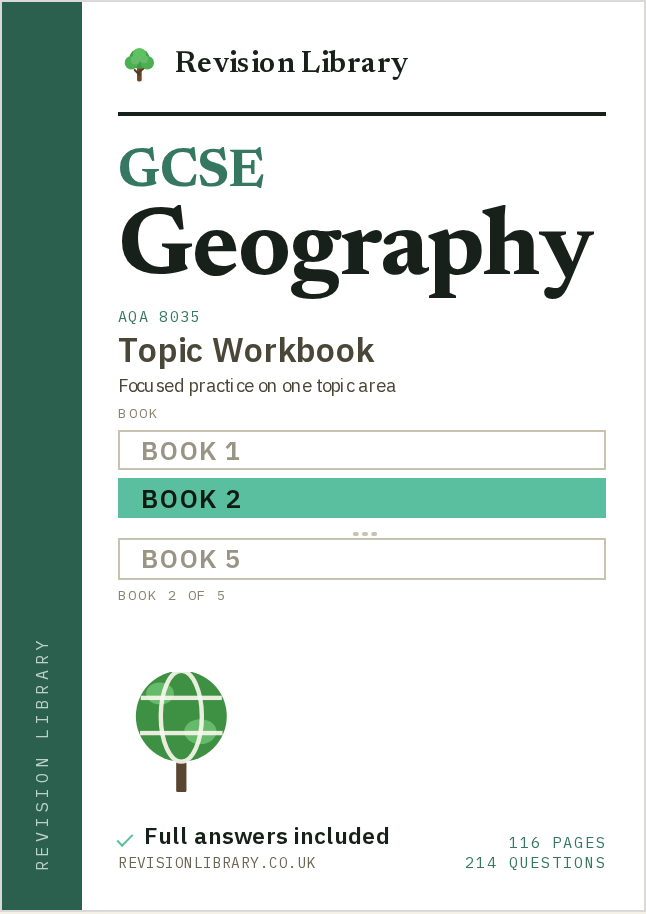
GCSE Geography Topic Workbook 4

Impacts of Food Insecurity: Drought and Famine in the Horn of Africa, UK Food Security: Agribusiness, Food Miles and Sustainable Choices, Food Security: Rising Demand and Factors Affecting Supply and 11 more

Level
GCSE · AQA 8035
Series
GCSE Geography Topic Workbooks, book 4 of 5
Suitable for
Years 10-11, AQA
FreePDF download · 2027 edition · 100 A4 pages
  • One file, prints straight to A4
  • No account, no password

Workbooks like this one, with 14 topics, 185 questions and mark schemes at the back, are usually printed and sold by publishers. This one is one of 558 free PDFs on the shelf.

Pages
100 A4 pages
Chapters
14 worksheet chapters
Questions
185 · 459 marks
Answers
From page 72
Working time
About 9h 10m

What is inside

14 chapters · answers from p72

Each chapter starts with a page showing its marks and a suggested time, followed by the questions. The mark schemes for all 14 chapters are at the back, so the book works for homework, a timed test or revision.

  1. 01Impacts of Food Insecurity: Drought and Famine in the Horn of Africa15 questions · 37 marks · about 45 min Topic guide: Impacts of Food Insecurity: Drought and Famine in the Horn of Africap3
  2. 02UK Food Security: Agribusiness, Food Miles and Sustainable Choices14 questions · 26 marks · about 30 min Topic guide: UK Food Security: Agribusiness, Food Miles and Sustainable Choicesp9
  3. 03Food Security: Rising Demand and Factors Affecting Supply9 questions · 26 marks · about 30 min Topic guide: Food Security: Rising Demand and Factors Affecting Supplyp13
  4. 04Impacts of Food Insecurity: Undernutrition, Unrest and Damage15 questions · 24 marks · about 30 min Topic guide: Impacts of Food Insecurity: Undernutrition, Unrest and Damagep17
  5. 05Strategies to Increase Food Supply: Technology and Sustainability9 questions · 24 marks · about 30 min Topic guide: Strategies to Increase Food Supply: Technology and Sustainabilityp21
  6. 06Food Security Case Study: Almeria's Greenhouse Agriculture14 questions · 28 marks · about 35 min Topic guide: Food Security Case Study: Almeria's Greenhouse Agriculturep25
  7. 07Water Insecurity: Physical and Human Causes of Water Stress16 questions · 49 marks · about 60 min Topic guide: Water Insecurity: Physical and Human Causes of Water Stressp30
  8. 08Impacts of Water Insecurity and Conflict Over Shared Rivers15 questions · 42 marks · about 50 min Topic guide: Impacts of Water Insecurity and Conflict Over Shared Riversp36
  9. 09Increasing Water Supply: Large-Scale Engineering Schemes15 questions · 39 marks · about 45 min Topic guide: Increasing Water Supply: Large-Scale Engineering Schemesp41
  10. 10Sustainable and Small-Scale Water Supply Solutions15 questions · 35 marks · about 40 min Topic guide: Sustainable and Small-Scale Water Supply Solutionsp46
  11. 11Water Security: Rising Demand and Factors Affecting Supply9 questions · 24 marks · about 30 min Topic guide: Water Security: Rising Demand and Factors Affecting Supplyp51
  12. 12Impacts of Water Insecurity: Disease, Pollution and Conflict9 questions · 24 marks · about 30 min Topic guide: Impacts of Water Insecurity: Disease, Pollution and Conflictp55
  13. 13Strategies to Increase Water Supply: Transfer, Dams and Local Schemes15 questions · 39 marks · about 45 min Topic guide: Strategies to Increase Water Supply: Transfer, Dams and Local Schemesp59
  14. 14Energy Insecurity: Causes of Growing Energy Demand and Supply Issues15 questions · 42 marks · about 50 min Topic guide: Energy Insecurity: Causes of Growing Energy Demand and Supply Issuesp64
  15. AnswersMark schemes for every chapterp72

Each chapter is drawn from one of our worksheet packs. Follow a chapter title for the full pack on its own page, or browse every GCSE Geography pack. Every book on the shelf is a complete printable workbook of up to 120 A4 pages.

Explore this volume

GCSE Geography Topic Workbook 4 includes Impacts of Food Insecurity: Drought and Famine in the Horn of Africa (from page 3); UK Food Security: Agribusiness, Food Miles and Sustainable Choices (from page 9); Food Security: Rising Demand and Factors Affecting Supply (from page 13); Impacts of Food Insecurity: Undernutrition, Unrest and Damage (from page 17); Strategies to Increase Food Supply: Technology and Sustainability (from page 21); Food Security Case Study: Almeria's Greenhouse Agriculture (from page 25); Water Insecurity: Physical and Human Causes of Water Stress (from page 30); Impacts of Water Insecurity and Conflict Over Shared Rivers (from page 36); Increasing Water Supply: Large-Scale Engineering Schemes (from page 41); Sustainable and Small-Scale Water Supply Solutions (from page 46); Water Security: Rising Demand and Factors Affecting Supply (from page 51); Impacts of Water Insecurity: Disease, Pollution and Conflict (from page 55); Strategies to Increase Water Supply: Transfer, Dams and Local Schemes (from page 59); Energy Insecurity: Causes of Growing Energy Demand and Supply Issues (from page 64).

Worked question 15 - Impacts of Water Insecurity and Conflict Over Shared Rivers

Open the included worksheet

The next two questions focus on the Nile basin dispute involving Egypt, Ethiopia and Sudan and the Grand Ethiopian Renaissance Dam (GERD). Use named country facts in your answers. Describe THREE political concerns Egypt has about the GERD upstream in Ethiopia.

Answer and mark scheme

Question 15

CreditAnswer or working
B1concern 1, e.g. reduced Nile flow affecting Egypt's water supply for population and irrigation, oe
B1linked detail, e.g. Egypt relies on the Nile for over 90% of its freshwater needs historically, oe
B1concern 2, e.g. control over timing and volume of releases from GERD affecting downstream agriculture and power generation in Sudan and Egypt, oe
B1linked detail, e.g. sudden releases or prolonged filling periods could damage crops or reservoirs downstream, oe
B1concern 3, e.g. long-term changes to sediment flow and river ecology that could harm agriculture and fisheries in Egypt, oe
B1linked detail, e.g. sediment trapped by a large dam reduces nutrient-rich silt reaching downstream floodplain soils, oe
  • Answer: Egypt is concerned that GERD could reduce Nile flow affecting its water supply for people and irrigation (Egypt historically relies on the Nile for the vast majority of its freshwater); it is also concerned that control over timing and volume of releases could harm downstream agriculture and power generation in Sudan and Egypt, and that the dam could trap sediment, changing river ecology and reducing nutrient-rich silt reaching downstream soils.
Question 4 - Impacts of Water Insecurity and Conflict Over Shared Rivers

Open the included worksheet

Explain FIVE reasons why disputes over shared rivers like the Nile can escalate into interstate tension or conflict.

Answer and mark scheme

Question 4

CreditAnswer or working
B1resource scarcity creates strong national interest, e.g. water is essential for drinking and irrigation, increasing stakes and willingness to act, oe
B1asymmetric power and dependency, e.g. downstream countries may be much more dependent on the river so feel existentially threatened by upstream development, oe
B1lack of effective legal agreements or mistrust, e.g. absence of a binding treaty on water sharing increases uncertainty and competition, oe
B1political leaders may use water disputes to gain domestic support or distract from internal problems, raising rhetoric and tension, oe
B1inability to resolve technical issues like filling schedules and drought management can lead to repeated crises and brinkmanship, oe
  • Answer: Disputes escalate because water scarcity raises the national stakes and willingness to act; asymmetric dependency makes downstream states feel existentially threatened by upstream projects; the absence of binding agreements and mistrust increases uncertainty and competition; political leaders may use the dispute to gain domestic support, raising rhetoric; and inability to agree on technical issues like filling schedules can lead to repeated crises and brinkmanship.

Question 13 - Impacts of Water Insecurity and Conflict Over Shared Rivers

Open the included worksheet

Explain ONE way that water insecurity can increase household expenditure and reduce disposable income in a small town that relies on a river.

Answer and mark scheme

Question 13

CreditAnswer or working
B1households may need to buy bottled or tanker-supplied water when river supplies are unsafe or unreliable, oe
B1this increases regular household spending, leaving less money for food, education or health, oe
B1linked example or consequence, e.g. poorer families become more vulnerable economically and socially, oe
  • Answer: Households may have to buy bottled or tanker-supplied water when river supplies are unsafe or unreliable; this raises regular spending, leaving less money for food, education or health, which increases economic vulnerability.

Question 15 - Energy Insecurity: Causes of Growing Energy Demand and Supply Issues

Open the included worksheet

Explain TWO ways in which the high cost and technical difficulty of extracting new fossil fuel reserves can contribute to higher global energy prices.

Answer and mark scheme

Question 15

CreditAnswer or working
B1point 1 stated, e.g. expensive extraction increases production costs, oe
B1linked development, e.g. companies pass higher production costs to consumers through higher prices, oe
B1point 2 stated, e.g. technical difficulty reduces supply growth, oe
B1linked development, e.g. if supply cannot expand to meet rising demand, competition for available energy raises prices, oe
B1additional linked point or example, e.g. capital-intensive projects require long lead times and risk premiums, which investors recoup via higher prices, oe
  • Answer: Expensive extraction raises production costs, which suppliers pass on to consumers so prices rise. Technical difficulty and long lead times mean supply cannot quickly expand to match demand, so competition for limited supply pushes prices up; capital-intensive projects also require risk premiums that feed into higher final prices.

Question 8 - Energy Insecurity: Causes of Growing Energy Demand and Supply Issues

Open the included worksheet

Table 1 shows hypothetical world energy consumption by source in million tonnes of oil equivalent (Mtoe) for selected years. These figures are illustrative and not real statistics.
Source199020052020
Coal250032003600
Oil300034003300
Natural gas180024003100
Nuclear600700800
Renewables2004001200
(a)Using Table 1, state which single energy source showed the largest absolute increase in consumption between 1990 and 2020.(1)
(b)Calculate the absolute change in coal consumption between 1990 and 2020 using the table. Show your working.(2)
(c)Describe the pattern of change in renewable energy consumption shown in Table 1 between 1990 and 2020.(3)
(d)Suggest ONE reason, linked to technology or policy, that could explain the rapid rise in renewables between 2005 and 2020.(2)

Answer and mark scheme

Question 8

CreditAnswer or working
B1(a) natural gas
M1(b) 3600 - 2500 or equivalent calculation seen, oe
A1(b) 1100 Mtoe cao
B1(c) renewable consumption increased overall from 200 Mtoe in 1990 to 1200 Mtoe in 2020, oe
B1(c) increase accelerated after 2005 (from 400 Mtoe in 2005 to 1200 Mtoe in 2020), oe
B1(c) this shows rapid growth in renewables, particularly in the most recent period, oe
B1(d) e.g. improvements and cost reductions in renewable technologies such as wind turbines and solar panels, oe
B1(d) linked detail, e.g. government subsidies or renewable energy targets encouraging investment and deployment, oe
  • (a) Answer: Natural gas.
  • (b) Answer: 1100 Mtoe.
  • (c) Answer: Renewable energy consumption rose from 200 Mtoe in 1990 to 1200 Mtoe in 2020, with faster growth after 2005 (400 Mtoe to 1200 Mtoe), indicating rapid recent expansion of renewables.
  • (d) Answer: Improvements and cost reductions in renewable technologies such as wind turbines and solar panels, often combined with government subsidies or targets that encouraged investment and deployment.

Question 8 - Impacts of Water Insecurity: Disease, Pollution and Conflict

Open the included worksheet

Describe two social impacts on communities of long-term freshwater pollution from sewage and industrial waste, context: a mid-sized inland town relying on the river for bathing, washing and local food.

Answer and mark scheme

Question 8

CreditAnswer or working
B1first social impact identified, e.g. increased illness among residents who use the river for washing or bathing
B1linked detail for first impact, e.g. recurring illnesses reduce quality of life and can place a burden on family carers and local health services
B1second social impact identified, e.g. loss of cultural or recreational use of the river, such as loss of swimming spots or festivals
B1linked detail for second impact, e.g. this damages community cohesion and local traditions and can reduce mental wellbeing
  • Answer: For example, polluted river water causes recurring illnesses among people who bathe or wash in it, reducing quality of life and increasing pressure on carers and health services; and pollution can end cultural and recreational uses of the river, such as swimming and local festivals, harming community cohesion and mental wellbeing.

Question 7 - Impacts of Water Insecurity: Disease, Pollution and Conflict

Open the included worksheet

Explain one economic impact on local businesses when a coastal resort is affected by river pollution that discolours water and creates odour, context: small seaside town dependent on day-trip tourism.

Answer and mark scheme

Question 7

CreditAnswer or working
B1identification of economic impact, e.g. drop in visitor numbers or cancellations
B1linked explanation, e.g. fewer tourists reduce revenue for hotels, cafes and shops, leading to loss of income and potential job losses in the local economy
  • Answer: A visible and smelly polluted river deters visitors, causing a drop in day-trip tourists; this reduces revenue for cafes, shops and boat operators and can lead to staff being laid off and lower local income.

GCSE Geography Topic Workbooks runs to 5 volumes

Book 4 of 5 · 513 pages in the set

Each book is a separate free PDF.

Volume 1

98 pp · 151 Qs

Natural Hazards and Hazard Risk, Weather Hazards, Climate Change and 9 more

Volume 2

116 pp · 214 Qs

Tropical Rainforests: Causes and Impacts of Deforestation, Tropical Rainforests: Sustainable Management Strategies, Hot Desert Characteristics, Adaptations and Opportunities for Development and 13 more

Volume 3

98 pp · 176 Qs

Urban Regeneration and Rebranding in Bristol, Urban Sustainability and Reducing Cities' Environmental Impact, Urban Issues: A City in a Newly Emerging Economy (NEE) Case Study and 10 more

Volume 4 · this book

100 pp · 185 Qs

Impacts of Food Insecurity: Drought and Famine in the Horn of Africa, UK Food Security: Agribusiness, Food Miles and Sustainable Choices, Food Security: Rising Demand and Factors Affecting Supply and 11 more

Volume 5

101 pp · 190 Qs

Impacts of Energy Insecurity and Large-Scale Strategies to Increase Supply, Sustainable Energy Use and Local Renewable Schemes, Energy Security: Changing Demand and Factors Affecting Supply and 10 more

More GCSE books

GCSE Geography Essentials 1

33 topics · 268 Qs

The challenge of natural hazards, The living world, Physical landscapes in the UK, Urban issues and challenges, The changing economic world, The challenge of resource management

Want a different mix of topics?

Sitting an exam soon? Build a GCSE Geography mock paper or print a ready-made one.