Revision Library
Choose a subject
Menu

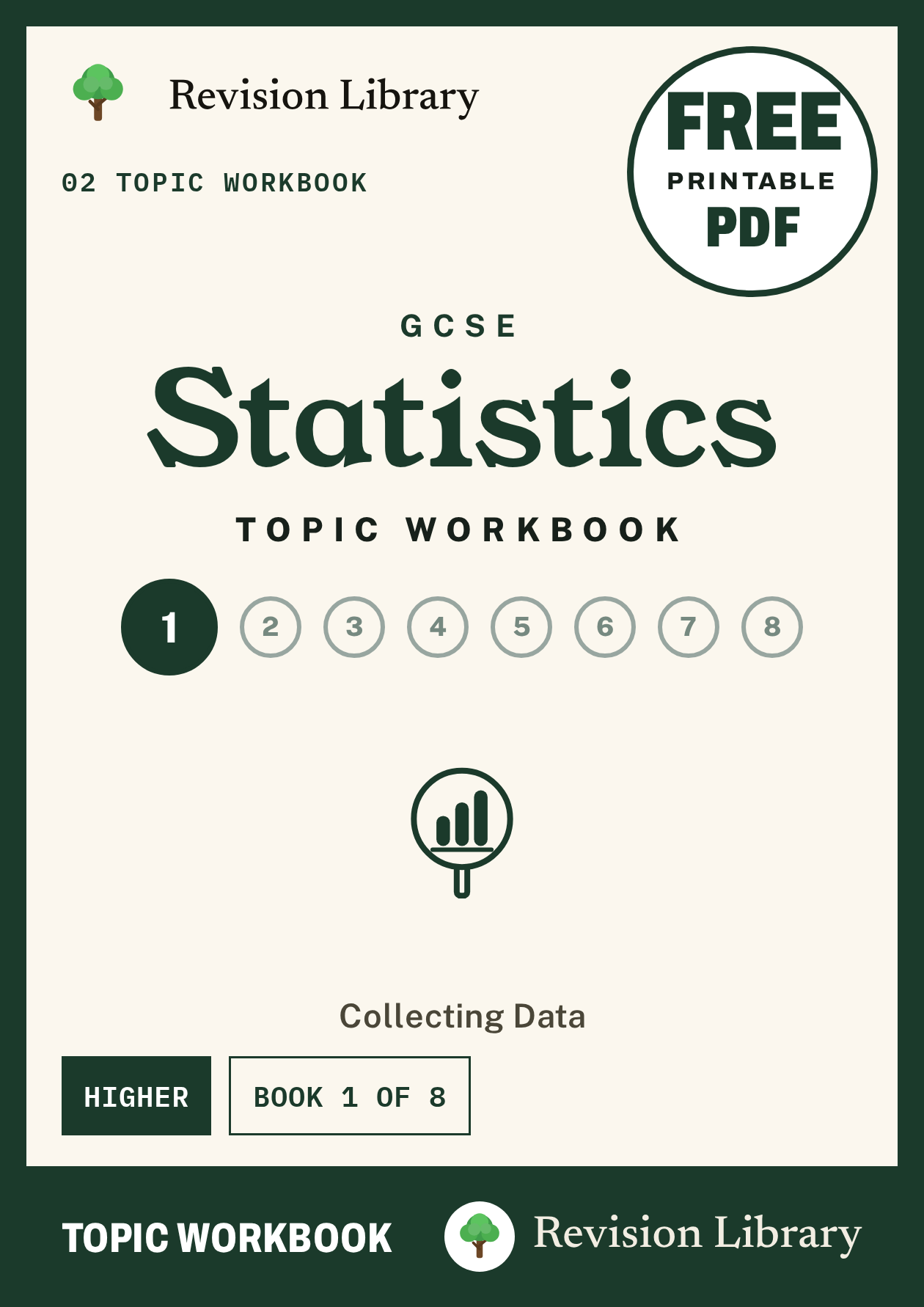
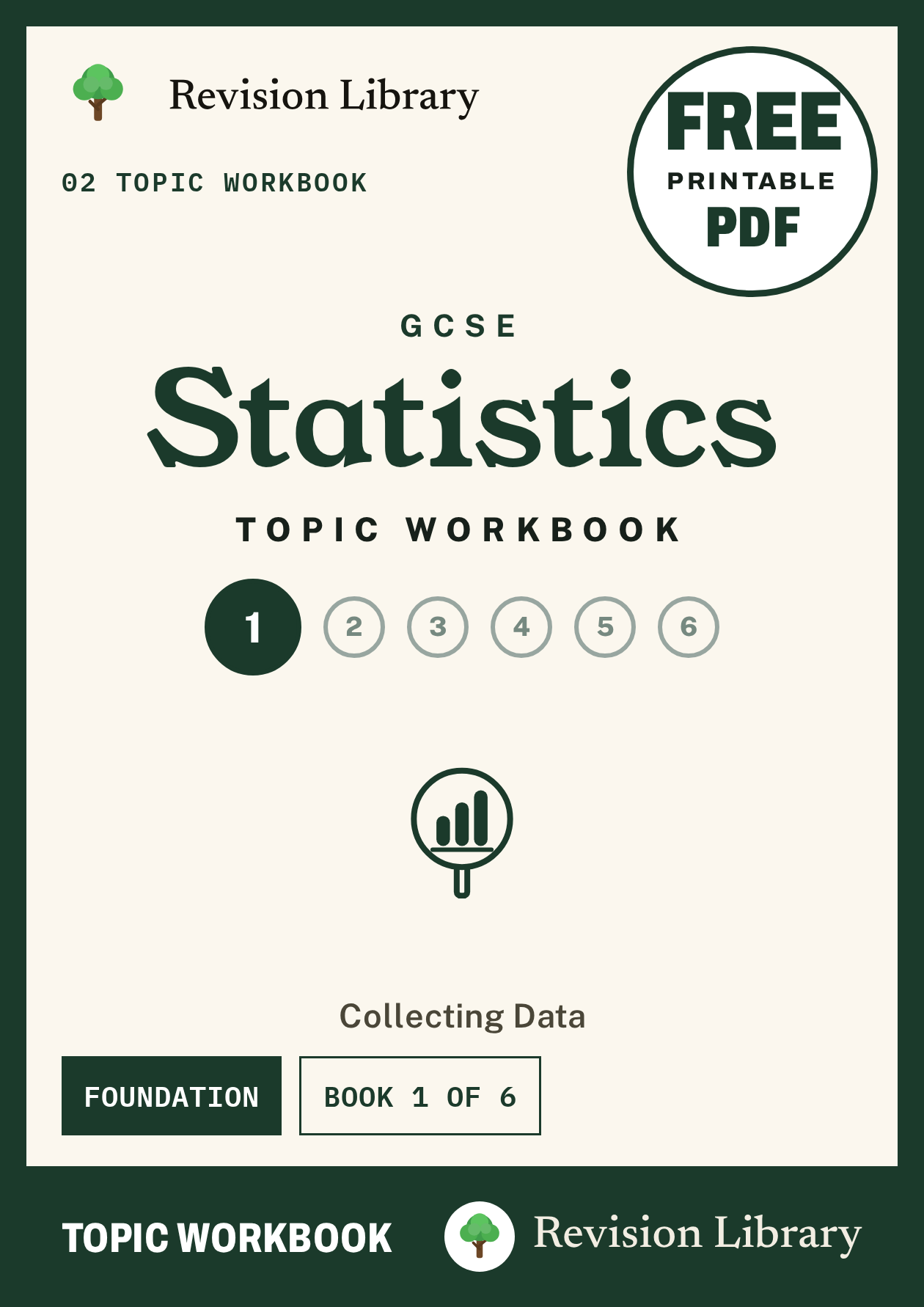
GCSE Statistics Foundation Topic Workbooks · Book 1 of 6

GCSE Statistics Foundation Topic Workbook 1

Data Cleaning and Outliers (Foundation), Estimating from Samples (Foundation), Stratified Sampling (Foundation) and 5 more

Level
GCSE Foundation · Edexcel 1ST0
Series
GCSE Statistics Foundation Topic Workbooks, book 1 of 6
Suitable for
Years 10-11, Edexcel
FreePDF download · 2027 edition · 98 A4 pages
  • One file, prints straight to A4
  • No account, no password

Workbooks like this one, with 8 topics, 110 questions and mark schemes at the back, are usually printed and sold by publishers. This one is one of 558 free PDFs on the shelf.

Pages
98 A4 pages
Chapters
8 worksheet chapters
Questions
110 · 471 marks
Answers
From page 82
Working time
About 8h 10m

What is inside

8 chapters · answers from p82

Each chapter starts with a page showing its marks and a suggested time, followed by the questions. The mark schemes for all 8 chapters are at the back, so the book works for homework, a timed test or revision.

  1. 01Data Cleaning and Outliers (Foundation)12 questions · 53 marks · about 55 min Topic guide: Data Cleaning and Outliers (Foundation)p3
  2. 02Estimating from Samples (Foundation)13 questions · 57 marks · about 60 min Topic guide: Estimating from Samples (Foundation)p13
  3. 03Stratified Sampling (Foundation)12 questions · 60 marks · about 65 min Topic guide: Stratified Sampling (Foundation)p22
  4. 04Pilot Surveys (Foundation)14 questions · 45 marks · about 45 min Topic guide: Pilot Surveys (Foundation)p33
  5. 05The Statistical Enquiry Cycle16 questions · 49 marks · about 50 min Topic guide: The Statistical Enquiry Cyclep40
  6. 06Types of Data17 questions · 94 marks · about 100 min Topic guide: Types of Datap47
  7. 07Sampling Methods14 questions · 63 marks · about 65 min Topic guide: Sampling Methodsp62
  8. 08Collecting Data12 questions · 50 marks · about 50 min Topic guide: Collecting Datap73
  9. AnswersMark schemes for every chapterp82

Each chapter is drawn from one of our worksheet packs. Follow a chapter title for the full pack on its own page, or browse every GCSE Statistics pack. Every book on the shelf is a complete printable workbook of up to 120 A4 pages.

Explore this volume

GCSE Statistics Foundation Topic Workbook 1 includes Data Cleaning and Outliers (Foundation) (from page 3); Estimating from Samples (Foundation) (from page 13); Stratified Sampling (Foundation) (from page 22); Pilot Surveys (Foundation) (from page 33); The Statistical Enquiry Cycle (from page 40); Types of Data (from page 47); Sampling Methods (from page 62); Collecting Data (from page 73).

Worked question 16 - The Statistical Enquiry Cycle

Open the included worksheet

A gym chain wants to know whether offering a free fitness app to members increases how often they visit the gym. It gives the app to 30 members at one branch for a month, and finds their average number of visits rises from 4 to 7 per month. The gym manager concludes: "Giving every member the app will increase gym visits nationwide, and no further research is needed."

Evaluate the manager's conclusion, and explain what the gym should do next in the statistical enquiry cycle.

Answer and mark scheme

Question 16

CreditAnswer or working
B1identifies that the manager's conclusion is not fully justified, e.g. one branch's 30 members is a small, potentially unrepresentative sample of all members nationwide
B1recommends returning to the plan stage to design a larger-scale/randomised trial across multiple branches before rolling the app out nationwide, oe
B1recognises the enquiry cycle should continue/repeat rather than stop, e.g. results should be interpreted again after a wider trial to check the increase holds nationally, oe
  • Answer: The manager's conclusion goes too far: 30 members at one branch is a small sample and may not represent all members nationwide. The gym should return to the plan stage and trial the app across a larger, more representative sample of branches, then collect, process and interpret those results again before deciding whether to roll it out to everyone, rather than stopping the enquiry cycle after just one trial.
Question 13 - The Statistical Enquiry Cycle

Open the included worksheet

A council wants to investigate how satisfied residents are with a new recycling scheme. It considers two methods:

Method 1: a postal questionnaire sent to a random sample of 500 households across the town.
Method 2: interviewing 50 people at the local recycling centre.
(a)Give one advantage of Method 1 over Method 2.(1)
(b)Give one advantage of Method 2 over Method 1.(1)
(c)The council wants a conclusion that applies fairly to all residents of the town. State which method is more suitable, and explain why, referring to the plan and collect stages of the enquiry cycle.(2)

Answer and mark scheme

Question 13

CreditAnswer or working
B1(a) a random sample of households is more representative of all residents than only people who already visit the recycling centre, oe
B1(b) a valid advantage of interviews, e.g. face-to-face interviews usually get a higher response rate, or answers can be collected/clarified immediately, oe
B1(c) identifies Method 1 (the postal questionnaire to a random sample) as more suitable
B1(c) explains that choosing a random sample of households at the plan stage means the data collected represents all residents, whereas Method 2 only collects data from residents who already visit the recycling centre
  • (a) Answer: A random sample of households is more likely to represent all residents, since people at the recycling centre are more likely to already support recycling.
  • (b) Answer: Interviewing people face to face usually gets a higher response rate than a postal questionnaire, and any unclear questions can be explained immediately.
  • (c) Answer: Method 1 is more suitable. Because the plan stage chooses a random sample of households across the whole town, the data collected at the collect stage represents all residents fairly, whereas Method 2 would only reach residents who already use the recycling centre.

Question 14 - The Statistical Enquiry Cycle

Open the included worksheet

A student investigating "Do students who eat breakfast get better exam grades than those who do not?" carries out the following statistical enquiry:

Plan: she decides to compare the grades of 10 friends who eat breakfast with 10 friends who do not.
Collect: she asks her 20 friends what their grades are and whether they eat breakfast.
Process: she calculates the mean grade for each group of friends.
Interpret: she concludes that eating breakfast always improves exam grades for all students.
(a)Identify one weakness in the plan stage of this enquiry.(1)
(b)Identify one weakness in the collect stage of this enquiry.(1)
(c)Identify two weaknesses in the interpret stage of this enquiry.(2)

Answer and mark scheme

Question 14

CreditAnswer or working
B1(a) the sample of 10 friends in each group is small and not chosen randomly, so may not be representative of students in general, oe
B1(b) grades and breakfast habits are self-reported by friends, so may be inaccurate or not checked, oe
B1(c) the conclusion overgeneralises to 'all students' from a small, unrepresentative sample of 20 friends
B1(c) a link between breakfast and grades does not prove breakfast causes better grades, oe other factors could be involved
  • (a) Answer: Only 10 friends are chosen for each group, and they are not a random sample, so they may not represent students in general.
  • (b) Answer: The grades and breakfast habits are simply reported by her friends, and are not checked against any official record, so may not be accurate.
  • (c) Answer: The conclusion wrongly applies to 'all students' when only 20 friends were studied, and even if breakfast and higher grades are linked, this does not prove breakfast causes the better grades, since other factors could be involved.

Question 10 - Data Cleaning and Outliers (Foundation)

Open the included worksheet

The weekly pocket money, in £, of 9 pupils in a class is recorded below.

£5, £6, £5, £7, £6, £5, £6, £7, £45
(a)Work out the mean and the median weekly pocket money for all 9 pupils.(3)
(b)One pupil's pocket money, £45, is much higher than the rest. Excluding the £45, work out the new mean and new median for the remaining 8 pupils.(3)
(c)Comment on the effect that removing the £45 had on the mean compared with its effect on the median.(1)

Answer and mark scheme

Question 10

CreditAnswer or working
M1(a) 5+6+5+7+6+5+6+7+45 (= 92), oe
A1(a) mean = £10.22 (awrt 10.22) cao
B1(a) median = £6 cao
M1(b) 5+6+5+7+6+5+6+7 (= 47), oe
A1(b) mean = £5.875 (= £5.88 to 2 dp) cao
B1(b) median = £6 cao
B1(c) the mean changed a lot (from £10.22 to £5.88 approx) but the median stayed the same (£6), showing the median is much less affected by (more resistant to) an outlier than the mean oe
  • (a) Answer: Mean = £10.22 (awrt), median = £6
  • (b) Answer: Mean = £5.875 (= £5.88 to 2 dp), median = £6
  • (c) Answer: The mean fell a lot (from about £10.22 to about £5.88) but the median stayed exactly the same (£6), showing the median is far less affected by an outlier than the mean.

Question 8 - Data Cleaning and Outliers (Foundation)

Open the included worksheet

A weather station records the daily maximum temperature, in °C, in a town for 14 days in July.

22, 23, 21, 24, 23, 22, 38, 23, 24, 22, 21, 23, 24, 22
(a)Write down the value in the data set that could be considered an outlier.(1)
(b)Give one possible genuine explanation for why the temperature was 38°C on that day (i.e. a reason it might NOT be a data-entry error).(1)
(c)Explain why the weather station should not automatically remove this value from the data set.(1)

Answer and mark scheme

Question 8

CreditAnswer or working
B1(a) 38 cao
B1(b) a genuine, unusually hot day / short heatwave could have occurred oe
B1(c) the value may be a genuine, real reading, and removing it without checking would lose important information / make the data set unrepresentative; it should only be removed once checked against other records oe
  • (a) Answer: 38°C
  • (b) Answer: There may genuinely have been an unusually hot day (e.g. a brief heatwave), so the reading could be correct.
  • (c) Answer: 38°C might be a genuine reading, so removing it straight away could hide a real weather event and make the data set less accurate; it should only be removed if checking confirms it was an error.

GCSE Statistics Foundation Topic Workbooks runs to 6 volumes

Book 1 of 6 · 628 pages in the set

Each book is a separate free PDF.

Volume 1 · this book

98 pp · 110 Qs

Data Cleaning and Outliers (Foundation), Estimating from Samples (Foundation), Stratified Sampling (Foundation) and 5 more

Volume 2

110 pp · 103 Qs

Designing Questionnaires and Surveys, Experimental Design, Spreadsheets and ICT (Foundation) and 5 more

Volume 3

111 pp · 105 Qs

Pie Charts, Stem and Leaf Diagrams, Histograms and 5 more

Volume 4

103 pp · 100 Qs

Skewness by Inspection, Percentiles, Mean Median Mode and Range and 5 more

Volume 5

107 pp · 100 Qs

Correlation and Causation (Foundation), Spearman's Rank Interpretation, Time Series and Moving Averages and 5 more

Volume 6

99 pp · 85 Qs

Mutually Exclusive Events, Sample Space Diagrams, Relative and Expected Frequency and 4 more

More GCSE Foundation books

Want a different mix of topics?

Sitting an exam soon? Build a GCSE Statistics mock paper or print a ready-made one.