Revision Library
Choose a subject
Menu

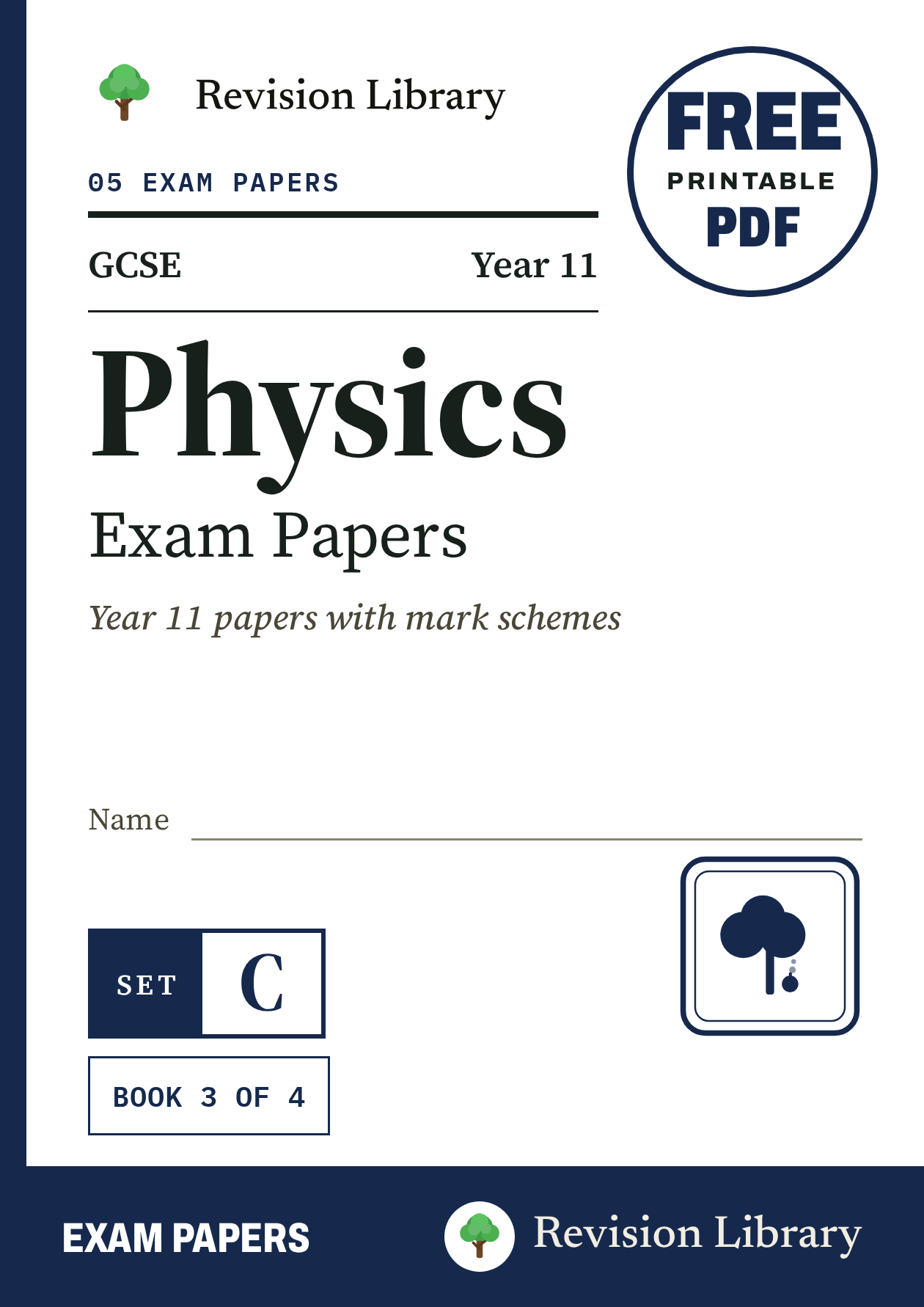
Book 3 of 4

GCSE Physics Exam Papers Set C

Year 11 Paper 1: Energy and Electricity Recap, Year 11 Paper 2: Matter, Forces and Waves, Year 11 Paper 3: Forces and Waves and Space

Level
GCSE · Edexcel 1PH0 · AQA 8463 · OCR J249
Series
GCSE Physics Exam Papers, book 3 of 4
Suitable for
Years 10-11, AQA / Edexcel / OCR
FreePDF download · 2027 edition · 48 A4 pages
  • One file, prints straight to A4
  • No account, no password

3 papers, mark schemes at the back. This set is one of 558 free PDFs on the shelf.

Pages
48 A4 pages
Papers
3 papers
Questions
44 · 160 marks
Answers
From page 36

What is inside

3 papers · answers from p36

Each paper starts with a page showing its marks and a suggested time, followed by the questions. The mark schemes for all 3 papers are at the back, so you can sit each paper as a mock and mark it afterwards.

  1. 01Year 11 Paper 1: Energy and Electricity Recap10 questions · 40 marksp3
  2. 02Year 11 Paper 2: Matter, Forces and Waves17 questions · 60 marksp12
  3. 03Year 11 Paper 3: Forces, Waves and Space17 questions · 60 marksp24
  4. AnswersMark schemes for every paperp36

Each paper is drawn from one of our worksheet packs. Follow a paper title for the full pack on its own page, or browse every GCSE Science pack. Every book on the shelf is a complete printable workbook of up to 120 A4 pages.

Explore this volume

GCSE Physics Exam Papers Set C includes Year 11 Paper 1: Energy and Electricity Recap (from page 3); Year 11 Paper 2: Matter, Forces and Waves (from page 12); Year 11 Paper 3: Forces, Waves and Space (from page 24).

Worked question 4 - Year 11 Paper 1: Energy and Electricity Recap

A three-pin plug used in the UK contains a live wire, a neutral wire and an earth wire.

State the approximate potential difference between the live wire and earth, and describe the function of the earth wire in terms of electrical safety.

Answer

Live is about 230 V relative to earth. The earth wire connects the metal case to earth by a low-resistance path. If live touches the case, a large fault current flows along this path, causing the fuse to blow or circuit breaker to trip and disconnect live, reducing the risk of electric shock.

Mark scheme

B1for the potential difference between the live wire and earth being about 230 V
B1for stating the earth wire is a safety wire connected to the case (or metal parts) of an appliance
B1for explaining that if a fault occurs and the live wire touches the case, a large current flows to earth through the earth wire rather than through a person touching the case
B1for stating this large current blows the fuse (or trips the circuit breaker), disconnecting the live wire and cutting off the electricity supply to the appliance, protecting the user from electric shock

Question 9 - Year 11 Paper 1: Energy and Electricity Recap

5 marks

A wind turbine has a maximum power output of 2 MW. On a particular day it operates at this maximum output for 9 hours, but produces no useful output for the remaining 15 hours because there is no wind.

Calculate the total energy transferred by the wind turbine that day. Then calculate the energy a resource with a steady, reliable output of 2 MW would transfer over the same 24 hours, and state what this comparison shows about intermittent resources such as wind power.

Answer

Turbine output = 18 MWh; a steady 2 MW output over 24 hours would give 48 MWh, 30 MWh more, illustrating the unreliability of an intermittent resource like wind power.

Mark scheme

M1for energy transferred by the turbine = power x time = 2 x 9
A1for turbine energy = 18 MWh; accept 6.48 x 10^10 J or equivalent units
M1for energy a steady 2 MW resource would transfer in 24 hours = 2 x 24
A1for steady resource energy = 48 MWh; accept 1.728 x 10^11 J or equivalent units
B1for interpreting the comparison: intermittent output gives less energy over the day than continuous operation at the same maximum power; a numerical shortfall is acceptable but not required

Question 7 - Year 11 Paper 1: Energy and Electricity Recap

5 marks

A solar panel receives 1000 W of power from sunlight and produces 180 W of useful electrical power.

Calculate the efficiency of the solar panel. State the theoretical maximum efficiency any device could have, and state where most of the wasted power is dissipated to.

Answer

Efficiency = 180 / 1000 = 0.18 (18%); the theoretical maximum is 1 (100%). The remaining 820 W mainly heats the panel and surroundings. Some sunlight can be reflected away and later absorbed elsewhere.

Mark scheme

M1for efficiency = useful power output / total power input
M1for substituting 180 / 1000
A1for efficiency = 0.18 (18%)
B1for stating the theoretical maximum efficiency is 1 (100%)
B1for stating unused energy heats the panel and surroundings; accept energy reflected away and subsequently absorbed by the surroundings

Question 5 - Year 11 Paper 1: Energy and Electricity Recap

4 marks

A block of solid wax is heated until it melts and becomes a liquid.

Describe what happens to the arrangement, movement and forces between the wax particles as the wax changes from a solid to a liquid, and state what happens to the mass of the wax during melting.

Answer

Wax particles become disordered and generally further apart, while remaining close together. They move past one another rather than only vibrating about fixed positions. Energy overcomes some attractive binding so particles are no longer fixed in place. Mass remains unchanged because no particles are lost.

Mark scheme

B1for the fixed, ordered arrangement becoming disordered and generally further apart, while particles remain close together
B1for the particles being able to move around each other rather than only vibrating in fixed positions; no increase in average kinetic energy is required during melting
B1for stating energy is used to overcome some of the attractive binding between particles so they are no longer held at fixed positions, though they remain close together
B1for the mass remaining unchanged during melting

Question 15 - Year 11 Paper 2: Matter, Forces and Waves

5 marks

A cyclist accelerates from rest and reaches a velocity of 8 m/s after 5 seconds.

Calculate the acceleration of the cyclist. The cyclist and bicycle have a combined mass of 75 kg; calculate the resultant force needed to produce this acceleration.

Answer

Acceleration = 1.6 m/s^2; resultant force = 120 N These are average values; they are also constant values if acceleration is uniform.

Mark scheme

M1for acceleration = change in velocity / time
M1for substituting (8 - 0) / 5
A1for acceleration = 1.6 m/s^2; average acceleration unless uniform acceleration is assumed
M1for resultant force = mass x acceleration = 75 x 1.6
A1for resultant force = 120 N; average resultant force unless uniform acceleration is assumed

Question 13 - Year 11 Paper 2: Matter, Forces and Waves

5 marks

A cyclist travels at a constant speed, covering 84 m in 7 s. He then brakes, and decelerates uniformly from this speed to rest in a further 3 s.

Calculate the cyclist's constant speed before braking, and then calculate his deceleration while braking.

Answer

Constant speed = 12 m/s; deceleration = 4 m/s^2.

Mark scheme

M1for speed = distance / time
M1for substituting 84 / 7
A1for speed = 12 m/s
M1for acceleration = change in velocity / time = (0 - 12) / 3
A1for deceleration = 4 m/s^2 (acceleration = -4 m/s^2)

Question 5 - Year 11 Paper 2: Matter, Forces and Waves

3 marks

A water wave has a frequency of 4 Hz and a wavelength of 1.5 m.

Calculate the speed of the wave.

Answer

6 m/s

Mark scheme

M1for wave speed = frequency x wavelength
M1for substituting 4 x 1.5
A1for wave speed = 6 m/s

Question 6 - Year 11 Paper 3: Forces, Waves and Space

3 marks

A rugby player of mass 95 kg runs with a velocity of 6 m/s.

Calculate the momentum of the rugby player.

Answer

570 kg m/s

Mark scheme

M1for momentum = mass x velocity
M1for substituting 95 x 6
A1for momentum = 570 kg m/s

Question 4 - Year 11 Paper 3: Forces, Waves and Space

3 marks

A cheetah of mass 45 kg runs with a velocity of 25 m/s.

Calculate the momentum of the cheetah.

Answer

1125 kg m/s

Mark scheme

M1for momentum = mass x velocity
M1for substituting 45 x 25
A1for momentum = 1125 kg m/s

GCSE Physics Exam Papers runs to 4 volumes

Book 3 of 4 · 218 pages in the set

Each set is a separate free PDF with its own mark schemes at the back.

Volume 1

50 pp · 46 Qs

Year 10 Paper 1: Core Skills, Year 10 Paper 2: Energy and Particles and Year 10 Paper 3: Circuits and Motion

Volume 2

60 pp · 39 Qs

Year 10 Paper 4: Matter and Motion, Year 10 Paper 5: Energy and Atoms and Year 10 Paper 6: Full Topic Review

Volume 3 · this book

48 pp · 44 Qs

Year 11 Paper 1: Energy and Electricity Recap, Year 11 Paper 2: Matter, Forces and Waves, Year 11 Paper 3: Forces and Waves and Space

Volume 4

60 pp · 41 Qs

Year 11 Paper 4: Energy, Particles and Forces, Year 11 Paper 5: Particles, Waves and Space and Year 11 Paper 6: Whole-Course Practice

More GCSE books

GCSE Biology Exam Papers Set A

102 pp · 94 Qs

Year 10 Paper 1: Cells and Body Systems, Year 10 Paper 2: Organisation and Energy, Year 10 Paper 3: Cells, Digestion and Respiration and 3 more

Want a different mix of topics?

Sitting an exam soon? Build a GCSE Combined Science mock paper or print a ready-made one.