Revision Library
Choose a subject
Menu

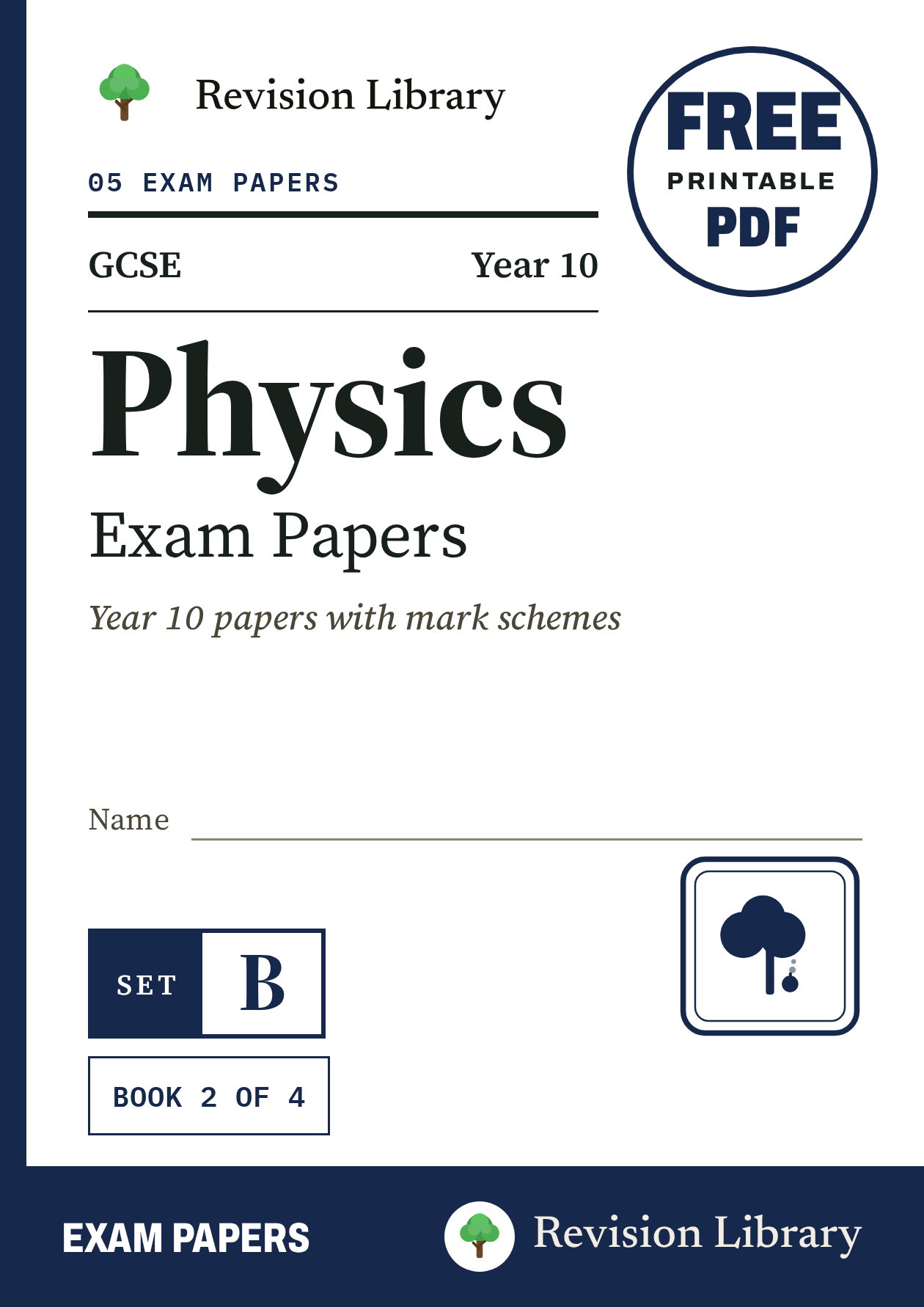
Book 2 of 4

GCSE Physics Exam Papers Set B

Year 10 Paper 4: Matter and Motion, Year 10 Paper 5: Energy and Atoms and Year 10 Paper 6: Full Topic Review

Level
GCSE · Edexcel 1PH0 · AQA 8463 · OCR J249
Series
GCSE Physics Exam Papers, book 2 of 4
Suitable for
Years 10-11, AQA / Edexcel / OCR
FreePDF download · 2027 edition · 60 A4 pages
  • One file, prints straight to A4
  • No account, no password

3 papers, mark schemes at the back. This set is one of 558 free PDFs on the shelf.

Pages
60 A4 pages
Papers
3 papers
Questions
39 · 200 marks
Answers
From page 46

What is inside

3 papers · answers from p46

Each paper starts with a page showing its marks and a suggested time, followed by the questions. The mark schemes for all 3 papers are at the back, so you can sit each paper as a mock and mark it afterwards.

  1. 01Year 10 Paper 4: Matter and Motion12 questions · 60 marksp3
  2. 02Year 10 Paper 5: Energy and Atoms12 questions · 60 marksp16
  3. 03Year 10 Paper 6: Full Topic Review15 questions · 80 marksp28
  4. AnswersMark schemes for every paperp46

Each paper is drawn from one of our worksheet packs. Follow a paper title for the full pack on its own page, or browse every GCSE Science pack. Every book on the shelf is a complete printable workbook of up to 120 A4 pages.

Explore this volume

GCSE Physics Exam Papers Set B includes Year 10 Paper 4: Matter and Motion (from page 3); Year 10 Paper 5: Energy and Atoms (from page 16); Year 10 Paper 6: Full Topic Review (from page 28).

Worked question 7 - Year 10 Paper 4: Matter and Motion

A student investigates the current against potential difference characteristic of a fixed resistor kept at constant temperature, and compares it with that of a filament lamp.

Describe the current against potential difference graphs for the fixed resistor and the filament lamp. Explain the shape of the filament lamp graph in terms of heating and the movement of particles.

Answer

The fixed resistor has a straight I-V line through the origin. The lamp curve passes through the origin and becomes shallower as the magnitude of potential difference increases. Current heats the filament; greater lattice vibrations cause more electron scattering and increased resistance.

Mark scheme

B1for the fixed resistor having a straight I-V line through the origin
B1for the lamp curve passing through the origin and becoming shallower as the magnitude of potential difference increases
B1for explaining current heats the filament
B1for explaining hotter lattice ions vibrate more strongly, causing more electron scattering and increased resistance

Question 9 - Year 10 Paper 4: Matter and Motion

5 marks

A car's braking distance depends on its speed when the brakes are applied.

Explain, using the ideas of kinetic energy and the work done by the braking force, why doubling a car's speed increases its braking distance by a factor of four, assuming the braking force stays the same.

Answer

Kinetic energy is proportional to speed squared, so doubling speed quadruples it; since work done by a constant braking force (force x distance) must remove this kinetic energy, the braking distance also increases by a factor of four.

Mark scheme

B1for kinetic energy = 0.5 x mass x speed^2
B1for using the square dependence to show doubling speed quadruples kinetic energy for the same mass
B1for work done against the braking force = braking force magnitude x braking distance
B1for explaining that the work done against the braking force equals the initial kinetic energy removed in stopping
B1for deducing from distance = kinetic energy / braking force that four times the energy requires four times the braking distance at the same constant force

Question 2 - Year 10 Paper 4: Matter and Motion

4 marks

A sealed, rigid container holds a fixed mass of gas. The gas is cooled while the volume of the container stays constant.

Use the particle model to explain why the pressure of the gas decreases as its temperature decreases at constant volume.

Answer

Cooling decreases average particle kinetic energy. Particles move slower and collide with the walls less often, with a smaller momentum change per collision. The rate of momentum transfer, hence the force on the walls and the pressure (force per unit area), decreases.

Mark scheme

B1for stating cooling the gas decreases the average kinetic energy of the gas particles, so on average they move slower
B1for stating the particles collide with the walls of the container less often per second
B1for a smaller average change in particle momentum in each wall collision
B1for linking the rate of momentum transfer to force on the wall, and pressure to force per unit area

Question 4 - Year 10 Paper 4: Matter and Motion

5 marks

A 15 ohm resistor and a 25 ohm resistor are connected in series with an 8 V battery.

Calculate the total resistance of the circuit, the current flowing through the circuit, and the potential difference across the 15 ohm resistor.

Answer

Total resistance = 40 ohm; current = 0.2 A; potential difference across the 15 ohm resistor = 3 V.

Mark scheme

M1for total resistance in series = sum of the individual resistances = 15 + 25
A1for total resistance = 40 ohm
M1for current = potential difference / total resistance = 8 / 40
A1for current = 0.2 A
B1for potential difference across the 15 ohm resistor = current x resistance = 0.2 x 15 = 3 V

Question 10 - Year 10 Paper 5: Energy and Atoms

6 marks

A kettle is rated at 230 V, 2760 W. Fuses are available in 3 A, 5 A and 13 A ratings.

Calculate the normal operating current of the kettle, and determine which of the available fuses should be fitted. Explain why the chosen fuse rating should be only a little higher than the normal operating current, rather than much higher.

Answer

Current = 2760 / 230 = 12 A. Choose the 13 A fuse, the lowest available rating above normal current. It permits normal operation but disconnects if current becomes excessive. A much higher rating can allow an overload to persist, heating the wiring and potentially damaging insulation or causing a fire.

Mark scheme

M1for current = power / potential difference
M1for substituting 2760 / 230
A1for current = 12 A
B1for selecting the 13 A fuse, because it is the only rating higher than the normal operating current (a 5 A fuse would blow during normal use)
B1for explaining the fuse rating should be only a little higher than the normal operating current so that it still blows quickly if a fault causes the current to become dangerously large
B1for explaining that a sustained excessive current heats the wiring and can damage insulation or cause a fire

Question 4 - Year 10 Paper 5: Energy and Atoms

4 marks

A student wants to reduce the electrical energy used by an old refrigerator to maintain the same internal temperature. Heat enters through its casing, and friction in its compressor motor dissipates some input energy.

Describe two methods that could be used to reduce this waste, and explain how each method increases the refrigerator's efficiency.

Answer

Improve the casing insulation to reduce heat entering from the warmer surroundings, so the compressor runs less to maintain the same internal temperature. Lubricate the compressor bearings to reduce friction and frictional heating, reducing electrical input for the same cooling.

Mark scheme

B1for improving the casing insulation
B1for explaining that less heat enters from the warmer surroundings, so less compressor operation is needed for the same temperature
B1for lubricating the compressor bearings or another valid method of reducing compressor losses
B1for explaining how that method reduces losses, such as less frictional heating for the same cooling; accept two other distinct valid methods with their corresponding explanations

Question 1 - Year 10 Paper 5: Energy and Atoms

4 marks

A sealed container holds a fixed mass of gas. The gas is heated while the volume of the container stays constant.

Use the particle model to explain why the pressure of the gas increases as its temperature increases at constant volume.

Answer

Heating increases average particle kinetic energy. Particles move faster and collide with the walls more often, with a larger momentum change per collision. The rate of momentum transfer, hence the force on the walls and the pressure (force per unit area), increases.

Mark scheme

B1for stating heating the gas increases the average kinetic energy of the gas particles, so on average they move faster
B1for stating the particles collide with the walls of the container more often per second
B1for a larger average change in particle momentum in each wall collision
B1for linking the rate of momentum transfer to force on the wall, and pressure to force per unit area

Question 14 - Year 10 Paper 6: Full Topic Review

6 marks

A school replaces an old gas boiler, which has an efficiency of 72%, with a new gas boiler of the same power rating that has an efficiency of 90%. Both boilers transfer 500,000 kJ of chemical energy from burning gas each day.

Calculate the useful heating energy transferred each day by the old boiler and by the new boiler, then calculate the extra useful energy the new boiler provides per day for the same amount of gas used.

Answer

Old boiler: 360000 kJ useful per day; new boiler: 450000 kJ useful per day; the new boiler provides 90000 kJ more useful heating energy per day for the same gas used.

Mark scheme

M1for useful energy from old boiler = efficiency x total input energy = 0.72 x 500000
A1for old boiler useful energy = 360000 kJ
M1for useful energy from new boiler = 0.90 x 500000
A1for new boiler useful energy = 450000 kJ
M1for extra useful energy = 450000 - 360000
A1for extra useful energy = 90000 kJ

Question 9 - Year 10 Paper 6: Full Topic Review

6 marks

A worker at a nuclear power station may be exposed to radiation both from external sources and from radioactive dust.

Explain why internal contamination can be particularly hazardous compared with irradiation from an external source, especially for alpha-emitting material. Describe two safety measures used at nuclear power stations to reduce contamination risk, and explain how at least one works.

Answer

Contamination leaves radioactive material on or in the body, causing exposure for as long as it remains. External irradiation stops when the source is removed or shielded. Alpha radiation has low penetration externally but is strongly ionising, so an internal alpha emitter close to living cells can cause substantial damage. Protective clothing and respirators limit deposition and inhalation; containment and controlled ventilation limit the spread of radioactive dust. Monitoring followed by decontamination is also valid.

Mark scheme

B1for stating contamination means radioactive material is on or in the body, continuing to expose the person for as long as it remains there
B1for stating irradiation from an external source, in contrast, stops as soon as the person leaves the source or it is shielded/removed
B1for explaining that alpha radiation, although only weakly penetrating from outside the body, is strongly ionising and can do more damage if the emitting material is inside the body, close to living cells, than it could from outside
B1for one suitable measure, such as protective clothing/respirators preventing dust inhalation or deposition, or containment and controlled ventilation
B1for a second distinct suitable measure, such as contamination monitoring followed by decontamination before leaving controlled areas; dosimetry alone does not prevent contamination
B1for explaining how at least one measure prevents radioactive material getting onto or into the body, or removes it to limit ongoing exposure

GCSE Physics Exam Papers runs to 4 volumes

Book 2 of 4 · 218 pages in the set

Each set is a separate free PDF with its own mark schemes at the back.

Volume 1

50 pp · 46 Qs

Year 10 Paper 1: Core Skills, Year 10 Paper 2: Energy and Particles and Year 10 Paper 3: Circuits and Motion

Volume 2 · this book

60 pp · 39 Qs

Year 10 Paper 4: Matter and Motion, Year 10 Paper 5: Energy and Atoms and Year 10 Paper 6: Full Topic Review

Volume 3

48 pp · 44 Qs

Year 11 Paper 1: Energy and Electricity Recap, Year 11 Paper 2: Matter, Forces and Waves, Year 11 Paper 3: Forces and Waves and Space

Volume 4

60 pp · 41 Qs

Year 11 Paper 4: Energy, Particles and Forces, Year 11 Paper 5: Particles, Waves and Space and Year 11 Paper 6: Whole-Course Practice

More GCSE books

GCSE Biology Exam Papers Set A

102 pp · 94 Qs

Year 10 Paper 1: Cells and Body Systems, Year 10 Paper 2: Organisation and Energy, Year 10 Paper 3: Cells, Digestion and Respiration and 3 more

Want a different mix of topics?

Sitting an exam soon? Build a GCSE Combined Science mock paper or print a ready-made one.