Revision Library
Choose a subject
Menu

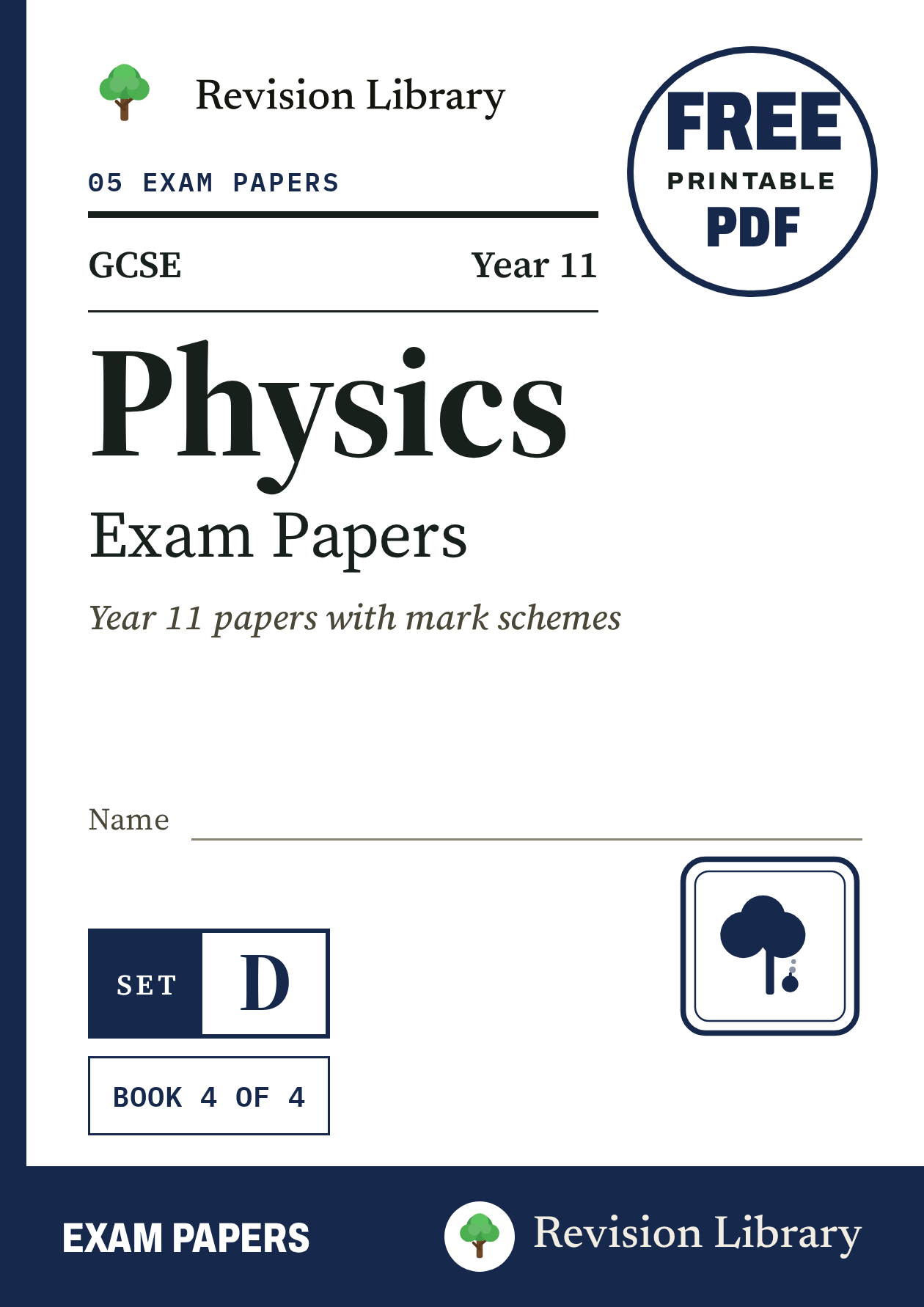
Book 4 of 4

GCSE Physics Exam Papers Set D

Year 11 Paper 4: Energy, Particles and Forces, Year 11 Paper 5: Particles, Waves and Space and Year 11 Paper 6: Whole-Course Practice

Level
GCSE · Edexcel 1PH0 · AQA 8463 · OCR J249
Series
GCSE Physics Exam Papers, book 4 of 4
Suitable for
Years 10-11, AQA / Edexcel / OCR
FreePDF download · 2027 edition · 60 A4 pages
  • One file, prints straight to A4
  • No account, no password

3 papers, mark schemes at the back. This set is one of 558 free PDFs on the shelf.

Pages
60 A4 pages
Papers
3 papers
Questions
41 · 200 marks
Answers
From page 46

What is inside

3 papers · answers from p46

Each paper starts with a page showing its marks and a suggested time, followed by the questions. The mark schemes for all 3 papers are at the back, so you can sit each paper as a mock and mark it afterwards.

  1. 01Year 11 Paper 4: Energy, Particles and Forces12 questions · 60 marksp3
  2. 02Year 11 Paper 5: Particles, Waves and Space13 questions · 60 marksp15
  3. 03Year 11 Paper 6: Whole-Course Practice16 questions · 80 marksp27
  4. AnswersMark schemes for every paperp46

Each paper is drawn from one of our worksheet packs. Follow a paper title for the full pack on its own page, or browse every GCSE Science pack. Every book on the shelf is a complete printable workbook of up to 120 A4 pages.

Explore this volume

GCSE Physics Exam Papers Set D includes Year 11 Paper 4: Energy, Particles and Forces (from page 3); Year 11 Paper 5: Particles, Waves and Space (from page 15); Year 11 Paper 6: Whole-Course Practice (from page 27).

Worked question 4 - Year 11 Paper 4: Energy, Particles and Forces

A current of 3 A flows through a component connected to a 12 V supply for 40 seconds.

Calculate the charge that flows through the component, and hence calculate the energy transferred.

Answer

Charge = 120 C; energy transferred = 1440 J.

Mark scheme

M1for charge = current x time
M1for substituting 3 x 40
A1for charge = 120 C
A1for energy transferred = charge x potential difference = 120 x 12 = 1440 J

Question 9 - Year 11 Paper 4: Energy, Particles and Forces

6 marks

A gas syringe contains a fixed mass of gas at a pressure of 1.05 x 10^5 Pa and a volume of 4.8 x 10^-5 m^3. The gas is slowly expanded at constant temperature until its pressure falls to 6.0 x 10^4 Pa.

Calculate the new volume of the gas, and explain, using the particle model, why the pressure falls as the volume increases at constant temperature.

Answer

8.4 x 10^-5 m^3. At constant temperature average particle speed is unchanged, but the larger volume has a lower number density and fewer collisions per unit wall area per second, decreasing pressure.

Mark scheme

M1for using pressure x volume = constant, at constant temperature
M1for substituting p1 V1 = p2 V2, i.e. 1.05 x 10^5 x 4.8 x 10^-5 = 6.0 x 10^4 x V2
A1for p1 V1 = 5.04 (J)
M1for rearranging to V2 = 5.04 / (6.0 x 10^4)
A1for new volume = 8.4 x 10^-5 m^3
B1for explaining that at constant temperature average particle speed is unchanged, but the larger volume has a lower number density and fewer collisions per unit wall area per second, decreasing pressure.

Question 11 - Year 11 Paper 4: Energy, Particles and Forces

6 marks

In a road safety test, a crash test dummy of mass 70 kg is in a car travelling at 15 m/s when it collides with a wall. In Test A the car has no airbag, and the dummy is brought to rest in 0.05 s by the seatbelt and dashboard. In Test B an airbag is fitted, and the dummy is brought to rest in 0.2 s.

Calculate the average force on the dummy in Test A and in Test B, and explain why fitting an airbag makes a collision safer for a passenger.

Answer

Force in Test A = 21000 N; force in Test B = 5250 N; the airbag extends the stopping time, lowering the force for the same change in momentum. Both average forces act opposite to the original motion of the dummy.

Mark scheme

M1for magnitude of change in momentum = 70 x 15 = 1050 kg m/s, the same in both tests
M1for force in Test A = change in momentum / time = 1050 / 0.05
A1for force in Test A = 21000 N
M1for force in Test B = 1050 / 0.2
A1for force in Test B = 5250 N
B1for explaining the airbag increases the time taken for the dummy's momentum to reach zero, reducing the rate of change of momentum and so the force on the dummy for the same change in momentum, making injury less likely

Question 1 - Year 11 Paper 4: Energy, Particles and Forces

4 marks

A trolley of mass 2 kg moving at 3 m/s collides with a stationary trolley of mass 1 kg. After the collision, the two trolleys stick together and move off with a common velocity.

Calculate the total momentum of the system before the collision, and use conservation of momentum to calculate the common velocity of the trolleys after the collision.

Answer

Momentum before = 6 kg m/s; common velocity after = 2 m/s

Mark scheme

M1for total momentum before = (2 x 3) + (1 x 0)
A1for total momentum before = 6 kg m/s
M1for using conservation of momentum, common velocity = total momentum / total mass = 6 / 3
A1for common velocity = 2 m/s

Question 9 - Year 11 Paper 5: Particles, Waves and Space

5 marks

Astronomers use the redshift of light from distant galaxies, together with Hubble's Law, to estimate how long ago the universe began.

Explain how measurements of the redshift and distance of many galaxies can be used to estimate the age of the universe, and explain why this age can only be an estimate rather than an exact value.

Answer

Redshift estimates recession speed. Plot speed against independently measured galaxy distance and find the gradient H_0 in v = H_0 d. With constant-rate backward extrapolation the age estimate is d/v = 1/H_0, using consistent units. Distance/speed measurement uncertainty and changes in expansion rate make this an estimate; no numerical age follows without a measured H_0.

Mark scheme

B1for stating that the redshift of a galaxy's light can be used to calculate its speed of recession, how fast it is moving away
B1for plotting recession speed v against independently measured distance d for many galaxies and finding the gradient H_0 in v = H_0 d
B1for a constant-rate backward extrapolation giving age approximately d/v = 1/H_0, converting H_0 to reciprocal time in consistent units
B1for explaining the estimate depends on uncertainty in the measurements of galaxies' distances and speeds, which are difficult to measure precisely
B1for explaining the calculation also assumes the rate of expansion has been constant, when in reality the expansion rate may have changed over the universe's history, adding further uncertainty to the estimate

Question 11 - Year 11 Paper 5: Particles, Waves and Space

5 marks

A satellite orbits the Earth in a stable circular orbit of radius 7.0 x 10^6 m, completing one full orbit every 6000 s.

Calculate the orbital speed of the satellite, using the fact that in one orbit it travels a distance equal to the circumference of its circular orbit, 2 x pi x r. Then explain, in terms of velocity, why the satellite is accelerating even though it moves at a constant speed.

Answer

Orbital speed is about 7330 m/s; the satellite accelerates because its direction, and therefore velocity, constantly changes even though its speed stays constant.

Mark scheme

M1for substituting 2 x pi x 7.0 x 10^6
A1for circumference = 43982297.15... m; accept 4.4 x 10^7 m (2 significant figures) or 4.40 x 10^7 m (3 significant figures)
M1for speed = distance / time, using their circumference / 6000
A1for speed = 7330.382858... m/s; accept 7.3 x 10^3 m/s (2 significant figures) or 7.33 x 10^3 m/s (3 significant figures)
B1for explaining that although the satellite's speed is constant, its direction is continuously changing as it moves around the circular orbit, and since velocity is a vector, this changing direction means the velocity is changing, so the satellite is accelerating

Question 12 - Year 11 Paper 5: Particles, Waves and Space

6 marks

A laboratory technician works with radioactive sources as part of their job.

Explain the difference between contamination and irradiation by a radioactive source. Describe two precautions the technician should take while handling a source and explain how at least one reduces the radiation dose received.

Answer

Contamination is radioactive material on or in a person or object; it can continue exposing them while it remains. Irradiation is exposure to emitted radiation and stops when the external source is removed or shielded. Use tongs to increase distance and minimise handling time; suitable shielding is another option. Gloves prevent contamination rather than generally shielding penetrating radiation.

Mark scheme

B1for stating contamination is the unwanted presence of radioactive atoms on or in an object or person (or material)
B1for stating irradiation is exposure to radiation emitted by a source; it does not require radioactive material to be deposited on or in the person or object
B1for stating a contaminated person continues to be exposed to radiation for as long as the radioactive atoms remain on/in them, whereas irradiation stops as soon as the source is removed or shielded
B1for one suitable precaution, such as remote handling/tongs, minimising exposure time, appropriate shielding, or gloves/protective clothing to prevent contamination
B1for a second distinct suitable precaution; credit any two valid methods without requiring a specific pair
B1for explaining how at least one method reduces dose, such as increased distance, reduced exposure time, shielding absorbing radiation, or gloves preventing transfer of radioactive material; ordinary gloves are not general shielding

GCSE Physics Exam Papers runs to 4 volumes

Book 4 of 4 · 218 pages in the set

Each set is a separate free PDF with its own mark schemes at the back.

Volume 1

50 pp · 46 Qs

Year 10 Paper 1: Core Skills, Year 10 Paper 2: Energy and Particles and Year 10 Paper 3: Circuits and Motion

Volume 2

60 pp · 39 Qs

Year 10 Paper 4: Matter and Motion, Year 10 Paper 5: Energy and Atoms and Year 10 Paper 6: Full Topic Review

Volume 3

48 pp · 44 Qs

Year 11 Paper 1: Energy and Electricity Recap, Year 11 Paper 2: Matter, Forces and Waves, Year 11 Paper 3: Forces and Waves and Space

Volume 4 · this book

60 pp · 41 Qs

Year 11 Paper 4: Energy, Particles and Forces, Year 11 Paper 5: Particles, Waves and Space and Year 11 Paper 6: Whole-Course Practice

More GCSE books

GCSE Biology Exam Papers Set A

102 pp · 94 Qs

Year 10 Paper 1: Cells and Body Systems, Year 10 Paper 2: Organisation and Energy, Year 10 Paper 3: Cells, Digestion and Respiration and 3 more

Want a different mix of topics?

Sitting an exam soon? Build a GCSE Combined Science mock paper or print a ready-made one.