Revision Library
Choose a subject
Menu

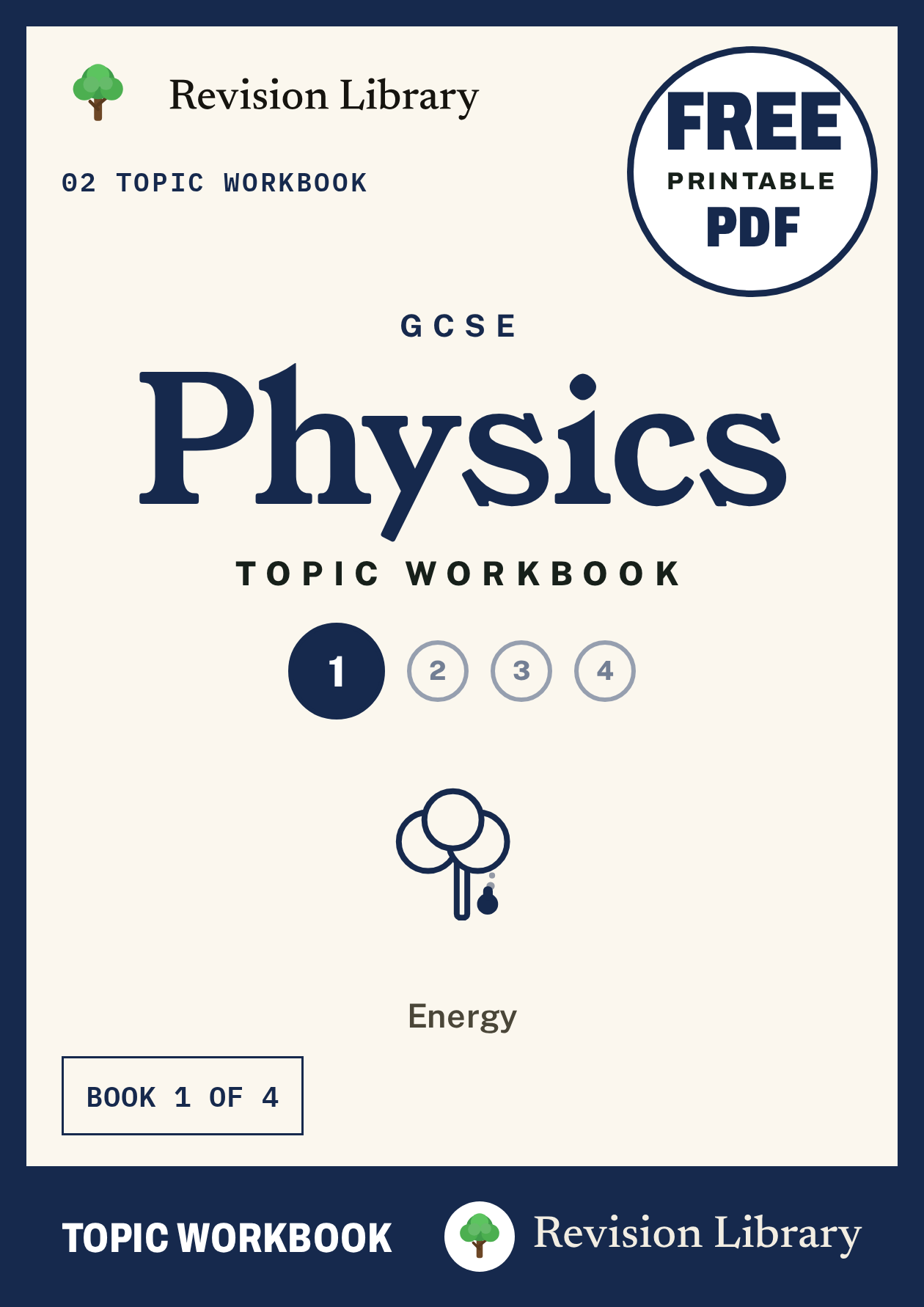
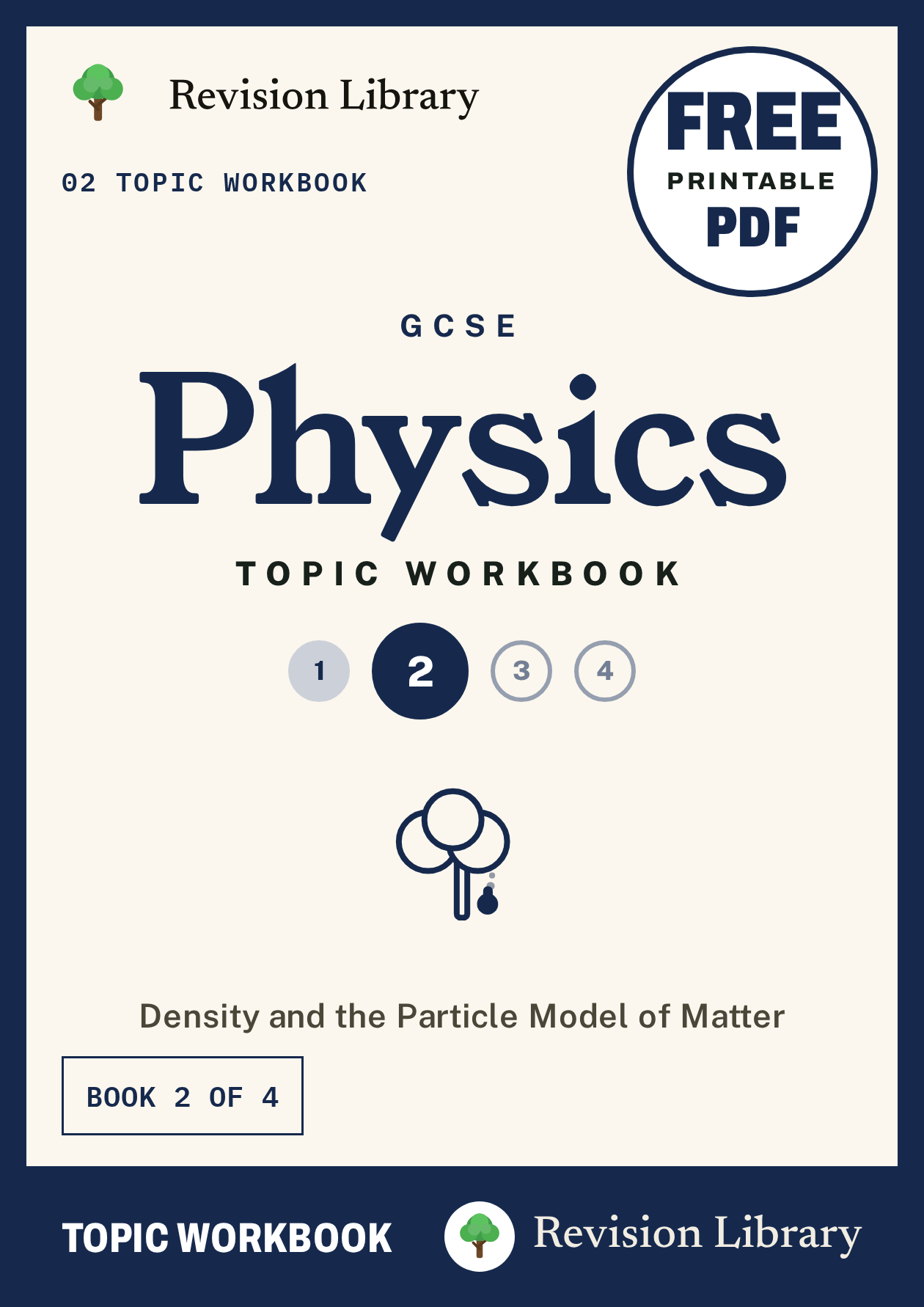
GCSE Physics Topic Workbooks · Book 4 of 4

GCSE Physics Topic Workbook 4

Electromagnetic Induction and Transformers, Space Physics, The Solar System, Orbital Motion and Satellites and 3 more

Level
GCSE · Edexcel 1PH0 · AQA 8463 · OCR J249
Series
GCSE Physics Topic Workbooks, book 4 of 4
Suitable for
Years 10-11, AQA / Edexcel / OCR
FreePDF download · 2027 edition · 78 A4 pages
  • One file, prints straight to A4
  • No account, no password

Workbooks like this one, with 6 topics, 94 questions and mark schemes at the back, are usually printed and sold by publishers. This one is one of 558 free PDFs on the shelf.

Pages
78 A4 pages
Chapters
6 worksheet chapters
Questions
94 · 408 marks
Answers
From page 64
Working time
About 8h 55m

What is inside

6 chapters · answers from p64

Each chapter starts with a page showing its marks and a suggested time, followed by the questions. The mark schemes for all 6 chapters are at the back, so the book works for homework, a timed test or revision.

  1. 01Electromagnetic Induction and Transformers18 questions · 64 marks · about 85 min Topic guide: Electromagnetic Induction and Transformersp3
  2. 02Space Physics16 questions · 56 marks · about 60 min Topic guide: Space Physicsp13
  3. 03The Solar System, Orbital Motion and Satellites15 questions · 55 marks · about 75 min Topic guide: The Solar System, Orbital Motion and Satellitesp21
  4. 04Red-shift and the Expanding Universe15 questions · 51 marks · about 70 min Topic guide: Red-shift and the Expanding Universep30
  5. 05Physics Equations: Recall, Rearrangement and Application16 questions · 71 marks · about 95 min Topic guide: Physics Equations: Recall, Rearrangement and Applicationp38
  6. 06Physics Required Practicals and Uncertainties14 questions · 111 marks · about 150 min Topic guide: Physics Required Practicals and Uncertaintiesp48
  7. AnswersMark schemes for every chapterp64

Each chapter is drawn from one of our worksheet packs. Follow a chapter title for the full pack on its own page, or browse every GCSE Science pack. Every book on the shelf is a complete printable workbook of up to 120 A4 pages.

Explore this volume

GCSE Physics Topic Workbook 4 includes Electromagnetic Induction and Transformers (from page 3); Space Physics (from page 13); The Solar System, Orbital Motion and Satellites (from page 21); Red-shift and the Expanding Universe (from page 30); Physics Equations: Recall, Rearrangement and Application (from page 38); Physics Required Practicals and Uncertainties (from page 48).

Worked question 15 - The Solar System, Orbital Motion and Satellites

Open the included worksheet

Key words and equations: the Solar System, orbital motion and satellites (P8a)

Revision Library

The Solar System consists of the Sun (a star) and the objects that orbit it: eight planets, their natural satellites (moons), dwarf planets, asteroids and comets. A star forms from a nebula, a cloud of dust and gas, which is pulled together by gravity to form a protostar; once the core becomes hot and dense enough, nuclear fusion begins and a new star is born. For most of its life, a star sits on the main sequence, a long, stable period in which nuclear fusion of hydrogen into helium in its core balances the inward pull of gravity. A star with a similar mass to the Sun eventually becomes a red giant, then loses its outer layers to leave a white dwarf, which cools over a very long time into a black dwarf. A much more massive star becomes a red super giant, then explodes as a supernova, leaving behind either a neutron star or, if the remaining core is massive enough, a black hole; elements heavier than iron are only formed during a supernova explosion. An object moving in a circular orbit has a constantly changing direction of velocity, so it is always accelerating towards the centre of the orbit; this centripetal acceleration is caused by a centripetal force, which for an orbiting planet, moon or satellite is provided by gravitational attraction. For a stable orbit, an orbit with a larger radius requires a slower orbital speed, because gravitational force is weaker at greater distances. Equation used in this worksheet: orbital speed = (2 x pi x orbital radius) / time period (v = 2 x pi x r / T). A satellite is an object that orbits a larger object; a geostationary satellite orbits above the equator with a time period of 24 hours, staying above the same point on the Earth's surface, while a low polar orbit satellite orbits much closer to the Earth with a much shorter time period, passing over a different strip of the Earth's surface on each orbit.

A company is designing a new satellite to provide continuous, real-time internet coverage to a single fixed region of the United Kingdom. They are choosing between placing the satellite in a geostationary orbit or a low polar orbit. Evaluate which type of orbit would be more suitable for this purpose. In your answer, you should consider: the orbital period and altitude of each orbit type; how each orbit type would affect the satellite's position relative to the region being served; any other relevant advantages or disadvantages of each orbit.

Answer and mark scheme

Question 15

CreditAnswer or working
0Level 0 No relevant content.
1-2Level 1 Isolated statement(s) are made about one orbit type, with little or no evaluation.
3-4Level 2 Relevant points are made about both orbit types, with some comparison, but the conclusion may not be clearly justified.
5-6Level 3 A detailed, well-reasoned evaluation of both orbit types is given, leading to a clearly justified conclusion, with correct scientific vocabulary throughout.
  • Indicative content:
    • A geostationary orbit has a time period of 24 hours and stays above the same point on the Earth's equator/surface at all times.
    • This means a satellite dish on the ground could stay pointed in one fixed direction, useful for continuous coverage of a single fixed region.
    • A geostationary orbit is at a very high altitude, so the signal travels a long distance, which can introduce a noticeable delay in real-time communication.
    • A low polar orbit satellite orbits at a much lower altitude, closer to the Earth, giving a shorter signal delay.
    • However, a low polar orbit satellite moves quickly relative to the ground and only passes over the UK for a short time on each orbit, so continuous coverage of a single fixed region would need a large constellation of many satellites working together.
    • A single geostationary satellite can provide constant coverage of a fixed region, whereas a single low orbit satellite cannot.
    • A valid conclusion: for continuous single-region coverage with minimal ground equipment, a geostationary orbit is more suitable overall, though a low-orbit constellation could offer a lower signal delay if enough satellites are used, oe (accept a different, well-justified conclusion).

Answer: A geostationary orbit gives constant coverage of one region from a single satellite but with a longer signal delay; a low polar orbit gives a shorter delay but needs many satellites for continuous coverage. Either conclusion is acceptable if well justified.
Question 13 - The Solar System, Orbital Motion and Satellites

Open the included worksheet

Key words and equations: the Solar System, orbital motion and satellites (P8a)

Revision Library

The Solar System consists of the Sun (a star) and the objects that orbit it: eight planets, their natural satellites (moons), dwarf planets, asteroids and comets. A star forms from a nebula, a cloud of dust and gas, which is pulled together by gravity to form a protostar; once the core becomes hot and dense enough, nuclear fusion begins and a new star is born. For most of its life, a star sits on the main sequence, a long, stable period in which nuclear fusion of hydrogen into helium in its core balances the inward pull of gravity. A star with a similar mass to the Sun eventually becomes a red giant, then loses its outer layers to leave a white dwarf, which cools over a very long time into a black dwarf. A much more massive star becomes a red super giant, then explodes as a supernova, leaving behind either a neutron star or, if the remaining core is massive enough, a black hole; elements heavier than iron are only formed during a supernova explosion. An object moving in a circular orbit has a constantly changing direction of velocity, so it is always accelerating towards the centre of the orbit; this centripetal acceleration is caused by a centripetal force, which for an orbiting planet, moon or satellite is provided by gravitational attraction. For a stable orbit, an orbit with a larger radius requires a slower orbital speed, because gravitational force is weaker at greater distances. Equation used in this worksheet: orbital speed = (2 x pi x orbital radius) / time period (v = 2 x pi x r / T). A satellite is an object that orbits a larger object; a geostationary satellite orbits above the equator with a time period of 24 hours, staying above the same point on the Earth's surface, while a low polar orbit satellite orbits much closer to the Earth with a much shorter time period, passing over a different strip of the Earth's surface on each orbit.

For a stable circular orbit, the gravitational force provides exactly the centripetal force needed to keep an object moving in a circle at that radius.
(a)State what happens to the strength of the gravitational force between two objects as the distance between them increases.(1)
(b)Use this idea to explain why an object in a stable orbit at a large orbital radius has a lower orbital speed than an object in a stable orbit at a small orbital radius.(3)

Answer and mark scheme

Question 13

CreditAnswer or working
B1(a) the gravitational force decreases (gets weaker)
B1(b) at a larger orbital radius, the gravitational force is weaker
B1(b) a weaker force provides a smaller centripetal force
B1(b) a smaller centripetal force is needed to keep an object moving in a circle at a lower speed, so the orbital speed needed for a stable orbit is lower at a larger radius, oe
  • (a) Answer: It decreases.
  • (b) Answer: Weaker gravity at a larger radius provides less centripetal force, which is only enough to hold an object in a stable orbit if it moves more slowly.

Question 14 - The Solar System, Orbital Motion and Satellites

Open the included worksheet

Key words and equations: the Solar System, orbital motion and satellites (P8a)

Revision Library

The Solar System consists of the Sun (a star) and the objects that orbit it: eight planets, their natural satellites (moons), dwarf planets, asteroids and comets. A star forms from a nebula, a cloud of dust and gas, which is pulled together by gravity to form a protostar; once the core becomes hot and dense enough, nuclear fusion begins and a new star is born. For most of its life, a star sits on the main sequence, a long, stable period in which nuclear fusion of hydrogen into helium in its core balances the inward pull of gravity. A star with a similar mass to the Sun eventually becomes a red giant, then loses its outer layers to leave a white dwarf, which cools over a very long time into a black dwarf. A much more massive star becomes a red super giant, then explodes as a supernova, leaving behind either a neutron star or, if the remaining core is massive enough, a black hole; elements heavier than iron are only formed during a supernova explosion. An object moving in a circular orbit has a constantly changing direction of velocity, so it is always accelerating towards the centre of the orbit; this centripetal acceleration is caused by a centripetal force, which for an orbiting planet, moon or satellite is provided by gravitational attraction. For a stable orbit, an orbit with a larger radius requires a slower orbital speed, because gravitational force is weaker at greater distances. Equation used in this worksheet: orbital speed = (2 x pi x orbital radius) / time period (v = 2 x pi x r / T). A satellite is an object that orbits a larger object; a geostationary satellite orbits above the equator with a time period of 24 hours, staying above the same point on the Earth's surface, while a low polar orbit satellite orbits much closer to the Earth with a much shorter time period, passing over a different strip of the Earth's surface on each orbit.

Higher Tier only. A satellite completes one orbit of the Earth in a time period of 7200 s, at an orbital speed of 6800 m/s. Use the Physics Equations Sheet. Use the equation: orbital speed = (2 x π x orbital radius) / time period.
(a)Rearrange the equation to make orbital radius the subject.(1)
(b)Calculate the orbital radius of the satellite.(3)

Answer and mark scheme

Question 14

CreditAnswer or working
B1(a) orbital radius = (orbital speed x time period) / (2 x π)
M1(b) substitution: r = (6800 x 7200) / (2 x π), oe
M1(b) correct evaluation of the numerator: 6800 x 7200 = 4.896 x 10⁷
A1(b) r = 7.79 x 10⁶ m (3 s.f.), cao (accept awrt 7.79 x 10⁶ m)
  • (a) Answer: r = (v x T) / (2 x π)
  • (b) Answer: r = 7.79 x 10⁶ m

Question 6 - Electromagnetic Induction and Transformers

Open the included worksheet

Key ideas: electromagnetic induction and transformers

Original text written for Revision Library.

When there is relative motion between a conductor and a magnetic field, or when the magnetic field through a coil changes, a potential difference is induced across the ends of the conductor; if the conductor is part of a complete circuit, a current is induced too. This is called electromagnetic induction, or the generator effect. The size of the induced potential difference increases with a stronger magnetic field, a faster speed of movement, and more turns on a coil; its direction reverses if the direction of motion or the polarity of the field is reversed. This effect is used in an alternator, which generates alternating current (a.c.) using slip rings, and in a dynamo, which generates direct current (d.c.) using a split-ring commutator; it is also used in moving-coil microphones, which convert sound into a varying electrical signal. A transformer uses electromagnetic induction to change the size of an alternating potential difference; because it needs a constantly changing magnetic field, it only works with a.c., not d.c. Step-up and step-down transformers are used throughout the National Grid to transmit electrical power efficiently across the country.

Required practical. Priya investigates the factors that affect the potential difference induced across the ends of a coil of wire. She sets up a coil of 100 turns connected to a voltmeter sensor and a data logger, which records the peak potential difference induced as a bar magnet is pushed into the coil. For each trial she pushes the magnet through a fixed distance of 0.50 m by hand, trying to keep the speed as constant as possible, and calculates the average speed of the push using a stopwatch. She repeats this for a range of speeds. Her results are shown below.

Speed of magnet (m/s): 0.20, 0.40, 0.60, 0.80, 1.00
Peak induced pd (V): 0.05, 0.10, 0.15, 0.22, 0.25
N S coil, 100 turns voltmeter sensor & data logger
(a)Identify the independent variable and the dependent variable in this investigation.(2)
(b)State two variables Priya should control to make this a fair test.(2)
(c)Describe the relationship between the speed of the magnet and the peak induced potential difference shown by the data in the table.(2)
(d)One of the readings does not fit the pattern shown by the rest of the data. Identify this anomalous result and suggest one reason it may have occurred.(2)
(e)Suggest one improvement to the method that would increase the accuracy of the peak induced pd readings, and explain how it would improve the results.(2)
(f)Based on the data (ignoring the anomalous result), describe the shape of the graph of peak induced pd (y-axis) against speed of the magnet (x-axis).(1)
(g)Using the data (ignoring the anomalous result at 0.80 m/s), calculate the gradient of the graph of peak induced pd against speed of the magnet. Give the unit of the gradient.(2)

Answer and mark scheme

Question 6

CreditAnswer or working
B1(a) independent variable: the speed at which the magnet is pushed into the coil
B1(a) dependent variable: the peak potential difference induced across the coil
B1(b) the same magnet is used each time (same strength of magnet)
B1(b) any other correct control variable, e.g. the same coil (same number of turns) is used each time; the magnet is pushed through the same fixed distance (0.50 m) each time; the magnet starts from the same position relative to the coil each time
B1(c) as the speed of the magnet increases, the peak induced potential difference increases, oe
B1(c) the relationship is (approximately) directly proportional, e.g. doubling the speed from 0.20 m/s to 0.40 m/s approximately doubles the pd from 0.05 V to 0.10 V, oe
B1(d) the reading at 0.80 m/s (peak pd = 0.22 V, when a value of about 0.20 V would be expected from the pattern)
B1(d) any sensible suggested reason, e.g. Priya did not push the magnet at a truly constant speed during that trial (hand-pushing introduces variation); a timing error with the stopwatch for that trial; the magnet was not aligned centrally with the coil for that trial, oe
B1(e) any sensible improvement, e.g. use light gates to measure the speed of the magnet directly and precisely; use a mechanical/motorised system to push the magnet at a controlled, repeatable speed; repeat each speed several times and calculate a mean pd, oe
B1(e) linked explanation of how this reduces error, e.g. removes the variation caused by pushing the magnet by hand, giving more precise/repeatable speed values and more reliable pd readings, oe
B1(f) a straight line passing through the origin, oe (showing direct proportion)
M1(g) correct gradient calculation using two points on the line, e.g. (0.25 - 0.05) / (1.00 - 0.20), oe
A1(g) gradient = 0.25, with unit V / (m/s), i.e. volts per metre per second (accept range 0.24 to 0.26)
  • (a) Answer: Independent variable: speed of the magnet. Dependent variable: peak induced potential difference.
  • (b) Answer: E.g. the same magnet is used each time, and the magnet is pushed through the same fixed distance (0.50 m) each time.
  • (c) Answer: As speed increases, the peak induced pd increases, and the relationship is approximately directly proportional (e.g. doubling the speed roughly doubles the pd).
  • (d) Answer: The 0.80 m/s reading (0.22 V, expected about 0.20 V) is anomalous, possibly because the speed was not kept truly constant during that particular push.
  • (e) Answer: E.g. use a mechanical/motorised system to push the magnet at a controlled, repeatable speed, removing the variation caused by pushing by hand and giving more reliable results.
  • (f) Answer: A straight line through the origin.
  • (g) Answer: Gradient = 0.25 V / (m/s)

Question 18 - Electromagnetic Induction and Transformers

Open the included worksheet

Key ideas: electromagnetic induction and transformers

Original text written for Revision Library.

When there is relative motion between a conductor and a magnetic field, or when the magnetic field through a coil changes, a potential difference is induced across the ends of the conductor; if the conductor is part of a complete circuit, a current is induced too. This is called electromagnetic induction, or the generator effect. The size of the induced potential difference increases with a stronger magnetic field, a faster speed of movement, and more turns on a coil; its direction reverses if the direction of motion or the polarity of the field is reversed. This effect is used in an alternator, which generates alternating current (a.c.) using slip rings, and in a dynamo, which generates direct current (d.c.) using a split-ring commutator; it is also used in moving-coil microphones, which convert sound into a varying electrical signal. A transformer uses electromagnetic induction to change the size of an alternating potential difference; because it needs a constantly changing magnetic field, it only works with a.c., not d.c. Step-up and step-down transformers are used throughout the National Grid to transmit electrical power efficiently across the country.

Higher Tier only. A laptop charger contains a transformer. The primary coil is connected to the 230 V mains supply and has 2300 turns. The secondary coil outputs a potential difference of 20 V, with a secondary current of 2.3 A. Assume the transformer is 100% efficient. Use the Physics Equations Sheet. Use the equations: potential difference across primary coil / potential difference across secondary coil = number of turns on primary coil / number of turns on secondary coil (Vp / Vs = Np / Ns); potential difference across primary coil * current in primary coil = potential difference across secondary coil * current in secondary coil (Vp * Ip = Vs * Is).
(a)Calculate the number of turns on the secondary coil.(3)
(b)Calculate the current in the primary coil.(3)

Answer and mark scheme

Question 18

CreditAnswer or working
M1(a) correct rearrangement: Ns = Np * (Vs / Vp), oe
M1(a) correct substitution: Ns = 2300 * (20 / 230), oe
A1(a) Ns = 200 (turns), cao
M1(b) finds the secondary (output) power: Ps = Vs * Is = 20 * 2.3, oe
M1(b) rearranges Vp * Ip = Vs * Is to give Ip = (Vs * Is) / Vp, and substitutes, oe
A1(b) Ip = 0.2 A, cao
  • (a) Answer: Ns = 200 turns
  • (b) Answer: Ip = 0.2 A

GCSE Physics Topic Workbooks runs to 4 volumes

Book 4 of 4 · 353 pages in the set

Each book is a separate free PDF.

Volume 1

91 pp · 102 Qs

Energy, Energy Stores, Transfers and Calculations, Efficiency, Power and Energy Resources and 4 more

Volume 2

95 pp · 106 Qs

Density and the Particle Model of Matter, Particle Motion, Gas Pressure and Temperature, Atomic Structure and 4 more

Volume 3

89 pp · 99 Qs

Forces, Newton's Laws and Momentum, Pressure, Moments and Levers, Waves and 4 more

Volume 4 · this book

78 pp · 94 Qs

Electromagnetic Induction and Transformers, Space Physics, The Solar System, Orbital Motion and Satellites and 3 more

More GCSE books

GCSE Biology Exam Papers Set A

102 pp · 94 Qs

Year 10 Paper 1: Cells and Body Systems, Year 10 Paper 2: Organisation and Energy, Year 10 Paper 3: Cells, Digestion and Respiration and 3 more

Want a different mix of topics?

Sitting an exam soon? Build a GCSE Combined Science mock paper or print a ready-made one.