Revision Library
Choose a subject
Menu
Psychology
Need a new topic?
Missing a topic, found a bug, or want something added?

A Level Psychology Topic Workbooks · Book 4 of 7

A Level Psychology Topic Workbook 4

Applying Nature-Nurture and Gene-Environment Interaction to Biopsychology, Research methods: variables, hypotheses, choosing a statistical test and the sign test, Experimental Designs: Repeated Measures, Independent Groups and Matched Pairs and 12 more

Level
A Level · AQA 7182
Series
A Level Psychology Topic Workbooks, book 4 of 7
Suitable for
Years 12-13, AQA

At A Level the marks sit in evaluation rather than description, and that is the half students most often run out of time to practise. Each volume takes a group of topics and keeps the full mark scheme, so the evaluative points can be checked against what the examiner credits.

FreePDF download · 2027 edition · 110 A4 pages
  • One file, prints straight to A4
  • No account, no password

Workbooks like this one, with 15 topics, 152 questions and mark schemes at the back, are usually printed and sold by publishers. This one is one of 558 free PDFs on the shelf.

Pages
110 A4 pages
Chapters
15 worksheet chapters
Questions
152 · 649 marks
Answers
From page 74
Working time
About 13h 45m

What is inside

15 chapters · answers from p74

Each chapter starts with a page showing its marks and a suggested time, followed by the questions. The mark schemes for all 15 chapters are at the back, so the book works for homework, a timed test or revision.

  1. 01Applying Nature-Nurture and Gene-Environment Interaction to Biopsychology8 questions · 44 marks · about 55 min Topic guide: Applying Nature-Nurture and Gene-Environment Interaction to Biopsychologyp3
  2. 02Research methods: variables, hypotheses, choosing a statistical test and the sign test9 questions · 51 marks · about 65 min Topic guide: Research methods: variables, hypotheses, choosing a statistical test and the sign testp7
  3. 03Experimental Designs: Repeated Measures, Independent Groups and Matched Pairs10 questions · 37 marks · about 45 min Topic guide: Experimental Designs: Repeated Measures, Independent Groups and Matched Pairsp15
  4. 04Types of Experiment: Laboratory, Field, Natural and Quasi-Experiments9 questions · 41 marks · about 50 min Topic guide: Types of Experiment: Laboratory, Field, Natural and Quasi-Experimentsp19
  5. 05Observational Techniques: Design, Sampling and Inter-Observer Reliability13 questions · 41 marks · about 50 min Topic guide: Observational Techniques: Design, Sampling and Inter-Observer Reliabilityp23
  6. 06Self-Report Techniques: Questionnaire and Interview Design8 questions · 42 marks · about 55 min Topic guide: Self-Report Techniques: Questionnaire and Interview Designp28
  7. 07Correlational Analysis: Co-Variables, Correlation Coefficients and Scattergrams12 questions · 46 marks · about 60 min Topic guide: Correlational Analysis: Co-Variables, Correlation Coefficients and Scattergramsp32
  8. 08Sampling Methods and Ethical Issues in Psychological Research13 questions · 47 marks · about 60 min Topic guide: Sampling Methods and Ethical Issues in Psychological Researchp37
  9. 09Reliability and Validity in Psychological Research8 questions · 46 marks · about 60 min Topic guide: Reliability and Validity in Psychological Researchp42
  10. 10Data Handling: Descriptive Statistics, Graphs and Levels of Measurement10 questions · 42 marks · about 55 min Topic guide: Data Handling: Descriptive Statistics, Graphs and Levels of Measurementp46
  11. 11Probability, Significance and Type I and Type II Errors12 questions · 46 marks · about 60 min Topic guide: Probability, Significance and Type I and Type II Errorsp50
  12. 12The Chi-Squared Test: Rationale, Application and Critical Values12 questions · 42 marks · about 55 min Topic guide: The Chi-Squared Test: Rationale, Application and Critical Valuesp55
  13. 13Spearman's Rho: Rationale, Application and Critical Values8 questions · 40 marks · about 50 min Topic guide: Spearman's Rho: Rationale, Application and Critical Valuesp59
  14. 14Features of Science: Objectivity, Falsifiability, Replication and Paradigms8 questions · 41 marks · about 50 min Topic guide: Features of Science: Objectivity, Falsifiability, Replication and Paradigmsp64
  15. 15Peer Review and the Reporting of Psychological Research12 questions · 43 marks · about 55 min Topic guide: Peer Review and the Reporting of Psychological Researchp68
  16. AnswersMark schemes for every chapterp74

Each chapter is drawn from one of our worksheet packs. Follow a chapter title for the full pack on its own page, or browse every A Level Psychology pack. Every book on the shelf is a complete printable workbook of up to 120 A4 pages.

Explore this volume

A Level Psychology Topic Workbook 4 includes Applying Nature-Nurture and Gene-Environment Interaction to Biopsychology (from page 3); Research methods: variables, hypotheses, choosing a statistical test and the sign test (from page 7); Experimental Designs: Repeated Measures, Independent Groups and Matched Pairs (from page 15); Types of Experiment: Laboratory, Field, Natural and Quasi-Experiments (from page 19); Observational Techniques: Design, Sampling and Inter-Observer Reliability (from page 23); Self-Report Techniques: Questionnaire and Interview Design (from page 28); Correlational Analysis: Co-Variables, Correlation Coefficients and Scattergrams (from page 32); Sampling Methods and Ethical Issues in Psychological Research (from page 37); Reliability and Validity in Psychological Research (from page 42); Data Handling: Descriptive Statistics, Graphs and Levels of Measurement (from page 46); Probability, Significance and Type I and Type II Errors (from page 50); The Chi-Squared Test: Rationale, Application and Critical Values (from page 55); Spearman's Rho: Rationale, Application and Critical Values (from page 59); Features of Science: Objectivity, Falsifiability, Replication and Paradigms (from page 64); Peer Review and the Reporting of Psychological Research (from page 68).

Worked question 12 - The Chi-Squared Test: Rationale, Application and Critical Values

Open the included worksheet

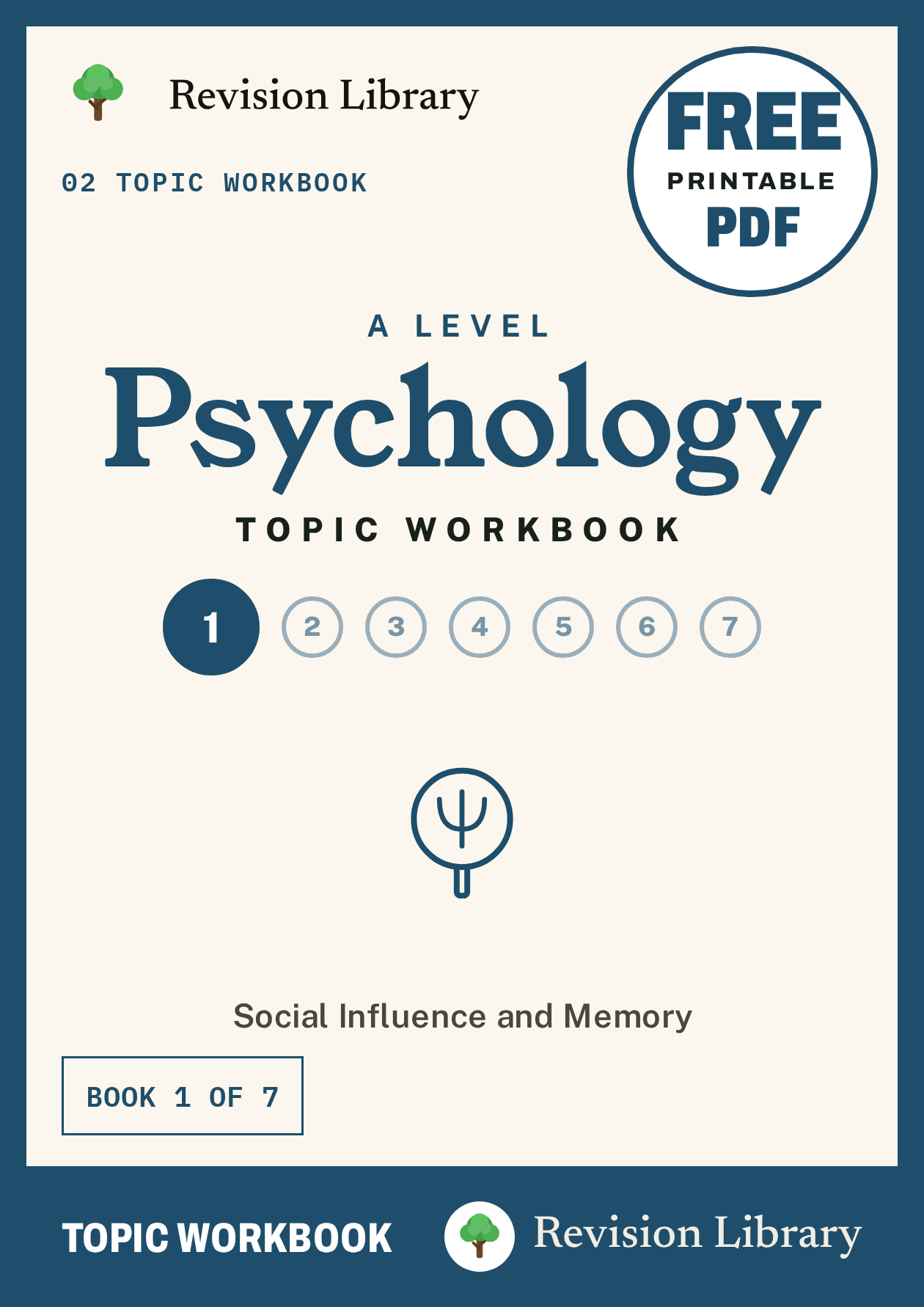
Complete the full Chi-Squared calculation for the 2x2 table above and state the conclusion at p ≤ 0.05.

Answer and mark scheme

Question 12

CreditAnswer or working
M1calculates the row totals, column totals and grand total correctly, e.g. leaflet total 60, no-leaflet total 60, contacted total 39, not contacted total 81, grand total 120 oe
M1shows how to calculate an expected value using E = (row total x column total) / grand total and substitutes correct numbers for at least one cell oe
A1gives the correct expected value for the contacted, leaflet cell as 19.5 and for the contacted, no-leaflet cell as 19.5 oe
A1gives the correct expected value for the not-contacted, leaflet cell as 40.5 and for the not-contacted, no-leaflet cell as 40.5 oe
M1substitutes O and E into the formula X2 = sum((O - E)2 / E) for each of the four cells oe
A1calculates and states the numerical value for X2 to two decimal places as 3.08 awrt 3.08 oe
M1calculates degrees of freedom correctly for the 2x2 table as df = (2 - 1) x (2 - 1) = 1 oe
A1states the correct critical value at p ≤ 0.05 for df = 1 as 3.841 and compares it with the calculated X2 oe
A1draws the correct conclusion that X2 = 3.08 < 3.841 so the result is not significant at p ≤ 0.05 and the null hypothesis is retained oe
  • Answer: Totals: leaflet 60, no-leaflet 60, contacted 39, not contacted 81, grand total 120. Expected frequencies: contacted, leaflet = (60 x 39)/120 = 19.5; contacted, no-leaflet = 19.5; not contacted, leaflet = (60 x 81)/120 = 40.5; not contacted, no-leaflet = 40.5. Components: (24 - 19.5)2/19.5 = 1.0385, (36 - 40.5)2/40.5 = 0.5, (15 - 19.5)2/19.5 = 1.0385, (45 - 40.5)2/40.5 = 0.5. Sum X2 = 3.077 = 3.08 (2 dp). df = 1. Critical value at p ≤ 0.05 is 3.841. Since 3.08 < 3.841 the result is not significant at p ≤ 0.05; retain the null hypothesis, no clear association between leaflet and contacting counselling in this sample.
Question 9 - The Chi-Squared Test: Rationale, Application and Critical Values

Open the included worksheet

Explain one-tailed vs two-tailed in Chi-Squared and state the convention for association tests.

Answer and mark scheme

Question 9

CreditAnswer or working
M1explains that one-tailed critical values test for an effect in a specified direction, while two-tailed test for any difference in either direction oe
A1states that Chi-Squared tests of association use the upper-tail critical value (conventionally the two-tailed table is not relevant because Chi-Squared is always non-negative, so the standard critical values give the threshold for significance in the upper tail) oe
  • Answer: One-tailed looks for an effect in a specified direction while two-tailed looks for any effect; for Chi-Squared association tests we use the upper-tail critical value (effectively the standard table threshold for the upper tail) since X2 is always non-negative.

Question 8 - The Chi-Squared Test: Rationale, Application and Critical Values

Open the included worksheet

Identify two features pointing to Chi-Squared and one feature favouring a t-test.

Answer and mark scheme

Question 8

CreditAnswer or working
M1feature indicating Chi-Squared: both variables are nominal/categorical and recorded as counts/frequencies oe
M1feature indicating Chi-Squared: independent groups design where participants are in separate categories (contingency table) oe
A1feature favouring a t-test: the dependent variable is continuous (interval/ratio) and approximately normally distributed so group means are compared oe
  • Answer: Chi-Squared: two nominal categorical variables recorded as frequencies, and an independent-groups design with a contingency table. A t-test is appropriate if the DV is continuous and approximately normally distributed so that group means are compared.

Question 7 - Data Handling: Descriptive Statistics, Graphs and Levels of Measurement

Open the included worksheet

A researcher wants to present the distribution of scores from a memory test (scores 0 to 10) for a sample of 12 participants. Which graph is most appropriate to show the frequency distribution of these interval-level whole-number scores, and state two labelling conventions that must be followed for that graph.

Answer and mark scheme

Question 7

CreditAnswer or working
B1graph: histogram or bar chart for frequency distribution of whole-number interval scores (histogram preferred for continuous data grouped in bins) oe
B1labelling convention 1: x-axis labelled with the variable name and units, e.g. 'Memory test score (0 to 10)' oe
B1labelling convention 2: y-axis labelled with 'Frequency' or 'Number of participants', and bars touching for a histogram or separated for a bar chart depending on data type oe
  • Answer: Histogram (preferred) or bar chart to show frequency distribution. Label the x-axis with the variable and units, e.g. 'Memory test score (0 to 10)', and label the y-axis 'Frequency' or 'Number of participants'; for a histogram the bars should touch.

Question 8 - Data Handling: Descriptive Statistics, Graphs and Levels of Measurement

Open the included worksheet

Calculate the mode and median for these ordinal satisfaction ranks collected from seven participants: 4, 2, 3, 4, 5, 2, 4. Explain briefly why the mean would be less appropriate here.

Answer and mark scheme

Question 8

CreditAnswer or working
M1orders data: 2,2,3,4,4,4,5 oe
A1median is middle value, 4 cao
M1mode is most frequent value, 4 (appears three times) cao
M1identifies that the data are ordinal ranks so mean assumes equal intervals which may not hold oe
A1explains consequence: mean could misrepresent central tendency for ordinal data and be affected by extremes, so median/mode are preferred oe
A1final statement: median = 4, mode = 4, mean less appropriate because interval equality is not guaranteed for ordinal data cao
  • Answer: Ordered data 2,2,3,4,4,4,5. Median = 4. Mode = 4. The mean is less appropriate because these are ordinal ranks and the mean assumes equal intervals between values, which may not be true.

Question 13 - Sampling Methods and Ethical Issues in Psychological Research

Open the included worksheet

A university study advertises on social media and accepts anyone who volunteers to take part in a memory experiment. Identify the sampling method and identify one ethical issue this raises for the researcher to address in the online recruitment process.

Answer and mark scheme

Question 13

CreditAnswer or working
B1identifies the sampling method as volunteer (self-selected) sampling cao
B1identifies an ethical issue: ensuring informed consent online, or verifying participant age, or protecting confidentiality oe
M1explains how the issue arises in this context, e.g. online adverts may not provide full information or may attract underage participants, so consent may not be properly informed oe
A1suggests a researcher action to address it, e.g. provide full information on the advert and a detailed online consent form with age verification, or allow contact with the researcher for questions oe
  • Answer: Sampling method: volunteer sampling. Ethical issue: ensuring informed consent online, because adverts may not give full information and underage people could respond. The researcher should provide clear study information, an online consent form including age verification, and an opportunity to ask questions before participation.

Question 7 - Sampling Methods and Ethical Issues in Psychological Research

Open the included worksheet

A researcher stands outside a supermarket and asks the first shoppers they meet to complete a quick wellbeing questionnaire. State one likely sampling bias in this opportunistic recruitment and explain its likely effect on the study's results.

Answer and mark scheme

Question 7

CreditAnswer or working
M1identifies a likely bias, e.g. selection bias or volunteer bias relating to time of day and shopper type oe
A1explains the effect: the sample may overrepresent certain demographic groups such as retirees or people shopping at that time, so results may not be generalisable to the wider population oe
A1may note that this could affect estimates of average wellbeing or mask effects present in underrepresented groups oe
  • Answer: Bias: selection bias due to opportunistic sampling linked to time and location. Effect: the sample may overrepresent certain groups, for example older people who shop during quieter hours, so wellbeing estimates may not generalise and could either overestimate or underestimate true population wellbeing.

A Level Psychology Topic Workbooks runs to 7 volumes

Book 4 of 7 · 785 pages in the set

Each book is a separate free PDF.

Volume 1

114 pp · 138 Qs

Conformity: types, explanations, Asch's research and Zimbardo's Stanford Prison Experiment, Milgram's Baseline Study Into Obedience: Procedure and Findings, Explanations for Obedience: Agentic State and Legitimacy of Authority and 12 more

Volume 2

118 pp · 143 Qs

Caregiver-Infant Interactions: Reciprocity and Interactional Synchrony, Attachment types: Ainsworth's Strange Situation and cultural variations in attachment, Stages of Attachment and the Role of the Father and 13 more

Volume 3

114 pp · 170 Qs

The Behaviourist Approach: Classical Conditioning and Pavlov's Research, The Behaviourist Approach: Operant Conditioning and Skinner's Research, Social Learning Theory: Imitation, Modelling and Bandura's Research and 12 more

Volume 4 · this book

110 pp · 152 Qs

Applying Nature-Nurture and Gene-Environment Interaction to Biopsychology, Research methods: variables, hypotheses, choosing a statistical test and the sign test, Experimental Designs: Repeated Measures, Independent Groups and Matched Pairs and 12 more

Volume 5

114 pp · 153 Qs

How to Write a Hypothesis, Gender Bias in Psychological Theory and Research, Culture Bias in Psychological Theory and Research and 8 more

Volume 6

109 pp · 131 Qs

Sexual Selection and Human Reproductive Behaviour, Factors in Attraction: Self-Disclosure and Physical Attractiveness, Filter Theory of Relationship Formation and 12 more

Volume 7

106 pp · 134 Qs

Treating Schizophrenia: Therapies and the Interactionist Approach, Explanations for the Success and Failure of Dieting, Biological Explanations for Anorexia Nervosa and 12 more

More A Level books

A Level Psychology 10-Minute Tests 1

85 pp · 72 Qs

Conformity: types, explanations, Asch's research and Zimbardo's Stanford Prison Experiment, Milgram's Baseline Study Into Obedience: Procedure and Findings, Explanations for Obedience: Agentic State and Legitimacy of Authority and 23 more

Want a different mix of topics?

Sitting an exam soon? Build a A Level Psychology mock paper or print a ready-made one.